Most activewear brands hit the same wall. Core SKUs plateau, margins compress, and the next growth lever isn't obvious.
Here's what the data keeps pointing toward — cyclists don't stop spending after they clip out of their pedals. Recovery is its own purchase occasion.For brands exploring OEM cycling apparel product expansion opportunities, recovery-focused apparel represents a natural extension of an existing cycling product ecosystem. Post-cycling compression tights sit right at the crossroads of muscle recovery after cycling and the broader activewear product diversification shift reshaping how performance brands grow.
The riders already buying your bib shorts and jerseys are searching for recovery solutions. They're just buying them from someone else.
This guide breaks down:
The market economics behind recovery compression
The product specs that matter most
The ROI math behind adding a recovery compression line
So you can walk into your next product meeting with a clear decision — not just a question.
Market Opportunity: Cycling Recovery Apparel TAM, Growth CAGR & Competitive White Space
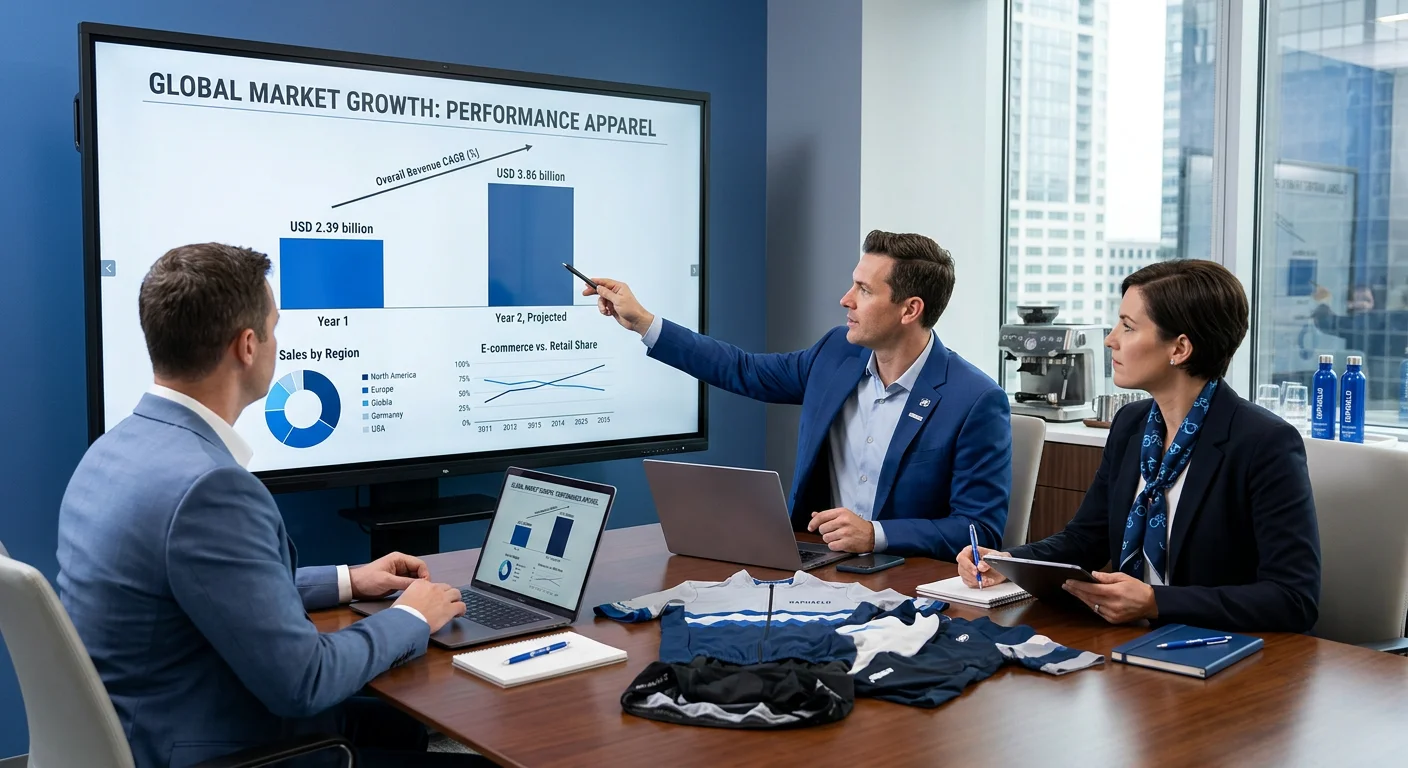
The global cycling apparel market stands at USD 2.39 billion in 2026 . It's heading toward USD 3.86 billion by 2034 . That's a 6.1% CAGR over eight years — steady enough to attract attention, but not so crowded that a focused challenger gets priced out.
Now look closer at what's inside that number.
The TAM Hidden in Plain Sight
No major market report has carved out "cycling recovery apparel" as its own line item. That's not a gap in the data — it's the signal. Analysts haven't named this category yet. The brand that names it first owns the narrative.
Here's how the math breaks down across two approaches:
From the cycling apparel side:
- Recovery-oriented items — compression tights, leg sleeves, post-ride bottoms — make up an estimated 10–15% of cycling apparel value as a distinct consumer need
- That puts the 2026 cycling recovery TAM at USD 240–360M
- By 2034, as recovery becomes a defined purchase occasion (the trajectory in running compression points that way), that share rises to 15–20% — translating to USD 580–770M
From the compression sportswear side:
- Global compression sportswear sits at USD 4–6 billion across all sports, growing at 5–8% per year
- Cycling makes up an estimated 15–20% of compression demand — around USD 0.6–1.2B
- Remove in-ride performance usage. Focus on post-ride recovery. That leaves USD 200–400M in cycling-specific recovery compression today
Both approaches point to the same place. The working TAM lands at USD 250–400M worldwide right now , with a 3-year forward CAGR of 8–10% — well above the 6.1% baseline for cycling apparel overall. Recovery and compression products beat generic category growth because they solve a specific problem. They don't just fill a wardrobe.
By year three, the midpoint scenario puts cycling recovery apparel at USD 420–430M .
Why Recovery Grows Faster Than the Category Average
Three structural forces are speeding up the timeline:
1. The participation base is widening, not just deepening.
Mainstream brands — REI, Aero Tech Designs, Montella — are pushing into inclusive sizing, with some reaching 6XL . This isn't a charitable gesture. It's market math. More bodies on bikes means more recovery occasions. Heavier, older, and recreational riders feel post-ride soreness more sharply than elite racers do. The TAM grows as the user base grows.
2. DTC channels are already built for this.
Cycling apparel has one of the strongest DTC conversion profiles in sports. Giants like Trek, Liv, and Giant run direct online stores with detailed fit guides and size charts. That infrastructure maps straight onto recovery compression. Compression products in adjacent sports already pull in 40–60%+ of sales through e-commerce . The pipeline is there. It just needs the right product.
3. Recovery has crossed from niche to norm.
Arm warmers and base layers were optional accessories five years ago. Now they're standard kit. The same pattern is playing out again. Technical recovery benefits — graduated compression technology , targeted muscle support, post-exercise inflammation reduction — are following the same adoption curve. Runners and triathletes have already educated the consumer. Cycling brands are next in line to benefit.
The Competitive White Space
Here's the uncomfortable truth about the current cycling apparel market : compression tights in cycling are sold as performance gear. Not recovery gear. The framing is in-ride. Post-ride is invisible in most brands' positioning.
That gap has a clear shape:
No major market report defines "cycling recovery apparel" as a standalone segment — so no existing brand is defending that space with focused product development and targeted messaging
Plus-size and older recreational riders — the exact segments where recovery benefits matter most and are valued most — get underserved by both recovery brands (who focus on elite athletes) and cycling brands (who focus on performance)
The positioning vocabulary itself — post-exercise compression benefits , performance recovery wear , athletic recovery clothing — comes straight from running. Cycling has no equivalent brand language. Not yet.
At the company level, the math gets sharp fast. A brand capturing just 5% of the global cycling recovery segment at its current size is looking at USD 12–20M in annual revenue . At DTC gross margins — which in performance apparel run 60–70% — that's a category worth building with full intent.
The segment exists. The demand is real. The language to own it hasn't been written yet.
Product Development Checklist: Compression Graduation, Fabric Specs & SKU Brief
Knowing the market exists is one thing. Building a product that belongs in it is another.
Most activewear brands entering compression fabric technology for the first time make the same mistake: they treat compression as a marketing claim, not an engineering specification. The result is a tight that looks the part but tests badly under lab conditions. The cyclist returns it after one ride — they could feel it wasn't doing what the hangtag promised.
Here's how to avoid that. Below is a supplier-ready cycling apparel product brief framework built around three decisions. Get these right and your performance recovery wear will actually deliver.
Decision 1: Compression Graduation — Picking Your mmHg and Owning the Positioning That Comes With It
Graduated compression technology works through a pressure gradient. Higher pressure at the ankle. Pressure drops as you move up the leg. That gradient pushes venous blood back toward the heart — the core mechanism behind muscle recovery after cycling .
The numbers matter more than the marketing language:
Compression Class | Ankle Pressure | Appropriate Claims |
|---|---|---|
Light support | < 15 mmHg | Comfort, perceived fatigue reduction |
Class I | 15–20 mmHg | Light sports recovery, symptomatic relief |
Class II (recovery target) | 20–30 mmHg | Medical-grade gradient, supports venous return, recovery post-training |
Class III | 30–40 mmHg | Clinical/venous disease management |
For post-cycling compression tights , Class II is the only credible choice . Studies comparing 20–30 mmHg against 10–15 mmHg garments show stronger venous return and edema reduction across the board. Anything below 15 mmHg at the ankle cannot carry "recovery" language — and serious cycling consumers will catch that.
Your tech pack pressure-gradient map should specify these exact measurement points:
Ankle (B): 22–26 mmHg (100% reference point)
Max calf (C): 17–21 mmHg (~70–80% of ankle)
Just above knee (E): 12–16 mmHg (~50–60%)
Mid-thigh (F): 8–12 mmHg (~40%)
Tolerance at each point: ±2–3 mmHg , tested on a standardized leg form at 90° joint angle. Reference ISO 13688 for sizing and pressure testing consistency. Also require a lab certificate documenting the full mmHg profile before signing off on any sample.
Gradient ratio target: ankle pressure should run 1.3–1.5× higher than thigh pressure. This isn't a style preference. It's the mechanical difference between a true compression garment and an expensive pair of running tights.
Decision 2: Fabric Specification — The Blend That Holds the Gradient
The pressure gradient doesn't come from the pattern alone. It comes from the combination of knit structure, yarn composition, and circumference reduction per zone . Get the fabric wrong and the graduation collapses after three wash cycles. Repeat purchases go with it.
Target yarn composition for a cycling recovery tight:
Nylon / polyamide: 60–75% — structural foundation, abrasion resistance, enables dense circular knit
Elastane (spandex): 20–30% — power and return; higher percentage means higher achievable mmHg
Polyester microfiber: 10–20% (optional) — improves moisture management during long post-ride wear
Two reliable OEM cycling apparel blends to anchor supplier conversations:
75% nylon / 25% elastane — high-power spec, smooth hand, standard performance baseline
60% nylon / 30% polyester / 10% elastane — better moisture transport, lower compression ceiling; a good fit if your customer wears these during travel or all-day use post-ride
Knit construction requirements:
Circular knit, 200–400 needle machine for fine gauge compression work
Fabric weight: 220–280 g/m² — the density range that supports genuine Class II pressure without excessive bulk
Higher GSM + higher elastane = higher achievable mmHg at equivalent circumference. Your pattern maker and cycling apparel's fabric supplier need to solve this equation together across every size in your run
Mandatory spec items in your tech pack:
Fiber percentage by zone (body vs any contrast panels)
Knit type, needle count, stitch density (courses and wales per cm)
Stretch testing: % elongation at ankle, calf, thigh — target 160–180% stretch at ankle
Recovery rate: time to 95% of original length post-stretch
Shrinkage: maximum ±3% after 5 domestic wash cycles
Colorfastness: ≥ Grade 4 to washing and perspiration
Pilling resistance: ≥ Grade 4 Martindale
One more non-negotiable: flatlock seaming throughout . A recovery tight worn 4–6 hours post-ride sits against fatigued skin. Any raised seam generates returns and one-star reviews fast enough to kill the category before it gains any ground.
Decision 3: SKU Architecture — The Brief Fields That Prevent Supplier Drift
The compression category has an unusual failure mode. A standard activewear SKU shows pattern inconsistency visually. A compression tight drifted 5 mmHg off-spec looks identical to a correct one. To protect product integrity across production runs, build the specification into the brief with zero room for interpretation.
Compression SKU brief — required fields:
Product Identity
- Category: "Graduated compression cycling recovery tight — post-exercise compression benefits, daytime use"
- Use case: "Post-ride recovery, 2–6 hours continuous wear; travel; prolonged sitting"
Compression Performance
- Target ankle mmHg (minimum–maximum): e.g., 22–26 mmHg
- Gradient table: ankle → calf → knee → thigh (see graduation map above)
- Compression class: "Equivalent to Class II, 20–30 mmHg at ankle"
- Testing standard: ISO 13688, tested on standardized leg form, 90° ankle flexion
- Required deliverable: lab certificate per colorway per production run
Zoning & Pattern
- Zone map artwork: distal calf (Zone 1) through proximal thigh (Zone 4)
- Required circumferences at measurement points B, B1, C, D, F for base size
- Grading rules: circumference reduction per size must maintain the target mmHg profile — not just scale the pattern by geometry
Clinical Positioning & Packaging Requirements
- Compression range (22–26 mmHg ankle) puts the product squarely in the therapeutic recovery bucket — not light support
- Packaging must include contraindication language: not recommended for peripheral arterial disease, severe circulatory disorders; consult physician if in doubt
- Marketing claims permitted at 20–30 mmHg: "medical-grade gradient compression," "supports venous return," "post-exercise compression benefits" — subject to local claims regulations
Post-Exercise Protocol (IFU / Hangtag Copy)
- "Wear for minimum 2 hours, up to 4–6 hours post-session for recovery benefits"
- "Do not wear overnight unless advised by a clinician"
- "Remove straight away if numbness, tingling, or skin discoloration occurs"
- Brief note: product is "validated for continuous wear up to 6 hours at 20–30 mmHg in healthy adults"
SKU Planning Starting Point
For a first-run launch, resist the urge to build a full size matrix from day one. Start focused:
Sizes: S / M / L / XL / 2XL — five sizes, graded against the circumference spec above
Colorways: 2 at launch (one neutral, one brand statement color)
Length: full tight only for the initial SKU — this gives you the clearest compression zoning and the strongest recovery claim; sleeves and socks come in Phase 2
A tighter first production run makes quality control easier to validate before scaling. It also keeps your minimum order quantity conversation with the Post-Cycling Compression Tights factory at a number where the unit economics still work — which is exactly where the next section picks up.
Activewear Expansion ROI Model: Margin Structure, MOQ Recommendations & Break-Even Forecast
The numbers either make the case or they don't. Here's what they say.
A post-cycling compression tight priced at $120 retail — landed COGS of $28, DTC variable selling costs of $10 — leaves you $82 contribution per unit . That's a 68% contribution margin ratio . For context, healthy activewear brands target 55–70% gross margin at retail. A well-executed compression line doesn't just hit that benchmark. It sits at the top of it.
This is the core economic argument for activewear product diversification into cycling recovery. Not the market TAM. Not the brand narrative. The per-unit math.
Margin Structure by Channel
Not every unit ships DTC. The contribution picture shifts across channels. Your sportswear brand growth strategy depends on knowing which doors to prioritize.
DTC e-commerce
- Retail price: $120
- Landed COGS: 25–35% of retail ($30–42)
- Gross margin: 65–75%
- Variable selling (payment fees, fulfillment, returns): 8–15%
- Contribution margin: 50–60%
DTC is your highest-margin channel. Athletic recovery clothing performs well here — compression products in adjacent sports pull 40–60%+ of sales through e-commerce. Your existing cycling audience is already shopping online.
Wholesale to specialty retailers
- MSRP $120 → activewear wholesale price $54–60
- Brand COGS: $28–35
- Brand gross margin on wholesale: 40–50%
- After commissions and trade costs: contribution margin 30–45% of wholesale (≈15–23% of MSRP)
Distributor / international bike networks
- MSRP $120 → wholesale $60 → distributor buys at $42–46
- Brand COGS: $26–31
- Brand gross margin: 30–40% on ex-factory
- Contribution margin: ~25–35% on distributor revenue (≈12–18% of MSRP)
Blended channel reality (illustrative mix: 60% DTC / 25% wholesale / 15% distributor):
0.60 × 60% + 0.25 × 20% + 0.15 × 15% ≈ 38–42% blended contribution on MSRP
The takeaway is simple: weight your first-phase channel mix toward DTC. Every percentage point you shift from distributor to direct adds 2–4 points of contribution margin at the line level.
MOQ Recommendations: Where the Unit Economics Work
Compression tights from established Asian cut-and-sew cycling apparel suppliers run MOQ 300–800 units per color per style for standard construction. Seamless or technical circular-knit compression — the spec needed for genuine graduated compression technology at 20–30 mmHg — requires 500–1,000 units per color .
A practical first-run structure:
2 styles (full tight + knee-length short)
2 colorways (one neutral, one brand signature)
6 sizes (S through 2XL)
150 units per SKU → 3,600 units total initial buy
This structure clears most cycling clothing factory MOQ thresholds. You get a workable size curve. Stockout risk stays manageable. And you're not locked into inventory you can't move if the launch falls short.
Break-Even Forecast: The 53% Threshold
At the unit economics above ($120 MSRP, $82 contribution), fixed launch costs drive the break-even number.
Plan your first-year fixed costs on the low end:
Cost category | Range |
|---|---|
Design, sampling, tooling | $30–50K |
Photography + content production | $20–30K |
Paid media (launch window) | $60–80K |
Incremental team / agency time | $40–60K |
Total fixed launch investment | ~$150–220K |
Break-even at $150K fixed costs:
$150,000 ÷ $82 contribution per unit ≈ 1,830 units
With a 3,600-unit opening order, that's a 53% sell-through requirement to cover launch costs. For a brand with an existing cycling customer base, that number is reachable in the first 90 days. Position it as a post-exercise compression benefits product for riders already in your database and the path gets shorter.
At a higher fixed cost scenario ($250K, including more aggressive paid media):
$250,000 ÷ $82 ≈ 3,050 units — still inside your opening inventory if sell-through tracks above 85%
Target profit milestone: Modeling a $500K operating contribution from the compression line:
($250K fixed + $500K profit) ÷ $82 ≈ 9,150 units sold
Revenue at that volume: ~ $1.1M
Operating margin on the line: ~ 45%
That's not a stretch target for a brand with 50,000+ cycling customers. It's a Year 2 baseline.
Discount Guardrails: What Promos Cost You
Performance recovery wear doesn't need aggressive discounting to sell — as long as the product brief is right and the positioning holds. Run promotions, yes. But know what you're giving up each time.
Discount | New price | CM/unit | CMR | Volume uplift needed to hold contribution flat |
|---|---|---|---|---|
10% | $108 | $70 | 65% | ~+5% units |
20% | $96 | $58 | 60% | ~+13–14% units |
30% | $84 | $46 | 55% | ~+24% units |
For a line running above 65% base CMR, keep standard promotions in the 10–20% band . Save 25–30% discounts for end-of-season clearance — and use them only when inventory carrying cost justifies the margin hit. Build a price ladder (core black vs. seasonal colorways). This lets you absorb promotional pressure without cutting into your full-margin SKU.
The ROI case for adding post-cycling compression tights is backed by real numbers. At $120 retail, 68% contribution margins, a 53% sell-through break-even, and a Year 2 path to $1M+ revenue from a focused SKU range — the math holds up. The margin structure works. The real question is whether you build the product brief with enough discipline to protect it.
Go-to-Market Execution: Channel Integration, Cross-Sell Tactics & Post-Ride Positioning Strategy
The product brief is done. The margin math works. Most category launches fail at this stage — not because of the product, but because the go-to-market plan treats a new SKU like an island.
Post-cycling compression tights don't need a new audience. They need a smarter path to the audience you already have.
Build the Channel Architecture First, Then Fill It
Brands running three or more integrated channels achieve 287% higher purchase rates than single-channel shoppers. Omnichannel cyclists spend 30% more per order . These aren't wishful numbers. They're the floor your channel mix should clear.
For a compression recovery launch, the channel priority order is simple:
Phase 1 — DTC first. This is your highest-margin door and your fastest feedback loop. Compression products in adjacent sports already pull 40–60%+ of sales through e-commerce. Your existing cycling customers are already shopping there.
Phase 2 — Specialty retail (cycling apparel wholesale Tier 2). Think regional bike shops and coaching organizations. MOQ thresholds of 40–60 units per style keep entry manageable. Margin off MSRP runs 35–40%. Give retailers planograms and shelf talkers — "After 2 hours in the saddle, recovery starts here" — so the product lands in the right spot, not buried in a generic compression section.
Phase 3 — Club and team accounts (Tier 3). 20–30 unit minimums, 25–35% margin. Volume is low per account, but clubs work as peer amplification networks. One team kit appearance at a gran fondo does what three paid ads can't.
Keep your channel weighting front-loaded toward DTC in Year 1. Each percentage point shifted from distributor to direct adds 2–4 points of contribution margin at the line level.
Cross-Sell Tactics: Wire the Compression Tight Into Every Purchase Touchpoint
The fastest revenue from a new compression line doesn't come from new customer acquisition. It comes from the customer who just bought bib shorts and doesn't know yet that you solve their next problem too.
On the product page: Attach 3–5 context-aware cross-sells to your bib shorts PDP. Place them above the reviews section. Cross-sell widgets in that spot generate 2–3x higher click-through versus footer or cart placement. Use a ride-phase logic structure:
"During the ride" module: nutrition, tools, repair
"After the ride" module: compression tights, recovery sandals, chamois cream, sport wash
"Complete the kit" bundles with a 5–10% bundle discount hit attach rates of 20–35% for newer cyclists.
Post-purchase email sequence: Send a cross-sell prompt within 24 hours of a bib shorts purchase. A personalized "you forgot X" email at that window hits open rates of 45–60% and CTR of 8–15% for active enthusiast segments. The subject line practically writes itself: "Your bibs are on the way — here's what your legs will want afterward."
An order bump offer — "Add recovery tights before we ship, 10% off" — pulls 6–15% acceptance rates . At a $120 MSRP, that's $108 per accepted bump, well inside your target contribution margin band.
SMS — keep it tight: Cap promotional messages at two per month. Use it for high-intent trigger moments only. Delivery day works. So does a big weekend ride flagged by local weather patterns and Strava history. Try: "Big ride tomorrow? Recovery bundle, 15% off today." Opt-in rates run 5–10% of site traffic with a first-order discount incentive. Small list, high conversion, zero brand fatigue.
Post-Ride Positioning: Own the Language Before Anyone Else Does
No major cycling brand has built a clear post-ride identity yet. The vocabulary — performance recovery wear , post-exercise compression benefits , athletic recovery clothing — is borrowed from running. Cycling's version is still unwritten.
Create a dedicated Post-Ride navigation bucket in your site architecture. Sub-categories to include: Recovery & Mobility, Skincare & Hygiene, Nutrition Recovery, Garment Care. Build shoppable content around it. A guide titled "Post-ride recovery after 100km" with inline product slots reliably delivers +5–8% conversion uplift versus non-shoppable editorial for enthusiast segments.
Set up your loyalty program to reinforce the behavior. Double points on recovery and care items. Award bonus points for connecting Strava and logging rides each month. Loyalty members in DTC sports spend 20–40% more per year and retain at rates 15–25% higher than non-members.
The compression tight is the anchor SKU. The post-ride ecosystem is the moat.
Conclusion
The window won't stay open forever.
Cyclists are spending on recovery right now. They're just not spending it with activewear brands. That's the gap — and it's sitting wide open.
Post-cycling compression tights hit a sweet spot. You get a buyer who's ready to spend. You get margins that hold at 55–70%. You get a product your existing channels can carry without rebuilding your go-to-market from the ground up.
You've seen the numbers. The projected CAGR beats the broader activewear market. Your cross-sell base trusts your brand through the hardest miles of their week. That's not a cold audience — that's a warm one with a problem you can solve.
This isn't a moonshot pivot. It's a clean addition. Brands that move with purpose here will capture margin and loyalty. Brands that wait will hand that advantage to someone else.
So here's the real question: Your competitors are scanning this same market signal right now. Will your brand own the category first — or validate it for them?
The brief is in your hands. Now build it.