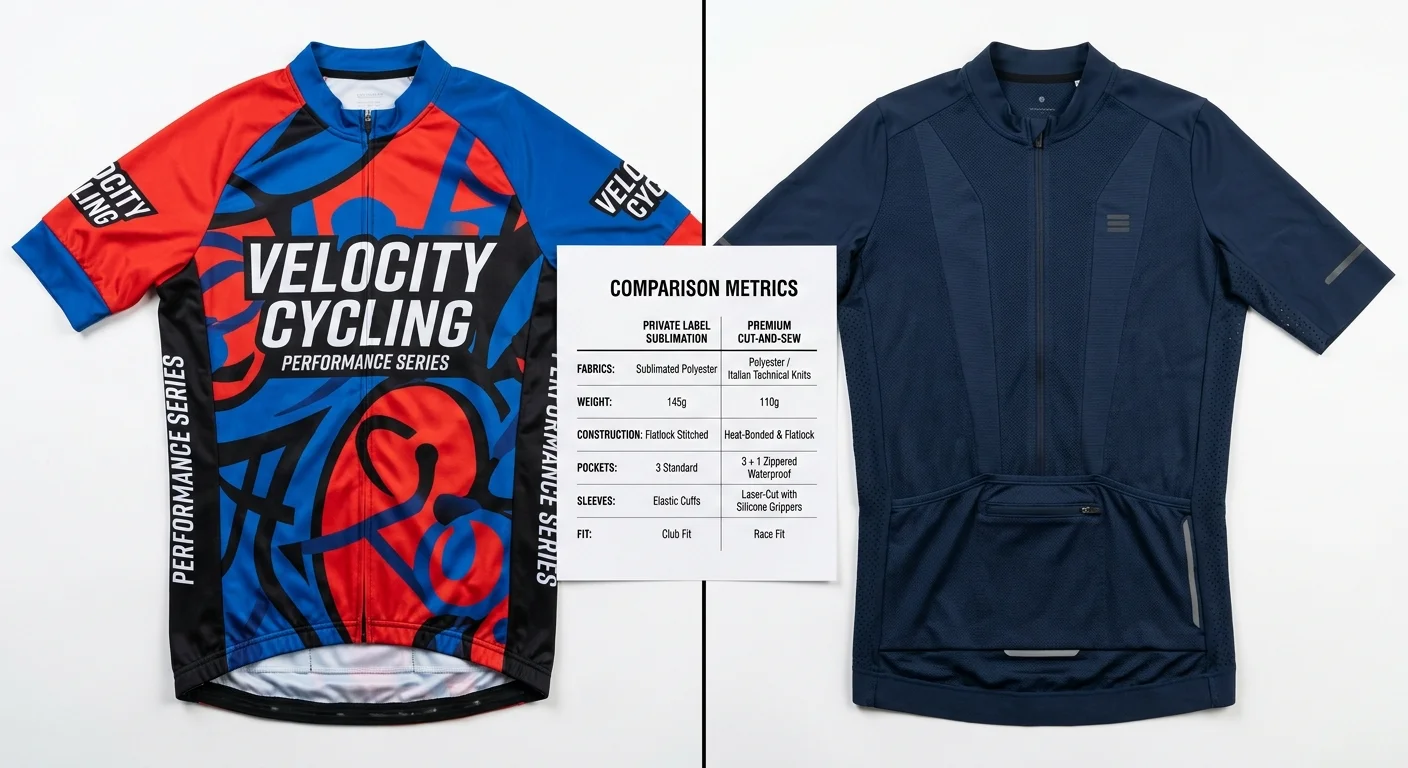
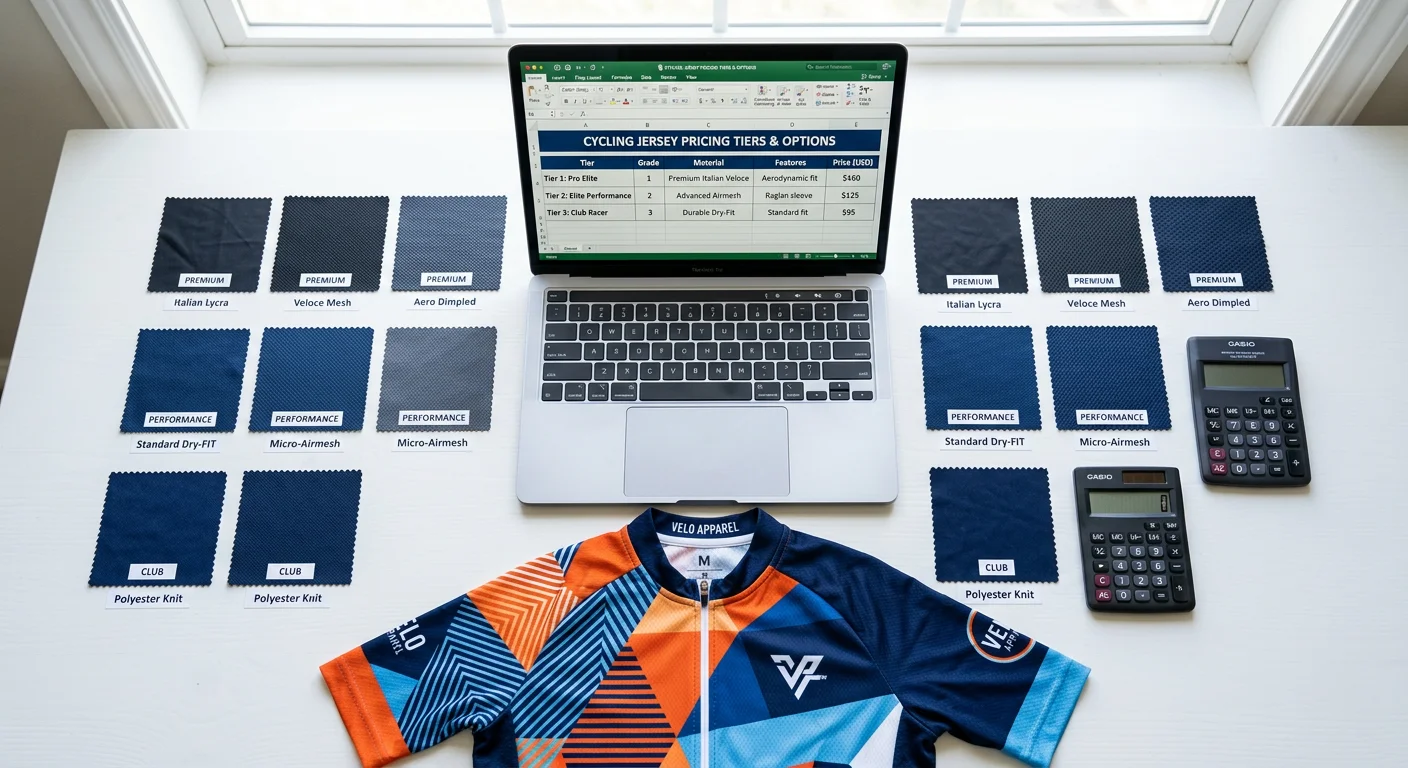
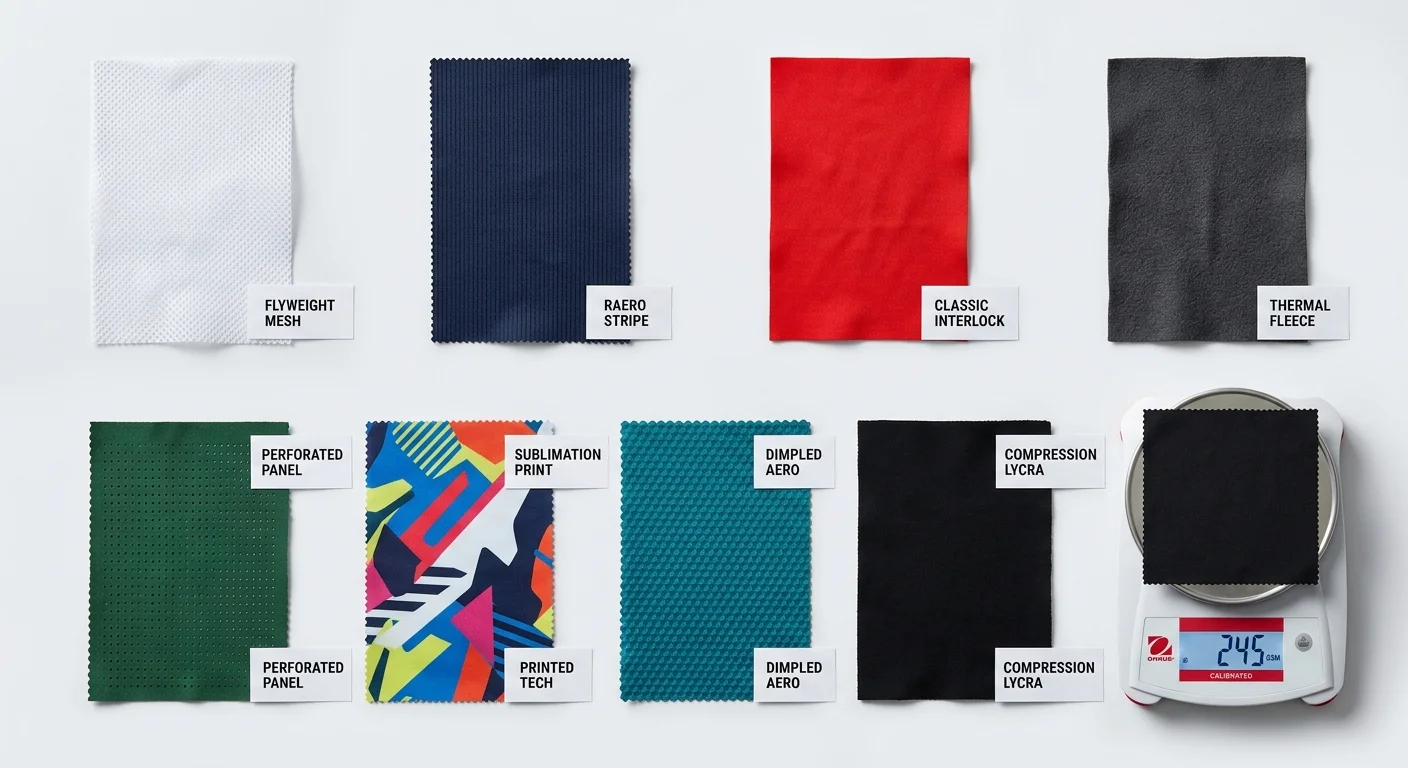
Missing a delivery deadline for your team kit — right before the season opener — is the kind of mistake you make once. Yet it keeps happening, and almost always for the same reason: someone assumed the supplier's quoted lead time was the whole story. It wasn't. That quote covered production only.
The truth is, custom cycling apparel lead times involve at least six distinct stages. Each one carries its own variables, its own risk factors, and its own ability to swallow a week you never planned for.
This guide breaks those stages down — from design sign-off through final-mile delivery. Each stage gets real numbers attached to it. So you can:
Build a procurement calendar that holds up under pressure
Spot warning signs before they turn into delays
Walk into any cycling apparel supplier conversation knowing which questions to ask
Stage 1 — Design Confirmation: Artwork Sign-Off and Pattern Development
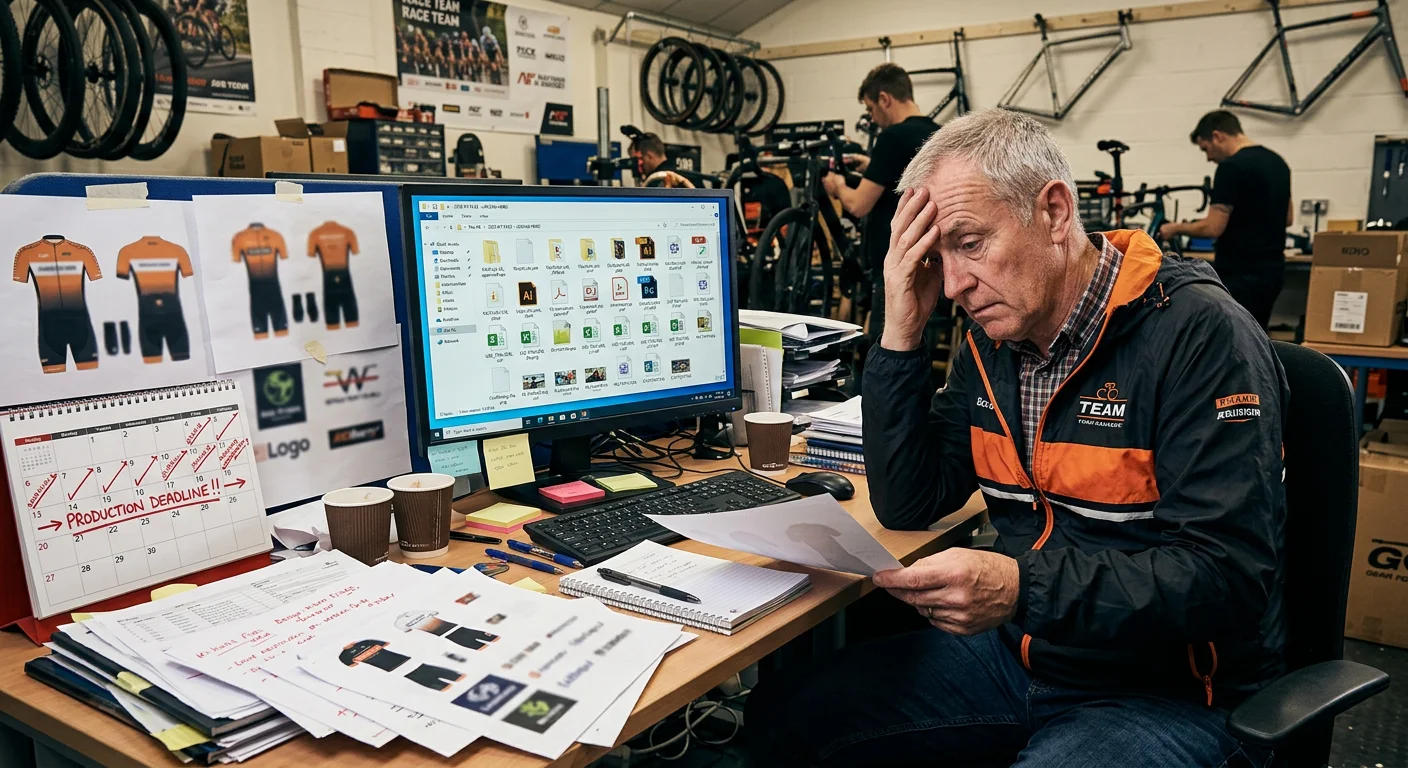
Most delays don't start on the production floor. They start in a shared folder full of low-resolution logos and a design review chain that involves six people who can never agree on the same day.
The design confirmation stage covers artwork finalization and pattern development. For a standard cycling jersey or kit, this runs 7–14 days . Add more pieces — jersey + bib shorts + gilet — and 18–25 days is a realistic estimate.
Here's how those days break down:
Order Complexity | Typical Timeframe |
|---|---|
Single item, standard construction | 7–10 days |
Mid-complexity (multi-panel, sponsor logos, bonded seams) | 10–14 days |
Full kit with technical features (waterproofing, compression, accessories) | 18–25 days |
What's Really Eating Your Time
File quality is the silent schedule-killer. Submit a layered, Pantone-referenced AI vector file and you cut artwork approval by 2–3 days. Submit a 72dpi PNG exported from someone's email signature and you lose that time. Plus, the brand team has to re-approve the redrawn version — that's another full day gone.
Your internal approval chain matters more than the factory's speed. Each extra stakeholder — legal, sponsors, marketing — adds 1–2 working days per round. Three rounds of conflicting feedback can erase a full week. The pattern maker hasn't even opened their CAD software yet.
Grading adds up. A standard S–XL size run adds less than a day. Move to six size brackets or introduce custom cycling apparel's body-proportional sizing, and budget an extra 1–3 days for grading validation and fit verification.
The One Habit That Prevents Most Design-Stage Delays
Lock a Design Freeze deadline on Day 1 — not Day 7. Make it a contract term, not a casual agreement. Once artwork is frozen, all parties sign off via a versioned document (v1.0, v1.1 labeled by version). This single step removes the most common cause of cascading delays across the entire custom cycling apparel lead time chain.
Stage 2 — Prototype Sampling: Build Time, Approval, and Revision Control
Sample rejection is expensive. Not just in money — in time. Every unplanned revision round is a week pulled straight from your production buffer.
Here's the standard benchmark: a pre-production sample (PPS) for a custom cycling jersey takes 7–14 working days from tech pack confirmation to first sample delivery. That window covers pattern drafting, cut-and-sew, internal fit review, and sublimation color strike. For a semi-custom order — same block pattern, new colorway or logo placement — experienced factories can compress this to 3–5 working days on a rush line.
The industry average sits around 10 working days for a full development sample. Factories using 3D virtual sampling and standardized review templates can cut 25% off that. This pushes the realistic turnaround to 7–8 days and trims revision rounds by an average of two.
The Revision Round Structure You Should Negotiate Upfront
Most experienced OEM cycling apparel factories build revision allowances into their sampling contracts. The standard structure looks like this:
Revision Type | Included Free | Additional Cost | Lead Time Impact |
|---|---|---|---|
Major revision (pattern restructure, fit overhaul, large print repositioning) | 1 round | USD 20–50/round | +3–5 working days |
Minor adjustment (dimension tweak ≤±1.5cm, logo shift, color correction) | 2 rounds | USD 10–20/round | +1–2 working days |
Total revision cap (recommended) | ≤4 rounds | Triggers full re-quote | Re-evaluation required |
Go past four total rounds and you're no longer managing a sampling process. You're running an undocumented second development cycle. At that point, most factories will reset the timeline from scratch — and that's a fair call on their part.
A Realistic Cycling Jersey Sampling Timeline
Here's what a well-managed PPS cycle looks like, day by day:
Day 0 — Tech pack, size chart, and sublimation print files locked. Fabric and trim lead times confirmed.
Day 7–10 — First PPS delivered. Internal fit session: 1–2 days of on-bike wear testing.
Day 11–13 — Consolidated feedback submitted. One major revision initiated (fit in riding position, back rise, shoulder articulation).
Day 16–18 — Revised sample 1 delivered. Two minor adjustment windows open (dimension corrections within ±1.5cm, color balance).
Day 20–22 — Final sample signed off. PPS approved, pattern locked for bulk production.
Total elapsed: 20–22 calendar days , or 10–12 working days . That's the benchmark. A cycling clothing supplier quoting you 5 days flat for a full development sample with no caveats? Push back and ask what's getting skipped.
The Three Variables That Can Wreck Your Sampling Schedule
1. Sublimation color matching. Most cycling kits use digital sublimation printing. Before the full sample gets cut, a color strike must happen first — a small-scale print test covering key zones like the chest logo and side panel gradient. That step alone takes 0.5–1.5 days. Skip it, and you risk a full-sample color rejection that burns your entire "1 free major revision" in one shot. The fix: require color strike approval before the complete sample goes into production. Also set a written color tolerance threshold — main color ΔE ≤ 2.0; logo secondary color ΔE ≤ 3.0.
2. Stretch fabric pattern matching. High-performance cycling fabric stretches at different rates in different directions. A pattern maker who hasn't calibrated stretch ratios for riding posture — forward lean, shoulder blade extension, hip flexion — will produce a first sample that pulls across the back and bunches at the shoulders. Ask your factory to document stretch direction and elongation rate (30–40% stretch for key body zones) in the tech pack before sampling starts. Also build a riding-position fit score into your review form: the first sample must hit 3 out of 5. Anything below that is a pattern issue, not a minor adjustment.
3. Internal review bottlenecks on your side. Factories take the blame for slow sampling. Often, the real delay is a client-side approval chain that needs four days to pull feedback from three people. Set up a single point of contact for sample sign-off. Lock in a 48-hour internal review window. Hold your own team to that deadline as hard as you'd hold a supplier.
Rush sampling is available — but price it in. Standard PPS: 10 working days, USD 80–150 per style. Need it in 5 days? Expect a 15–25% rush surcharge on top of the base sampling fee. That's the going rate across the industry. Build it into your budget rather than take the schedule hit.
Stage 3 — Fabric Sourcing: Performance Materials and Trim Lead Times
Fabric sourcing is where procurement plans fall apart. Not in one dramatic moment — just bit by bit, one delayed dye bath at a time.
Most buyers put all their schedule worry on sampling and production. Fabric sourcing gets treated like a logistics formality. It isn't. For specialty cycling apparel, this stage alone can eat up 25–40 days — close to a fifth of your entire custom cycling apparel lead time . Get it wrong, and the rest of your timeline falls apart.
Here's how the numbers break down.
Stock Fabric vs. Custom Performance Fabric: A Very Different Clock
The gap between "we have it in stock" and "we need to make it" is measured in weeks, not days.
Standard stock fabrics — conventional knits and wovens held by domestic mills or major traders — can reach your garment factory in 5–10 days . Factories with fast-response inventory systems can cut that to 3–7 days from order placement to dispatch. That window doesn't cover internal inspection or pre-shrinking at the receiving factory. For a standard cycling kit built on proven fabric blocks, though, it works fine.
Custom performance fabrics of cycling apparel — woven-to-order constructions, specialized dye formulations, multi-function technical finishes — run on a completely different schedule. Break it down by subprocess:
Subprocess | Typical Timeframe |
|---|---|
Design approval + swatch confirmation (1–2 dye trials, wear test) | 3–5 days |
Greige weaving (yarn prep → loom → initial inspection) | 5–10 days |
Standard dyeing + basic moisture-wicking finish | 7–12 days |
Complex functional finishing (UPF 50+, cold-feel, heat-reflective, waterproof-breathable) | 15–20 days |
Total: custom dye + specialty finish + domestic transit to garment factory | 20–35 days |
That final number — 20–35 days — is your planning benchmark for high-performance cycling fabric sourcing in normal production periods. During peak season, add 7–10 days on top.
Why Specialty Finishing Creates a Hidden Bottleneck
The bottleneck isn't weaving. It's the dye house.
Advanced functional finishes — Coldblack heat-reflective coatings, UPF 50+ treatment, multi-layer waterproof-breathable laminates comparable to Gore-Tex constructions — go through a small number of certified finishing mills. These facilities run production in dye-bath batches. They often group orders from multiple clients with similar colorways into a single dye run. This cuts cleaning costs and chemical waste — a common practice in Bluesign- or OEKO-TEX-certified operations.
Here's what that means in real terms: you're not just waiting for your order to be processed — you're waiting for it to be grouped. During peak season (March–July for spring/summer, September–November for autumn/winter restocking), a functional finishing run that takes 10–15 days in slower periods gets quoted at 18–25 days. High-barrier specialty processes — PU moisture-permeable membranes, three-layer bonded constructions, strict waterproof-breathable specs — can push another 5 days beyond that.
Trim Lead Times: The Checklist That Gets Skipped
Main fabric gets managed. Trims get forgotten. Then production stalls at 94% completion waiting for logo elastic tape.
Here's the realistic trim sourcing timeline for a standard cycling kit:
Trim Component | Standard / Stock | Custom / Branded |
|---|---|---|
Sewing thread (standard polyester high-tenacity) | 3–5 days | +3–5 days for color-matching or performance spec |
Mesh lining / sublayer panels (black, white, grey) | 3–7 days | 7–12 days (anti-odor, high-stretch, custom color) |
Elastic waistband / gripper tape (standard widths) | 3–5 days | 10–15 days (jacquard logo, silicone anti-slip, reflective yarn) |
Reflective tape / heat transfer / silicone prints | 3–5 days (stock) | 7–10 days (custom artwork, die-cut, film testing) |
That 10–15 day window for custom cycling apparel's logo gripper tape is the one that catches buyers off guard most often. It needs weaving machine scheduling, color matching, and a sample approval loop. None of those steps can be rushed without a surcharge.
MOQ Reality: What the Minimums Mean for Your Timeline
Minimum order quantities don't just affect your unit cost. They decide whether your order goes into regular production scheduling or gets handled as a trial run.
Standard knit performance fabric : 1,000–1,500 meters to qualify for normal bulk scheduling
Custom-woven + functional finish : 1,500–3,000 yards (driven by dye-bath economics and finishing line startup waste)
Specialty fibers (UHMWPE, high-performance nylon blends): 2,000–3,000 meters minimum before most mills accept the order
Fall below MOQ, and your fabric gets treated as a sampling job. The price goes up. More importantly, the lead time becomes unpredictable . You're asking the mill to fit you between their real production runs. That's not a schedule you can build a procurement calendar around.
Imported Technical Fabrics: The Customs Variable
Some cycling kits call for imported performance fabrics — Japanese cold-feel constructions, European-licensed waterproof-breathable membranes. Those choices add another layer of time to your supply chain.
Air freight + express customs clearance (regional warehouse to China coastal factory): 7–12 days
LCL sea freight : 18–30 days — fine for long-range planning, not for reactive restocking
Customs clearance with complete documentation (MSDS, fiber content certification, environmental compliance): 1–3 days
Customs clearance with missing or flagged documentation : add 5–10 days for technical inspection
The documentation problem is avoidable. Get the full compliance file — MSDS, fiber declaration, test report — before the shipment leaves the overseas warehouse. One missing certificate holds your fabric at the port while your garment factory sits idle.
The Readiness Metric That Protects Your Schedule
Experienced OEM cycling apparel factories track a metric called material set completion rate — the percentage of all fabrics and trims received in full before the production line starts. The industry standard for performance sportswear: 95–98% minimum before bulk cutting begins.
That number has a direct impact on your planning. Don't let the factory start cutting until all critical materials are confirmed on-site. The pressure to "start early" while waiting for one trim component is exactly how you end up with a mid-run stoppage. A clean delayed start is easier to recover from than a broken production run.
The tactic that works best:
- Designate fabric and core trims as critical path materials
- Lock supplier inventory 3–7 days before your planned production start
- Use reverse scheduling from your line-on date to place trim orders — 7–10 days before the production line needs them
Top 3 Fabric Sourcing Delay Risks — and How to Head Them Off
Risk 1: Dye lot variation mid-production. Performance cycling fabric requires a color consistency grade of 4–5 (grey scale rating). Mixed dye lots cut into the same garment almost always fail that threshold. Reprocessing or replenishment adds 7–15 days minimum . The fix: write into your contract that all bulk fabric for a single style ships from a single dye lot. Budget a 5–8% fabric over-run allowance for cutting waste, inspection failures, and reorder risk. For orders that require multiple dye lots, make the mill provide a dye-lot allocation map and inter-lot color difference test reports before any fabric ships.
Risk 2: Functional finish formula failure. Complex coatings — UPF composites and multi-layer bonded membranes in particular — need repeated formula testing and performance checks. A finish that clears the dye house's internal check can still fail your product's field-wash and UV durability requirements. Build 1–2 finish verification cycles into your sourcing schedule from day one — not as a backup plan. Each cycle runs 3–5 days.
Risk 3: Trim synchronization failure. The scenario: main fabric arrives on schedule, production gets authorized — and then the silicone leg gripper tape is two weeks out. Track fabric and trims on the same sourcing timeline. Use a single material tracker with confirmed arrival dates for every line item. The factory's sample room should not start bulk production without sign-off confirming all critical trims are on-site or within 48 hours of arrival.
The honest planning window for this stage : standard fabric orders with stock materials, 10–15 days . Technical performance fabrics with custom dye and specialized functional finishing, 20–35 days under normal conditions, 30–45 days during peak season. Import-sourced specialty fabrics with air freight, 27–47 days once you include customs clearance.
So if your cycling apparel supplier quotes a flat "2-week fabric turnaround" for a custom sublimation cycling kit with UPF and moisture-wicking specifications — ask them which of those subprocesses they're leaving out.
Stage 4 — Bulk Production: Cutting, Sublimation, and Sewing Capacity Allocation
Production time is the number most suppliers quote. Most buyers accept it without question — and that's where schedules fall apart.
For full custom cycling apparel, bulk production runs 20–35 days after samples are approved. That window covers everything: fabric spreading, CAD nesting, sublimation printing, heat transfer, cut-and-sew, inline quality checks, and outbound packaging. Semi-custom orders — same base pattern, updated colorway or logo — can compress to 10–15 days on a dedicated express line. The gap between those two numbers isn't production speed. It's complexity management.
Three systems decide where your order lands in that range: the cutting room, the print floor, and the sewing line. Each runs on a different capacity logic. Misalign them, and the whole production rhythm breaks.
How Order Volume Changes Everything
Order size doesn't just affect unit price. It reshapes the entire production workflow.
Orders under 50 pieces run on a manual cutting table with electric scissors, a desktop sublimation printer, and a flexible 5–8 person sewing cell producing 40–80 jerseys per day. The full bulk production cycle — spreading through packaging — lands at 15–20 days . The real risk at this scale isn't production capacity. It's a last-minute roster change that forces a reprint two days before shipment.
Orders of 300–500 pieces cross the point where manual methods stop making sense. This tier needs CAD nesting software and an automated cutting table to control fabric use. Print capacity steps up to 2–4 digital sublimation machines paired with a continuous heat transfer unit. Together, they output 500–800㎡ of transfer paper per day — enough to cover 300–600 printed jerseys. A 15–20 person dedicated sewing line produces 150–250 pieces per day. Total bulk production: 25–30 days for full custom; 15–20 days for semi-custom on a proven template.
Orders of 2,000 pieces and above need a different approach. Cutting splits into batches of 300–500 pieces per run to control size-mixing errors. Three mid-to-high-speed sublimation machines plus one large-format heat press take 4–6 days for printing alone. Large orders also need rolling scheduling — print primary colorways and standard sizes first, then cycle back for small sizes and custom team names. Sewing requires two dedicated lines running side by side:
- A 25–30 person main jersey line producing 250–350 pieces per day
- A separate 15–20 person shorts line at 150–250 pieces per day
A single combined line for a 2,000-piece full kit order stretches sewing time to 8–12 days alone. Two parallel lines cut that to 5–8 days . Factor in all stages, and the realistic bulk production schedule at this volume runs 35–42 days . Phased delivery milestones go into the contract — structured as: first batch (500 pcs) at Day 25, second batch at Day 32, final batch by Day 40.
The Bottleneck Nobody Talks About
Here's a production truth most people miss: sublimation printing and cutting are almost never your bottleneck. One automated cutting table running 8–12 hours per day produces 800–1,500 sets of cut pieces . A standard print floor outputs enough sublimated fabric to support 500–800 finished jerseys per day . Both systems run faster than your sewing line.
The sewing line sets the pace. Schedule every other process around it.
The most effective approach: run printing and cutting in concentrated bursts during the first two days. Build a work-in-progress safety stock of cut pieces . Then let the sewing line draw down through the back half of the production schedule at a steady pace. This stops the most common mid-production crisis — a print floor waiting on the cutting room while the sewing line sits idle.
Two Process Variables That Add Time to Your Timeline
Personalization complexity. A single-size, uniform-color order lets CAD pull a standard nesting template in under three hours. Add individual team names, jersey numbers, or multi-squad colorway variants, and every player's layout needs a separate file. Data preparation and nesting verification alone can stretch from half a day to 2–3 days — before a single piece of fabric is cut.
Sewing complexity. A standard jersey with basic overlock seaming runs at about 12–15 minutes per piece (SMV). Add flatlock stitching, bonded seams, reflective tape application, and heat-pressed silicone grippers, and that SMV climbs to 18–25 minutes per piece . That's a 20–40% drop in daily line output. For complex kits, ask the factory to produce a process breakdown and workstation balance sheet before bulk production starts. Isolate high-complexity operations — heat pressing, reflective tape bonding — into parallel stations to recover overall throughput.
Peak Season: The Variable That Breaks Every Quoted Lead Time
Spring team kit season and autumn brand restocking push sublimation machines and sewing lines to full capacity. Orders placed without a confirmed production slot slide to 35–45 days — not because factories are slow, but because your order sits behind six others that locked their slot first.
The fix is a production slot deposit. Lock your spot 60–75 days before peak season . Pay a 10–15% scheduling deposit . In return, you get:
- Pre-reserved fabric inventory
- A dedicated line blocked from spot orders
- Pre-scheduled print and cutting runs that don't get bumped
That deposit is the most reliable tool you have for holding a bulk production timeline during the periods when everyone else is scrambling.
Stage 5 — Quality Control & Packaging: Full Inspection and Final-Stage Finishing
Four days before shipment. That's where most cycling apparel orders either hold together or fall apart.
Quality control and packaging gets the least planning attention — and creates the most last-minute chaos. For a standard custom cycling kit order, budget 2–4 days for this stage. Not one day. Not "a few hours while loading the truck." Two to four full working days. Lock them into your timeline before you make the freight booking.
Here's what those days contain.
The Inspection Standard Your Contract Should Name
Two valid inspection approaches exist for custom cycling teamwear. They are not interchangeable.
AQL sampling (Level II) is the industry baseline. For most cycling kit orders, the standard split is AQL 2.5 for Major defects / 4.0 for Minor defects , following ISO 2859-1, General Inspection Level II. Higher-stakes orders — club championships, national team kits, brand launch collections — should tighten that to AQL 1.5 / 2.5 . The sample size, acceptance number, and rejection number must appear in the inspection plan and sign-off report. These aren't suggestions. They're the release criteria.
100% full inspection applies when the risk profile changes:
- Post-repair goods (any batch that failed first inspection)
- Captain's or leader's jerseys — low volume, high visibility
- Any style with a history of sizing inconsistency or print placement drift
- Orders where one wrong piece causes public embarrassment
Here's the combination most experienced procurement managers use for team kit orders:
Inspection Type | Applied To | Standard |
|---|---|---|
AQL Level II final inspection | Full bulk order | Major 1.5–2.5 / Minor 4.0 |
100% full inspection | Repaired goods, VIP pieces | All critical defect categories |
Random box re-check | 5–10% of sealed cartons | Size ratio, logo position, color |
That final step — opening sealed cartons to re-verify contents — is the one most buyers skip. It's also the one that catches label-to-garment mismatches. Those mismatches cause warehouse receiving chaos three weeks later.
The Finishing Checklist Before a Single Box Gets Sealed
Reserve half a day to one full day for thread trimming, pressing, and folding. This runs before inspection begins, or in parallel with it. It's not optional cleanup. Cycling apparel with multi-panel sublimation, bonded seams, and silicone gripper applications needs clean surface finishing. Poor surface prep raises defect rates at final inspection.
Thread trimming : Cover every seam allowance zone — cuffs, hem, side seams, logo bonding edges. Sublimation printing tends to shadow these areas. That makes loose threads harder to spot under artificial light.
Pressing : Polyester-spandex blends need controlled temperature and steam pressure. Direct steam on heat-transfer or silicone-bonded zones causes delamination. Use a pressing cloth. Document the temperature setting in the quality plan.
Folding specification : Align shoulder seam to shoulder seam. Match side seams. Size the folded dimensions to fit the polybag and carton without compression distortion. One non-standard fold and the garment arrives at the warehouse looking like someone packed it in a rush.
Packaging: The Detail Layer That Protects Everything Upstream
Every week of sampling, production, and printing is at risk the moment a barcode doesn't match its garment.
Individual unit packaging:
- PE polybag, minimum 0.03mm thickness , with printed or labeled size identifier
- Each bag carries: style number, color, size, barcode — all matching the purchase order
Inner box and outer carton:
- Packing list inside each carton listing style, color, size breakdown, and quantity total
- Outer shipping mark: customer/brand name, PO number, style, color, size range, carton number (e.g., 12/50), gross/net weight, country of origin
- Cross-border platform orders add FNSKU or platform-designated barcodes
The verification step that prevents warehouse failure: Assign one person to a 100% cross-check — outer shipping mark against inner packing list against the ASN (advance shipping notice) in your system. Then add barcode scanning at the carton level. Scan the outer carton barcode and confirm it resolves to the correct SKU and size in your system. For high-value or high-volume SKUs, run a second scan at warehouse receiving. That second pass catches anything that slipped through the first check.
The Final Inspection Sequence (Executable)
Use this order of operations to protect your timeline without cutting quality checks short:
Production completion ≥ 95% — all repair work finished before inspection begins
AQL final inspection : appearance, measurements, functional tests (zipper, elastic, print adhesion), logged defect rate
Defects concentrated in appearance/thread/surface issues? Trigger 100% visual scan + pressing + re-trim. Attach corrective records.
Random carton re-check (minimum 5–10% of sealed boxes): verify size ratio, label accuracy, fold spec, and shipping mark
Box seal + QC sign-off : generate final inspection report and packing list. Issue QC Certificate — most overseas platforms and brand distribution partners require this as a physical release condition before they accept goods
The 3 Risks That Derail This Stage (and What to Do About Each)
Risk 1: Measurement deviation triggers batch rework.
Submit measurement spec sheets for 3–5 pieces per size 48 hours before final inspection — not after. Any size showing average deviation beyond ±1–1.5 cm on a critical dimension means you stop packaging. No garment ships with a known systematic sizing error. Start CAPA (corrective and preventive action) before the freight booking date.
Risk 2: Packaging label errors cause warehouse receiving failure.
Outer carton size codes mismatched to actual contents, inner packing lists with missing data, ASN mismatches — none of these show up until your goods are sitting in a distribution center getting rejected. The fix is a dedicated pre-seal verification step. Don't assume the packing team got it right.
Risk 3: A missing QC Certificate delays customs clearance or brand induction.
Some platforms and brand partners require a third-party or brand-specified QC certificate as an inbound condition. An order that clears production but can't be received is still a missed delivery. Confirm the certificate requirement with your buyer before the inspection date — not after the boxes are sealed.
The pressure trap: Timelines compress, and QC days get cut first. Shrinking 2–3 days of inspection down to a single day is how systematic sizing errors get shipped, barcodes go unverified, and a week of post-delivery rework ends up costing more than the time you thought you saved. The inspection stage is not where you recover a delayed schedule. It's where you protect every stage that came before it.
Stage 6 — Logistics & Delivery: International Freight, Customs Clearance, and Last-Mile Timeline
The goods are packed, the QC certificate is signed, and the cartons are sealed. Most buyers exhale here. They shouldn't. The logistics stage carries more schedule variance than any other phase in the custom cycling apparel lead time chain — and it's the one where you have the least direct control.
Here's the honest number: door-to-door delivery from a Chinese factory to a European or North American customer runs 5–45 days . Three decisions drive that range: how you ship, when you ship, and how clean your paperwork is.
Those aren't vague variables. Each one has a trackable impact on your timeline.
The Three Freight Routes — and What Each One Really Costs You in Time
International Express (DHL / FedEx / UPS door-to-door)
This is the fastest option and the most predictable. China to the US or Europe: 3–7 working days , door to door, customs included. That's the standard. During peak periods — Black Friday, Christmas, Q4 restocking — add 2–5 days for carrier backlog and customs queue time.
Express freight makes sense for small batches, orders that are already behind schedule, or situations where a delayed delivery costs more than the freight premium.
Air Freight + Destination Customs + Last-Mile Courier
Break this down by subprocess. Each one runs on its own clock:
Subprocess | Typical Timeframe |
|---|---|
Factory to departure airport (South/East China) | 0.5–1 day |
Flight: China → US/Europe main hub | 1–3 days |
Ground transfer + customs clearance (clean documents, no inspection) | 1–3 days |
Last-mile delivery (UPS / FedEx / GLS / DPD) | 1–3 days |
Total door-to-door | 5–14 days |
That 5–14 day window is the real benchmark for air freight under normal conditions. It's not the "5 days" some freight agents quote — that figure counts flight time only. Ground operations on both ends add 2–4 days to the total. Every single time.
Sea Freight LCL/FCL + Port Clearance + Inland Delivery
Sea freight is where buyers most often get their estimates wrong. Here's the full breakdown for a China-to-US or China-to-Europe custom teamwear delivery on a standard bulk order:
Leg | US West Coast | US East Coast | North Europe (Hamburg/Rotterdam) |
|---|---|---|---|
Port waiting + loading (China) | 2–5 days | 2–5 days | 2–5 days |
Ocean transit (port to port) | 12–18 days | 25–35 days | 25–35 days |
Port discharge + customs clearance | 3–7 days | 3–7 days | 3–7 days |
Inland trucking to customer/DC | 2–5 days | 2–5 days | 2–3 days |
Total door-to-door | 22–37 days | 35–55 days | 35–52 days |
During peak season or port congestion, every number above gets worse. A 30-day standard transit becomes 40–45 days. An LCL shipment that looked comfortable on paper becomes the reason your jerseys miss the race.
The industry standard for a complete US-bound cycling clothing factory lead time — production plus sea freight — runs 8–10 weeks (56–70 days) across established OEM cycling apparel suppliers. So a supplier quoting much less, with no clear explanation of what's being compressed, is a number worth questioning hard.
Customs Clearance: The Stage Where Clean Paperwork Is Everything
Customs adds 1–3 days with complete documentation and no flags. It adds 2–7 days for a physical inspection. A valuation dispute or suspected undervaluation adds 1–3 weeks — and that delay comes with penalty exposure on top.
The physical inspection rate for standard apparel shipments runs around 5–15% across major trade lanes. Most shipments clear fast. But "most" isn't a planning guarantee.
These three documentation errors are the ones that most often trigger delays:
1. Vague or mismatched product descriptions. "Garment" on a commercial invoice draws more scrutiny than "Cycling Jersey, 100% Polyester, Sublimation Printed." Your HS code, product description, and declared value need to form a clear, consistent picture. Any mismatch between those elements flags your shipment for manual review. Write it out in full: material composition, construction method, end use.
2. Declared value inconsistent with market pricing. US and EU customs authorities target branded cycling kits, team apparel with sponsor logos, and technical performance garments for undervaluation checks. The fix is straightforward — declare the actual transaction value and match your commercial invoice, packing list, and payment record. All three documents need to tell the same story.
3. Missing compliance certificates for technical fabrics. UPF-rated materials, moisture-wicking treatments, and functional coatings can require MSDS documents or fiber content certifications as a condition of import. A missing document won't stop your shipment at the gate — but it can hold it at the port for 5–10 days while you scramble to produce paperwork that should have traveled with the goods.
Peak Season: The Multiplier Nobody Builds Into Their Calendar
Delivery windows that overlap with Black Friday, the Christmas/New Year shipping rush, Chinese New Year factory closures, or the spring cycling season all need a buffer built in — not an assumption that things will run on schedule.
Here's what peak season adds in real terms:
Booking lead time : +3–7 days to secure cargo space (flights and vessels fill up fast)
Port/airport processing : +2–10 days at origin and destination
Last-mile delivery : +2–5 days as carrier networks absorb volume spikes
An air freight shipment that takes 5–10 days under normal conditions can stretch to 10–25 days during peak periods. That's not a rare outlier. It's a documented pattern, every Q4.
The fix is simple, if unsexy: book freight space 3–4 weeks earlier than you think you need to . Confirm your departure date with the freight forwarder in writing — not a verbal estimate.
The Delivery Scenarios Side by Side
For a cycling kit order shipping from East China:
Scenario A: Air Freight + US Last-Mile
- Factory dispatch → Shanghai airport: 0.5–1 day
- Shanghai → LA/Chicago direct flight: 1–2 days
- Customs clearance (no inspection): 1–3 days
- UPS/FedEx/USPS last-mile: 1–3 days
- Realistic door-to-door: 5–10 days
Scenario B: LCL Sea Freight + US Trucking
- Factory stuffing → port departure: 2–5 days
- Shanghai/Ningbo → LA/Long Beach: 15–20 days
- Port discharge + customs (no inspection): 3–7 days
- Inland trucking to customer/DC: 2–5 days
- Realistic door-to-door: 22–37 days (add 7–14 days for inspection or peak-season congestion)
Top 3 Logistics Delay Risks — and the Fixes That Work
Risk 1: Customs valuation dispute causes goods to be held.
Undervalued or loosely described cycling apparel is a customs red flag. A hold for valuation investigation runs 1–3 weeks — long enough to miss a race season opener. To prevent it: declare the actual transaction value, use precise product descriptions, and make sure your commercial invoice, packing list, and payment records all match.
Risk 2: Flight or vessel cancellation causes cargo to roll.
Rolled cargo during peak season adds 2–7 days on a routine basis, and up to 1–3 weeks during port strikes or extreme weather. To prevent it: work with freight forwarders who have multi-carrier access and can rebook across airlines or vessel operators. Never book a single departure point with no fallback option.
Risk 3: Last-mile delivery fails to reach decentralized team recipients.
Club orders shipping to multiple individual members — rather than a central address — see higher last-mile failure rates. One failed delivery attempt adds 2–5 days to the recipient's actual receipt date. To prevent it: confirm individual delivery addresses before the shipment leaves China. Give recipient phone numbers to the carrier. Track at the individual parcel level, not just the master shipment.
The planning number to use: For a standard custom cycling kit order shipping from China to the US or Europe by sea, build 35–45 days from factory dispatch to customer receipt into your procurement calendar. For air freight, plan for 7–14 days under normal conditions and 14–25 days during peak season. These numbers don't include production time. Both figures need to be on your Gantt chart before you lock any delivery commitment with your team or client.
Order Volume & Seasonal Shifts: Your Custom Cycling Apparel Lead Time Matrix
Numbers without context are just noise. Here's what matters: a 50-piece club order and a 2,000-piece brand launch don't just differ in quantity — they run on different production logics. Lead times can shift by four to six weeks based on three variables: order volume, construction complexity, and the time of year you place the order.
The matrix below is a working reference built from OEM production data across South and East China cycling apparel factories. Use it to pressure-test supplier quotes and map out your procurement calendar.
The Lead Time Matrix: Volume × Complexity
Order Volume | Semi-Custom (template recolor/logo) | Fully Custom (new pattern, multi-panel) | High-Performance / Race Grade |
|---|---|---|---|
≤50 pcs | 2.5–4 weeks | 4–5 weeks | 5–7 weeks |
200–500 pcs | 4–5 weeks | 5–7 weeks | 7–9 weeks |
1,000–5,000 pcs | 5–7 weeks | 7–9 weeks | 10–12 weeks |
A few things this table doesn't show — but you need to know.
Semi-custom orders use existing blocks with updated colorways or logo placement. Factories that already have your size grade on file can cut sampling down to 5–7 working days. That pulls your total lead time toward the lower end of each cell.
Fully custom orders need 1–2 pattern correction rounds plus 1–2 physical samples. Each extra confirmation loop adds 3–5 working days to the total. Plan for it.
Race-grade orders sit in their own category. Custom-dyed compression fabrics, bonded seams, silicone gripper applications, and functional coatings — UPF laminates, waterproof membranes — can eat up 4–6 weeks on fabric sourcing alone . That's the main reason for the 10–12 week ceiling.
How Seasonality Moves Every Number in That Table
Peak season runs November through March. Factories absorb the next year's spring/summer cycling orders during this stretch, pushing sublimation lines and sewing capacity to 80–100% utilization . New orders queue. The real-world effect: add 15–25% to whatever the matrix shows.
A 4-week baseline becomes 4.5–5 weeks
An 8-week baseline becomes 9–10 weeks
Your order includes imported technical fabric — Italian MITI, Carvico, or Taiwanese high-stretch mesh? Place it during peak season and budget for the top end of that 25% buffer. Import freight congestion stacks on top of the dye house queue. Both hit at once.
Off-season — June through September — is the window most buyers miss. Factory utilization drops to 50–70% . Print and cutting lines have open capacity. For new club accounts or second-half race season orders, factories can slot you in for priority scheduling with no formal rush premium. Lead times run 10–15% shorter than the matrix baseline.
A 5-week baseline comes in around 4.5 weeks
A 10-week baseline lands around 8.5–9 weeks
The shoulder months — April–May and October — are unpredictable. Build in a ±5–10% buffer . Also, check with your factory to see which product lines are filling their schedule right now. Don't assume.
Rush Orders: Where the Matrix Has Hard Limits
Rush capacity exists — but it has a hard ceiling.
Most mid-size cycling apparel factories accept genuine rush orders (pattern-to-shipment in under three weeks) for ≤300 pieces of semi-custom styles. Go beyond 300 pieces and phased delivery becomes your practical path: first batch rushed, remaining units on standard scheduling.
Rush surcharges run 10–30% above standard factory pricing :
- 10–15% for factories shifting scheduling priority with fabric already in stock
- Around 20% for overtime and displaced capacity on standard lines
- Up to 30% for high-performance styles needing overnight fabric airfreight or extended night-shift production
What can be compressed : design confirmation (1–3 days with parallel online review), sampling slot (priority print scheduling, 2–3 day turnaround), QC and packaging (extra inspectors and extended shifts).
What cannot be compressed : custom dyeing and functional finishing, bulk sea freight, and any quality check that needs full wash-cycle or UV durability testing. These have fixed timelines. No amount of premium changes that.
The practical rule: Lock your production slot 60–75 days before peak season . Placing a high-performance race kit order for a spring season opener? Get it into the factory queue by December at the latest — not February.
Procurement Calendar Template: Working Backwards from Day Zero
Every missed delivery shares the same root cause — someone built a timeline forward from the factory, not backward from the event.
Flip that logic. Define your Day 0 first: the race, the launch, the team photo where everyone shows up in matching kit. Then map every milestone back from that fixed point. Professional procurement teams build custom cycling apparel lead times this way — and it's why their calendars hold.
The full cycle — supplier lock-in through warehouse distribution — runs 75 days . Add a 7–10 day safety buffer before Day 0. That buffer isn't padding. It covers customs delays, last-minute size swaps, and rework situations no one wants to plan for but everyone faces at some point.
The Core Timeline: T-Minus Milestones
T-75 Days — Supplier Lock-In & Framework Agreement
This is your starting gun. Select your primary factory plus at least one qualified backup. Sign the framework agreement — price range, lead time terms, penalty clauses. Pay the scheduling deposit ( 20–30% of contract value ). No deposit means no production slot. It's a handshake, not a booking.
Deliverables: Supplier Master Sheet, signed PO contract, confirmed production schedule.
T-60 Days — Technical Freeze
All artwork, size breakdowns, and material specifications lock here. Submit:
Final vector files (AI/PDF, Pantone-referenced)
Confirmed size ratios with ±2% quantity tolerance
Your complete tech pack
After this date, design changes need a formal change order — with a documented lead time impact attached.
Deliverables: Final Artwork v[X].0 FINAL, Size Breakdown Sheet, Tech Pack.
T-45 Days — Pre-Production Sample Approval
Your physical PPS arrives. Run the internal review — brand, procurement, event team. Consolidate all feedback into one signed Sample Approval Form . That document is your production release. Nothing moves to bulk without it.
Deliverables: Signed PPS Approval Form, Confirmed Measurement Chart.
T-35 Days — Bulk Production Start & First-Cut Confirmation
Fabric spreading starts now. For sublimation cycling kits, check the first heat-transfer print panel output before full-run printing goes ahead. Lock cutting and print parameters as your production standard.
Deliverables: Production Start Notice, First Cut & Print Approval record.
T-20 Days — Main Sewing Complete & AQL Inspection
Sewing completion must hit ≥90%. Finishing operations start — labeling, folding, packaging. Run your AQL Level II inspection at this stage. Standard benchmark: Major 2.5 / Minor 4.0. Document every corrective action with a target completion date. No verbal reassurances.
Deliverables: In-line QC Report, Pre-shipment Inspection Plan.
T-12 Days — Final Inspection, Balance Payment & Freight Booking
A third-party inspector or buyer representative runs the final random inspection. Once it passes, release the balance payment ( 70–80% of order value ). Confirm freight booking in writing — vessel name, flight number, or domestic carrier.
Deliverables: Final Inspection Report, payment confirmation, Booking Confirmation.
T-7 to T-2 Days — Customs Clearance & Last-Mile Delivery
Goods reach the destination port or domestic hub. Track status at each handoff:
Arrived → Clearing customs → Released → In transit → Signed
For sea freight, budget 5–7 days for port processing. For international express, plan 3–5 days to your facility.
T-5 to T-1 Days — Warehouse Receiving & Kit Distribution
Count every carton. Check for damage. Sort by team, size, or store against your Size Breakdown Sheet. Hold back a 2–3% contingency quantity in common sizes (M, L, XL) for last-minute swaps. Personalized names or numbers on the order? Do the roster-to-garment matching now — not on event morning.
Deliverables: Warehouse Receiving Report, Packing List by Group, Shortage & Damage Report.
Keep It Alive: The Tracking Mechanics That Prevent Drift
A calendar template without active tracking is just a good intention printed on paper.
Three mechanisms keep this timeline on track under real-world pressure:
Check-ins every 14 days (T-75 through T-12).
Get procurement, the factory PM, and your logistics contact on one call. Review actual vs. planned completion for every active milestone. Catch fabric delays and sampling rework early — while they're still fixable, not after they've eaten into your buffer.
Supplier Production Tracker, updated twice a week.
The factory shares a live tracker covering:
Cutting completion %
Print/sublimation output
Sewing yield per day
Cumulative finished goods count
Projected pack-and-ship date
Updates go out Tuesday and Friday. No exceptions.
48-hour escalation trigger.
Any milestone running more than 48 hours behind plan triggers an emergency review within 24 hours. Cover three questions on that call:
Can overtime or extra lines recover the lost time?
Can a secondary supplier take part of the order?
What's the new delivery date, and who needs to know?
Gantt fields worth building in: Task Name · Milestone (Y/N) · T-Day · Calendar Date · Responsible Party · Dependency · Status · Risk Flag (Green / Amber / Red) · Remarks.
Most teams skip the Risk Flag column. That's the column that catches problems before they turn into crises.
Avoiding Lead Time Disputes: 5 Contract Clauses That Protect You
Most delivery disputes don't start on the production floor. They start in the contract — or in the gaps where the contract said nothing.
You've already done the hard work: locked artwork, managed sampling rounds, tracked production milestones. The last thing you need is a vague clause that gives a supplier room to argue their way out of a late delivery. The five clauses below close those gaps. They're written for buyers, not suppliers.
1. Define When the Clock Starts (Lead Time Trigger)
"Lead time starts upon order confirmation" is not a clause. It's a dispute waiting to happen.
Use a dual-condition trigger instead:
"Lead time commences from the later of: (1) full receipt of the deposit payment; and (2) buyer's written confirmation of final artwork, size breakdown, and tech pack."
"Written confirmation" means one of two things. A signed artwork approval form with an authorized signature. Or an email sent from the contracted address with "Final Artwork Confirmation" in the subject line. That's it. Verbal approvals, WhatsApp messages, and "looks good to me" voice notes don't count. You can't cite them as confirmation either.
Also add a clause that blocks suppliers from claiming silent approval:
"If buyer does not raise written objection within 2 working days of receiving artwork marked 'Final Version,' this shall not constitute confirmation. Supplier must continue revisions until explicit written approval is received."
This one clause kills the most common supplier argument: "You didn't object, so we started the clock."
2. Make Delay Penalties Specific and Graduated (Delay Penalty Clause)
A vague "penalties apply for late delivery" clause is nearly impossible to enforce. Replace it with a tiered structure. This removes all room for negotiation after a delay happens:
Delay Period | Daily Penalty | Cap |
|---|---|---|
Days 1–7 | 0.5% of total order value per day | 5% |
Days 8–14 | 1.0% of total order value per day | 10% |
Beyond 14 days | Buyer may cancel; full refund + 5% additional penalty | — |
Attach this table as a contract annex. That way, you can adjust it per order without renegotiating the main agreement.
Also define what doesn't count as force majeure. Worker shortages, equipment failure, raw material price increases, routine logistics delays — none of these qualify. Force majeure covers earthquakes, floods, and government embargoes. Nothing else.
On top of that, set strict notice rules. A genuine force majeure event gives the supplier 48 hours to notify you in writing and 5 days to provide official documentation . Miss those windows, the exemption is void.
3. Set Hard Rules on Partial Shipment and Shortages
Every garment order has quantity tolerance. The question is whether you define it in advance — or argue about it afterward.
Write it in:
"A final delivered quantity within ±3–5% of the contracted amount shall constitute full performance. No price adjustment shall apply within this tolerance."
For anything outside that range — a real shortage — the clock starts the moment you confirm the shortfall in writing. The supplier gets 7 days to ship the replacement units , at their cost.
Miss that window? You have two options:
Cancel the shortage and claim a refund at 150% of the missing unit value
Source replacements from a third party and bill the price difference plus any related costs back to the supplier
Your order tied to a specific event — a race, a club launch, a team sponsor activation? Name it in the contract:
"Goods are intended for use at [Event Name] on [Date]. Delays or shortages that prevent participation on that date entitle buyer to claim direct and documented indirect losses, including but not limited to registration fees and sponsorship penalties."
This clause holds up in most jurisdictions. Use it.
4. Require Production Milestone Reporting (Not Just a Delivery Date)
A delivery date tells you when things should arrive. Milestone reporting tells you when things are going wrong — with enough time to act.
Require written updates at four production points:
Cutting complete
Sublimation / heat transfer printing complete
Sewing ≥50% complete
Final QC inspection complete
Each update must arrive within 24 hours of the milestone . It must include at least three timestamped photos of the product. It must also attach a progress sheet showing planned vs. actual completion and a revised delivery forecast.
A missing milestone report is a contract event in itself:
"Failure to submit a required milestone report — or submission of reports that are inaccurate or unverifiable — constitutes a 'Delivery Risk Event.' Buyer may demand a written explanation and corrective plan within 24 hours. If final delivery is late after any such event, supplier may not claim reduced liability on grounds of planning issues or material supply problems."
Tie milestone sign-off to payment release. The second and third installments process only after confirmed milestone delivery — not on a calendar date.
5. Define What Happens If You Cancel (Cancellation and WIP Settlement)
Circumstances change. Orders get cancelled. The contract needs to spell out what cancellation costs both parties — based on how far production has gone.
Start by defining "bulk production started":
"'Bulk production' shall mean the commencement of fabric cutting or mass printing/embroidery operations, evidenced by production logs, floor records, or timestamped photographs."
Before cutting begins: The supplier refunds at least 80% of the deposit within 5 working days . The remaining 20% covers documented pre-production costs — pattern making, sampling, layout work. The supplier wants to keep more than 20%? They have 3 days to provide itemized cost records and payment receipts . No receipts, no retention.
After cutting begins: Settlement covers actual, verifiable costs only:
Fabric and trims purchased for this order (minus any returnable materials)
Printing or embroidery costs already spent on unusable panels
Direct, order-specific labor costs
The supplier cannot claim lost profit on work that hasn't started. Cap settlement at documented costs plus a reasonable margin — and require receipts for everything.
These five clauses won't make your supplier faster. What they do is remove every vague exit that turns a manageable delay into a long, drawn-out dispute. Negotiate them before the PO is signed — that's when both sides still want the deal to work.
Conclusion
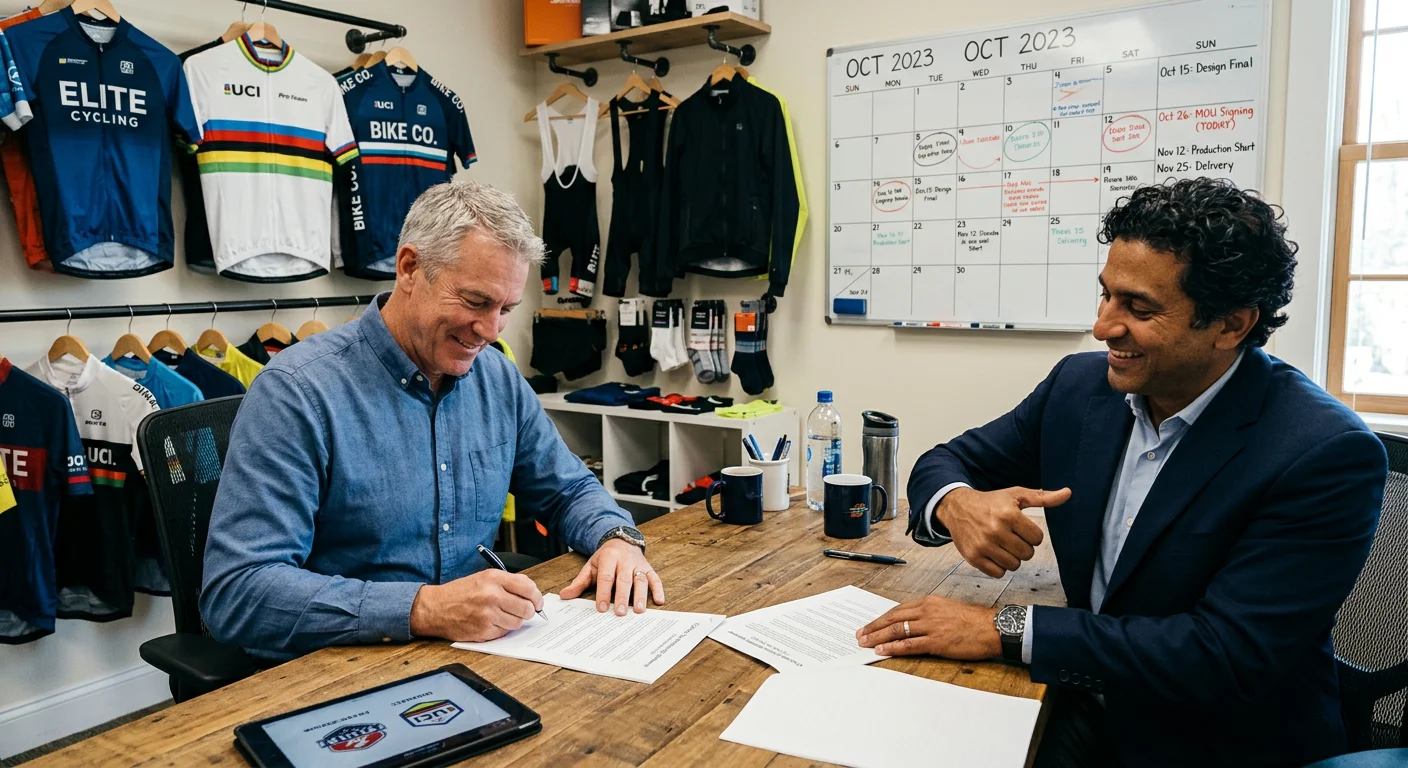
Here's what most cycling apparel suppliers won't tell you: the calendar works against you — unless you take control of it.
Custom cycling apparel lead times aren't a mystery. They're math. Design confirmation, sampling, fabric sourcing, bulk production, QC, freight — each stage carries a fixed number. Those numbers add up fast. Miss one window, and you're standing in front of your team explaining why the kits showed up the week after the season opener.
Now you have the tools to avoid that. The framework. The timeline data. The risk variables. The matrix that shows where your order lands based on quantity, complexity, and season.
So here's your next move: stop asking "when do we need it?" Start asking "when does production need to begin?"
Work backwards from your deadline. Build in a buffer. Get your supplier to confirm every critical milestone in writing — before a single yard of fabric is cut. No handshakes. No vague promises. Written commitments, stage by stage.
Planning wins. Chasing always costs you.