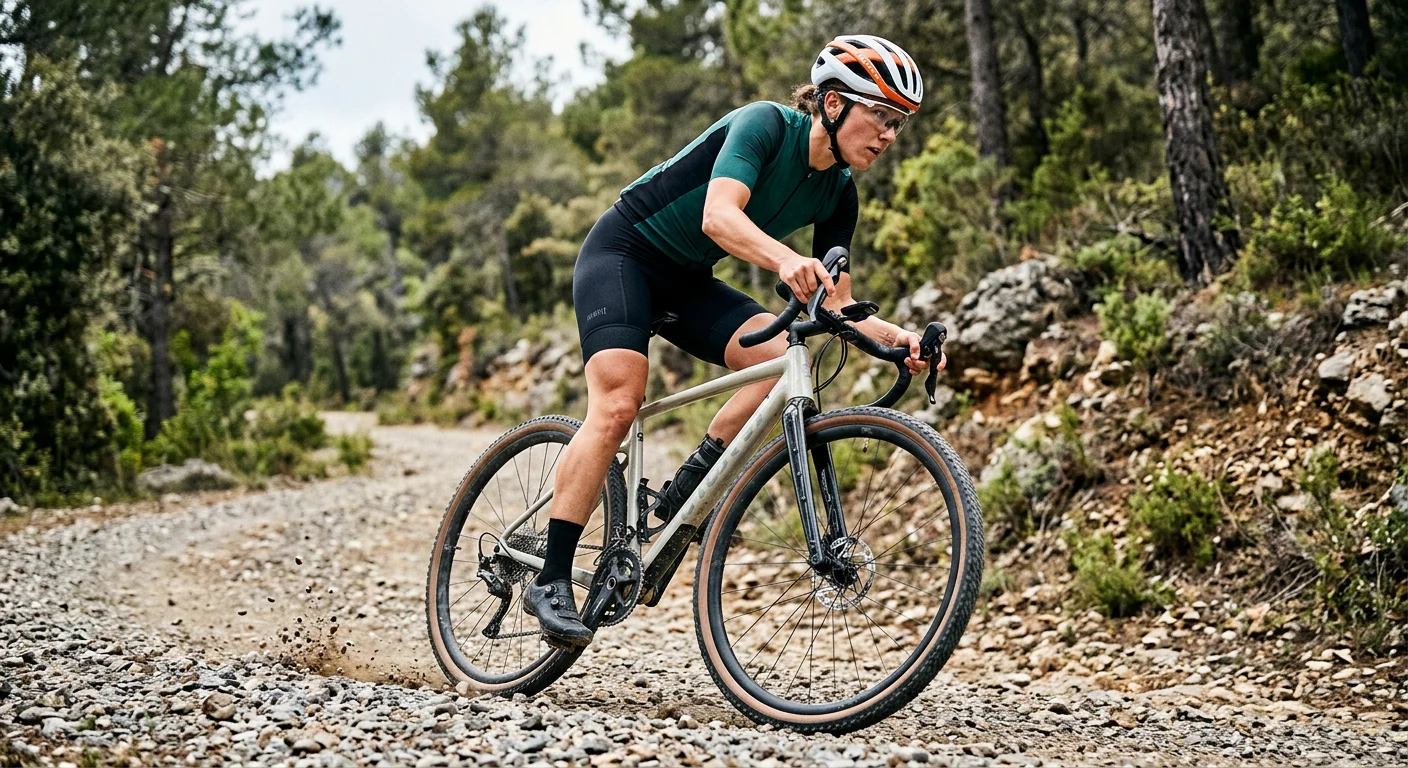
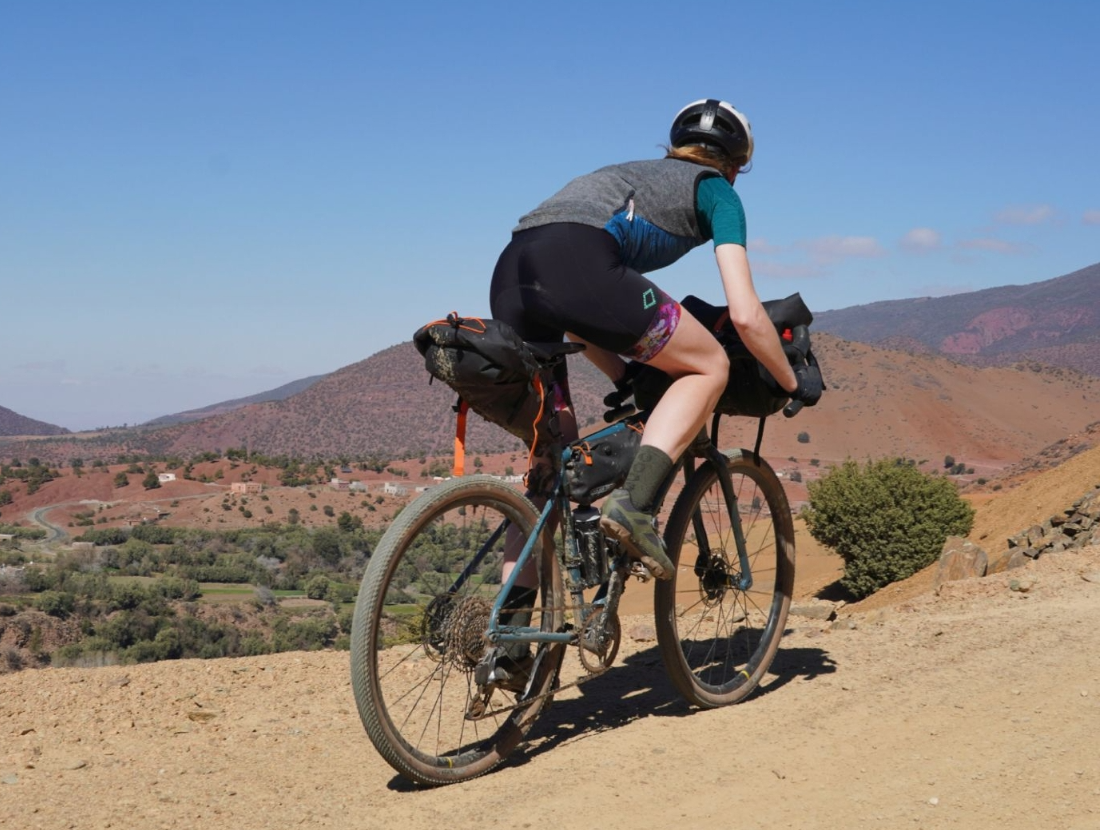
Pick up two cycling jerseys — one labeled "130 GSM Italian fabric," the other "lightweight race cut." You'd expect the difference to be obvious the moment they hit your hands. It's not. Not until you're 60 kilometers into a summer criterium, soaked through, wondering why you paid a premium for fabric that's clinging to your back like a second skin.
I've handled hundreds of jersey swatches across cycling jerseys supplier mills in Guangdong and Zhejiang. I've tested finished kits across four seasons. Here's the honest truth: GSM is the single most misunderstood specification in cycling apparel. Brands misquote it. Buyers ignore it. And almost no one explains what the number means for a real ride.
This guide fixes that. You'll get a quantified performance matrix, scene-specific recommendations, and a decision framework. Use it to find the right cycling jersey GSM in under three minutes.
GSM Performance Matrix: Quantifying 80–220g Across 6 Critical Cycling Apparel Metrics
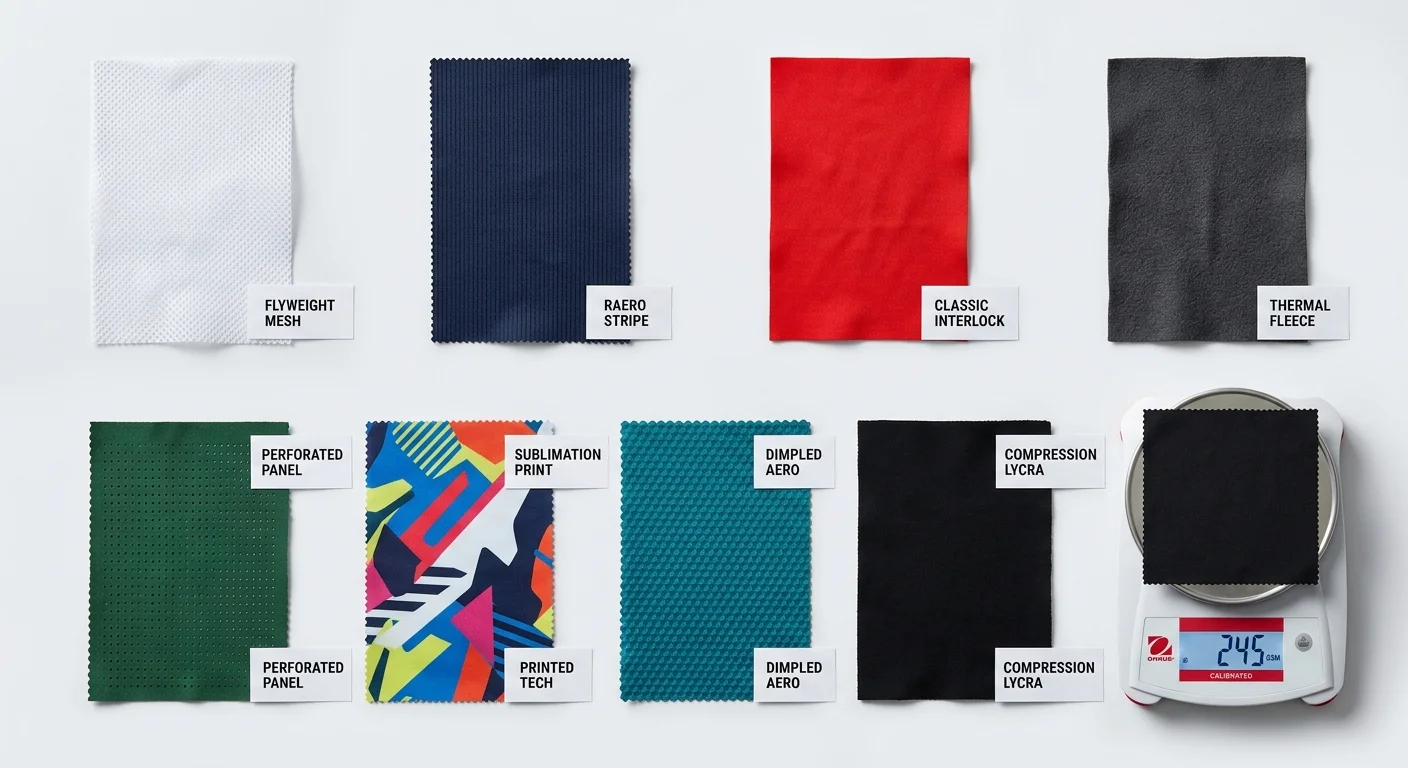
Six numbers. That's what separates a jersey that saves you watts from one that soaks through at kilometer 40 and never dries out.
The matrix below covers what fabric mills measure in labs — and what you feel on the bike. Six performance dimensions, five GSM bands, no filler.
The Six Dimensions, Defined
Before the numbers make sense, here's what each one measures:
Breathability/Moisture Transmission — Moisture Vapour Transmission Rate (MVTR, g/m²/24h) plus air permeability (L/m²/s at 100 Pa)
Stretch Recovery — Cyclic extension recovery after 50% load, 5–10 cycles (BS EN 14704-1)
Sublimation Print Compatibility — Color fidelity, dye migration risk, and gradient resolution at heat-press
Abrasion Durability — Martindale cycles (ISO 12947) to first visible wear
UPF Sun Protection — Ultraviolet protection factor by GSM band and color
Aerodynamic Drag Influence — CdA impact based on wind-tunnel skinsuit correlations
The Full Performance Matrix
GSM Range | Breathability Index | Stretch Recovery | Print Compatibility | Martindale Durability | UPF Rating | Aero Impact |
|---|---|---|---|---|---|---|
80–110g | 95–100% / MVTR 15,000–20,000+ | 88–92% | ⚠ Risk of windowing on light colors; dot-gain on gradients | 5,000–8,000 cycles | UPF 10–25 (color-dependent) | Lowest drag potential when fit is tight |
110–140g | 85–92% / MVTR 10,000–16,000 | 94–97% | ✓ Reliable for complex gradients up to 200–250 dpi | 10,000–15,000 cycles | UPF 20–40 | ~1–3% CdA reduction vs. 150–160g at 45 km/h |
140–170g | 70–85% / MVTR 8,000–12,000 | 96–99% | ✓✓ Optimal: minimal distortion, stable through 180–210°C press | 18,000–25,000 cycles | UPF 30–40 | Sweet spot for textured aero sleeves (trip-strip geometry) |
170–220g | 50–70% / MVTR 5,000–9,000 | 97–99.5% | ⚠ Surface texture flattening risk on piqué/honeycomb structures | 25,000–35,000+ cycles | UPF 50+ routine | Flutter risk at 45+ km/h if elastane < 15% |
220g+ | 30–50% / MVTR 3,000–6,000 | Varies | Limited to logo/zone printing, not full-coverage art | 35,000+ cycles | UPF 50+ | Not applicable for performance road use |
What the Numbers Mean on the Bike
Dry time tells you more than MVTR alone. An 80–110g open-mesh panel reaches touch-dry in 8–12 minutes at 20–25°C in forced air. Move up to 170–220g, and that same panel takes 25–35 minutes. On a five-hour Gran Fondo with two climbs, that gap matters. One jersey resets between efforts. The other keeps building up moisture.
Buyers often underestimate lighter fabrics on recovery. An 88–92% recovery rating at 80–110g sounds fine — until you load rear pockets with 600g of food and ride five hours on rough tarmac. The numbers drop fast under real load. Heavier bands — 140–170g with up to 18–20% elastane — hold 96–99% recovery under the same conditions. That's why Castelli 's Aero 6.0 and Q36.5's Grid Skin both use this GSM zone for compressive torso panels. The featherweight mesh looks great in unboxing videos. It doesn't hold up the same way across five hours.
For team kits, the 130–170g band is the standard. Below 120g, you're dealing with windowing on white backgrounds and dye migration on dark-to-light logo transitions. Custom cycling jerseys suppliers like Primal and most Italian mill converters specify 135–155g polyester for a clear reason — it holds up through the 180–210°C heat-press cycle without panel distortion. Go above 180g, and a different problem appears. Piqué and honeycomb textures flatten under the calender. You lose the micro-surface geometry that delivers measurable aero benefit on sleeves.
The aero numbers need context. A smooth 120–140g lycra-poly build can cut CdA by 1–3% compared to a looser 150–160g jersey at 45 km/h. That's around 5–10 watts for a typical road rider, based on independent test data. That advantage disappears the moment the lighter fabric sags under loaded pockets or creates flutter on your lower back at race speed. Here's the core tension: fabrics with the highest aero potential are also the most fit-sensitive. Get the cut wrong by 5mm and the gain is gone.
Quick-Reference: Performance Priority by GSM Band
If your priority is… | Target GSM band |
|---|---|
Maximum breathability, summer criterium | 80–110g (mesh panels) + 110–130g main body |
Race-day aero with compression snap-back | 130–160g (high elastane, tight warp-knit) |
135–155g (Italian polyester standard) | |
Endurance durability, gravel, pack-strap contact | 140–170g |
Long-sleeve sun protection, UPF 50+ | 160–190g |
Autumn training, light thermal, UPF 50+ | 170–220g |
Note on fiber interaction: All values above assume 82–90% polyester/nylon + 10–18% elastane construction. Adding merino wool or nylon-dominant blends shifts both MVTR and recovery figures by a wide margin — covered in the fiber matrix section below.
80–110 GSM Summer Cycling Jersey Fabric: Maximum Airflow & Pro Racing Application
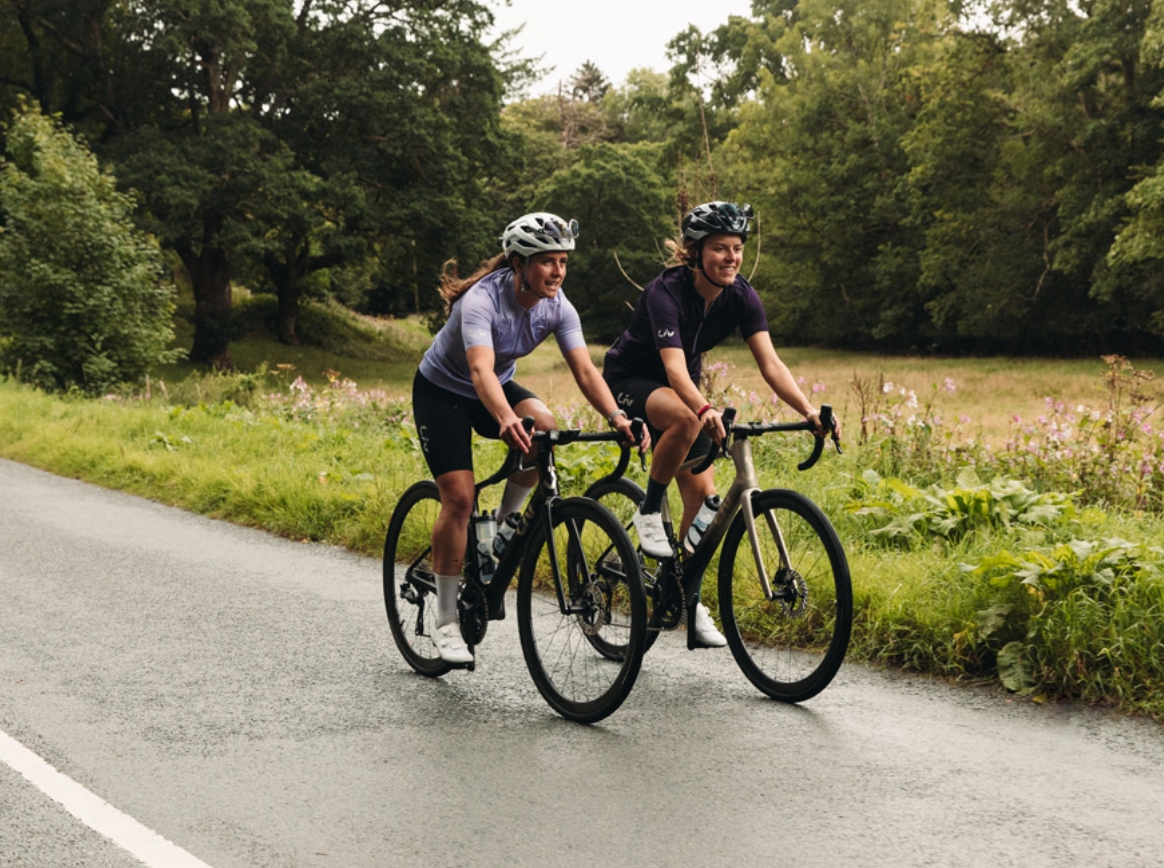
The lightest band in cycling apparel isn't just a weight category. It's a different philosophy of fabric engineering.
At 80–110 GSM, you're not designing a jersey. You're designing airflow with some structure around it. The fabric almost disappears on the bike. A size-M race jersey in this range lands between 90–130 grams total — lighter than most energy bar wrappers in your back pocket. Hold a swatch at arm's length and it hangs like tissue. Stretch it and it snaps back. That combination of near-zero drape stiffness and elastic memory is what separates race-grade micro-mesh from cheap lightweight polyester.
Where This GSM Lives: Panel-by-Panel
No serious race jersey uses one GSM throughout. The 80–110g band gets placed with purpose across different zones:
Side panels / underarm : 70–90 GSM open micro-mesh — the lightest zone on the entire jersey, built for convective airflow where heat builds fastest
Back panel : 80–100 GSM, more porous than the front, pushing evaporative cooling where sweat load is highest. Pocket zones step up to 100–120 GSM to prevent sagging under 0.8–1.0 kg of food and tools
Front panel : 100–110 GSM micro-mesh or warp-knit — a tighter weave to hold logo opacity and chest coverage in lighter colorways
Sleeves : 90–110 GSM seamless or raw-cut warp-knit with 10–20% elastane for aero compression. A textured surface handles boundary-layer control in criterium and TT applications
Collar / zipper placket : 120–140 GSM narrow reinforcement strip — the one zone where you add weight on purpose to stabilize the zipper without raising the whole jersey's average
The logic is simple: put the lightest, most open fabric where your body generates the most heat and faces the least mechanical stress.
The Evaporative Cooling Advantage — Quantified
Open-mesh polyester at 80–110 GSM evaporates sweat at 2–3x the rate of a standard 150–180 GSM club jersey under identical airflow conditions. The reason comes down to structure. Bird's-eye or dimpled outer surface geometry — the same principle behind the Funkier Airflow jersey — expands the surface area exposed to moving air. That drives faster phase-change evaporation. Add a hydrophilic wicking treatment to the polyester fiber, and sweat spreads across the fabric face before it pools. Riders describe the result as "a slight breeze seems to get to the skin" even in still air. That's not a metaphor. It's the real thermal effect of reduced trapped-air volume in a very thin cross-section.
The practical sweet spot in this band sits at 95–105 GSM . Below 80 GSM, structural stability drops fast — higher snag risk, pocket deformation, and serious opacity issues unless you use multi-filament yarns or reinforced knit patterns. Above 110–120 GSM, you'll feel the warmth in still air. The 95–105g micro-mesh holds capillary channels open enough for reliable wicking while keeping fabric integrity without heavy reinforcement. It sits at the engineering edge of lightweight before it tips into fragile.
The Opacity Problem Nobody Warns You About
Lighter fabrics in light colors carry a real-world risk that doesn't show up on spec sheets. At 90 GSM or below, white and neon fabrics can show more than 40% apparent see-through — backlit by sun, or once the fabric saturates with sweat. Moisture increases polyester fiber transparency. What looked opaque in the fitting room becomes translucent at kilometer 30.
Experienced kit designers handle this in three ways:
Double-layer chest panel — two 80–90 GSM layers over the sternum creates an effective 160–180 GSM zone in a limited area, without pulling much weight from the overall jersey
Differential front/back GSM — 100–110g on the front, 80–90g on side and back mesh where modesty matters less
Color and print placement — reserve white and pastels for back panels with a denser knit. Route darker colorways or sublimation prints over the highest-risk opacity zones
Brands like Ryzon solve this through panel engineering rather than bumping the whole jersey up in weight. The Signature AirFlow — specced for 25–35°C riding with fine Italian and Portuguese mesh — keeps side panels at ultra-light ventilation weight while the front construction handles both sun and opacity requirements.
Procurement Specification: What to Tell Your Mill
Sourcing fabric in this GSM range with vague descriptions will cost you three sampling rounds. Be specific:
Example warp-knit micro-mesh spec:
- Construction: 85% polyester / 15% elastane, 20D/36F yarn
- Finished fabric GSM: 90 ± 5 g/m² , panel-specific variants as required
- 4-way stretch, air permeability ≥ 3,000 L/m²/s at 100 Pa
- Moisture management wicking time < 3 seconds
- Finish: hydrophilic wicking treatment + anti-snag (higher filament count to offset low-GSM structural vulnerability)
Panel-specific targets for a pro summer jersey tech pack:
Panel | GSM Target | Key Requirement |
|---|---|---|
Front body | 100–110g | Matte finish, UPF 30+, opacity |
Back body | 90–100g | High air permeability, open structure |
Side / underarm | 80–90g | Maximum convective airflow |
Sleeves | 90–110g | Warp-knit, raw-cut capable, high modulus |
QC checkpoints that matter at this weight: Backlight white and neon swatches wet — simulate sweat saturation before approving colorways. Load 90–100 GSM back fabric with 0.8–1.0 kg equivalent (three full pockets) and verify dimensional recovery. Benchmark air permeability against known reference jerseys — Castelli Aero Race, Rapha Core Aero, or Ryzon AirFlow — in the same lab, same conditions. Your fabric needs to match or beat their airflow numbers at equivalent GSM. A mill spec sheet that falls short tells you the finished product will too.
This is the GSM band where fabric construction matters most. There's almost no margin to hide manufacturing inconsistency. At 170 GSM, a variable knit density goes unnoticed. At 90 GSM, it shows up as a hot spot on your back at kilometer 50.
110–140 GSM Lightweight Race-Grade: Decoding the "130 GSM Italian Fabric" Experience
"130 GSM Italian fabric." Four words on a product page that add $60 to the price and tell you almost nothing.
Here's what those words mean — and why the gap between the marketing copy and your sweaty back at kilometer 80 is smaller than you'd expect. You just need to know what you're reading.
What "130 GSM Italian" Actually Refers To
The spec describes a warp- or circular-knit polyester/elastane construction . Nominal weight sits at ~125–135 g/m² , built at 40–60 gauge with ~85% high-tenacity polyester / 15% elastane . The Italian mills making this fabric — MITI, Carvico, Sitip, Eurojersey (Sensitive®) — hold tolerances of ±2–3 g/m² across production runs. So a brand labeling a jersey "130 GSM Italian" ships fabric that lands at ~127–133 g/m² on the cut table. That tight weight range keeps race fit consistent across all sizes.
At this weight, a size-M race jersey using mostly 110–140g panels finishes at ~105–130 grams total . A comparable endurance jersey? ~140–190 grams . That weight difference is what you're paying for.
Hand Feel, Airflow, and What "Airy" Measures
Pick up a 130 GSM Italian race panel. It runs ~20–30% thinner than a 155–180g endurance jersey. Dry, it feels paper-crisp — not spongy at all. Stretch it and you get 40–70% two-way extension in the course direction. It snaps back with more force than 5–8% elastane training fabrics.
On the bike, perforated and mini-mesh panel versions push air permeability of 200–400 L/m²/s at 100 Pa . You feel that convective cooling above ~25 km/h. That's a real, measurable airflow rate — not a marketing claim.
Drying speed comes down to fabric structure. A 130 GSM race jersey holds ~20–30% less water per area than 160–180g fabric. In dry summer air, riding at tempo or descending, you go from soaked to dry ~25–40% faster than in an all-round jersey. Over a 3–4 hour gran fondo with relative humidity below 60%, that's the jersey that resets between climbs — versus the one that stays clammy to the finish.
Where This GSM Breaks Down
The durability trade-off is real. State it plainly: Martindale abrasion resistance on 110–140g high-gauge knits runs 10,000–15,000 cycles . That's fine for road riding, but marginal under backpack straps or hydration pack contact. Fine pilling and snagging show up after dozens of rides with any abrasive surface contact. Cycling jerseys manufacturers reinforce shoulders and rear pocket zones with 160–200 GSM overlays for that exact reason. The race-grade main fabric can't handle heavy-load friction on its own.
Care is another factor. Plan on some compression loss and surface fuzz after 30–50 machine washes at standard settings. To keep the race hand-feel: cold wash, gentle cycle, garment bag, line dry .
This GSM band does one thing well : road and gravel racing, gran fondos, and structured training where your only load is jersey pockets. It's not built for commuting with a pack, or gravel riding through technical brush.
Buying Checklist: What the Label Should Say
Evaluating a jersey claiming race-grade 110–140 GSM construction? Check for these:
Main fabric : 120–140 GSM, 80–88% polyester or polyamide / 12–20% elastane
Side/back panels : 90–120 GSM lighter mesh for ventilation zoning
Hem : minimal silicone micro-dots or laser-cut finish — wide compression grippers mean the fabric isn't doing the work
Label claims : UPF ≥30, quick-dry/hydrophilic finish, 4-way stretch
Care label : 30°C wash, no tumble dry — the standard marker of high-elastane Italian race knits
Climate fit : This fabric band performs best at 24–35°C daytime temperatures, low-to-moderate humidity, and sustained speeds above 25 km/h . Drop below those conditions — early spring rides, cool mountain descents, sub-20°C starts — and you'll feel the difference straight away.
140–170 GSM All-Round Cycling Kit Fabric Thickness: Structure, Coverage & Gran Fondo Comfort
There's a weight class in cycling fabric that gets overlooked — not because it's boring, but because it doesn't sell well on a spec sheet. No brand leads with "140–170 GSM: the fabric that holds up for five hours and keeps you comfortable on the descent." But that's what this range does, every time.
This is the workhorse band. It handles Gran Fondos, endurance club rides, loaded commutes, and mixed-weather training. You don't have to compromise anything critical.
Structure: Why This Band Builds Differently
At 140–170 GSM, fabric engineers shift their focus. They stop chasing minimum weight and start building for dimensional stability under load . That's a real difference.
The standard construction runs 85–90% polyester / 10–15% elastane . That elastane content gives you genuine four-way performance stretch — not the token 5–8% you find on basic training jerseys. Monton's MIXC (80.5% polyester / 19.5% elastane, 150 g/m²) and DeanGrid (93% polyester / 7% elastane, 150 g/m²) sit at opposite ends of that elastane range. The MIXC gives you more lateral give — useful for rib expansion on long climbs. The DeanGrid holds its shape better under repeated mechanical stress.
The knit architecture shifts too. Instead of open micro-mesh built for maximum airflow, 140–170 GSM fabrics use micro-piqué or small square-grid structures . Think Primalwear's Q3 Elite at 154 GSM with its plaited double-knit square grid texture. That surface geometry keeps moisture moving — you still get 75–80% of the airflow of a 120 GSM open mesh. Plus, it adds enough continuous face for coverage and light wind buffering on cold descents.
The fabric runs 0.15–0.25 mm thicker than 120–130 GSM knits. You can't feel that difference in your hand. On a four-hour ride into a headwind, you notice it.
Coverage: The Opacity Problem, Solved
Source or wear lightweight jerseys in white or neon colorways and you know the problem fast. At 120–130 GSM, single-layer mesh panels can hit more than 40% apparent transparency when wet or backlit. Most brands patch the front panel with a heavier layer or push bold colorways only to the denser zones.
At 140–160 GSM, that trade-off disappears. Full coverage in white and neon works in a single-layer construction — no double-panel engineering needed. Primalwear's SLR Ion at 140 GSM is described as "open-channel, lightweight" yet holds enough opacity for full-coverage sublimation prints. Step up to 154 GSM and you get UPF 35+ alongside printable surface stability through the 180–210°C heat-press cycle.
For custom cycling team kits, this is a practical win. You don't need to spec separate chest-panel overlays or limit your colorway options. The fabric handles it on its own.
Gran Fondo Performance: Pocket Load & Recovery
This is where the GSM band earns its reputation. Load three rear pockets with 600–800 grams — gels, a phone, a gilet, a full bidon — and ride five hours on variable tarmac. At 110–130 GSM, pocket panels stretch out and don't come back. By hour three, the fabric has crept. You feel every gram pulling.
At 140–160 GSM with 10–15% elastane, Martindale durability runs 18,000–25,000 cycles — double the 110–140 GSM race band. Stretch recovery holds at 96–99% under repeated load. Brands building real endurance kits already know this. Santini's mid-tier Karma line uses 140–160 GSM microfibre polyester with 10–15% elastane in the body panels, then steps up to a denser 160–180 GSM tricot variant at the rear pockets. Pearl Izumi 's SELECT Transfer fabric — the core of the Escape series for commuters and gran fondo riders — landed at 150 GSM with 10–14% spandex, built for this exact durability profile.
The pocket reinforcement rule is worth locking in as a procurement standard: primary body at 145–155 GSM, pockets and hem at 160–180 GSM, same fiber ratio but denser gauge . That 15–25 GSM step adds 0.03–0.05 mm at the pocket panel. Enough to resist sag. Not enough to create a visible bulk transition at the seam line.
The Breathability Trade-Off, Stated Plainly
This band is not the right call for a summer criterium at 35°C and full race pace. MVTR drops to 8,000–12,000 g/m²/24h, against 15,000–20,000+ for open-mesh race fabrics. In still air or high humidity, you'll feel that gap.
The fix most cycling jerseys manufacturers use: pair 140–150 GSM micro-piqué on the front and sleeves with 110–130 GSM mesh on back and side panels . The front faces the wind. The back handles your sweat load. Kazoom's 140 GSM LIGHTweight fabric is positioned for temperatures below 25°C/80°F — that's not a weakness, it's an accurate read on where this weight range performs without any compromise.
Procurement Spec Template: 140–170 GSM Gran Fondo Kit
Panel | GSM Target | Fiber Ratio | Key Requirement |
|---|---|---|---|
Main body (front/chest) | 145–155g | 86–90% poly / 10–14% elastane | Micro-piqué or square-grid, UPF 30+, full sublimation coverage |
Sleeves | 135–145g | 82–88% poly / 12–18% elastane | Higher elastane for unrestricted arm movement |
Back/side panels | 110–130g | 85–90% poly / 10–15% elastane | Open mesh for airflow, matched hem |
Rear pockets / hem | 160–180g | 80–85% poly / 15–20% elastane | Dense gauge, load-bearing, non-brushed back |
Brushed-back note : Don't spec brushed-back fabric across this entire GSM band. Reserve brushed-back tricot for limited panels — a yoke strip or kidney zone — for mild thermal function only. Full-panel brushing at 160–170 GSM stacks moisture against the skin and adds bulk under bib straps. For real thermal performance, that's a job for 200 GSM and above.
170–220 GSM Winter Cycling Jersey Thickness: Thermal Knits & Shoulder-Season Layering
Cold mornings expose every GSM shortcut you made in spring.
At 170–220 GSM, fabric engineering stops being about cutting weight. It starts being about managing heat — how much you trap, how much you shed, and how fast you shift between the two. A 12°C climb can become a 4°C descent in eight minutes. Your jersey has to keep up.
This is the thermal band. It behaves like a different category of textile.
Construction: What Changes at 170g
The jump from 140–160 GSM to 170–220 GSM isn't a gradual scale. It's a structural pivot.
Summer and race jerseys run single-layer, open or mid-gauge weft knits. One face. Airflow straight through. At 170g and above, that architecture gets replaced:
Double-faced thermal tricot — smooth, wind-resistant exterior with a brushed or looped interior that traps a still-air layer against your skin
Micro-brushed warp/weft knits — inner face raised into a shallow pile; the raised fibers create thousands of small air pockets that act as passive insulation
Bonded softshell front panels — polyester face knit laminated to a PU or PES membrane, used across chest and shoulder zones where convective wind loss is highest
The result: a 190–210 GSM brushed polyester knit reduces air permeability by 18–22% compared to a 140 GSM summer jersey under equivalent lab conditions. You don't need a wind tunnel to feel that. You notice it the moment a headwind stops cutting through your chest panel.
High collar construction and extended drop tails show up at this GSM range for a clear reason. Both cut convective heat loss at the neck and lumbar zones — the two spots where heat bleeds fastest in the riding position.
The Three Sub-Bands, Split by Temperature
Not all winter jerseys share the same thickness. The 170–220 GSM range covers three distinct use scenarios:
170–185 GSM — Shoulder-Season Tempo
This is late October and early April fabric. It works from 8–15°C over a short-sleeve wicking base, with a packable gilet in your pocket for gusty descents. At this weight, you're still generating enough heat on climbs that overheating is a real risk. Hard intervals in this band will have you unzipping before the first summit. That's by design — the thermal layer is light enough to vent by opening the zip.
190–210 GSM — The Core Winter Jersey
This is what "winter jersey thickness" means in practice. The Le Col Pro Aqua Zero LS and the MBO Cycling C160/C161 thermal jerseys both sit at this construction weight — soft fleece-lined Lycra with DWR finish and full-length zip. Working range: 3–10°C with a thin synthetic or merino base, or layered under a windproof vest for sub-5°C starts. Most temperate-climate winter training blocks never need anything heavier.
215–220 GSM — Deep Winter Mid-Layer
Above 215 GSM, you're building a mid-layer, not a standalone jersey. These fabrics work at or near freezing (0–5°C) tucked under a membrane softshell. Worn alone above 10°C, most riders overheat. The evaporation rate drops to 45–60% of a 130–140 GSM open knit . That means sweat management falls on your base layer. Get that wrong and the clammy-on-the-climb, cold-on-the-descent cycle starts. A wicking base isn't optional here — it's essential.
Moisture Management: The Trade-Off You Can't Avoid
More warmth. Less breathability. That's not a design flaw — it's physics.
Brushed fleece-backed polyester at 190–210 GSM moves moisture at about half the rate of a race jersey. The pile structure that traps warm air also slows vapor transport. That's why every serious thermal jersey in this band relies on mechanical venting rather than passive breathability:
Full-length front zipper for active heat release on climbs
Lighter 120–160 GSM mesh panels at underarms and sides
Panel-specific construction: denser chest and shoulders, more open side panels
Montella's winter kits show this contrast well. Their 120 GSM mesh pieces sit at one end of the range. The fleece-backed winter jersey fabric sits at 180–210 GSM at the other. That gap is the entire thermal performance story, expressed in a single product line.
Durability: The Winter Bonus
The same density that slows airflow also improves abrasion resistance. Martindale durability on 180–220 GSM thermal knits reaches ≥25,000 cycles — well above the 10,000–15,000 cycles you get from race-grade 110–140 GSM fabric. That matters in winter for three real reasons:
Washing frequency jumps in winter training blocks — 3–4 cycles per week is common
Gravel and cross rides bring brush contact, strap rub, and road spray
Softshell layering creates shoulder friction that wears through thinner face fabrics fast
For winter jerseys built for heavy use, spec ≥25,000 Martindale as a minimum procurement requirement . TOPOW's bonded softshell constructions target 25,000–40,000 cycles for this exact reason.
Procurement Spec: 170–220 GSM Winter Jersey
Panel | GSM Target | Construction | Key Requirement |
|---|---|---|---|
Chest / shoulders | 190–210g | Double-faced brushed polyester or Lycra blend | DWR finish, ≥25k Martindale, UPF 50+ |
Back body | 185–200g | Micro-brushed weft knit | Drop-tail extension, brushed interior |
Side / underarm | 120–160g | Open mesh or lighter knit | Mechanical vent, moisture bleed |
Sleeves | 170–190g | Brushed warp-knit | Full coverage, elastane ≥12% for mobility |
UPF note : Dense double-faced thermal knits at 190–210 GSM test at UPF 50+ without chemical additives. Dark colorways and double-faced constructions clear that threshold with ease. So winter thermal jerseys actually deliver better sun protection than most summer jerseys — a spec point most product listings overlook. It's worth adding to yours.
Fiber Composition × GSM Matrix: How Polyester, Nylon-Spandex & Merino Alter Cycling Apparel Fabric Construction
Two jerseys. Same 140 GSM on the hangtag. One is polyester-elastane. The other is merino-nylon. On a cold, wet climb, these two fabrics perform so far apart that sharing a GSM label is nearly pointless.
GSM tells you how much material is there. Fiber composition tells you what that material does . You need both numbers together before the spec means anything real.
Here's how the four main fiber families behave — and why the same GSM value produces very different results based on what's in the yarn.
Polyester-Elastane: The Default, and Why It Earned That Status
Pure polyester or polyester-elastane blends (84–92% polyester, 8–16% elastane) cover most performance cycling jerseys across the full 80–200 GSM range. The reasons are practical and clear.
Sublimation printing is the deciding factor for most brands. Polyester — microfilament circular knits at 90–150 GSM — accepts disperse dye sublimation with higher color fidelity and lower dye migration risk than any other fiber. Recycled polyester constructions like MITI Green Fly (115 GSM) and Velodrome Green (95 GSM) now deliver the same print performance at lower environmental cost. For custom cycling team kits with full-coverage graphic work, polyester at 120–155 GSM is the one fiber family that makes commercial sense.
The elastane percentage controls how GSM translates to compression. At 8–10% elastane, a 140 GSM jersey gives moderate shape retention — good for endurance and gran fondo riders. Raise that to 15–20% elastane at the same 140 GSM and you get race-compression behavior equal to a straight polyester jersey at 160–165 GSM. That 20–25 GSM "compression shift" holds steady across multiple mill specs. A well-blended 130 GSM polyester-elastane race jersey can match the body-mapped compression of a heavier 150 GSM training fabric — with no added weight or thermal penalty.
The one documented weakness: odor retention . Polyester's hydrophobic fiber surface holds odor-causing compounds more than merino or some polyamide blends. Above 150 GSM, most serious brands add antimicrobial finishes at the mill stage to address this.
Nylon-Spandex: Higher Cost, Real Performance Advantages at Specific GSM Bands
Nylon-spandex (polyamide-elastane) warp and tricot knits run heavier — 180–260 GSM — and work best where abrasion resistance and soft hand-feel matter more than sublimation compatibility or cost.
The performance gap at identical GSM shows up on two dimensions:
Abrasion resistance. At equal filament size, nylon beats polyester in Martindale durability. That's why 200–240 GSM nylon-spandex tricot is the standard for bib shorts seat panels. A 200 GSM polyester panel would show visible wear much sooner. Carvico Revolutional Energy (71% polyamide / 29% elastane, 195 GSM) and Primal's 90% nylon / 10% spandex (190 GSM) are built for this exact abrasion-load profile.
Moisture transport under pressure. Nylon-spandex tricot at 160–200 GSM moves moisture 10–15% faster than polyester jerseys at the same GSM — especially under contact pressure against the saddle or seat. Finer filaments and a more open loop structure explain why a 160 GSM nylon blend often feels as breathable as a 140 GSM polyester jersey. That 20 GSM perceptual gap is real and shows up across rider feedback.
The trade-off: nylon-spandex doesn't sublimate cleanly , and it costs more per meter. Most brands use it for shorts, aero skinsuits, and high-abrasion overlay panels — not full-coverage jersey bodies.
Merino Blends: The Thermal Efficiency Outlier
Merino wool in cycling apparel shows up most often as merino-nylon blends in the 70–87% merino range. Jersey weights sit at 150–200 GSM. Base layers run 120–200 GSM. Rapha, Icebreaker, and Smartwool all work in this construction zone.
The key spec insight is thermal equivalence relative to GSM. A 180 GSM merino-blend jersey produces warmth on par with a 210–220 GSM polyester jersey — about a 30–40 GSM thermal shift in merino's favor. At the same time, merino's moisture-absorbing fiber behavior means sweat management feels closer to a 130–150 GSM polyester knit, despite the heavier weight. That dual advantage — warm like a 210 GSM polyester, breathable like a 140 GSM polyester — is why designers spec merino blends 20–30 GSM lighter than polyester for the same thermal target.
Durability is the limiting factor. Merino pills and snags fast at 150–200 GSM under jersey pocket friction and backpack strap contact — unless the yarn construction is engineered to resist it. Core-spun construction (nylon filament core, merino wrap) and compact ring-spun yarns cut down on hairiness and extend anti-pilling performance through 10–20+ wash cycles. Without that approach, merino jersey fabric shows clear wear within the first season of regular use.
The other real advantage: odor resistance. Merino outperforms polyester by a wide margin here — enough that brands accept a slightly higher GSM without a comfort penalty in warm-to-cool conditions. For multi-day touring and bikepacking where washing isn't always an option, that one property changes the whole equation.
The Fiber × GSM Quick Reference
Fiber Type | Typical Jersey GSM | Sublimation | Thermal Efficiency | Moisture Transport | Best Application |
|---|---|---|---|---|---|
100% Polyester | 80–180g | ✓✓ Optimal | Baseline | Baseline | Race jerseys, custom team kits |
Poly/Elastane (8–16% EA) | 90–200g | ✓✓ Optimal | +5–10% vs pure poly | Baseline | Race + endurance, all GSM bands |
Nylon/Spandex (15–30% EA) | 180–260g | ✗ Not recommended | Similar to poly | +10–15% at same GSM | Shorts, aero panels, high-abrasion zones |
Merino Blend (70–87% wool) | 150–200g | ✗ Not compatible | +30–40 GSM advantage | Hygroscopic — performs above weight | Shoulder-season, multi-day, odor-critical rides |
Cotton / Acrylic | 180–220g | ✗ Not applicable | Traps moisture | Poor | Casual off-bike only |
The practical read : Sourcing or buying a cycling jersey? Polyester-elastane blends cover 90% of performance use cases across all GSM bands. Add nylon construction where abrasion loads are highest. Move into merino territory when odor resistance, thermal efficiency, or multi-day comfort justifies the cost premium and reduced print compatibility. Cotton and acrylic belong off the bike — at any GSM.
Scene-Specific GSM Quick Reference: Riding Type to Fabric Weight Mapping
Five riding types. Five different GSM targets. This table gives you one clear, usable number for each scenario — no fluff, no guesswork.
Riding Type | GSM Target | Core Priority |
|---|---|---|
Road Race / Criterium | 100–130g | Maximum cooling, aero fit, sublimation clarity; pocket yoke at 130–150g |
Gran Fondo / Endurance | 130–170g | Pocket load support, UV coverage, moisture diffusion across 4–8 hours |
MTB / Gravel / Trail | 150–190g | Abrasion tolerance, ergonomic cut; vent panels at 140–150g, body at 170–190g |
Daily Commute / Urban | 160–200g | Opacity, casual drape, wind resistance, wash durability |
Winter Training / Cold Climbs | 180–220g | Thermal retention, brushed-back construction, dense wind-facing knit |
One rule to keep in mind: these are main-body targets, not whole-jersey averages. Every serious jersey zones its GSM. Lighter mesh goes at the back and sides. Heavier fabric covers the pocket panels and plackets. A "130 GSM gran fondo jersey" needs its pocket yoke specced 20–30g above that number. Skip that, and the pockets sag by hour three.
Start with this table as your baseline coordinate. The fiber matrix and performance data above show you exactly what shifts 20g in either direction will do to the ride feel and function.
5-Step Decision Framework: Pinpoint Your Cycling Jersey GSM in Under 3 Minutes
Five questions. That's all this takes. Answer them in order, and the right GSM range locks itself in — no spec sheets needed, no guessing what "lightweight" means on a product page.
Step 1: How Hard Are You Riding, and How Hot Is It?
These two variables move together. Push them both high, and your GSM ceiling drops fast.
>80% HRmax or >30°C sustained → cap your main body fabric at 100–130 g/m² . Above that threshold, the thermal load builds up. You stop cooling. Heat starts stacking.
Moderate intensity, variable temperatures → 130–160 g/m² handles the swing. It keeps you comfortable without locking you into one extreme.
Racing a summer criterium in July? You already have your answer. Stop here if that's you.
Step 2: How Long Is the Ride, and What Season?
Duration changes what the fabric needs to sustain , not just how it feels at the start.
Condition | Target GSM |
|---|---|
Hot summer, under 3 hours | 100–120 g/m² |
Hot summer, over 3 hours / Spring or Fall | 130–160 g/m² |
Winter or high-altitude training | 180–220 g/m², brushed thermal knit |
A 110 GSM race jersey can feel great for 90 minutes. By hour four, it works against you. Pocket panels deform. Fabric creep sets in. The weight that felt featherlight at the start feels wrong by the finish.
Step 3: Does Opacity or Abrasion Resistance Matter?
Most riders skip this question. It costs them later.
White or pale colorways, or frequent machine washing → set your floor at ≥140 g/m² for the main panel. Drop below that, and single-layer construction in light colors goes see-through when wet.
Gravel, MTB, or any ride with strap or brush contact → ≥160 g/m² on high-wear zones. Use reinforced panels at 180–220 g/m² for shoulders if you're running a hydration pack.
Aero racing where transparency is acceptable → 90–110 g/m² works. Manage the see-through risk with darker colorways and higher print density over the chest.
Step 4: What's Your Fiber Base?
Same GSM, different fiber — different jersey. This step adjusts your target range based on what's in the yarn.
Polyester/spandex (race compression) → 110–140 g/m²
Nylon/spandex (endurance comfort, softer hand-feel) → 140–170 g/m²
Merino blend (odor control, multi-day, shoulder-season) → 170–200 g/m²
Merino needs those extra grams to hold structure when wet. A 160 GSM merino-nylon jersey breathes more like a 130 GSM polyester. The fiber compensates across several properties at once — not just one.
Step 5: What Are Your Production or Purchasing Constraints?
This step is for buyers, brand owners, and kit builders. Retail shoppers can skip it.
Full-panel sublimation print on polyester → lock main fabric at 120–150 g/m² . Drop below 110–120 g/m², and color saturation weakens. Panel distortion risk also rises at the heat-press.
Embroidered logos or patch applications → you need ≥160 g/m² in those zones — either across the full build or through localized reinforcement panels.
Heavy rear pocket load (600g+) → specify ≥140 g/m² for the pocket panel, no matter what the main body uses. This is non-negotiable. The jersey has to hold food, tools, and a gilet without sagging by hour three.
Your 3-Minute Output
Run all five steps and you'll land in one of these confirmed ranges:
Your Profile | Confirmed GSM Range |
|---|---|
Race / criterium / >30°C / polyester | 100–130 g/m² |
Gran fondo / endurance / summer long-haul | 130–160 g/m² |
Gravel / MTB / opacity-critical / nylon blend | 150–180 g/m² |
Shoulder-season / merino / multi-day | 170–200 g/m² |
Winter training / thermal / brushed-back | 190–220 g/m² |
This framework doesn't give you one magic number. It gives you a solid 20–30 GSM window — tight enough to write a mill spec or filter a product search, wide enough to cover panel zoning and fiber variation. That's the precision you need. Go narrower and you're faking confidence. Go wider and you're back to guessing.
OEM & DIY Procurement Specification Checklist: Avoiding GSM-Only Pitfalls in Cycling Jersey Textile Specification
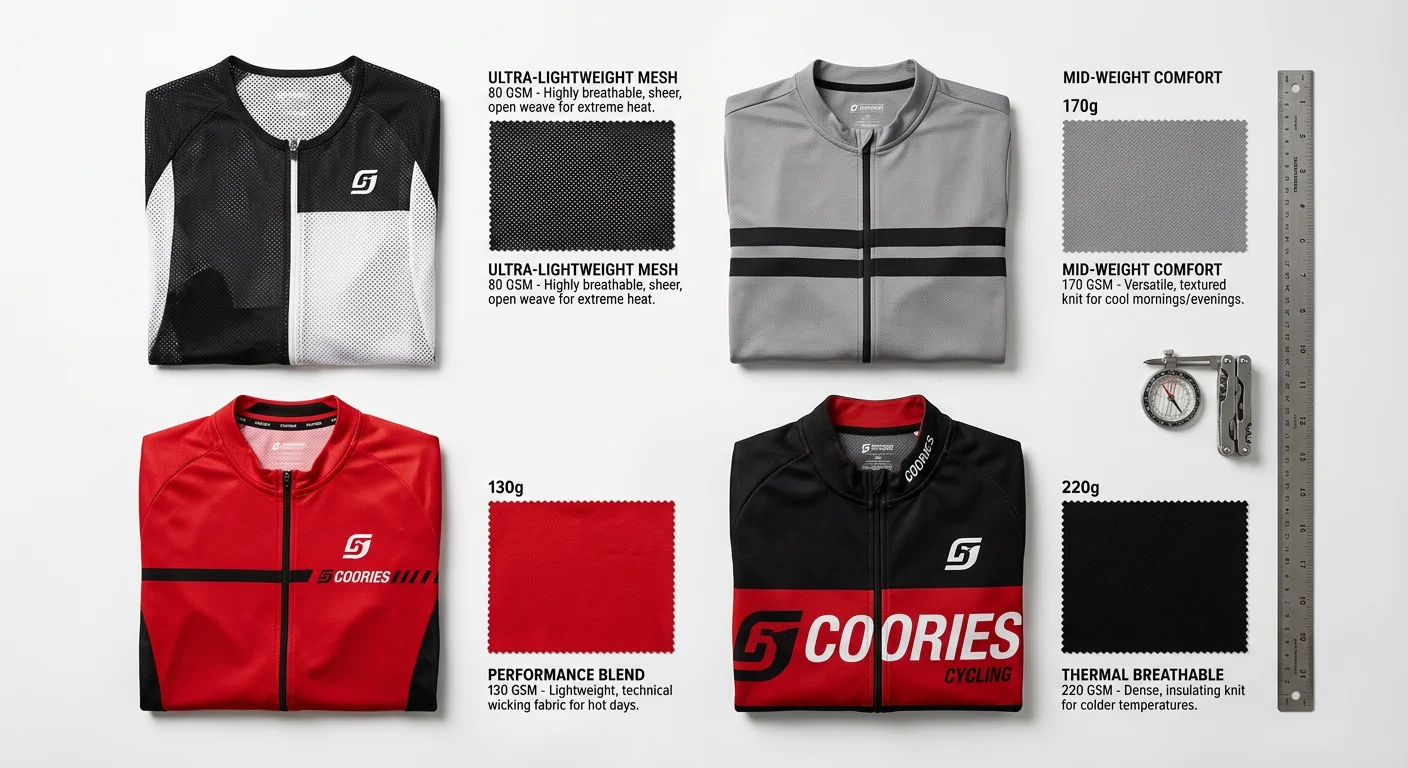
Ordering fabric by GSM alone is like ordering coffee by cup size. You'll get something. It won't be what you wanted.
Most experienced kit buyers learn this the hard way. A production run comes back with fabric that matches the spec sheet number — and fails every real-world test. The spec sheet stopped at GSM and left everything else to the mill's discretion. That's the problem.
Here's what you need to lock down, panel by panel.
The Full Co-Spec: Six Variables That Can't Be Left Blank
1. Fiber Composition
- Sublimation jerseys: ≥85–92% polyester + 8–15% elastane
- Eco lines: rPET ≥50% with GRS certification; elastane ≤15% for printability
2. Knit Structure
- Main body: circular knit interlock or tricot, 120–150 g/m² , smooth face
- Side panels: pinhole/eyelet mesh, 80–130 g/m²
- Pockets: dense warp or high-gauge circular knit, 150–180 g/m²
3. Yarn Denier
- Jersey body: 50–100D polyester filament — denier controls drape, shine, and opacity at identical GSM
- Mesh panels: 40–75D minimum — too low a denier on mesh panels creates see-through areas under stretch
4. Stretch and Recovery
- Weft stretch: ≥18–25% club fit / 25–35% race fit
- Warp stretch: 10–20% to limit pocket sag
- Recovery: ≥90–95% after 50% extension, 10 cycles
5. GSM Tolerance
- Require ±3–5 g/m² on mill test reports — not the ±10 g/m² standard on commodity knit orders. Request both greige and finished weights.
6. Print Compatibility
- Sublimation: ≥85% polyester face yarn , white or near-white ground, no thermal yellowing or shrink >2% at 200–210°C / 40–60 seconds
- Screen printing: ≥150 g/m² in print zones, flat knit surface, low-bleed polyester inks
- HTV/logos: non-brushed face, 4-way stretch-compatible films, adhesion test after 5 washes at 40°C
The Six GSM-Only Procurement Failures
These are the patterns that end in a reorder.
Failure Mode | What Goes Wrong | The Fix |
|---|---|---|
GSM only, no denier or knit structure | Two 135 g/m² fabrics feel and drape in entirely different ways | Specify GSM + knit type + yarn denier: "135 g/m², 90% rPET/10% elastane, 75D/72F, circular interlock, 30 GG" |
Ignoring brushed-back finish | Brushed Roubaix-type finishes add 15–25 g/m² effective thickness and warmth above stated GSM | State face/back finish clearly; require separate MTR pre- and post-brush |
Wrong elastane % for GSM band | 120 g/m² + 20% spandex = seam blowout under pocket load and bagging | 120–140 g/m²: 8–12% elastane ; 160–200 g/m²: 12–20% ; always spec minimum bursting strength |
Same fabric for pockets | Pocket panels sag, tear, items fall | Pockets: ≥150–180 g/m² , ≤8% elastane , bartacks on corners |
No opacity standard for women's fits | Light and mesh fabrics go see-through at the chest | Mandate double-layer front panel; run the 4-step opacity test on both male and female mannequins |
Recycled fiber without performance tie-in | rPET fabrics pill and bag despite matching GSM | GRS certification must come with: pilling grade ≥4 , recovery ≥90% , UPF ≥30 |
Opacity QA: The Four-Point Test
Sub-120 g/m² fabrics in light colorways need this. It's not optional.
Dry opacity over a standardized dark backing
Light-backing test on a dressed dummy under direct light — no visible skin outline at riding posture
Wet spray test — check for acceptable coverage when fabric is sweat-saturated
Stretch opacity at 120% width — main torso panels must not go transparent under ride load
The Supplier Documentation Demand List
A mill spec sheet missing any of the following items tells you something about that mill:
Finished GSM ± tolerance
Exact fiber % including recycled content % and cert IDs
Yarn denier and filament count — face and back if different
Knit type and gauge (e.g., 28–32 GG circular knit )
Warp and weft stretch % + recovery data
Applied finishes: wicking, anti-odor, brushing, peaching
UPF documentation from an accredited lab ( UPF 30–50+ for main panels)
Wicking time <3 seconds , vertical wicking ≥10 cm after 30 min (AATCC 197/198)
Anti-pilling: grade 4–5 after 10,000 Martindale cycles on main body; grade ≥4 after 15,000 cycles on pockets and side panels
Dimensional change: ≤3% after 5 industrial wash cycles at 40°C, line dry
Condensed Panel Checklist
Copy this into your tech pack for every fabric panel:
GSM target ±3–5 g/m²
Composition: poly % / rPET % / elastane %
Yarn: denier + filament count
Knit: type + gauge
Stretch: warp % / weft % + recovery after 50% and 100% extension
Print method: sublimation / screen / HTV — compatibility verified
Opacity: 4-step test passed for light colors and fabrics <140 g/m²
Dimensional change: ≤3% after 5×40°C wash
Functional tests: wicking, UPF, Martindale, bursting strength
Finishes stated: brushed / non-brushed, anti-odor, quick-dry
Documentation: MTR + OEKO-TEX, GRS, UPF lab report
Fill this for every panel — not just the main body. That's where orders go wrong. Not the chest panel spec, but the gaps around the pocket and the side mesh.
Conclusion
GSM is not a marketing number. It's a performance specification. Now you have the framework to read it like one.
Sourcing fabric for a custom cycling kit run? Decoding a product page before spending serious money on a pro-level jersey? Pulling together materials for a small-batch studio project? The answer was never "lighter is better." It's always right weight for the right ride . That means knowing what changes between 95g and 160g — beyond how the swatch feels between your fingers.
Run the 5-step decision framework. Cross-reference the fiber matrix. Bookmark the scene-specific GSM table. Pull it up the next time a cycling jerseys supplier quotes you "130g Italian polyester" like that closes the case.
Because it doesn't. You know that now.
Riders and buyers who understand cycling jersey GSM at a specification level — not just a marketing one — will outperform those who don't. That edge starts here.