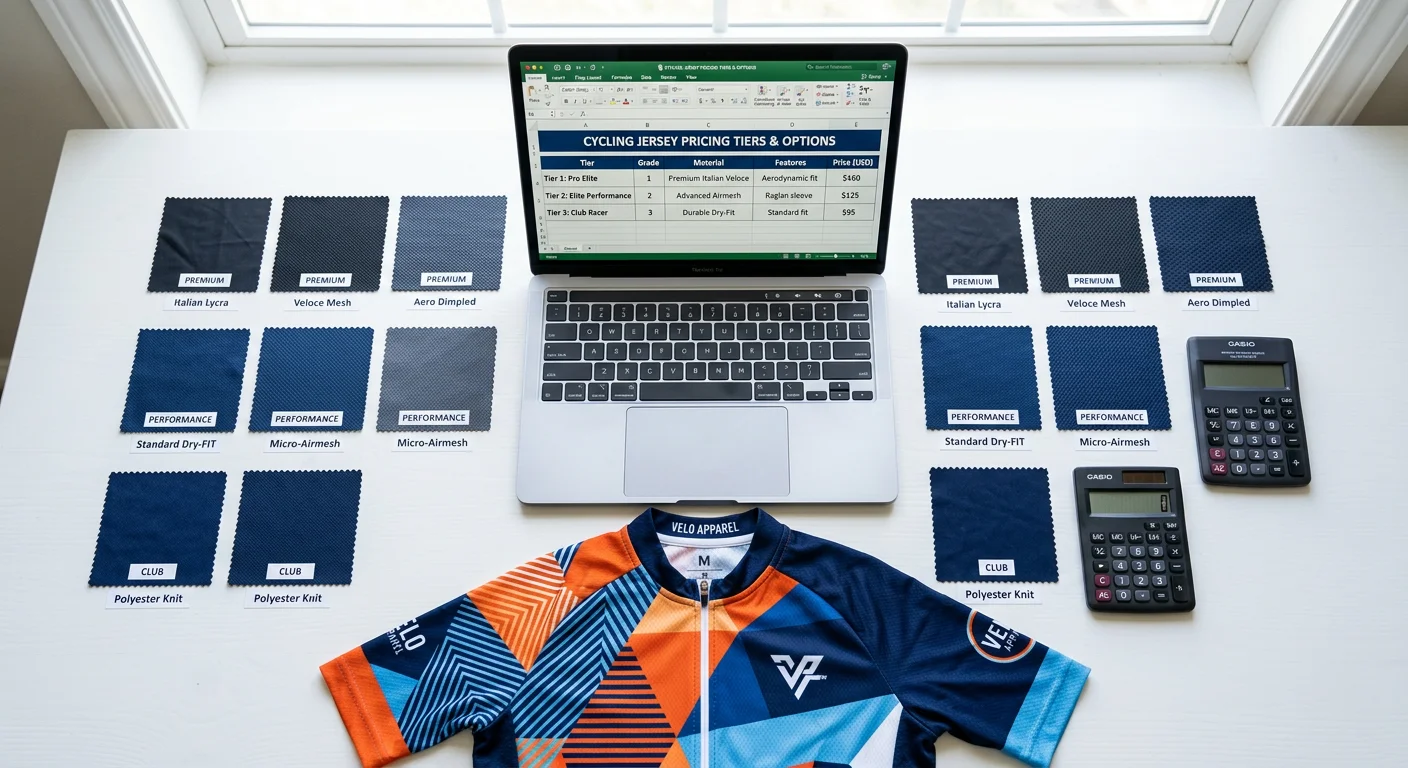
You've made the hardest decision — building a cycling apparel brand. Now you need to know how to choose a cycling apparel supplier you can trust — a custom cycling jersey manufacturer that actually delivers what the sample promised.
Here's the truth most sourcing guides skip: cycling jersey disasters don't come from choosing bad cycling jerseys factories. They come from having no clear way to tell the difference .
Sound familiar?
1.Wrong fabric hand-feel after bulk delivery
2.Sublimation prints that looked perfect on samples but faded after three washes
3.MOQs that jumped overnight with no warning
You don't need another cycling apparel supplier directory. You need a sharp, quantifiable vetting framework built around eight criteria that separate reliable custom cycling jersey factories from costly mistakes.
That's what this guide gives you — a scoring-based audit system you can run before sending a single dollar.
Fabric Composition & Print Durability Testing
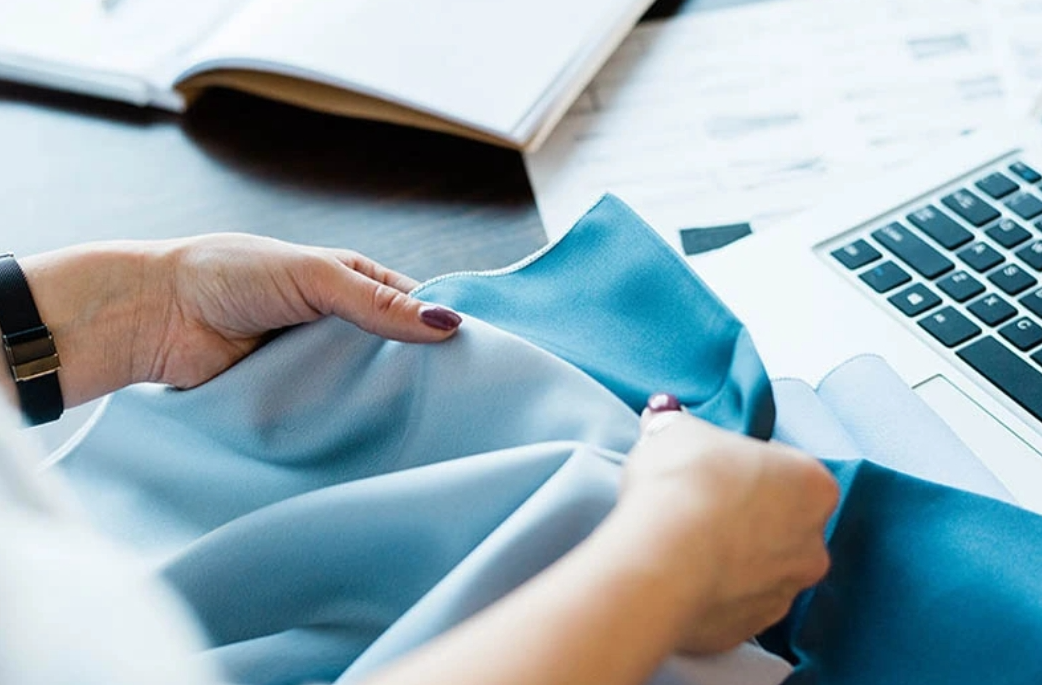
Sublimation prints that pass the sample stage and fall apart after three washes — that one failure has ended more cycling apparel brands than bad marketing ever could.
Fabric selection isn't about preference. It's a technical decision with clear pass/fail thresholds. Here's the data that matters.
Know Your Fabric Hierarchy
Not all polyester performs the same. The gap between fabric grades shows up hard in long-term wear.
100% polyester and polyester-spandex blends are the baseline — no exceptions — for serious cycling jersey production. Run the right tests, and these fabrics deliver:
Abrasion resistance : 30,000+ Martindale cycles before meaningful pilling
Shrinkage : under 3% after 50 wash cycles (premium blends hold below 2%)
Color vibrancy : 95% retention post-50 washes
Pilling score : 4–5 on the standard 1–5 scale (5 = zero change)
Stretch recovery : 20%+ elongation retention with zero permanent deformation
Cotton-poly blends drop to a pilling score of 3–4 and shrink 3–5%. Pure cotton? Shrinkage hits 5–10% in Wascator wash testing. Neither belongs in performance cycling kit.
The acetone test is your quick field check for stretch polyester: no melting, no deformation. A cycling apparel supplier who can't explain why this matters is showing you exactly how deep their technical knowledge goes.
The Print Durability Tests That Predict Real-World Performance
Here's how to read a factory's print durability claims without getting burned:
TM7 Wash Test — this is the standard that counts. Prepare 50×50cm all-over print samples. Run them through full wash-dry cycles. Then assess against the original using grey scales across five dimensions: color change, surface fiber effects, cracking, adhesion loss, and cross-staining. A colorfastness score below 4 on grey scales is a hard reject .
Ask for documentation on these tests:
Test | What It Catches | Minimum Standard |
|---|---|---|
TM7 (50-wash) | Print fading, cracking, peeling | ≥4 grey scale rating |
Martindale Abrasion | Rub resistance on stress zones | 30,000+ cycles |
Shrinkage (50-wash) | Fit distortion post-production | <3% polyester |
Tensile Strength (ASTM D5034) | Stretch fabric pull resistance | No failure at standard load |
Pilling Box/Martindale | Surface degradation | Score 4+ |
Critical red flag : sublimation cracking at elbow and shoulder zones. This tells you the factory isn't accounting for stress-point flex during print curing. That's a process control failure — not a one-off defect.
What to Request From a Factory
Don't test swatches. Test complete garment panels or full small-area designs — stress zones included.
Ask for these specific documents:
Third-party Martindale abrasion test reports (not internal QC sheets)
TM7 wash test results with grey scale photography
Fabric composition certification that matches the actual bulk material
A factory that hesitates to share test documentation before order confirmation? That hesitation is your answer.
For home validation before committing to bulk: run 50-wash cycles yourself. Do manual stretch and tensile pulls. Use the acetone test on any polyester-spandex samples. Need lab-level confidence? Equipment like DynaWash (James Heal) or TES garment testers delivers that — useful when order values justify the cost.
The factories worth your business have these numbers ready. The ones that don't are exactly why this guide exists.
runcyclingapparel.com
Public data on runcyclingapparel.com as a standalone manufacturer is thin. That alone is worth paying attention to.
Direct verification isn't always possible. So sourcing teams use a benchmark framework to fill the gap. Here's what that looks like in practice.
A credible custom cycling jersey factory should meet these standards:
MOQ : 50 pieces per style — low enough for brand launches, but enough to confirm the factory runs real production lines
Timeline : 7-day digital proof → 14-day sample → 28–42 days bulk production
Certifications : ISO 9001 (quality systems), OEKO-TEX Standard 100 (fabric safety), BSCI or Sedex (social compliance audit)
Communication : English-speaking merchandisers with a ≤2-hour response window during business hours
Payment terms : 30% deposit, 70% post-QC inspection — no credible factory asks for full payment upfront
The red flag this benchmark exposes : Some factories can't produce certification documents on request. Others quote very different lead times across separate email threads. Both tell you something real about how they operate — before your order ever starts.
Run runcyclingapparel.com — or any cycling apparel supplier you're considering — against this checklist, point by point. Factories that clear every standard without hesitation are hard to find. That's what makes them worth the effort.
Sample-to-Bulk Consistency & Prototyping Workflow
The sample looked perfect. The bulk order was a disaster. That gap — between what a factory shows you and what ships — is where cycling apparel sourcing budgets go to die.
Here's the brutal reality: most factories treat sampling as a sales exercise, not a production rehearsal. Your job is to force them to prove otherwise.
The Four-Stage Sample Ladder You Must Demand
A credible cycling jersey manufacturer doesn't just send you one sample and call it done. They run a structured progression:
Prototype sample — initial concept, confirms design intent
Fit sample — validates sizing accuracy against your tech pack
Pre-production sample — locks final specs before bulk cut
Top-of-production (TOP) sample — pulled from the live bulk run, not pre-production
That last stage is the one most buyers skip. It's also the one that catches 80% of bulk consistency failures. Demand a TOP sample before authorizing final shipment — no exceptions.
The Numbers That Define Acceptable Consistency
Vague promises mean nothing. Hold factories to measurable thresholds:
Dimensional tolerance : ±1.5cm on chest, length, and sleeve measurements
Color delta : less than 2 on Pantone TCU comparison between sample and bulk
Revision rounds : maximum 2–3 rounds capped in writing before sampling starts
A factory that won't commit to these benchmarks upfront has already answered your question. Their production control is loose.
The Red Flags That Expose Weak Prototyping Workflows
Watch for these warning signs during the sampling phase:
No version control — the factory sends updated samples with no changelog or spec comparison document. Your approved specs have no clear link to production orders. That's how bulk fabric downgrades happen with zero notice.
Unlimited free revisions — sounds generous. It's a sign the factory has no defined spec review process.
Sample and bulk fabric from different lots — ask straight out whether the sampling fabric matches the bulk roll lot. Factories with real quality control track this. Factories without it give you vague answers.
Your Verification Move
Before bulk approval, request the factory's "golden sample" archive — the final approved spec with version history and material lot records attached.
Factories using structured sample management systems — even basic internal PLM tools — can pull this together in minutes. Factories running on email threads and spreadsheets cannot.
That one document request tells you more about a factory's real production consistency than any factory tour ever will.
Production Capacity, MOQ Flexibility & Lead Time Validation
Capacity problems don't announce themselves on your first cycling jerseys supplier call. They show up six weeks later. Your bulk order is sitting half-finished because the factory batched your job with three other clients and ran out of sublimation printer slots.
This is the dimension most buyers under-audit. Here's how to fix that.
Three Gates You Must Validate Before Committing
Every cycling apparel factory assessment needs three parallel checks — all at once, not one after another.
Gate 1: MOQ Compliance & Flexibility
MOQ isn't just a minimum number. It's a signal of how a factory manages production economics.
Setup costs for a single production run average $5,000+. That's why factories set MOQ floors — they need to cover fixed costs before the first jersey ships. Knowing this shifts how you negotiate.
What separates a flexible partner from a rigid one:
- Will they offer phased delivery agreements — splitting a 500-unit order across two shipments at 250 each?
- Can they show a clear path to lower thresholds as your relationship grows?
- Do they flag pack-size violations in your requested quantity — or do they accept the order and sort it out later?
Factories with locked MOQs at 500+ units and no room to negotiate aren't rigid by policy. Their production planning is too basic to handle anything else.
Gate 2: Lead Time Feasibility Against Real Data
Standard production runs 15–30 days. Rush orders drop to 7–14 days — about 40% faster — but carry a 15–25% cost premium. Also, the freight question (air vs. sea) needs to be written into your contract before you ever need it.
Here's the number most buyers miss: total lead time includes manufacturing + shipping + customs clearance + internal processing + safety margin . Factories that quote manufacturing time alone are setting you up for a missed launch date.
Two benchmarks worth holding suppliers to:
- Negotiated MOQ flexibility cuts lead times by 15–20% — a 6-week window drops to 4 weeks once a factory stops batching your order with others
- JIT-aligned factories cut storage costs by 30% and trim another 10–20% off lead time
A factory that can't show you historical lead-time data — real on-time delivery rates across past orders — is asking you to take their word for it. That's not good enough.
Gate 3: Live Capacity Walkthrough
Ask for a real-time capacity snapshot. A credible factory can answer right away:
Production Station | What to Ask |
|---|---|
Cutting tables | Throughput per day (pcs/day), current changeover time |
Sublimation printers | Queue depth, daily output capacity, color hold-time |
Packing lines | Shift capacity, reserved appointment slots |
Current backlog | Days-to-complete vs. your required delivery window |
A factory that stumbles on these questions is running on gut feel, not production data. Your order ends up competing in the dark against everyone else's.
The Red Flags That Predict Delays
1.No subcontracting disclosure : The factory hands off your core production to unvetted third parties without telling you. This one failure causes delivery delays beyond 14 days in most cases.
2.No peak season slot reservation : For Q3–Q4 production, capacity slots need confirmation at least 60 days in advance. A factory that hasn't brought this up hasn't planned for it.
3.Vague surcharge policy : Rush order costs need to be defined in writing. Who covers air freight costs for a delay the factory caused? No answer in your contract means you already know who pays.
The factories worth your business treat capacity as a data problem, not a talking point. They have the numbers. They share them without being asked. Everything else is a negotiation you'll lose.
Sewing Standards, Seam Construction & Aerodynamic Fit Specs
A jersey can pass every fabric and print test on your checklist — and still fall apart on the road. Bad stitching from the start is all it takes.
Seam construction is where factory skill gaps turn into real pain. A bad overlock seam on a pro-fit cycling jersey doesn't just look sloppy. It creates friction points riders feel by hour two of a four-hour ride. That's the quality failure that kills repeat business and stacks up refund requests.
Here's what separates factories that understand performance stitching from those that don't.
Seam Class Is Not a Minor Technical Detail
Good factories reference ISO 4916 seam classifications without you having to ask. The classes that matter most for performance kit:
1.Class 4 Flatseam (607 stitch) — abutted edges, zero raised ridge, zero chafe risk. This is the standard for any jersey with a pro or race-cut fit profile.
2.Class 1 Superimposed seams — fine for club-fit jerseys with standard 1.5cm allowances. Not for anything marketed as aerodynamic.
A factory that defaults to overlock seams (Class 3, 501 stitch) on a race-fit jersey — without explaining why — has already told you everything about their technical depth.
The Stitch Density Benchmark That Predicts Durability
Pull-test results tell you the minimum. Stitch density tells you the margin.
Flatlock stitching must hit ≥8 stitches per cm. Drop below that threshold and you get seam pull-out under repeated stretch. The chafing risk builds up over long rides. This is an industry performance standard — not a preference.
Hold every factory to this number. A factory that can't quote their flatlock density on the spot hasn't been tracking it.
Four Hard Thresholds to Build Into Your Supplier Scorecard
Specification | Minimum Standard | Rejection Trigger |
|---|---|---|
Seam strength (ASTM pull-test) | ≥35N/cm | Any result below 30N/cm |
Flatlock stitch density | ≥8 stitches/cm | Below 6 stitches/cm |
Silicone grip hem durability | Passes 5 wash cycles intact | Detachment before cycle 3 |
Zipper hardware specification | YKK #5 or Riri only | Generic unbranded hardware |
Silicone hem failure is more common than you'd expect. Factories cut costs on bonding adhesive. Riders notice within two washes. Require documented wash-cycle testing on grip hems — at minimum 5 cycles — before approving any bulk run.
On zippers: non-negotiable. Put YKK #5 in your tech pack for aero jerseys. State it clearly. Any factory that swaps in generic hardware without telling you has shown you their cost-cutting playbook — and your product pays for it.
Aerodynamic Construction: What "Aero" Means in Production Terms
"Aero fit" is marketing language. In factory specs, it means this:
1.Flatlock or heat-sealed butt seams on all high-contact panels — shoulders, sides, chest — to cut aerodynamic drag and surface friction
2.Heat-sealed panels on race-cut jerseys where seam bulk is not acceptable (standard for pro-level kit, not optional)
3.Standard seam allowances reduced at collars and necklines to 0.6cm to remove bulk without losing strength
4.Pocket depth : 12–15cm minimum — too shallow and riders can't carry nutrition with confidence; too deep and the jersey silhouette breaks
A factory's tech team that can't map these specs to their production process isn't building aero kits. They're building regular kit and calling it aero.
Your Verification Move Before Bulk Approval
Request macro photographs of stitching from the production line — not the sample room. Focus on: inner lining finish, pocket corner alignment, and seam junctions at the shoulder and armhole.
Then run three physical checks on your pre-production sample:
1.Pull-test seam junctions by hand against a 35N/cm benchmark
2.Inspect for skipped stitches along stress zones (underarm, crotch seam, pocket openings)
3.Check raw edge exposure inside the garment — visible raw edges on a performance jersey is a workmanship failure, full stop
Factories with solid quality control can hand over stitching documentation — seam class spec sheets, stitch density logs, QC inspection photos — fast. No 48-hour wait. Chase that paperwork and you already know what their bulk production oversight looks like.
Quality Management Systems & Third-Party Certification Audits
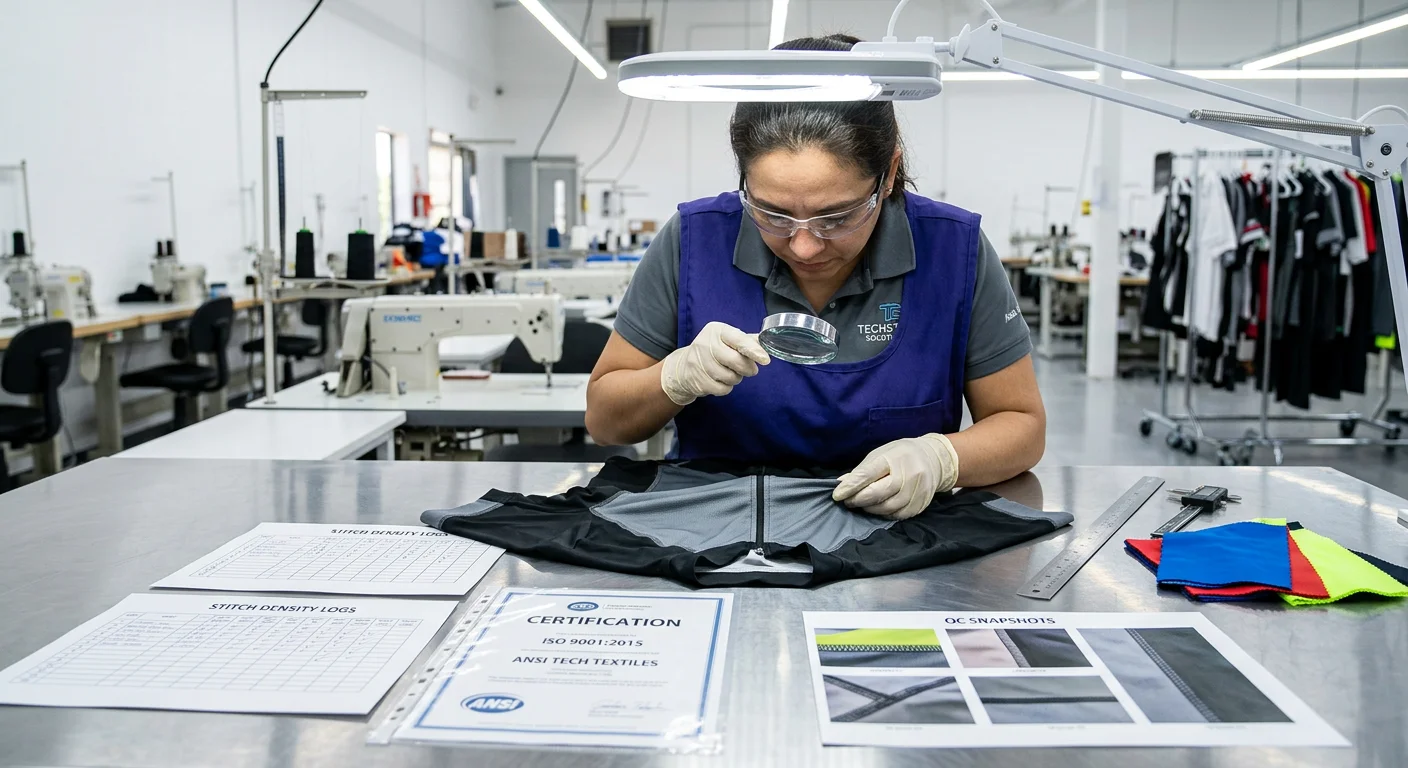
Certifications are either your strongest filter or your biggest blind spot. It all depends on whether you know how to read them.
A factory claiming ISO 9001 certification means nothing if you can't verify it. Plenty of cycling apparel suppliers flash certification logos on their websites. Those logos may have expired two years ago. Some were issued by non-accredited bodies. Others cover just part of the operation. Your job isn't to accept the certificate. It's to audit it.
The Certification Hierarchy That Matters
Three certifications form the baseline for any reliable custom cycling jerseys factory worth your business:
1.ISO 9001 — quality management system conformance, verified by independent third-party registrars
2.OEKO-TEX Standard 100 — fabric safety, confirms no harmful substances in the finished textile
3.BSCI or Sedex — social compliance audits, confirms ethical labor standards in cycling apparel production
A factory holding all three has passed external scrutiny on three separate fronts. That's a real signal. One missing? Ask why — and expect a specific answer, not a vague "in process" response.
How to Verify Certificates Without Taking Anyone's Word
Here's the step most buyers skip: cross-check every ISO 9001 certificate on iafcertsearch.org before your next supplier call. This free IAF portal shows you the issuing body, scope of certification, and expiry date in real time. A factory's certificate that doesn't appear here — or lists a non-accredited body — tells you exactly how they treat quality compliance. The answer won't be flattering.
Three documents to request right away:
1.Current ISO 9001 certificate with issuing body name and expiry date
2.Most recent surveillance audit report — annual audits are required; no report means no ongoing compliance
3.OEKO-TEX certificate with fabric lot traceability — confirming the bulk material matches what was tested
The Red Flags Inside the Paperwork
Watch for these failure patterns in cycling apparel quality control :
1.Certificate scope covers "design and sales" but excludes manufacturing — the production floor isn't audited at all
2.Last surveillance audit was over 18 months ago — annual audits are the ISO standard; a gap this size means the certification is slipping
3.No prior audit findings documented — clean audit histories don't exist in real manufacturing. A factory showing zero prior findings has either never faced a real audit or is hiding records
The hard rule : ISO 9001 certification runs on a 3-year cycle, with required annual surveillance checks in between. A factory that can't hand you dated audit reports for the current cycle isn't keeping up with compliance. They're holding an expired credential and hoping you don't notice.
Factories with solid quality systems can pull this documentation in under 24 hours. That response time tells you more than any certificate ever will.
Communication Efficiency, Language Alignment & Reference Verification

Slow replies don't just waste time. They reveal how a factory runs.
A supplier that takes 48 hours to answer a basic spec question during the sales phase — that's your preview of what happens mid-production. The factory floor doesn't get faster after you wire the deposit.
Here's the benchmark that matters: English-speaking merchandisers with a ≤2-hour response window during business hours. That's not a luxury expectation. It's the baseline for any factory handling international B2B orders at a professional level.
What "Language Alignment" Means in Practice
Fluent English isn't the same as functional English. The difference shows up in the details.
A merchandiser who writes "yes, no problem" to every spec question isn't aligned with your requirements. They're dodging conflict. Real language alignment looks different. Your technical terms come back to you in their replies — fabric weights, stitch classifications, colorway codes, tolerance thresholds — reflected with precision, not paraphrased into vague language.
Here's a simple test. Send a three-part technical question in one email. Count how many parts get a direct answer. A factory with real communication capability answers all three. A factory with surface-level English answers one and skips the rest.
Red flags to catch right away:
1.Replies that repeat your question without answering it
2.Constant switching between contact persons with no handoff notes
3.Responses that confirm specs you haven't finalized yet
Reference Verification: Check Their Track Record Before You Trust Their Word
Every factory claims experience. Few can back it up with proof.
Before committing to sampling, request three prior client references in your product category — cycling or performance sportswear, not general garment work. Reach out to those references and ask two targeted questions:
1.Did bulk production match the approved sample within stated tolerances?
2.How did the factory handle the first quality problem that came up?
The second question is the one that separates real references from staged testimonials. Every real production relationship hits friction at some point. A reference that describes a smooth, problem-free run from start to finish isn't giving you the full picture.
The 85% semantic overlap rule applies here. A factory's references should describe their experience in specific, consistent terms — timelines, MOQs, communication style, QC process. Those details should line up with what the factory claims about itself. A gap between the factory's self-description and what clients remember? That's your warning signal.
Factories worth your business welcome this process. They hand over reference contacts without hesitation. Their clients' answers hold up.
Contractual Risk Clauses, Payment Terms & After-Sales Guarantees
Every sourcing disaster has a paper trail. Most buyers don't read it — not until after the damage is done.
Your contract with a cycling jersey manufacturer isn't a formality. It's your real lever when bulk production goes wrong, shipments arrive late, or defect rates blow past what the factory agreed to verbally. Get the clauses right, and you have recourse. Get them wrong, and you're negotiating from zero.
Payment Terms: The Structure That Protects You
The industry standard exists for a reason: 30% deposit upfront, 70% after third-party QC inspection passes. That's the benchmark. Any deviation deserves a hard question.
Some factories ask for 50% or more upfront — before sampling is even done. That shifts financial risk onto you with nothing in return. Reject it. For first-time orders, use escrow or a Letter of Credit (L/C) instead of wire transfer. Both protect you if the factory doesn't deliver.
Build these clauses into every purchase agreement before you sign:
1.Late delivery penalty : ≥1.5% of order value per week of delay — written as a supplier liability clause, not a vague "we'll try our best" promise
2.Final payment retention : Hold 5% until third-party QC sign-off confirms bulk matches approved samples
3.Proforma Invoice with spec appendix attached : Tie every payment milestone to a documented production checkpoint, not a calendar date
After-Sales Terms: Define Defects Before They Happen
Vague after-sales language is how factories dodge accountability. "Defective items will be handled" means nothing without timelines and thresholds in writing.
Demand these terms in writing:
1.12-month defect liability window covering print failures, seam separation, and fabric deformation — the standard for cycling apparel quality control
2.<5% defect threshold as the trigger for replacement or refund — tracked for print mismatches and seam failures as two separate categories
3.Replacement timeline capped at 21 days from defect confirmation — no open-ended "we'll arrange it"
One clause most buyers miss: consequential damages limitation . Without it, a dispute over a delayed cycling kit can spiral into claims for lost sales or brand damage. A mutual waiver of consequential damages keeps both sides focused on fixing the actual problem — not fighting over knock-on losses.
The Red Flags Buried in Contract Language
Watch for these specific warning signs:
1."Pay-if-paid" language — the factory owes you resolution after their upstream suppliers get paid. That's their supply chain risk, now sitting on your side of the table.
2.No set-off rights for underperformance — without this clause, you can't deduct for factory-caused defects without triggering a full payment dispute
3.Subjective QC rejection criteria — a contract that says "acceptable quality" without a documented AQL level and defect percentage turns every rejection into an argument
Look at Dalkia v Celtech (2006) as a reference point. Three missed payment installments on a £15M contract counted as material breach under a "time is of the essence" clause — and that triggered immediate termination rights. The same logic works in your favor. Get termination triggers written into your contract for supplier failures: missed lead times, bulk-to-sample inconsistency, unauthorized subcontracting.
Factories with nothing to hide sign clean contracts fast. The ones with something to hide push back hardest on the exact clauses you need most.
Sourcing directly? See our OEM/ODM Cycling Apparel Manufacturing program for MOQ, lead times and private label options.
Supplier Vetting Checklist — Printable
Print this and take it into your next factory call or sample review.
Documents to request before you commit:
Business license / company registration
Third-party quality certifications (ISO 9001, BSCI, SEDEX, or equivalent)
Fabric composition and print durability test reports
Sample production and bulk production timeline in writing
Written MOQ, payment terms and after-sales/defect policy
What to check at the sample stage:
Fabric hand-feel and weight match what was quoted (not a heavier or lighter substitute)
Print/sublimation color matches your Pantone reference under daylight-balanced light
Seam construction and stitching hold up to a stretch test, not just a visual check
Sizing matches your spec sheet across the full size range you plan to order, not just one sample size
Turnaround from artwork approval to sample in hand matches what was promised in writing
Spot a red flag during vetting? See our Red Flags When Choosing a Cycling Jersey Supplier guide. Want to see our own factory credentials first? Check Our Factory Profile.
Conclusion
Failed sourcing relationships all share the same pattern. A factory looks great on paper, then falls apart under real-world pressure.
The 8 criteria in this guide exist to expose that gap before you wire a deposit.
So what separates buyers who build successful cycling apparel brands from those stuck in a loop of sampling nightmares? They don't pick factories on gut feeling. They score them with hard data.
Fabric test reports. Sublimation cycling jersey production audit trails. Stitching pull-force benchmarks. Contractual liability clauses. These aren't boxes to tick off a list. They're the tools that reveal what a factory can truly do when no one is watching.
Your next move is simple:
1.Download the supplier evaluation scorecard
2.Run your top three candidates through every dimension
3.Let the numbers make the decision
The right reliable custom cycling jerseys factory isn't the one with the prettiest catalog. It's the one that survives your audit.
That's the one qualification that matters.