Every sourcing conversation follows the same pattern. You request a quote. You get back a number that feels either suspiciously cheap or way too high. And you have no framework to judge which one it is. That's exactly what this guide fixes.
We've spent years running a cycling apparel production line. This is your cycling jersey wholesale reference. Now we're showing you what custom cycling jerseys wholesale price really looks like in 2026 — not the inflated trader markup, not the lowball bait-and-switch figure. Just the real factory floor math.
Here's what you'll get from this guide:
Tiered pricing by MOQ — so you know what to expect at each order volume
A cost-per-unit breakdown formula — run it against any supplier quote to spot red flags fast
Five hidden charges — these inflate your cycling kit wholesale invoice by 30% or more, and most buyers miss them entirely
Pull up a spreadsheet before you read on.
2026 Factory Direct Tiered Pricing Table by MOQ & Quality Grade
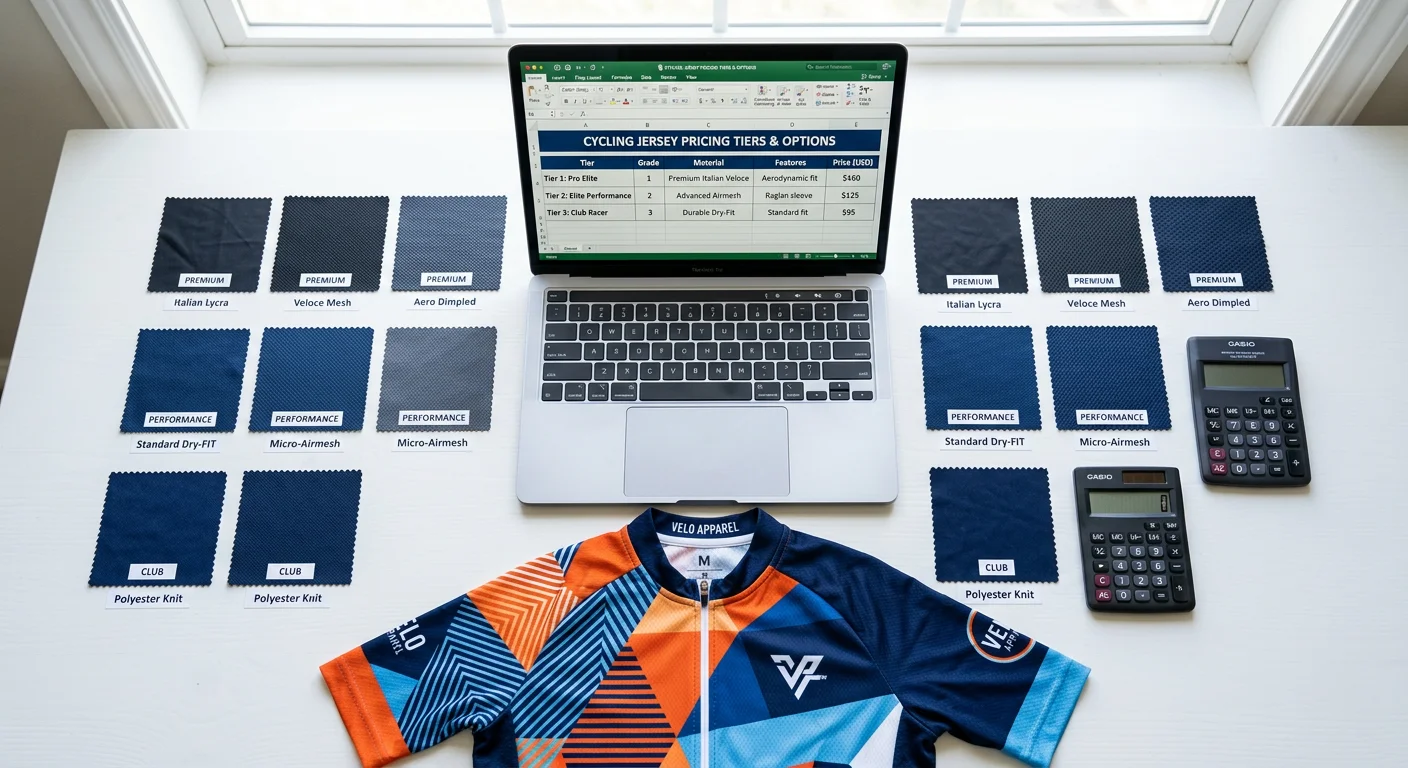
Here's the number most factory websites won't publish: a sublimated custom cycling jersey costs between $8 and $50 per unit at the factory gate. Where your order lands on that range comes down to two things: how many units you order and which quality tier you choose .
That range isn't vague. It's structural. Here's how it works.
The Three Quality Tiers (And What They Mean)
A quick note before the numbers. There are three quality grades in cycling apparel factory pricing — not five, not ten. Three. Each one serves a different buyer and a different business model.
Entry Level — Club kits, promotional giveaways, beginner teams. Basic polyester fabric, standard sublimation, YKK-equivalent zippers. Solid and functional. Not built for speed.
Mid-Range / Club Pro — The sweet spot for most wholesale buyers. You get better fabric weight, stronger moisture management, cleaner print resolution, and branded zipper options. Most team cycling jerseys bulk orders fall here.
Race / Competition Grade — Aero-cut construction, Italian or Taiwanese performance fabric, laser-cut panels, competition-spec finishing. Built for podiums. The price reflects that.
2026 Factory Direct Tiered Pricing Table
All prices: USD per unit, Ex-Works, full sublimation included, MOQ as noted.
MOQ Tier | Entry Level | Mid-Range / Club Pro | Race / Competition |
|---|---|---|---|
25 pcs | $14–16 | $22–28 | $42–50 |
50 pcs | $12–14 | $19–24 | $36–45 |
100 pcs | $10–12 | $16–21 | $30–38 |
300 pcs | $9–11 | $14–18 | $28–34 |
500 pcs | $8.50–10 | $13–16 | $26–32 |
1,000+ pcs | $8–9.50 | $11.50–15 | $24–30 |
Two things stand out here. Both affect your purchasing decision.
First , the sharpest price drop happens between 25 and 100 units. Moving from a 25-piece pilot order to a 100-piece run on a mid-range sublimation cycling jersey saves you $6–8 per unit . On 100 jerseys, that's $600–800 back in your pocket. That's not a rounding error — that's your next season's design budget.
Second , going from 300 to 1,000+ units delivers a much smaller saving: 10–15% , not the 25–35% drop you see at lower tiers. Production efficiency gains level off once a factory commits a full run to your design. That's the real ceiling of cycling clothing wholesale China pricing. Knowing this stops you from over-ordering just to chase a discount that barely moves at high volume.
Why These Numbers Move: The Volume-Efficiency Equation
Factories don't cut prices at higher MOQs without reason. Fixed costs — screen setup, color calibration, cut file preparation, sample production — spread across more units as your order grows. At 25 pieces, your share of those fixed costs can add $2.50–$4.00 to the unit price before production even starts. At 500 pieces, that same fixed cost load drops to $0.40–$0.80 per unit .
This is also why the MOQ cycling jersey order threshold matters so much when you compare supplier quotes. A factory quoting $11 at 100 pieces and $9.50 at 1,000 pieces shows healthy, real margin compression. A factory quoting $11 at 100 pieces and $10.80 at 1,000 pieces? That structure has a problem. Either their production isn't scaling, or the base quote was padded from the start.
The table above isn't wishful thinking. These are the custom cycling jerseys wholesale price benchmarks to bring into every supplier conversation in 2026 — not as a negotiating bluff, but as a reference point. Know the floor. Know the ceiling. Then work the gap in between.
Get Your Exact Quote once you know which pricing tier fits your order.
Cycling Jersey Production Cost per Unit Breakdown Formula
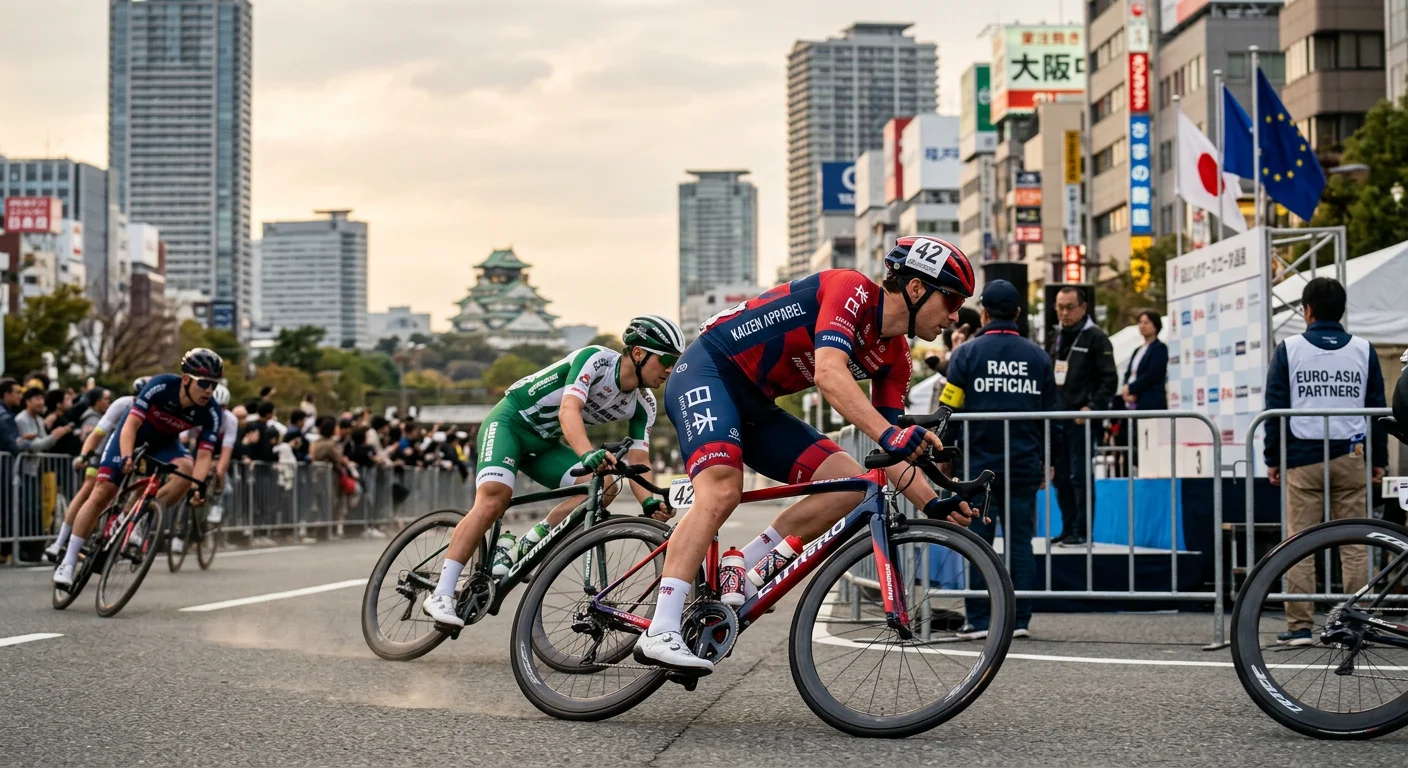
Pull apart any factory quote and you'll find the same four components inside — fabric, print, trims, and labor. Everything else is overhead and margin stacked on top. See how those pieces fit together, and a supplier's number stops being a mystery. It becomes a conversation.
Here's the formula behind every custom cycling jerseys wholesale price you'll ever receive:
Unit Cost = Fabric + Sublimation Print + Trims + Labor + Factory Margin (12–20%)
That's it. No black box. No secret algorithm. Just four input costs and a margin layer. The factory's job is to optimize each one. Your job is to know what reasonable looks like for each.
What Each Component Costs
The table below shows real component-level costs across all three quality tiers at MOQ 500+. These are the actual numbers behind the cycling apparel factory price list — not estimates, not ranges padded for comfort.
Component | Entry (~$12 total) | Mid-Range (~$25 total) | Race/Pro (~$40+ total) |
|---|---|---|---|
Fabric | $5.40 (45%) | $10.00 (40%) | $18.00 (45%) |
Sublimation Print | $3.00 (25%) | $7.50 (30%) | $14.00 (35%) |
Trims | $1.80 (15%) | $3.75 (15%) | $4.00 (10%) |
Labor | $1.80 (15%) | $3.75 (15%) | $4.00 (10%) |
Margin/Overhead | ~$0–$1.44 | ~$1–$5 | ~$2–$8 |
A few things in that table deserve your full attention.
Fabric is always your largest cost driver. Across all three tiers, it holds a 40–45% share of the unit price. Switching from standard polyester ($5–9/m²) to high-tenacity quick-dry mesh adds $3.50–$5.00 per unit — before you change anything else about the spec. For a sublimation cycling jersey at mid-range volume, that one material decision shifts your cost per unit by 15–20%.
Print cost scales with complexity, not just quantity. Full-dye sublimation across 6–12 panels is the baseline for any personalized cycling wear bulk order. Color density is where the price starts to climb. Each extra panel with high color saturation adds $0.50–$1.00 to your print cost. On a 12-panel pro jersey, that's a potential $12 difference between a clean two-color design and a photographic gradient wraparound.
Trims are small numbers with big impact. A standard zipper runs $0.80. Upgrade to an aero-silicone competition zipper and you're adding $1.20 per unit — a cost that blends into the total but shows up on the podium. Silicone leg grippers add $0.30. Reflective tape adds $0.20. None of these feel significant on their own. Together, they can shift your custom bike jersey cost per unit by $1.70–$2.50 without any change to fabric or print.
Labor follows SAM minutes, not guesswork. A standard cycling jersey runs 25–35 SAM (Standard Allowed Minutes) on the production line. At Asia CMT rates of $0.025–$0.039 per minute, that works out to $1.22–$1.46 per unit in cutting and sewing labor. Switch to laser-cut panel construction — the method most OEM cycling jersey manufacturer competition builds use — and you add 8–10 SAM minutes. Labor cost goes up by $2.10 per unit.
The Specification Upgrade Cost Map
Suppliers quote different prices for "similar" jerseys all the time. The gap almost always comes from one of these five upgrade decisions:
Fabric upgrade (poly → quick-dry mesh): +$3.50–$5.00/unit
Zipper upgrade (standard YKK → aero-silicone): +$1.20/unit
Cut method (flat pattern → 6-panel laser-cut): +$2.10/unit
Print upgrade (basic sublimation → high-density multi-color): +$2.00–$4.00/unit
Finishing additions (reflective tape + silicone gripper): +$0.50/unit
Stack all five upgrades and you've added $9.30–$12.80 per unit to an entry-level base cost. That's how a $12 jersey becomes a $25 jersey — with no one explaining why.
One more number worth keeping in mind: fabric waste. Production patterns use 3–5% more material than the finished garment. That adds $0.20–$0.50 per unit to your fabric line. Solid cycling clothing wholesale China factories include this cost in their quote up front and show it clearly. A fabric cost that looks too low is a red flag — check whether waste is accounted for. Most of the time, it's not.
Run this formula against every quote you receive. The components should add up to the total. A supplier who can't break down what's inside their number isn't just unclear on pricing — that's a supplier quality issue.
5 Hidden Cost Triggers That Inflate Custom Sportswear Wholesale Pricing Tiers
Most buyers get burned not by the price on the quote — but by the price that never appeared on it.
You've seen the tiered table. You've run the cost-per-unit formula. You think you know what a custom cycling jerseys wholesale price looks like going into 2026. Then the invoice arrives. It's 30% higher than the number you planned around. That gap isn't a mistake. It's built into the structure. Five specific cost mechanisms — each invisible until they hit your bottom line — drive most of that variance.
Here they are, named and numbered.
1. Setup Fee Amortization (What Small Orders Are Paying For)
Per-unit impact: $0.50–$1.20+ at MOQs under 50 pieces
Every production run starts with fixed one-time costs: artwork file preparation, screen setup, cut file calibration. Those costs don't disappear at low volume. They compress into fewer units. At under 50 pieces, setup fees alone can represent 8–12% of your per-unit price .
Here's a real example. One brand found their complex multi-panel pattern cut fabric yield by 15%. That one design decision triggered a 22% cost increase across the whole order. The amortized setup burden per unit jumped — and so did the final invoice.
The MOQ tier impact breaks down like this:
1–50 units: Setup fees dominate; highest per-unit premium
51–300 units: Amortization drops below $0.50/unit
300+ units: Setup cost becomes negligible per piece
What to do: Negotiate a flat setup fee as a one-time line item, not a per-unit surcharge. Better yet, batch multiple colorway or design variations into a single production run. Same setup cost, spread across more units.
2. Color Matching Premiums (The Pantone Tax Nobody Mentions)
Per-unit cost: $0.80–$1.50 extra per color match required
Full sublimation handles unlimited colors at no extra cost — it's the easier path. The trouble starts when buyers ask for strict Pantone spot-matching or high-density opaque inks. Both are common in custom cycling jersey brand identity work. Each matched color needs its own screen recalibration, ink formulation, and a separate quality control pass.
On orders under 100 pieces, this can trigger a 30%+ price jump . Not because the factory is being difficult. The labor cost on small-run color precision is just that high.
What to do: Default to sublimation for any design with more than three colors. Need spot-color precision on screen-printed elements? Cap it at two to three colors max. Negotiate the matching fee upfront as a fixed cost per color — not a percentage surcharge.
3. Small-Run Changeover Premiums (The Line Stoppage You're Paying For)
Per-unit impact: $2.50–$4.00 for orders under 100 pieces
Factories run best at continuous volume. Your small order breaks that flow. It requires machine recalibration, operator reallocation, and line-down time. The factory doesn't absorb that cost. You do. This is the changeover premium, and it's one of the most underestimated charges in cycling apparel factory pricing .
The math is straightforward. A 50-piece sublimation cycling jersey order carries the full cost of one complete line setup. A 500-piece order spreads that same setup cost across ten times the volume. At the lowest MOQ tiers, embedded changeover premiums can add 15–25% to your effective per-unit cost — and they never show up as a named line item on the quote.
What to do: Get a factory quote for both 50 and 500 pieces. Ask them to separate the changeover cost from the volume discount. Those numbers should stand apart on their own. Can't explain the gap? The quote is padded.
4. Custom Packaging Add-Ons (The $2.50 That Builds Up Fast)
Per-unit cost: $1.20–$2.50 for individual retail packaging
A standard cycling clothing wholesale China FOB quote includes: the jersey, a master carton, and nothing else. What it leaves out: branded hangtags, individual poly bags, barcode stickers, size labels, care instruction inserts, and eco-compliance tags like OEKO-TEX or GRS certification markers.
Each of those is a separate line item. Together, they add $1.20–$2.50 per unit . That sounds small. Order 500 pieces and you've added $1,250 to an invoice you thought was final.
The tier breakdown:
1.Bulk loose packing: Included in FOB price; no per-unit cost
2.Custom individual retail packaging: +$1.20–$2.50/unit
3.Eco-compliance certification tags: Additional labor surcharge per unit
What to do: On orders of 500 pieces or more, negotiate packaging into the base unit price before the quote is locked. For smaller orders, use standard hangtags and hold off on custom packaging until your volume makes the margin hit worth it.
5. Incoterm Mismatches (The 30% Variance Hidden in Three Letters)
Cost deviation: 12–22% for DDP; up to 30% total landed cost variance
This one causes the most damage — because it doesn't look like a hidden cost. It looks like a unit price.
A supplier quotes EXW (Ex Works) . You're seeing the lowest possible factory-gate number. That number excludes: inland freight to port, ocean shipping, customs clearance, import duties, port handling fees, and final-mile delivery to your warehouse. Stack all of that onto a $10 EXW quote and your real landed cost sits closer to $12.20–$13.00. That's a 22–30% gap between what you budgeted and what you pay.
The incoterm ladder works like this:
1.EXW: Lowest quote. Buyer absorbs all logistics, customs, and risk from factory gate forward.
2.FOB: Factory loads at origin port. Buyer covers ocean freight, customs, and inland delivery.
3.DDP: Factory quotes all-in to your door. Highest unit price, but zero hidden additions.
The hidden costs that turn an FOB quote into a landed reality:
Ocean freight: 3–8% of product cost
Import duties: 5–15% depending on destination country and HS code
Port handling and brokerage: 2–4%
Final-mile delivery: 1–3%
What to do: Request DDP pricing for all wholesale cycling apparel comparisons. It's the one number that lets you do a true apples-to-apples supplier evaluation. A supplier who won't quote DDP should itemize every downstream cost — freight, duties, brokerage, delivery — so you can build the landed number yourself before you commit.
The Compounding Effect: What All Five Look Like Together
None of these triggers is catastrophic on its own. Together, they are.
Take a mid-range sublimation cycling jersey quoted at $19 per unit (FOB, 50 pieces). Add complex Pantone color requirements, custom retail packaging, and no negotiated setup fee. That order can land at $26–$28 per unit once all five factors stack up. That's a 37–47% gap between the headline quote and the true cost — and it's completely predictable once you know where to look.
Run every supplier quote through these five filters before you respond. The suppliers who answer with specific line items — not vague verbal reassurances — are the ones worth taking further.
MOQ Cycling Jersey Order Negotiation Leverage & Volume Discounts
Volume discounts on custom cycling jerseys wholesale price don't work the way most buyers expect. There's no single sliding scale that rewards patience. There are three separate negotiation environments — each with its own leverage mechanics, its own pressure points, and its own version of "a good deal."
Here's how to work each one.
15–50 Units: You're Not Buying Volume. You're Buying a Relationship.
At this tier, the price moves very little on its own — maybe 0–5% off the base rate. Fighting for a volume discount here is the wrong move. The real fight is eliminating setup costs.
Ask the factory to waive digital proof fees. Offer a 50% deposit upfront — most factories will take that trade. Ask for shared production slots using stock fabrics already sitting in their warehouse. That one request can cut your per-unit cost by $1.50–$2.50 . That's a bigger win than any 4% volume discount.
The smarter play is a sample credit arrangement . Pay the premium rate ($15–20/unit) on a 5–10 piece prototype run. Then lock in a written credit toward your next 100+ piece order. You get proof-of-product at low risk. The factory gets a committed buyer on paper. Both sides win.
Timing is leverage too. Order during off-peak months — January–February or July–August. Factories in slow season will often cut their minimum by 50%. That's not generosity. That's production scheduling math working in your favor.
100–300 Units: The Price Break That Moves for Real
This is where MOQ cycling jersey order negotiations start producing real numbers. Pricing leverage at this tier runs 8–12% — enough to matter, but not enough to celebrate without a clear strategy.
A realistic pricing staircase looks like this:
1.50 units → $15/unit
2.200 units → $12/unit (20% reduction)
3.300 units → $11/unit (27% reduction from baseline)
To hit that bottom step, bring two specific requests to the table. First, ask the factory to lock raw material pricing using in-stock polyester and spandex rolls. This blocks mid-production price spikes that often inflate your final invoice. Second, push for unlimited digital proofs included in the base price. At this volume, most OEM cycling jersey manufacturer facilities will say yes — it's a fair ask.
Partial freight subsidies are on the table here too. A 10–20% factory contribution toward outbound shipping is common at 200–300 pieces. Show BSCI or ISO 9001 compliance requirements upfront. It tells the factory you're a serious, repeat-order buyer. That changes the tone of the whole conversation.
500–1,000+ Units: Lock In Everything Up Front
At this volume, pricing leverage reaches 15–25% . The cycling clothing wholesale China benchmark runs around $10/unit at 500 pieces and $8/unit at 1,000+. But the unit price isn't the biggest prize here — the structural terms you can lock in are.
Forward-contract your raw materials. Polyester and spandex prices move around. At 500+ units, you have real buying weight. Use it to ask the factory to fix material costs at today's rate for your next two production runs. That one move shields you from a 10–15% material cost spike — the kind that shows up quietly inside a "revised quote" with no warning.
Negotiate priority scheduling. Standard lead times at this tier run 4–5 weeks. Priority placement — a fair ask at 500+ units — cuts that down to 3–3.5 weeks. For seasonal buyers stocking up for race calendars, that 7–10 day gap is the difference between hitting your window and missing it.
On payment terms: the standard structure is 30% deposit with 70% paid by TT or LC before shipment. Offer a more favorable split — say 40/60 — and use it as a bargaining chip to push the unit price down another $0.30–$0.50. At 1,000 pieces, that small per-unit drop is $300–$500 in savings. That's worth one more round of negotiation.
The One Tactic That Works Across Every Tier
After a clean first order — on-time payment, no excessive revision requests, straightforward communication — ask your supplier point-blank: "What does our MOQ look like for the next run?"
Reliable buyers earn 50–60% MOQ reductions after a single successful order cycle. A supplier who started you at 1,000 pieces minimum will often confirm a repeat order at 500. That reduction won't appear in any price list. You earn it through good business behavior. And it does more for your team cycling jerseys bulk order unit economics than any headline discount ever could.
3-Step Factory Quote Verification Checklist for B2B Buyers
Three steps. Thirty minutes. That's all it takes to separate a verified factory quote from a number someone invented to see how much you'd pay.
You've done the hard work already — you know the tiered pricing benchmarks, you can run the cost-per-unit formula, you've mapped the five hidden cost triggers. Now comes the moment most buyers skip: confirming the quote in front of you reflects reality. Here's the checklist that does that.
Step 1: Deconstruct the Incoterm Before You Compare Anything
A quote means nothing until you know which Incoterm it's built on. An EXW number and a DDP number are not the same product. They're not even in the same conversation.
Start by demanding an explicit EXW line-item breakdown from every supplier. Then normalize. One factory quotes EXW, another quotes DDP? Subtract 10–18% from the DDP figure to put them on equal footing. Then look hard at what's inside the per-unit price — sample fees, testing certifications, master carton packing. These often hide inside a clean-looking total. Demand separation.
Watch for this specific flag: private-label quotes from cycling clothing wholesale China suppliers often embed $0.50–$1.00 per unit in packaging costs. That cost stays hidden until you ask. Factory-direct EXW benchmarks for custom cycling jerseys wholesale price at 500 pieces MOQ run $8–$12 per unit . The number is higher and no one can explain why? Packaging is carrying the difference.
Also, ask upfront whether the factory exports on its own or routes through a trading company. A factory that can't confirm direct export rights has a markup built into every number it gives you — before negotiations even start.
Step 2: Audit the Material Specs Against a Physical Swatch
Fabric descriptions on a quote sheet are intentions, not guarantees. The version that counts is the one you can hold in your hand and weigh.
Request certified GSM reports , exact fiber composition percentages (a standard cycling jersey fabric runs 85% polyester / 15% spandex), and dye-sublimation colorfastness test results. For sublimation cycling jersey production, target Grade 4 or higher on colorfastness. Anything below that and your jerseys fade before the season ends.
Here's the specific number to check: a physical swatch more than 15 GSM off from the quoted spec is a problem. A fiber blend that deviates more than 10% is also a problem. Either one points to a $2.00+ per unit overcharge . That gap signals a trading company mixing cheaper fiber into a spec they're selling as premium.
For cycling apparel factory pricing verification, target the 180–220 GSM range for mid-tier jerseys. A fabric claimed to be mid-range but sitting below that range? Someone substituted materials and kept the margin. Request BSCI or ISO 9001 certifications — then verify them with the auditing body, not the supplier.
Step 3: Confirm Production Capacity Is Real, Not Staged
This is the step most buyers never take. It's also the one that catches the most problems.
Ask for a real-time production floor video with a timestamp . Get active machine serial numbers visible in frame. Get in-progress batch photos from a current order. Then cross-check the registered business address against the actual factory location. A mismatch between those two data points is not a clerical error — it's a trading company passing itself off as a manufacturer.
Verified OEM cycling jersey manufacturer facilities running genuine production show consistent lead times of 3–4 weeks . Trading companies sourcing your order from a third party show 6–8 weeks and quote 20–30% higher than direct factory pricing. At 500 pieces, that markup is the difference between $9.50/unit EXW from a real factory and $12+/unit from a middleman who owns no machines.
Doing a site visit? Bring your factory evaluation form and match every photo to what you see on the floor. Check worker count — a functional cycling apparel factory runs 100+ workers . Check production lines too — 5 or more is the mark for meaningful capacity.
The Quick-Score Rule
Run all three steps and use this filter before responding to any quote:
1.Green: Incoterm confirmed, specs match swatch within tolerance, capacity verified with documentation. Move forward.
2.Yellow/Red: Incoterm vague, fabric specs deviate more than 10%, no video or proof of production. Disqualify.
Total time to run this checklist: 10–30 minutes per supplier . Buyers who skip it end up writing frustrated posts about invoices that came in 30% over budget. Buyers who run it already know what the invoice will say — because they built the number themselves.
Sourcing directly? See our OEM/ODM Cycling Apparel Manufacturing program for MOQ, lead times and private label options.
Wholesale Pricing — FAQ
Do you publish exact per-unit prices?
No — pricing depends on fabric, print method, MOQ tier and quality grade, so we quote per project rather than posting a fixed number that would mislead most buyers. Use the tiered pricing table and cost breakdown above to know what range to expect, then request a firm quote.
Where can I find MOQ details for cycling jerseys specifically?
See our Cycling Jersey MOQ Explained guide for fabric minimums and printing limits at small-batch volumes.
Ready to place an order? See our Custom Cycling Jerseys Manufacturer page.
Conclusion
You now have what most suppliers don't want you to have: the actual numbers.
Entry-tier jerseys run $8–$15. Competition-grade kits go from $28–$50. The custom cycling jerseys wholesale price range in 2026 is clear — as long as you know where the hidden costs hide. Tooling fees, small-batch surcharges, color-count penalties: these aren't accidents. Middlemen build them into every quote on purpose. That's how they protect their margins.
So what separates buyers who overpay from buyers who don't? One direct conversation with the actual factory.
Your next step is simple. Take the 3-step quote verification checklist from this guide. Use it on your next supplier inquiry. Watch how fast the inflated numbers drop.
Request a cycling kit wholesale sample quote today — with your real MOQ, your real design, and your real deadline. That's where smart procurement starts.
The factory price is out there. Now you know how to find it.
