That gap at your jersey zipper isn't a sizing quirk. It's your bust telling you the standard size chart was never built around you— especially when browsing options like custom women's cycling jerseys that promise performance but often ignore real body geometry.
For women with a fuller chest, buying a cycling jersey often means choosing between a chest that closes and a waist that fits. Getting both at once? That's the hard part.
The problem isn't your body. Most sizing guides treat bust measurement as an afterthought rather than the starting point . This guide flips that.
Start with your underbust and full bust measurements. Those are the primary numbers here. From there, you'll get a clear, brand-specific framework for converting your cup size into a jersey size that delivers — zipper flat, shoulders aligned, no riding-position surprises. All sorted before you hit checkout.
Convert Cup Size to Brand-Specific Jersey Charts with Offset Rules
Here's the uncomfortable truth about standard cycling jersey size charts: they were built on a single measurement axis. That axis isn't your bust.
Every brand has its own sizing logic — and that includes many custom women's cycling jersey manufacturers who quietly design around very different body assumptions depending on their target market.. Some anchor to chest circumference. Some use underbust as the primary driver. Some split the difference with a dual-axis system. None of them advertise this. The result is a confusing sizing landscape. A woman who measures 36D can be a Cycology S, a Rapha L, and a Jelenew M — all at the same time. All three answers are correct. It just depends on which measurement each brand prioritized when building their chart.
That's not a flaw in you. That's a flaw in how the industry communicates fit.
What follows is the framework that resolves it.
The 2026 Brand-by-Brand Bust Mapping Table
These ranges reflect 2026 sizing data. Use your full bust measurement in centimeters as the entry point. Then apply the offset rule for your cup size.
Brand | Sizing Logic | Bust Range (cm) | Cup-Based Offset Rule |
|---|---|---|---|
Jelenew | Underbust + bust dual-axis | S: 92.5–96.5 / M: 98–102 | D+ cup → size up to M regardless of underbust |
Cycology | Chest primary, fitted stretch | S: 80–85 / M: 85–90 | Stretch fabric tolerates ±2.5cm; follow chart as written |
Hincapie | Chest primary, athletic cut | M: ~91–96 | Size up if your waist falls below the brand's S/M threshold |
Rapha Women | Pro-cut, high compression | M: 90–96 / L: 96–102 | DD+ must size up one tier — the pro cut runs heavily compressed |
Performance and Select variants | M: 91–97 / L: 98–104 | Club fit runs true to chart; Pro cut requires bust-first selection |
Cup Size to Jersey Offset: The Conversion Layer
Your cup size isn't just a bra category. In cycling jersey fitting, it works as a pressure modifier . The larger the cup, the greater the chance the standard size will gap at the zipper or restrict your breathing on the bike.
Cup Size | Bust–Underbust Difference | Approx. cm Diff | Jersey Offset Rule |
|---|---|---|---|
A | 1 inch | 2.5 cm | Standard S if bust is under 92cm |
B | 2 inches | 5 cm | Size up if bust exceeds 96cm on fitted brands |
C | 3 inches | 7.6 cm | M baseline; verify Rapha's compression tolerance |
D | 4 inches | 10.2 cm | +1 size across fitted brands (Jelenew S → M) |
DD | 5 inches | 12.7 cm | Mandatory +1 on any pro-cut jersey, including Rapha L |
The rule that cuts through all of it: a bust-to-underbust difference over 10cm — D cup or fuller — means size up one tier . No exceptions for pro-cut jerseys. Skipping this step causes zipper gap, front pull, and that familiar feeling of the jersey riding up your torso the moment you drop into a riding position.
Sister Sizing: The Cross-Brand Conversion Trick
Sister sizes preserve your cup volume while adjusting the band. Use them when a jersey fits your bust but cuts into your ribcage — or the other way around.
34C sisters: 32D or 36B → use this when Cycology S is tight in the band but Hincapie M is your next logical jump
36D sisters: 34DD or 38C → Pearl Izumi M to Rapha L is the equivalent cross-brand move for DD+ riders
Universal rule: Move up one band size, drop one cup size. The volume stays the same. For fuller busts, this works out as: 32G = 34FF = 36F , all mapping to Jelenew M.
The Conflict Resolution Rule (Bust Always Wins)
Your measurements place you between two sizes — bust suggests M, waist suggests S. Default to bust. Every time.
A jersey that's a bit relaxed through the waist? Manageable. Pair it with a well-fitted chamois short or a jersey with elastic detailing at the hem. A jersey that pulls across the chest at the zipper plate is not manageable. It gaps on every climb. It restricts your breathing in an aggressive position. By mile twenty, you'll want to ditch the kit altogether.
The practical bracket breakdown:
Bust 92–96cm, C–D cup: Start with Jelenew S as your base. Size up to M if you're in firm D territory. Cycology S covers this range well thanks to its stretch tolerance.
Bust 97–102cm, DD+: Rapha L, Pearl Izumi L, Hincapie M+1. There's no flexibility here on pro-cut or compression-forward builds.
Inter-brand variance in this range runs 3–5cm . That's why Cycology S (80–85cm) and Rapha M (90–96cm) can share a size label while fitting completely differently on the same body. The label is not the measurement. Your tape is.
The 3-Minute Underbust & Full Bust Measurement Guide

Studies suggest 85% of women wear the wrong bra size . That means 85% of women feed incorrect data into every size chart they've ever trusted — which is exactly why even experienced buyers struggle to choose the right custom women's cycling jersey suppliers when fit consistency matters across orders. Before this guide can match you to the right jersey, you need two honest numbers from your own body.
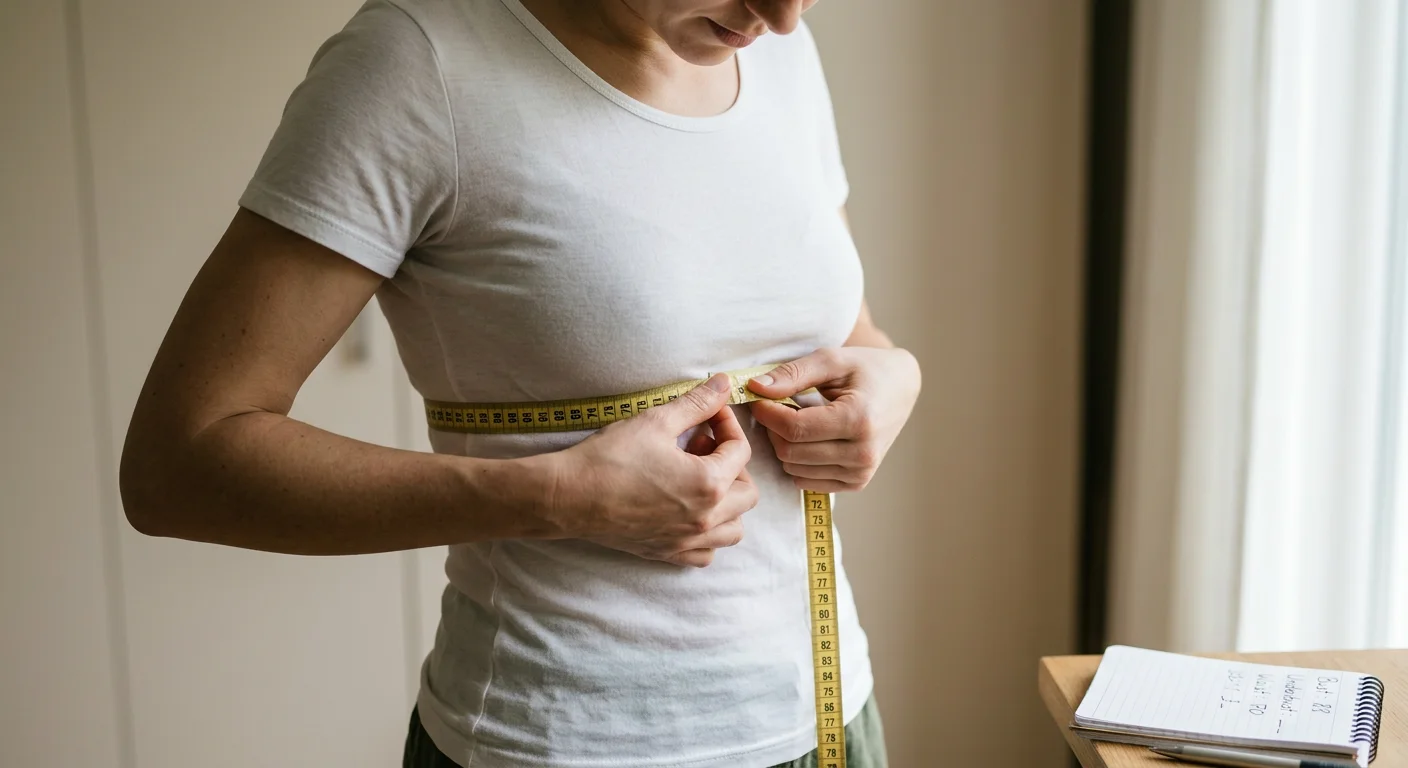
Grab a soft measuring tape. That's the one tool you need.
What You'll Need Before You Start
Tape measure: Flexible and soft — a dressmaker's tape, not a hardware store reel
What to wear: A thin, non-padded base layer or nothing at all. Skip the bra. It distorts the result
How to stand: Natural posture, arms relaxed at your sides, breathing at a normal pace. Don't pull a deep breath and hold it — that inflates your chest measurement by up to half an inch
Step 1: Measure Your Underbust
Place the tape beneath your breasts. Position it right where a bra band would sit against your ribcage. Keep it parallel to the floor and snug — not compressing, just firm.
Record that number. Then use this conversion:
Even number? Add 4 inches → your band size
Odd number? Add 5 inches → your band size
Example: Underbust 30" (even) + 4 = 34 band . Underbust 29" (odd) + 5 = 34 band .
Both paths give you the same result. Write this number down. It anchors everything that follows.
Step 2: Measure Your Full Bust
Move the tape to the fullest part of your chest , passing just below the underarm. Arms down, tape level, no digging in. You want snug contact with your body — not a squeeze.
Record this number too.
Step 3: Calculate Your Cup Size
Subtract your band size from your full bust measurement. That difference, in inches, gives you your cup size:
Difference | Cup Size |
|---|---|
1" / 7 cm | A |
2" / 8 cm | B |
3" / 9 cm | C |
4" / 10 cm | D |
5" / 11 cm | DD |
Example (inches): Full bust 35" − Band 32" = 3" = 32C
Example (metric): Full bust 90 cm − Underbust 80 cm = 10 cm = D cup
Step 4: Log Your Numbers
Write down three things:
Your underbust measurement (in cm or inches)
Your full bust measurement
Your calculated cup size
Your measurement falls between two cup sizes? Mark it as a half-size . That detail matters in the brand mapping step. It's often where the size-up offset decision gets made.
One more note: re-measure if your result varies by more than ±0.5 cm . A half-centimeter off at the tape turns into a full size off at the jersey. These two numbers are your foundation. Everything built on top of them is as reliable as the numbers themselves.
Match Fit Architecture to Cup Volume & Riding Style
Cup size doesn't just determine which jersey size you pull off the rack. It determines which type of jersey you should be reaching for in the first place.
That distinction becomes even more important when working directly with a custom women's cycling jersey factory, where fit architecture (race vs club vs relaxed) is often decided at the pattern-making stage — long before production.
Race fit, club fit, relaxed fit — these aren't just marketing categories. Each one is built around a different assumption about chest volume, compression tolerance, and how much front-panel drape your body needs. Get the fit architecture wrong, and no size-chart math will save you. You'll end up with a jersey that gaps, rides up, or locks your breathing down on a long climb.
Here's how to match your cup volume to the right fit structure before you commit to a size.
A/B Cup (Bust 78–92cm): Race Fit Is Your Natural Home
Smaller cup volumes — A and B — create minimal tissue displacement in a riding position. That's a structural advantage. Race-cut front panels were built around this range from the start.
With a bust-to-underbust difference of 1–2 inches, the chest fabric stays put under compression. It won't pull toward the zipper plate. You can follow the brand chart straight down the line. No offset adjustment, no size-up buffer needed. A high bust measurement of 78–92cm maps directly to the race fit column across most brands.
One exception to note: your full bust measurement sits near the top of the A/B range — around 92cm — check shoulder seam placement before you buy. Race cuts run narrow through the upper chest. That's not a common problem for B cups, but it can show up at the boundary.
C/D Cup (Bust 93–108cm): Club Fit or a Deliberate Race Fit Size-Up
This is the range where most sizing frustrations start. C and D cups carry a 3–4 inch bust-to-underbust difference. Standard race-cut front panels don't leave enough front drape for that projection. The seam line shifts, the zipper pulls, and the hem lifts at the back as you bend forward.
For club fit: Select your size from the high bust measurement. The ergonomic panel construction through the waist and side seams handles silhouette shaping without compressing the chest. It's the cleanest solution.
For race fit: Size up one level from your high bust chart position. D-cup riders need around 3–4cm of extra front drape to stop seam riding in an aggressive position. A quick check: add 4 inches to your full bust measurement. That number should fall within your selected size's chest range on the brand's race-cut spec sheet.
Real example: A rider with a 42" high bust and a D cup starts at a size built for a 46" full bust projection. On a race-cut jersey, that means going up one size from where the high bust alone places her. Then check that the rear hem still covers the lower back in a forward-leaning position.
DD+ Cup (Bust 109cm+): Club Fit First, Race Fit Only with Gusseted Panels
At five inches or more of bust-to-underbust difference, standard race-fit construction isn't built for your body's needs. The front panel geometry assumes a projection volume that DD+ tissue goes beyond. Once that assumption breaks down, no size adjustment makes up the difference.
Default recommendation: club fit. Size up one to two levels from the race-fit chart. Use your high bust as the base size. Then pick the DD-specific size in brands that offer it. The fit adjustment is tighter at this volume range than it would be for a B-cup base — so don't over-correct.
Race fit works under one condition: gusseted or darted front panels. A few performance brands — including select Jelenew constructions — build extra cup depth into the race-cut front panel. No gusset present means the jersey will restrict your breathing under load. The zipper also pushes forward off the sternum line.
Fit Type | Compression Level | Cup Range It's Built For | Primary Risk If Mismatched |
|---|---|---|---|
Race Fit | Highest | A / B | Zipper gap, front pull if bust exceeds chart max by 3cm+ |
Club Fit | Mid | C / D | Low risk; ergonomic taper manages bust-waist differential |
Relaxed Fit | Low | DD+ | Correct for volume; higher aero drag on performance rides |
The Fit Decision in One Rule
Your cup size tells you which fit architecture you're shopping inside. Your full bust measurement tells you which size within that architecture.
Run them in that order. Fit type first, size number second. Flip that sequence — find a size on a race-cut chart and assume the compression adjusts around your chest — and you get a 36DD in a Rapha M that fits the shoulders and nothing else.
Validate the Fit with a 5-Point Riding Posture Checklist
Size charts get you close. Your body on the bike tells you the truth.
Before you cut the tags, put the jersey on and ride — or at minimum, copy your riding posture. Hands on the hoods. Lean forward 45 degrees. Hold it there. That position is where every fit problem shows up. It's the one position that matters. A jersey can look perfect in the mirror. The moment you drop into your riding position, it gaps, rides up, and presses on your chest.
Run through these five checks in that posture. All five need to pass.
The 5-Point Check
1. Zipper Flatness
The zipper should lie flat against your sternum — no bubbling, no pulling away from the body. A visible gap wider than 1mm means the front panel is under too much tension. Your bust volume is pushing past what the jersey can hold. The fix isn't to yank the zipper harder. Go up a size, or switch from race fit to club fit.
2. Underarm Clearance
Reach one arm forward, as if grabbing the handlebar. The fabric under your arm — where the sleeve meets the side panel — should move with you. No binding. No tight, pinching feeling where the gripper meets your arm. Resistance there means the chest width is pulling the side fabric inward.
3. Back Hem Coverage
At your 45-degree lean, the rear hem should sit across your lower back. It rides up and shows skin above the saddle zone? The waist is too small. This often happens when you size up for bust first — the waist cut on some jerseys runs short at the next size. Check this before you commit.
4. Shoulder Seam Position
Find the seam at the very tip of your shoulder. It should sit right there — not drooping down your arm, not pulling toward your neck. Bust volume can pull the front panel tight and drag the shoulder seam forward and inward. That shift means your cup volume doesn't match how the jersey's panels are cut.
5. Front Chest Ease
With a slight forward bend, look at the sternum area. Zero pulling or "tenting" — no fabric lifting off the chest like a tent pole. But no loose fabric bunching up either. You're looking for the narrow window between too tight and too loose. That's where aero performance and all-day comfort meet.
Two Real Riders, Same Brand, Different Outcomes
32B, bust 81cm: Sizes into XS or S across most brands. Race fit passes all five checks — zipper flat, hem down, shoulder seam on point, zero sternum pull. No adjustment needed. This fit was built around this range.
36DD, bust 104cm: Her waist puts her in L. Her bust needs XL or XXL. In Club Fit L, the zipper check passes and the back hem sits right. In Race Fit L, the sternum pulls on the bend test and breathing feels tight on climbs. The fix isn't just a bigger size. It's a bigger size and a different fit type. Club Fit L, not Race Fit L. Both checks confirm it.
These five points aren't a formality. They're the final filter between a jersey that works on the bike and one that ends up in a return bag. Run through them in riding position — not standing at a mirror. Your posture is the size chart that doesn't lie.
Sourcing your own women's jersey line with real fit data behind it? See our Custom Cycling Jerseys Manufacturer program.
Conclusion

Your bust measurement isn't just a number. It's your most powerful tool for ending the cycle of ill-fitting jerseys, zipper gaps, and frustrating returns.
You now have everything you need:
A 3-minute measurement protocol that works
Brand-specific bust-to-jersey size offset rules that account for real-world fit variance
A framework that reads a 34DD differently than a 32B
That distinction matters. Most sizing guides skip it.
Here's what to do right now:
Grab your soft tape
Run the underbust and full bust measurement one more time
Locate your brand on the conversion chart
Use your cup volume offset before you click add to cart
Then take your new jersey through all five posture checkpoints before the tags come off.
The right cycling jersey fit isn't luck. It's a decision you make with the correct data— whether you're buying retail or working with OEM/ODM women's cycling jersey services for a more tailored solution..
Now go measure. Your next ride deserves a jersey that moves with you — not against you.
