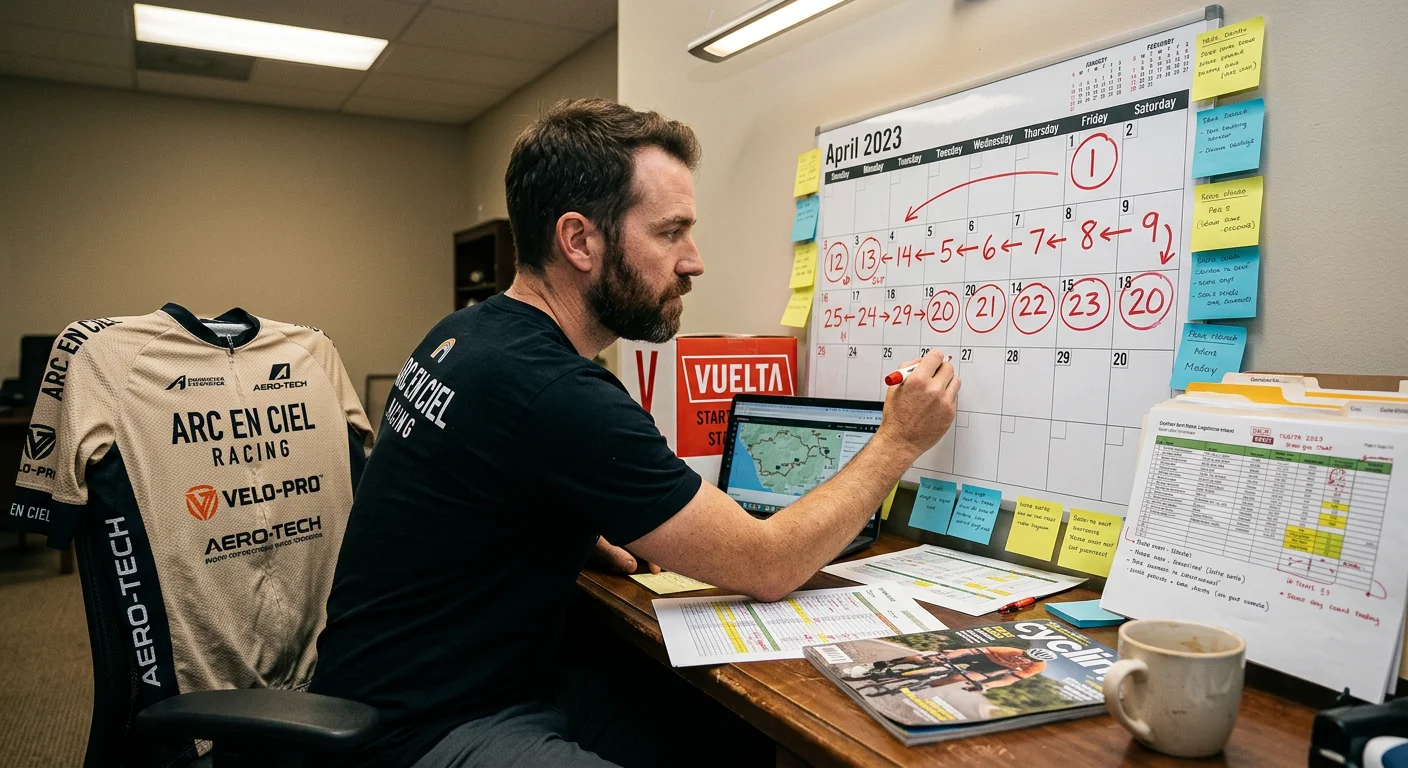
Every cycling apparel founder hits the same wall — somewhere between sketching logo ideas and getting that first cycling apparel supplier quote. The question isn't whether to build a brand. It's how to build one without burning through your budget on the wrong production model before you've sold a single kit.
Private label cycling apparel gets you moving fast. Lower minimums. Predictable costs. Custom cut-and-sew cycling clothing gives you a product nobody else can copy — but it demands more runway, more patience, and a clearer vision.
There's no single right answer for every brand. What matters is matching the model to your moment: your budget, your order volume, your long-term positioning.
The comparison ahead breaks all of it down — with real numbers, real brand paths, and a decision framework you can put to work right away.
Private Label vs Fully Custom Cycling Apparel: 5-Dimension Data Comparison
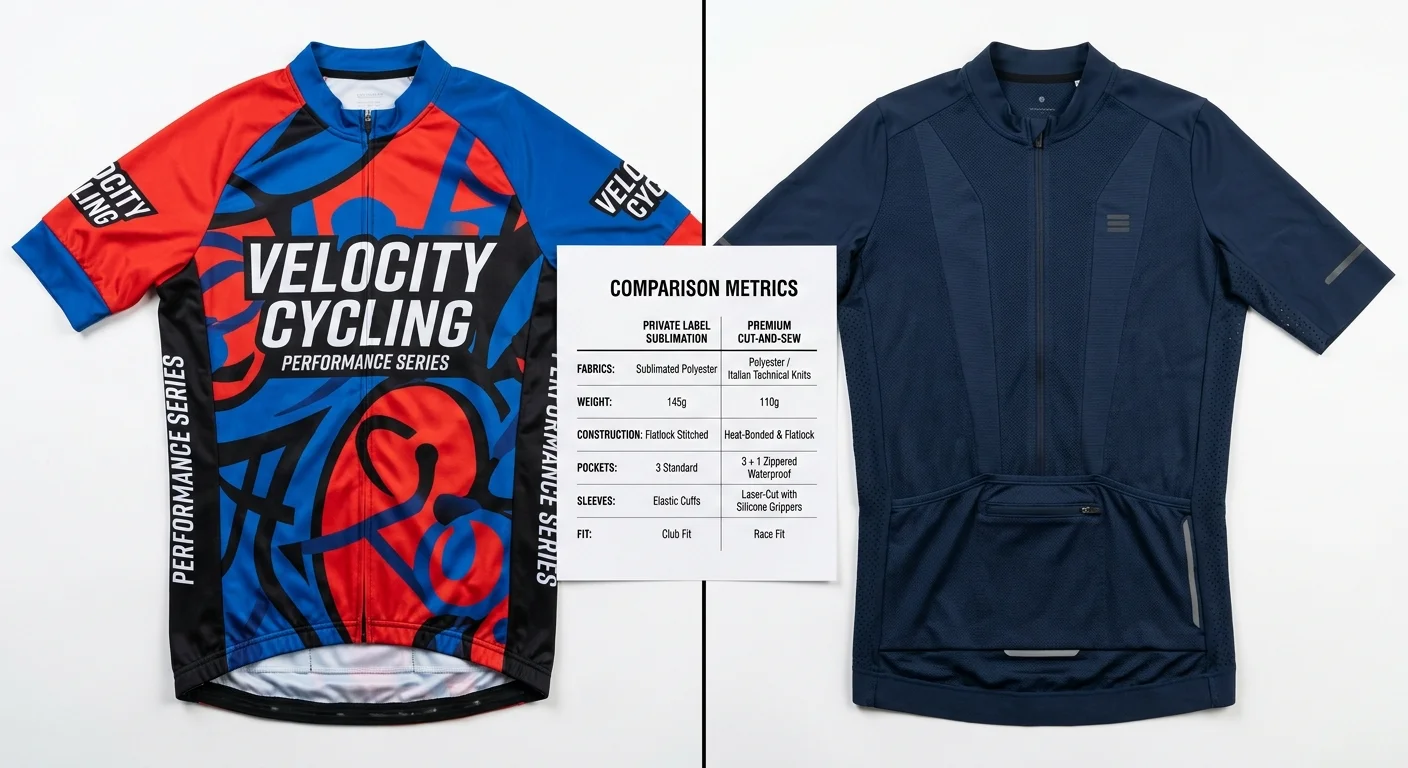
The gap between these two models is wider than most founders expect. In some areas, it's also narrower than suppliers will admit.
Here are the real numbers across five key dimensions. These are the ones that matter most as you plan your first — or next — cycling kit production.
The 5-Dimension Breakdown
Dimension | Private Label | Fully Custom |
|---|---|---|
MOQ | Low — flexible for small batches | High — minimum per style/design |
Unit Cost | Lower upfront; better margins early on | Higher investment; design + production fees |
Development Timeline | Fast — weeks, not months | Longer — multiple stages required |
Design Freedom | Moderate — modify a base garment | High — start from your own sketch |
Brand Uniqueness | Design-specific exclusivity | Unique; nobody else wears it |
What Each Number Means
MOQ: The first gate most brands hit
Private label works at lower quantities. That's why it fits cycling club buyers, startup founders, and bike shops testing a branded kit for the first time. Fully custom manufacturing needs higher minimums per style before production starts. Endura , for example, requires just 5 units per garment for custom orders — and only 1 unit for D2Z skinsuits. But Endura is a well-resourced cycling kit supplier with solid infrastructure. Many other custom cut-and-sew cycling clothing factories set their minimums much higher.
Cost: Where the hidden math lives
Private label's appeal isn't just speed — it's margin. Drop the full design-to-production costs, and emerging brands can price well and still stay profitable. Fully custom carries real fees you need to budget for upfront. Endura charges a £75 artwork fee (waived on orders over £2,000) and an $80 processing fee on orders under £1,000. Other cycling apparel suppliers charge a one-time €225 design fee per style — tops, bottoms, and accessories each counted as separate styles. These aren't deal-breakers. But they catch founders off guard, especially those who've only seen the per-unit quote.
Timeline: Weeks vs. months
Private label cycling apparel skips the design stage, the pattern stage, and the material sourcing stage. You enter at the final phase. Fully custom cycling clothing runs the full sequence — concept, sampling, technical specs, fabric sourcing, cutting, stitching, quality control. That's a much longer runway before anything ships.
Design Freedom + Brand Uniqueness: The trade-off that defines your ceiling
Private label gives you sublimation printing, custom logos, label changes, color modifications, and trim adjustments — all on a pre-existing base pattern. That's real customization. It's enough to look like your brand. But the silhouette, fit architecture, and fabric construction? Those belong to the base garment. You work within those limits.
Fully custom cycling kit design starts from your idea. The fit is yours. The trims are yours. No other brand gets the same product.
For a cycling clothing startup testing its first market, private label is a smart, low-risk entry point. For a brand that's found its customer base and wants to stand out long-term — fully custom is where real differentiation starts.
Hidden Costs & Manufacturing Pitfalls Checklist
The quote looks reasonable. The samples feel good. You're almost ready to sign — and then the real costs start showing up.
This is the part of cycling apparel sourcing that nobody puts in their pitch deck. Hidden manufacturing costs can account for 20–30% of total production expenses , according to lean manufacturing benchmarks. For a brand just finding its footing, that's not a rounding error. That's the difference between a profitable first run and a very expensive lesson.
Here's what to watch for before you commit.
The Costs That Don't Show Up in the Quote
Design and artwork fees — per style, not per order
Custom cycling kit design services charge per garment style, not per order. Tops, bottoms, and accessories each get their own line item. One supplier charges €225 per style. Another drops the artwork fee only after you hit a spending threshold. Launching a full kit — jersey, bib shorts, arm warmers — means those fees stack up fast.
Sample rounds and revision cycles
Your first sample is not your final sample. Each revision round adds time and cost. Budget for at least two to three sample rounds. This matters most on cut-and-sew cycling clothing where the fit is built from scratch.
Overseas manufacturing extras that nobody mentions
An international custom bike clothing supplier brings extra costs that eat into the savings you expected:
Quality inspection fees at the factory or port
Travel or third-party audit costs
Rework expenses when a batch fails spec
Communication delays across time zones — these slow approvals and push back timelines
Potential IP exposure and the legal fees that follow
Raw material volatility
70% of cycling apparel manufacturers report rising raw material costs as a top concern. Sublimation jersey fabrics, performance mesh, and technical bonded trims all move with global supply chains. A quote from three months ago may not match today's material pricing. Confirm current pricing before locking in an order.
Inventory carrying costs
Over-ordering to hit a minimum order quantity leaves you with unsold stock — and that stock costs money to hold. Industry benchmarks put inventory carrying costs at 20–25% of inventory value per year , factoring in storage, obsolescence, and tied-up capital.
Poor quality control — the silent budget drain
Rework costs in low-QC production can reach 5–10% of total revenue . Defective cycling wear hurts more than your margins. It triggers returns, damages customer trust, and forces reorders that throw off your entire launch schedule.
The Pitfall Checklist: Before You Sign Anything
Have you confirmed the MOQ per colorway , not just per style?
Is the quoted price locked, or subject to material cost adjustments?
What's the rework policy if a production batch fails quality inspection?
Are artwork, processing, and design fees included — or billed as separate items?
What's the supplier's documented lead time during peak season?
Who owns the pattern files if you switch suppliers later?
Is there a clear IP protection clause in the manufacturing agreement?
Have you budgeted for at least two sample rounds in your timeline?
That last question about pattern ownership catches a lot of cycling clothing founders off guard. Your technical patterns sitting on a cycling apparel supplier's server with no transfer clause means one thing: switching cycling apparel manufacturers sends you back to square one, at full cost.
The brands that scale well are not the ones who found the cheapest cycling apparel supplier. They're the ones who read the fine print before the first deposit cleared.
Brand Lifecycle Alignment: Startup, Growth & Mature Stage
Most cycling apparel brands don't fail because they chose the wrong fabric. They fail because they chose the wrong production model at the wrong moment.
Your brand's position in its lifecycle is the clearest signal of which path works — private label or custom. Get that match right, and everything else gets easier.
Startup Stage: Move Before You're Ready
You have a logo, a target customer, and maybe $5,000 to $15,000 to work with. What you don't have is proof. No proof your customer will buy. No proof your sizing works. No proof your market is as big as you think.
This is where private label cycling apparel earns its place. Lower MOQs let you test without overcommitting. Sublimation printing gives you a branded product that looks credible on day one. No pattern development, no material sourcing, no endless sample rework. You get to market in weeks, not months.
The goal at this stage isn't differentiation. It's data . Sell enough to learn. Learn enough to scale.
Growth Stage: Start Building What's Yours
Revenue is coming in. You know your customer. You're reordering — and you're starting to notice other brands carry the same base silhouette you do.
That's the inflection point. Brands growing at 50–100% year-over-year are ready to invest in a stronger identity. Start introducing custom cut-and-sew cycling clothing on hero SKUs — your bestselling jersey, your signature bib. Keep private label for the rest of the range. Your custom pieces build the look your brand becomes known for.
Budget reality: this stage needs $10,000–$20,000+ to cover design fees, sampling rounds, and higher per-unit costs — without stalling cash flow.
Mature Stage: Own Every Detail
Stable revenue. Loyal customers. A management team that runs the day-to-day. At this stage, a custom cycling kit isn't a luxury — it's a competitive requirement.
Premium positioning demands a product nobody else can wear. Proprietary fits, exclusive fabrics, signature trims — these are what separate a brand from a reseller. Brands that stay on private label too long end up competing on price instead of identity. That's a fight with no good ending.
The stage-by-stage summary:
Brand Stage | Recommended Model | Budget Signal | Priority |
|---|---|---|---|
Startup | Private Label | Under $15K | Speed + validation |
Growth | Hybrid approach | $10K–$20K | Identity building |
Mature | Fully Custom | $20K+ | Differentiation + loyalty |
Match the model to the moment. That's the whole framework.
3-Step Decision Framework: Budget, Order Volume & Positioning
Three numbers tell you almost everything about which production model fits your brand right now: how much you can spend, how many units you can move, and where you want to sit in the market. Work through each one with clear eyes. The answer gets simple fast.
Step 1: Know Your Real Budget — Not Your Optimistic One
Strip out the logo design fees, the website, the marketing spend you're already planning. What's left for production? That number is your actual budget.
Under $5,000: Private label cycling apparel is your lane. Full stop. At this budget, fully custom cut-and-sew cycling clothing isn't just risky — it's near impossible to execute well. Design fees alone can run €225 per garment style. Add two sample rounds, and you've spent half your budget before a single jersey ships. Private label gets you a credible, branded product on the market. Your cash stays intact.
$5,000–$20,000: This is the hybrid zone. You have enough to launch with private label cycling jerseys and put focused investment into one or two custom pieces. Think of it as your hero SKU — the jersey your brand becomes known for. Keep the rest of the range in white label until that custom piece proves itself.
$20,000 and above: Fully custom cycling kit design becomes a real, workable option. You can absorb the development timeline, the sampling rounds, and the higher per-unit cost without stalling the business. This is where branded cycling wear production starts to build a real competitive edge.
Step 2: Be Honest About Your Order Volume
Minimum order quantities in cycling apparel manufacturing aren't just supplier preferences. They reflect how sublimation printing and cut-and-sew production work at a basic level.
Ordering under 50 units per style? Private label is almost always the smarter path. Custom bike clothing suppliers need higher minimums per colorway, per style, before a production run makes sense. Going custom at low volumes means paying premium pricing to cover a small run. That collapses your margins before you've built any real customer base.
Ordering 100 units or more per style? Fully custom cycling clothing starts to make financial sense. Development costs spread across a larger run. The per-unit math begins to work in your favor.
Step 3: Define Where You're Positioning — And Commit to It
Price point and market positioning are the final filter. A cycling apparel brand targeting club-level buyers who care about value needs fast, affordable production first. A brand going after the premium performance or lifestyle market — where customers compare you to Rapha or Pas Normal Studios — needs a product that can stand in that conversation with confidence.
Private label cycling apparel can look sharp. It cannot feel proprietary. Your target customer might be the kind of rider who notices fit architecture, fabric hand-feel, and silhouette details. Those riders will notice. Fully custom is where that level of brand difference lives.
Quick-reference summary:
Budget | Order Volume | Positioning | Recommended Path |
|---|---|---|---|
Under $5K | Under 50 units/style | Value or club market | Private Label |
$5K–$20K | 50–100 units/style | Mid-market or growing brand | Hybrid approach |
Over $20K | 100+ units/style | Premium or performance | Fully Custom |
Run through all three steps before you approach a single cycling apparel supplier. Brands that get into trouble aren't the ones who chose wrong. They're the ones who skipped this framework and let a supplier's pitch make the decision for them.
Real-World Brand Paths: Scaling Production Models
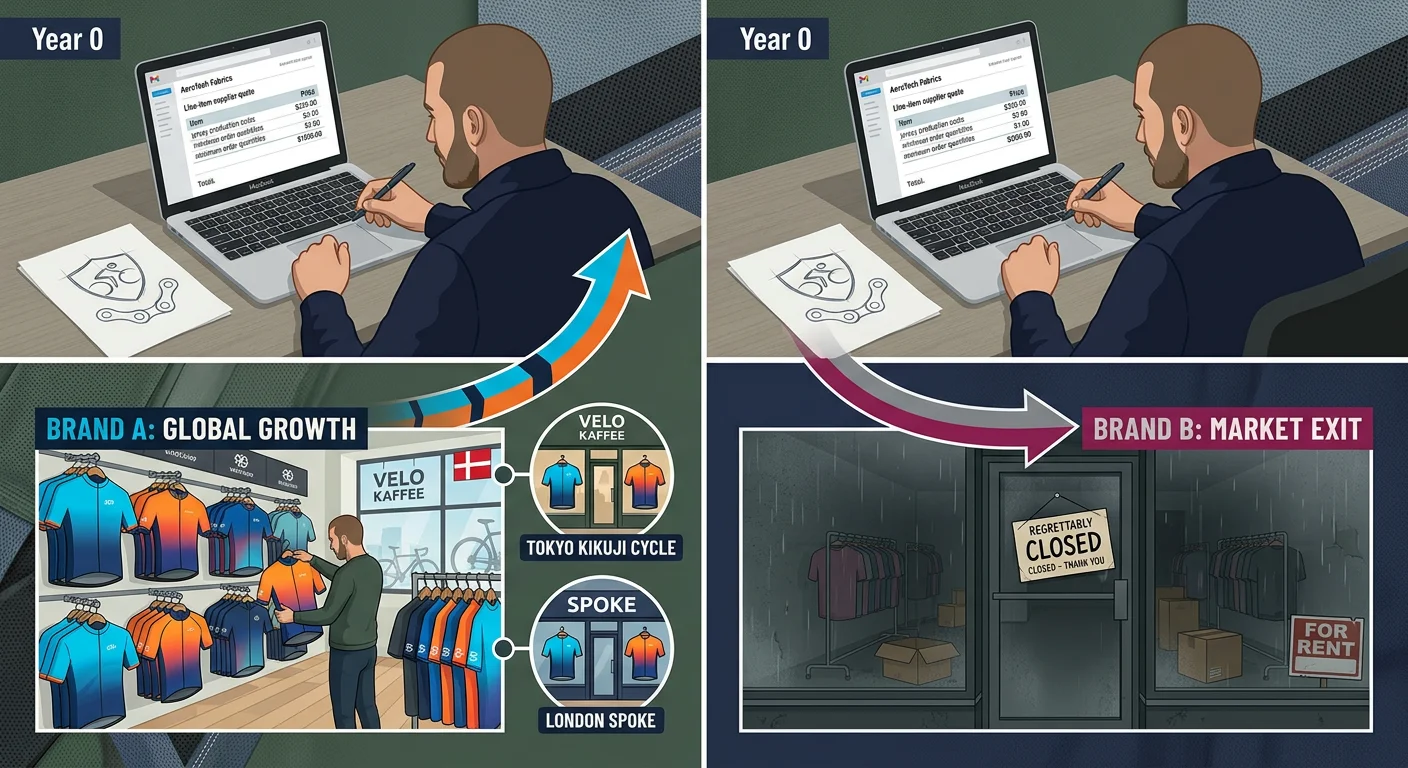
Two brands. Same starting point — a passion for cycling, a logo, and a supplier's quote open on a laptop screen. Five years later, one sits in independent bike shops across three countries. The other folded after its second season.
The difference wasn't product. It was sequencing.
Path One: The Private Label Start That Built Into Something Real
Picture a small cycling club kit brand. It starts with 30 members who want matching jerseys and one volunteer with a spreadsheet handling the order.
That's not a glamorous origin story. But it's a real one.
Starting with private label cycling apparel gave this founder a clear advantage. The first order was under 50 units. That's low enough to test the sublimation printing quality and sell through before committing to a second run. No design fees. No sampling cycles. No pattern development. A solid branded product was in riders' hands within six weeks.
By year two, reorders were steady enough to invest further. The brand introduced one custom-cut cycling jersey — a single hero SKU built from scratch with a custom bike clothing supplier. The rest of the range stayed in white label. That one jersey became the visual anchor the brand was known for. It looked different because it was different.
By year four, private label had done its job. The brand had revenue history, customer data, and order volumes to justify shifting the full range to cut-and-sew cycling clothing . The brand now owned its patterns outright. No supplier had leverage over the production files.
The key detail: this wasn't a leap. It was a series of small, deliberate steps — each one funded by what came before it.
Path Two: Starting Custom When the Brand Already Had a Market
Not every brand needs to start at the bottom of the ladder.
One founder brought ten years in the performance apparel industry to the table. She had a pre-built audience of serious riders who'd pay for a premium product. Going straight to custom cycling kit design made sense. The budget was there. The market was proven. Private label would have felt like a step backward.
So the lesson here isn't that one path is better. It's that skipping ahead works only when the runway actually exists. Going straight to custom without the audience, the capital, and the order volume — that's where brands run into serious trouble.
Match the model to the moment. The brands that scale aren't the boldest ones. They're the most honest ones.
Sourcing directly? See our OEM/ODM Cycling Apparel Manufacturing program for MOQ, lead times and private label options.
Conclusion
This decision isn't about jerseys or price sheets. It's about what kind of brand you're building — and how honest you are about where you stand right now .
Private label gets you moving. Custom gets you remembered. The smartest founders know which one they need this year — not the year they're dreaming about.
Budget under $5K? MOQ flexibility tight? Start with white label cycling jerseys. Protect your cash. Find out what your customers love before you pour money into a custom cycling apparel manufacturing process . Then, once the data is there and the demand is real, make the leap.
Here's the truth no one tells you at the starting line: the brands that last aren't the ones who went custom first. They're the ones who made smart decisions first.
Your next step? Get three cycling kit supplier quotes this week — and bring a list of questions from this guide.