Finding a reliable custom cycling jerseys manufacturer in the USA shouldn't feel like a blind gamble. Yet for most cycling club managers, event organizers, and apparel startups, that's what it becomes. One wrong supplier choice means missed race-day deadlines, washed-out sublimation prints, and jerseys that fit like trash bags.
I've put in the hours researching, comparing, and vetting domestic manufacturers so you don't have to. What follows isn't a generic directory dump. It's a data-driven breakdown of the top 10 US-based cycling apparel suppliers . Each one gets evaluated across:
Minimum order quantities
Pricing
Fabric technology
Turnaround times
Real buyer feedback
Outfitting a 10-person club or launching a performance cycling brand? Either way, you'll leave knowing which manufacturer deserves your budget.
Primal Wear

Denver-based and family-owned since 1992, Primal Wear has built over three decades of trust in custom cycling apparel across the USA. The numbers speak for themselves.
Founded by Dave Edwards, this 40-person team pulls in $5.7 million in annual revenue. They keep hands-on quality control in-house — something you won't get from a mass-production overseas vendor. Worth knowing: women make up over 55% of employees and hold 5 of 6 senior management seats. That's not a diversity talking point. It shapes how they engineer women-specific cuts that fit real bodies.
What makes Primal Wear stand out:
Women-first design : They acquired Team Estrogen (founded 1998) and Doyenne to offer women-specific kits up to 2XL. Most suppliers skip this size range entirely.
Performance construction : Close-to-body fit with moisture-wicking fabric built for real-ride conditions — not just appearance.
Custom design portal : Teams and clubs can build personalized kits at primalwear.com/collections/custom-core. The process is straightforward and self-guided.
Community credibility : Over $6M contributed since 2012 to groups like the National MS Society, People For Bikes, and Children's Hospital Colorado.
Best for : Cycling clubs, collegiate teams, amateur racers, and women's cycling groups who put fit quality and domestic accountability ahead of the lowest possible price.
Contact : (303) 745-8442 | primalwear.com
Runcyclingapparel.com

Fifty pieces minimum. That's the entry point at runcyclingapparel.com. For most cycling clubs or emerging apparel brands, that number lands in a good place — not too small to take seriously, not too large to risk.
This supplier focuses on performance first. Their kits use Italian-sourced poly-elastane fabrics rated 200–250gsm . Serious riders know that weight range well. It's the difference between a jersey that performs and one that just looks good. Add UV50+ protection , anti-odor treatment, and reinforced stitching, and you get construction that holds up through a full race season — not just race day.
Key specs at a glance:
MOQ : 50 pieces per order, scalable to 1,000+
Price range : $45–$65 per unit (wholesale, mid-grade kits)
Lead time : 20–30 days production
Print method : Dye-sublimation with consistent color matching on reorders
Fabric tech : High-GSM Italian poly-elastane, UV50+, anti-odor
Color consistency on reorders is a real selling point here. Clubs that add new members each year need fresh kits to match previous seasons. Color drift makes that a problem. runcyclingapparel.com handles this well — reorder colors stay on target.
Best for : Cycling apparel wholesalers, growing cycling clubs, and team managers who need durable sublimation cycling jerseys at stable unit costs without giving up fabric quality.
Contact : runcyclingapparel.com
Borah Teamwear
30 years of outfitting American athletes — that's not luck. That's a proven system.
Chris Jackson founded Borah Teamwear in 1996 in Coon Valley, Wisconsin. The brand built its reputation on one principle most suppliers still struggle with: small teams deserve the same quality as large ones. They adopted digital dye sublimation early on. That move made it possible — unlimited colors, low minimum orders, and no cutting corners on construction.
The operation runs lean. Around 35 employees turn out 10,000 garments per month. Every piece is Wisconsin-made. In 2026, the business moved to a 20,000+ sq ft facility in La Crosse under ORC Industries' Redfeather Outdoors. Manufacturing stayed local. Capacity grew.
Key specs:
MOQ : Small-team friendly (10–25 units estimated)
Price range : $60–$100/piece base, volume discounts at 50+ units
Lead time : 3–4 weeks standard
Print method : Digital dye sublimation — unlimited colors, consistent reorders
Warranty : Lifetime
Customer reviews back this up: "Delivered on every promised timeline with brilliant designs, quality fabrics, excellent construction." That kind of feedback shows up again and again.
Best for : Grassroots cycling clubs, collegiate teams, charity ride organizers, and Nordic/triathlon crossover programs. You get small batch cycling jersey production with no trade-off on domestic quality.
Contact : borahteamwear.com | 1-800-354-2825
Pactimo
Wind tunnel data doesn't lie. Pactimo's Flyte Suit beat every competitor tested — and that's the stock version, with no custom fit adjustments. For Colorado-based Pactimo, results like that are nothing new.
They've been running out of Denver since 2003. Today, Pactimo is a $21.7M company with 78 employees. Three straight years on the INC 5000 fastest-growing list. Top 50 Colorado Company in 2011. These numbers aren't just for show — they prove a reliable cycling Jerseys manufacturer that grows without cutting corners.
Key specs:
MOQ : 5 pieces — the lowest on this entire list
Price range : $75–$120 per unit (premium tier)
Lead time : 5-week guaranteed delivery
Team stores : Free setup, no fees (see teamstore.pactimo.com)
Fabric tech : 37.5® active cooling, recycled Summit Collection materials, Force chamois for long-distance comfort
The Summit Collection is worth a closer look. It uses recycled fabrics combined with 37.5® temperature control technology. Heat and moisture leave the body during effort — not after. You stay dry and comfortable while you're working hard, not just when you slow down. Their winter kits also cover 0–40°F conditions with no drop in performance.
Best for : Elite amateurs, competitive road and gravel riders, boutique clubs, and coaches running performance cycling programs. Great fit for teams that need aerodynamic custom cycling team kits at a premium build level — with the lowest possible MOQ to get started.
Contact : pactimo.com | (303) 790-7807
Flo Bikewear
Bentonville, Arkansas isn't just mountain bike country — it's grown into a real hub for cycling culture. Flo Bikewear set up shop there on purpose. That location shapes how they think about riders and what they need.
Their approach is simple: performance-level custom kits at a fair price. You get lightweight breathable mesh fabric, moisture management, quick-dry construction, raglan sleeves, and a low-profile collar. The build quality works for trail riders and road commuters alike — people who put real miles on their gear, not just race-day riders.
What stands out:
1.3D online design tool : Build your full kit — jerseys, bibs, accessories — right on their website. You see a live visual preview as you design.
2.Massive template library : The design process moves faster. This is a big help for clubs that don't have a graphic designer on hand.
3.Fabric performance : Lightweight mesh built for consistent trail use. This isn't one-season wear — it holds up over time.
Estimated specs (based on USA custom cycling jersey industry benchmarks):
1.MOQ : 10–25 units
2.Price range : $50–$80/unit retail; group promos around $40–$60
3.Lead time : 2–4 weeks domestic
Best for : Mountain bike clubs, local cycling communities, and budget-conscious teams who want personalized cycling uniforms with a smooth design process and no inflated price tag.
Contact : flobikewear.com
Evo9x
Most cycling apparel suppliers stick to one sport. Evo9x took a different path — and you can see it in everything they've built.
Based in Edison, New Jersey, Evo9x has spent over a decade making custom sublimated cycling uniforms . They cover baseball, basketball, football, lacrosse, wrestling, and esports. That cross-sport background builds real technical range. They know what performance fabric needs to do. They've tested it across multiple disciplines — not just cycling.
Their print options go beyond what most shops offer: full-dye sublimation, semi-sublimation, tackle twill, embroidery, and screen printing. All of it happens under one roof. So your cycling club can order coordinating warm-up gear or branded accessories in a different print style — without going to a second vendor.
Key specs:
1.MOQ : Flexible; team store setup available — contact for custom arrangements
2.Price range : $50–$90/unit depending on print complexity
3.Lead time : 3–5 weeks post-design approval
4.Made in USA : Edison, NJ facility, Mon–Fri pickup available
5.Best for : Multi-sport organizations and cycling clubs that need dye sublimation cycling wear as part of a larger team uniform program.
6.Contact : evo9x.com | [email protected] | 1-844-GO-EVO9X
Owayo USA
European engineering meets American fulfillment — that's Owayo in a nutshell.
Owayo runs its US hub out of Reno, Nevada. The brand brings a precision-driven, European design approach to domestic custom cycling jersey production . Its reputation rests on one thing: a 100% online design configurator. You get full control over every kit detail before spending a single dollar.
What makes Owayo worth considering:
1.Sample-first approach : You can request physical samples before placing a team order. Check the fit, sizing, and fabric feel in person. Most suppliers skip this step. Owayo makes it part of the process.
2.High-end construction : eKomi reviews point to quality, accurate fit, and responsive service as top-rated categories. These are the details that matter most on race day — no room for surprises there.
3.Online configurator : The tool is clean, easy to use, and built for endurance sports like cycling. Design your personalized cycling uniform on your own — no designer needed.
Estimated specs (based on comparable US custom cycling apparel providers):
1.MOQ : 10+ units for team orders; single-unit options available from ~$80/piece
2.Price range : $50–$90/unit at 50+ pieces
3.Lead time : 3–4 weeks typical for US-based fulfillment
4.Best for : Teams and clubs that want high-end performance cycling apparel with no guesswork. The sample service alone sets Owayo apart. Fit precision is non-negotiable — Owayo treats it that way.
Contact : owayo.com/us | Reno, NV 89511
Goal Sportswear
Not every manufacturer on this list is based in the United States — and Goal Sportswear is the clearest example of that.
Goal Sportswear is based in Shenzhen, China. They run as a dedicated sublimation sportswear OEM with over a decade of production experience. They ship to North America, Western Europe, Oceania, and Southeast Asia. That global reach means they know how to handle customs, shipping logistics, and cross-timezone communication — things that catch less experienced overseas vendors off guard.
Their custom cycling jersey production is part of a much wider catalog. You'll also find hockey, wrestling, lacrosse, rugby, compression wear, and track suits. That range across multiple categories points to real manufacturing depth — not a one-sport shop running on tight margins.
What we know:
- Specialization : Full-dye sublimation printing across team sportswear categories
- Market served : Schools, clubs, corporate teams, international buyers
- Contact : [email protected] | goaluniform.com
What's missing : MOQs, exact pricing, lead times, and verified customer reviews are not listed on their site. You'll need to reach out and request a direct quote.
Best for : Budget-focused buyers who are comfortable with overseas sourcing and want sublimation cycling jersey printing at scale — without needing a domestic manufacturing guarantee.
Badger Sport
Let's be straight about Badger Sport: they don't make dedicated cycling jerseys.
Badger Sport is a general athletic apparel brand. Their catalog covers tees, shorts, and hoodies. The core of their lineup is the B-Core line — 100% polyester moisture-management fabric at 3.5 oz./yd². It's built for general sports use. You get antimicrobial treatment, tag-free labels, double-needle hems, and sport-paneled shoulders. Solid, standard construction.
But cycling-specific kits? Aerodynamic panel cuts? Race-grade chamois? That's outside their range.
Where Badger stands out is customization accessibility . Their teamwear line works with partners like 4imprint and Badger Teamwear for branded bulk orders. You get a wide size range up to 4XL. Bulk pricing runs through distributors like SSActivewear and BlankStyle — no major friction in the ordering process.
Best for : Multi-sport organizations that need branded training tees or warm-up gear alongside their cycling kits. Not the right pick for teams focused on performance cycling fabric or sublimation cycling jersey printing .
Contact : badgerteamwear.com | momentecbrands.com
Alleson Athletic
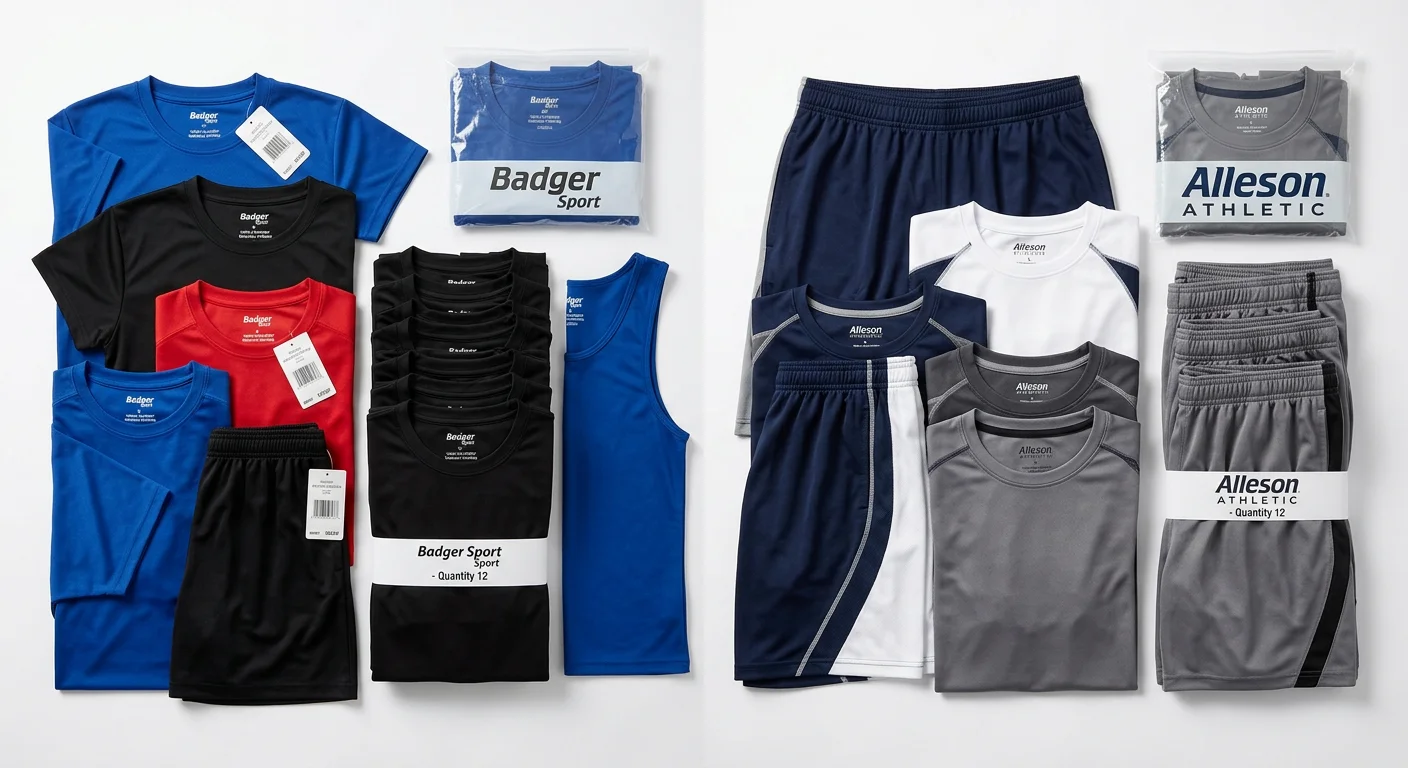
Alleson Athletic belongs in the same conversation as Badger Sport — and for the same reason.
This is a wholesale athletic apparel supplier. Their catalog goes deep on track shorts, jerseys, and tanks built for youth and adult sports programs. The B-Core line is their core product: 100% polyester, moisture-wicking, antimicrobial, and odor-resistant. Construction sits in the 3.5–3.8 oz/yd² range. That keeps things light and comfortable through full practice sessions and competition days.
But the honest truth: none of this is cycling-specific .
No aerodynamic panel cuts. No race chamois. No dye sublimation jersey printing. No performance fabric built for long road output.
What Alleson does well:
1.Blank wholesale apparel at low price points — B-Core tanks start at $12.10/unit
2.Wide sizing up to 3XL across most SKUs
3.Stock lead times of 7–14 days through distributors like BlankStyle and S&S Activewear
Best for: Multi-sport programs buying branded training gear in bulk. Your cycling club needs warm-up tanks or practice tops on a tight budget? Alleson covers that. You get quick turnaround, low unit costs, and solid sizing options. For actual custom cycling jerseys , look at other suppliers.
Contact : blankstyle.com | ssactivewear.com | momentecbrands.com
5-Step Team Kit Procurement Framework
Most team managers spend three weeks on a decision that should take three days. Here's the system that fixes that.
I've sourced kits across many squad sizes and budgets. That experience compressed the whole selection process into five steps. Run through them in order. You'll have a shortlist — and a signed order — by the end of the weekend.
Step 1: Lock Your True Budget (Not Just the Per-Jersey Price)
The jersey price is a starting point, not the finish line. Your real landed cost includes:
1.Design setup fees : 5–10% of total order value
2.International freight : 8–12% for overseas cycling apparel suppliers
3.EU VAT : ~20% average if importing into Europe
4.Customs duties : 2–5% depending on country of origin
A $65 jersey from an Asian cycling apparel OEM factory can land closer to $85–$90 after all those costs stack up. Run that math before you contact a single cycling jerseys supplier.
Benchmark target : Strong procurement teams hit 10–15% year-over-year cost savings by doing this calculation upfront — not after they've already committed.
Step 2: Match Your Headcount to MOQ Thresholds
This is where most small clubs get stuck. Standard minimum order quantity cycling jerseys from structured suppliers like Santini-tier factories run 25–100 units. That's a hard wall for a 15-rider amateur squad.
Before you commit to a manufacturer, verify:
1.Their hard MOQ vs. your actual headcount
2.Whether they hold your design template for future reorders
3.If they offer scalable reorder windows — aim for 10–20% above your base quantity to cover late additions
Practical rule: Buffer your order by 10–20% extra units. Riders join mid-season. Kit gets damaged. Replacements happen. Suppliers like JAKROO and Flo Bikewear remove this problem with no-minimum policies — a real advantage for teams under 25 riders.
Step 3: Test Fabric Before You Commit to a Full Run
Don't approve a custom cycling jerseys order based on a spec sheet alone. Ask for physical swatches first.
What you're evaluating:
Fabric composition : 80/20 poly-elastane is the baseline. Look for 4-way stretch with 200–300% recovery
UV protection : UPF 50+ is non-negotiable for multi-hour rides
Stitch density : 12–15 stitches per inch signals durable construction
Compression zoning : Check shoulder and waist panels — these are the first areas to fail under heavy training load
Industry reality: 80% of amateur teams skip this step. That's why they end up reordering after one season. A swatch request costs you nothing. A failed bulk order costs you everything.
Step 4: Mandate Digital Proof + Physical Samples Before Production
Never approve sublimation cycling jerseys from a screen mockup alone.
Use this two-stage verification process to protect your order:
3D digital mockup — confirms color placement, logo sizing, and panel layout before any ink touches fabric
2–3 physical samples — test stretch recovery (target 90%+ retention after five washes) and color fastness against AATCC 61 standards
Sample cost runs $50–$150 per unit. That's the cheapest insurance policy in cycling team kit design . About 70% of professional procurement projects use structured timelines — Gantt or RACI — at this stage. That same process discipline applies to team kit sourcing.
Color accuracy gaps are real. Even manufacturers with strong 3D tools show variance between digital approval and physical output. Always request a pre-production strike-off on your exact fabric before approving the full run.
Step 5: Structure the Bulk Order — Then Set Up for Reorders
Samples approved? Lock the order with clear structure:
Deposit terms : Standard is 50% upfront, 50% before shipping — get this in writing
Delivery KPIs : Contract for 95%+ on-time delivery rate. Build in penalty clauses for delays beyond 5 business days
Portal access : Suppliers like Pactimo offer B2B portals that store your team's design templates long-term — so you can reorder without hitting normal MOQ thresholds
Loyalty pricing : Negotiate 10–15% discounts on seasonal reorder runs before you sign the initial contract
Teams that set up supplier portals from day one cut their reorder friction fast. A single jersey replacement mid-season becomes a two-click process — not a week of back-and-forth emails.
Final benchmark : Structured cycling clothing wholesale contracts with documented KPIs deliver 12–20% average cost savings over ad hoc ordering. That gap adds up fast across multiple seasons of kit procurement.
Tiered Manufacturer Recommendations by Team Size & Budget
Squad size and budget cut 80% of your shortlist right away. Use this tier breakdown to find the manufacturers that fit your situation.
Tier 1 — Small Clubs & Grassroots Teams (10–20 Riders, Under $65/Jersey)
Budget is tight. Headcount is low. You need zero-minimum flexibility and fast turnaround. A factory built for pro squads ordering 500 units won't work here.
Best fits: JAKROO, Flo Bikewear
JAKROO starts at $35–$65/jersey with no rigid MOQ. The 3D self-design platform handles the back-and-forth for you. No emails, no delays.
Flo Bikewear has no minimum at all . Order 8 jerseys if that's your full roster. At $50–$80/unit with zero setup fees, it's built for small community teams from the ground up.
Tier 2 — Competitive Amateur Teams (20–40 Riders, $65–$110/Jersey)
You need consistent sizing across a mixed order. Reliable domestic support matters too. So does kit that holds up through a full racing season without fading.
Best fits: Pactimo, Borah Teamwear, Cuore
Pactimo's B2B portal collects bulk sizing across 20+ riders without spreadsheet chaos. MOQ sits at 15–30 jerseys , with pricing at $55–$110 .
Borah offers a lifetime warranty and 3–4 week domestic production. That's a solid pick for US clubs that put accountability ahead of cutting costs.
Tier 3 — Sponsored & Performance Squads (40+ Riders, $110–$180/Jersey)
Brand visibility matters. Race-grade aerodynamics matter. You're buying Italian or Belgian engineering, and the credibility needs to match.
Best fits: Giordana, Castelli, BioRacer
Giordana delivers hand-assembled Italian kit from €90–€160/jersey. Sizing stays consistent across collections. No refitting chaos before race day.
BioRacer uses wind-tunnel-validated construction at $80–$150/jersey. Their Team DSM partnership backs that up. MOQ starts at 20+ units — built for serious squads, not casual clubs.
Real-World Ordering SOP & Common Pitfalls Checklist
30% of custom cycling apparel kit orders run into problems. Every single one of those problems was avoidable. Here's the five-phase process that stops them before they start.
Phase-by-Phase Ordering SOP
Phase 1 — Inquiry & Specification
Know your discipline type (road/MTB/gravel), exact rider count, and gender breakdown before you contact any supplier. Get a sizing matrix for your riders' specific discipline before making any bulk commitment. Also, ask for a full spec sheet — fabric weight in GSM, sleeve length options, and inseam ranges. Don't skip this step.
Phase 2 — Quote & Proof Review
Ask for an itemized quote. Unit cost, MOQ, and lead time should all be listed separately. Check the digital proof for artwork placement and color accuracy. Then require a physical Pantone swatch match before any sublimation run starts. Digital screens push blues and reds too bright. What looks right on your monitor can land 15% off-brand on actual fabric.
Phase 3 — Sample & Durability Testing
Put physical samples through real stress testing:
- Minimum five wash cycles at 40°C
- Stretch recovery checks
- Seam integrity inspection
Specify high-heat stabilized dyes (140°C cure minimum) and double-needle flatlock stitching on all seams. Cheap thermal transfers crack by wash three. Put this spec language in your contract — it's what prevents that.
Phase 4 — Financial & Production
Standard deposit structure: 50% upfront, 50% pre-shipment. Set up a weekly production update schedule. Add a QC checkpoint too — random sampling of at least 2% of your total order before it ships.
Phase 5 — Delivery & Activation
Sort customs clearance early for offshore orders. Activate your team portal with documented sizing. Keep a 30-day post-delivery window open for fit issues.
The 5 Pitfalls That Kill Custom Kit Orders
Pitfall 1 — Fit Matrix Skipped
Club-fit vs. race-fit mismatches drive a 30% higher return and exchange rate . Fix it with one action: require fit photos across S, M, L, and XL body types before production sign-off. Set clear tolerance ranges — chest ±2cm, sleeve ±1.5cm. Include a one free exchange clause per rider within 30 days.
Pitfall 2 — Color Matching Skipped
Require Pantone swatch matching plus a lab dip printed on actual jersey fabric — not paper. Set your tolerance at ΔE ≤ 2 , which is the industry standard. Variance above that? Your contract should force a supplier reprint at zero cost to you.
Pitfall 3 — Hidden Landed Costs
Offshore quotes leave out customs clearance costs. A lot. The real landed cost runs 8–12% higher than the quoted price. Request a full itemized breakdown every time:
- FOB unit price
- Freight
- Insurance
- Customs duty of cycling jerseys (HS code 6115.10 carries a 16.5% US tariff)
- Brokerage fees ($150–$300 per shipment)
Go with CIF or DDP incoterms — they push logistics risk back onto the supplier.
Pitfall 4 — No Vector File Retention Clause
Skip this clause and you're looking at six-week redesign delays next season. Add a 12-month minimum digital asset retention clause to your initial contract. Require editable files in Adobe Illustrator (.ai format). Get written confirmation of the backup protocol. Also, request file handoff 30 days before contract expiry.
Pitfall 5 — Durability Not Tested
Set a minimum fabric composition: 85% polyester / 15% spandex. Run every sample through five wash cycles at 40°C plus five low-heat tumble dry cycles. Check for:
- Transfer cracking
- Seam separation
- Color fading against your Pantone reference
- Fabric pilling
Require a supplier warranty: no visible transfer degradation after 20 wash cycles.
Pre-Production Sign-Off Checklist
Checkpoint | Pass Criteria | Evidence Required |
|---|---|---|
Sizing matrix approved | Fit tested on 3+ body types | Fit photos + measurements |
Pantone swatch matched | ΔE ≤ 2 on lab dip | Physical swatch + photo |
Landed cost confirmed | All duties and fees itemized | Full invoice breakdown |
Vector files secured | 12-month retention clause signed | Contract addendum |
Durability tested | No cracking after 5 wash cycles | Test report + photos |
QC sample approved | 2% random sample inspected | QC inspection report |
Get every row to green before you release final payment. Miss one, and you're stuck fixing a problem that never should have existed.
Sourcing directly? See our OEM/ODM Cycling Apparel Manufacturing program for MOQ, lead times and private label options.
Conclusion
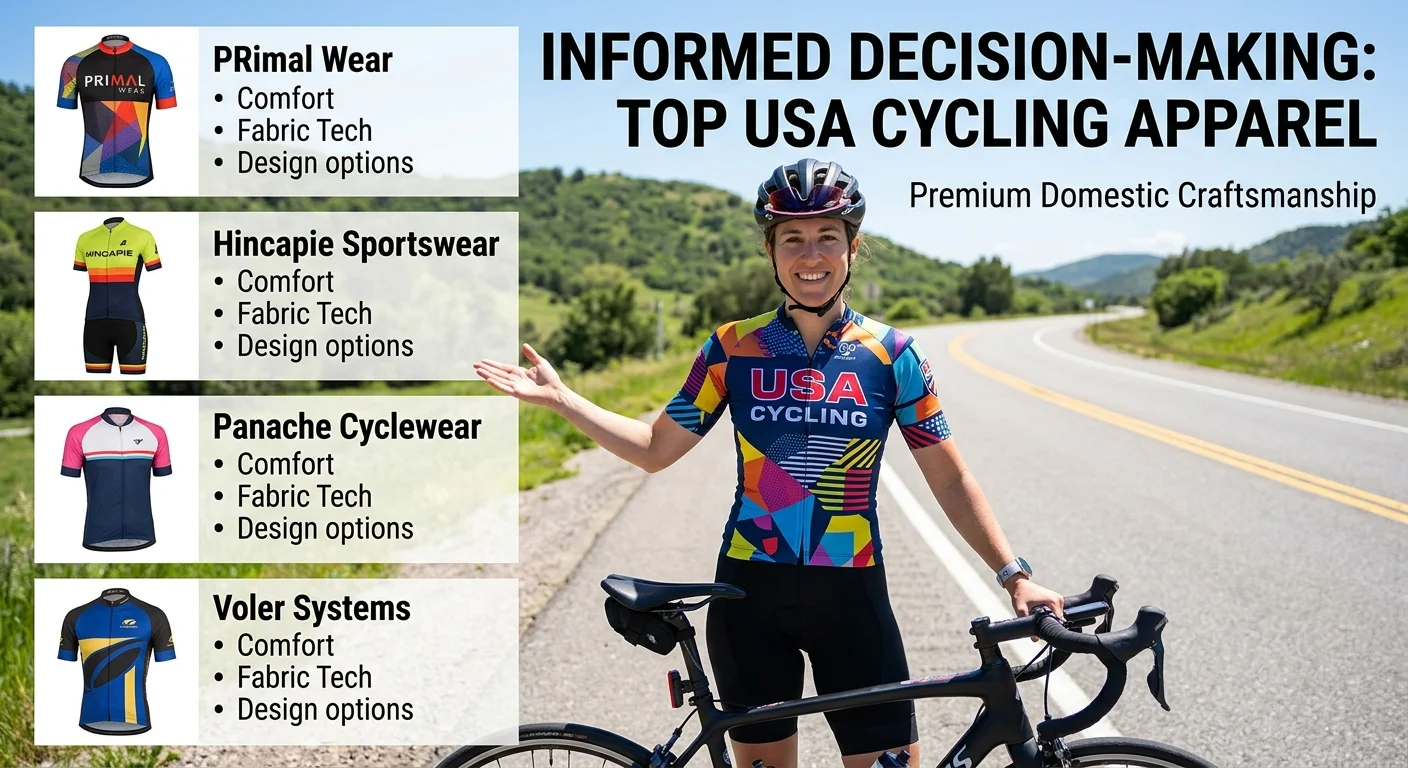
You've just done what most cycling teams spend weeks trying to figure out.
Sublimation precision, MOQ flexibility, and domestic turnaround times — these three factors decide everything. Get the manufacturer wrong, and that first order turns into a disaster. Get it right, and the whole process runs smooth.
Here's what the data shows:
1.Club or race organizer? Speed and quality matter most. Pactimo or Borah Teamwear deliver on both.
2.Small-batch production? runcyclingapparel.com or Evo9x handle low minimums well and the results will impress you.
3.Building a brand from scratch? Primal Wear's OEM infrastructure is built for that specific path.
The right cycling jerseys manufacturers are out there. The production capability exists here in the USA — no overseas delays, no import risk.
Your next step is straightforward:
Pick two manufacturers from your decision matrix
Request samples this week
Compare them side by side before you commit to bulk production
The best custom cycling jerseys manufacturer in the USA for your team isn't the most popular name. It's the one that matches your specs, timeline, and budget — nothing more, nothing less.
Now go get measured.
