Choosing between OEM cycling jerseys and ODM production can make or break your cycling apparel brand's profitability and timeline. Get it wrong, and you're stuck with bloated costs, limited design freedom, or shipments that miss the racing season entirely.
Most brand owners jump into production without understanding how these two models differ. One gives you full creative control but demands more upfront investment. The other moves faster and costs less, but the trade-off is your brand's uniqueness.
This breakdown covers how OEM and ODM compare on cost structure, design control, and production timelines. You'll know which model fits your brand's stage, budget, and speed-to-market goals.
Cost
Numbers tell the real story here. Before you commit to either model, run the math on what you're paying per unit—that's where OEM cycling jerseys and ODM production diverge the most.
Breaking Down the Cost Per Unit
Start with the basic formula: total production cost divided by total units produced. Say your monthly production cost hits $500K and you're making 100K units. That's $5 per unit. Simple on paper, but the components stacking up behind that number shift depending on which model you choose.
OEM cycling jersey production means you're covering:
Materials (fabric grade, moisture-wicking treatments, zippers)
Labor (cutting, sewing, quality checks)
Equipment and tooling (custom molds, dye sublimation setup)
Setup and scrap costs
Secondary operations (embroidery, heat transfers)
Packaging, overhead, and logistics
Risk margin built into the quote
ODM production removes several of these line items because you're buying into an existing design and production system. Less customization means fewer setup costs and no tooling fees for custom molds.
What Drives Your Cost
Commodity prices swing your numbers more than most brand owners realize. Fabric grade, minimum order quantities, certifications you need (OEKO-TEX, bluesign), and yield rates all factor in. A factory running at 95%+ yield efficiency wastes almost nothing. Drop below 75% efficiency, and you're eating a 20%+ cost premium from labor waste alone.
Machine hours matter too. So do inspection counts, cycle time, and how much of the process runs automated versus manual. OEM cycling jerseys with custom cuts or unusual colorways slow down cycle time—which drives cost up.
Benchmarking Your Quote Against the Market
Don't accept the first quote you get. Use a proper benchmarking workflow:
Identify every direct cost (materials, labor, tooling)
Allocate indirect costs (overhead, admin)
Calculate total cost per unit
Add your target profit margin to set the selling price
For overhead, use this range as your compass:
World-class: 80–120% of direct cost
Good: 120–180%
Average: 180–250%
Poor: above 250%
If your OEM cycling jersey manufacturer's overhead lands above 250%, you're overpaying.
To sanity-check pricing, compare your quote against 5–8 direct competitors manufacturing similar cycling jerseys, plus 2–3 adjacent alternatives (athletic apparel factories that also handle cycling gear). Normalize everything to cost per jersey at a fixed spec, and test the numbers across 2–3 realistic order scenarios (small batch, mid-volume, bulk).
The ODM Cost Advantage
ODM production usually wins on raw cost per unit because you're sharing tooling and design costs across multiple brands ordering the same base template. You skip the setup fees tied to custom OEM cycling jerseys, and minimum order quantities tend to be lower.
The trade-off: you're locked into existing designs with minimal customization.
If your margins depend on hitting a specific cost-per-unit target, run the benchmarking math before signing with either model. A $2 difference per unit sounds small until you're ordering 50,000 jerseys.
Design Control
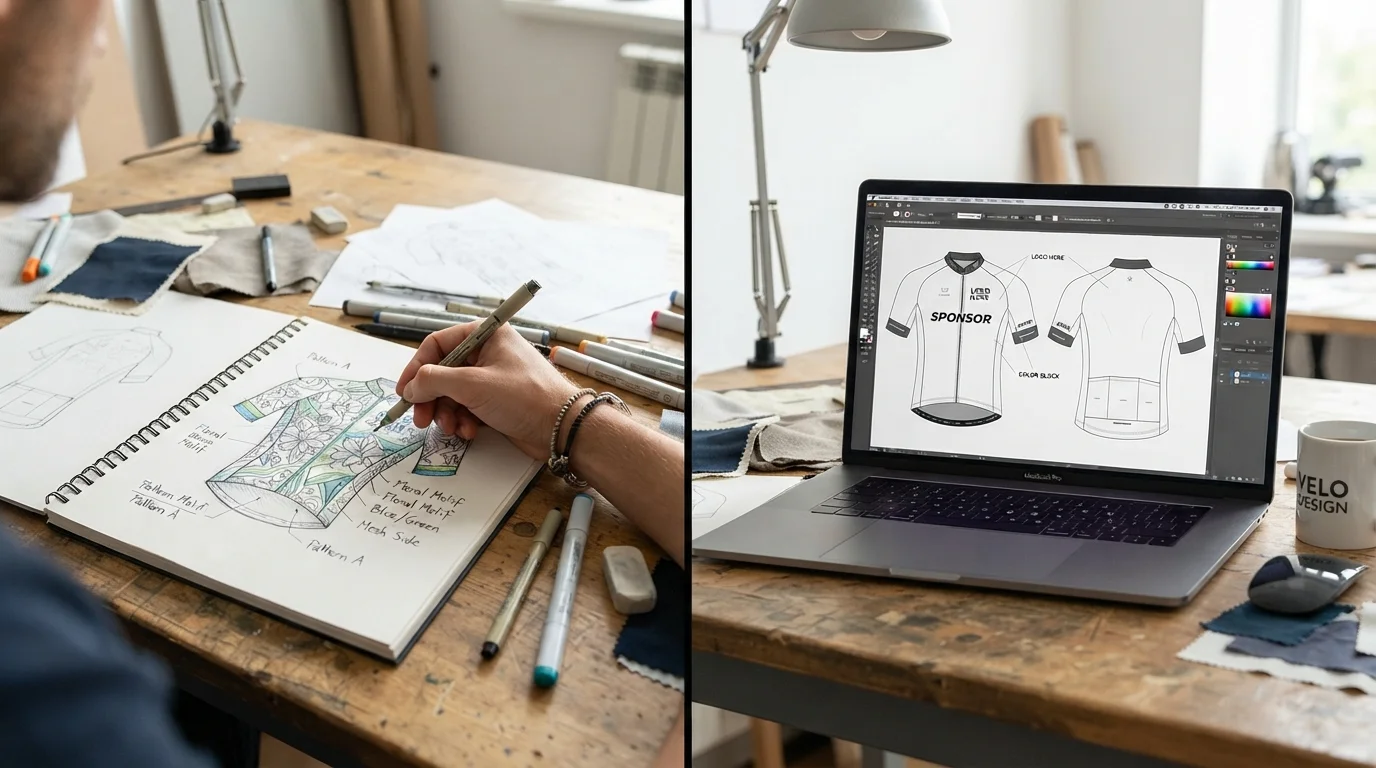
The thing that separates OEM cycling jerseys from ODM production more than anything else is who owns the design file. With OEM, you get the pen. With ODM, you get a template with a few blanks to fill in.
What OEM Gives You
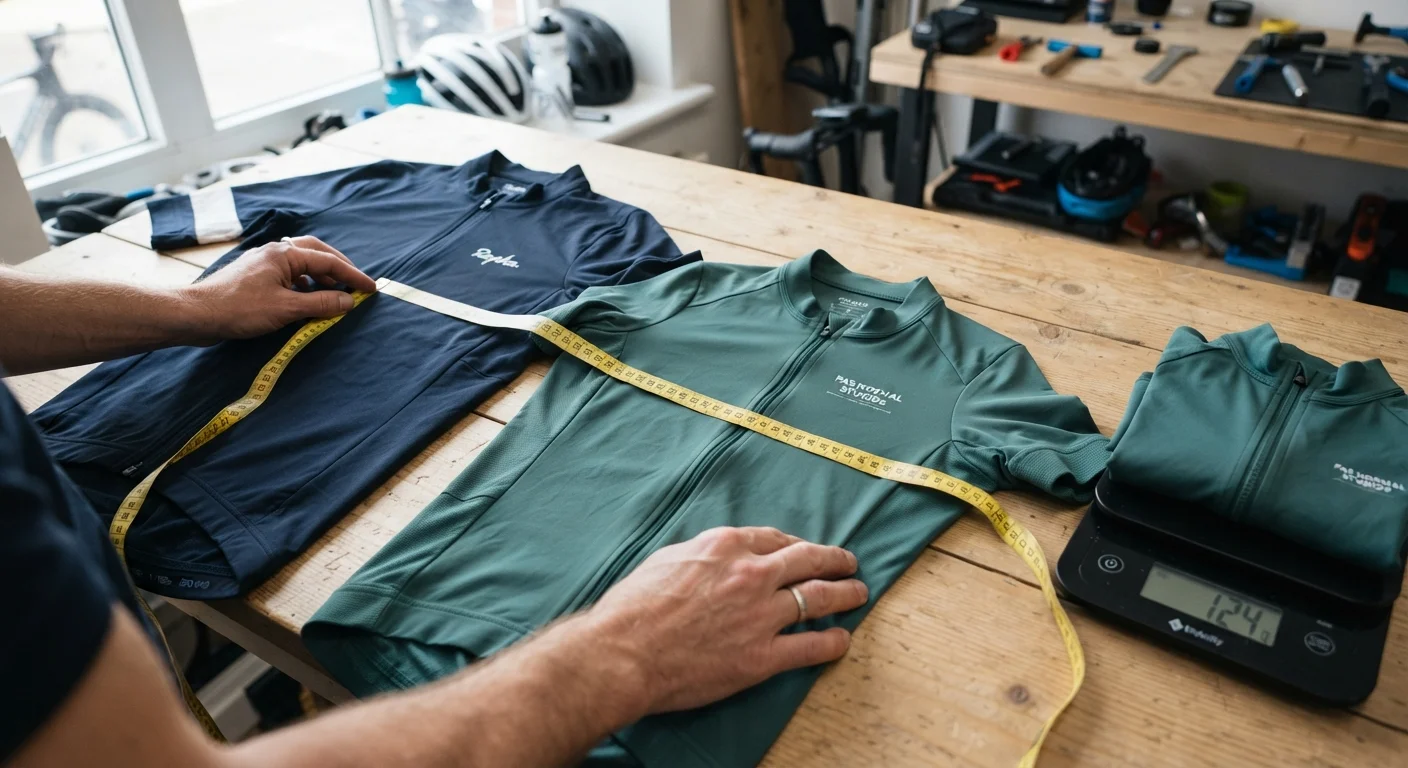
With OEM cycling jerseys, you control the entire design lifecycle from the first sketch to the final tech pack. Think of it as running your own internal design process. You define the silhouette, fit, panel construction, and fabric weight before a single sample gets cut. Your team specifies compression zones, ventilation panels, sublimation graphics, zipper placement, and pocket configuration. The factory converts your inputs into a tech pack, pattern, and grading rules that become the blueprint for production. You approve or reject each iteration before it moves forward; nothing advances without your sign-off. Prototypes go through fit testing, stretch testing, and often real-ride wear testing under actual riding conditions before bulk production starts. If you tweak the fit after round two of samples, that change gets documented and re-verified, not silently absorbed into the next batch.
Every one of these steps generates a record. Sample photos, revision notes, fit-test feedback, approved spec sheets. Stack them together and you've built a design file that's yours to keep, reuse, and license out if you ever want to.
What ODM Limits
ODM production skips most of that process because the design already exists. You select from a catalog of pre-engineered patterns the factory already owns. Customization typically stops at colorways, logo placement, and minor graphic tweaks like sublimation print swaps.
The base pattern, fit, and construction stay locked. You don't get a say in panel placement, fabric blend ratios, or seam engineering because those decisions were made before you ever placed an order. There's no design review cycle where you push back on fit. You either accept the template or move to a different factory.
Why This Matters for Your Brand
If your brand's identity depends on a signature fit, aero-cut race jerseys, relaxed gravel fits, or unusual mesh patterns, OEM is the only path that gets you there. You're building a design file no competitor can replicate because it's tied to your specific inputs and iterations.
If you're testing market demand or launching a smaller collection fast, ODM's lack of design control isn't a dealbreaker. You're trading creative ownership for speed and lower upfront cost, which lines up with what we covered in the cost breakdown above.
A practical way to decide is to ask how much of your brand equity lives in the fit and construction versus the graphics and colorway. Sports brands with loyal racing customers usually can't compromise on fit, so OEM cycling jerseys become non-negotiable. Lifestyle or fashion-forward cycling brands riding on aesthetics alone can often get away with ODM's template-based approach.
Either way, get your design decisions documented. Even with ODM, keep a record of every colorway approval and logo placement change. If you switch factories later, that paper trail saves you from re-explaining specs from scratch.
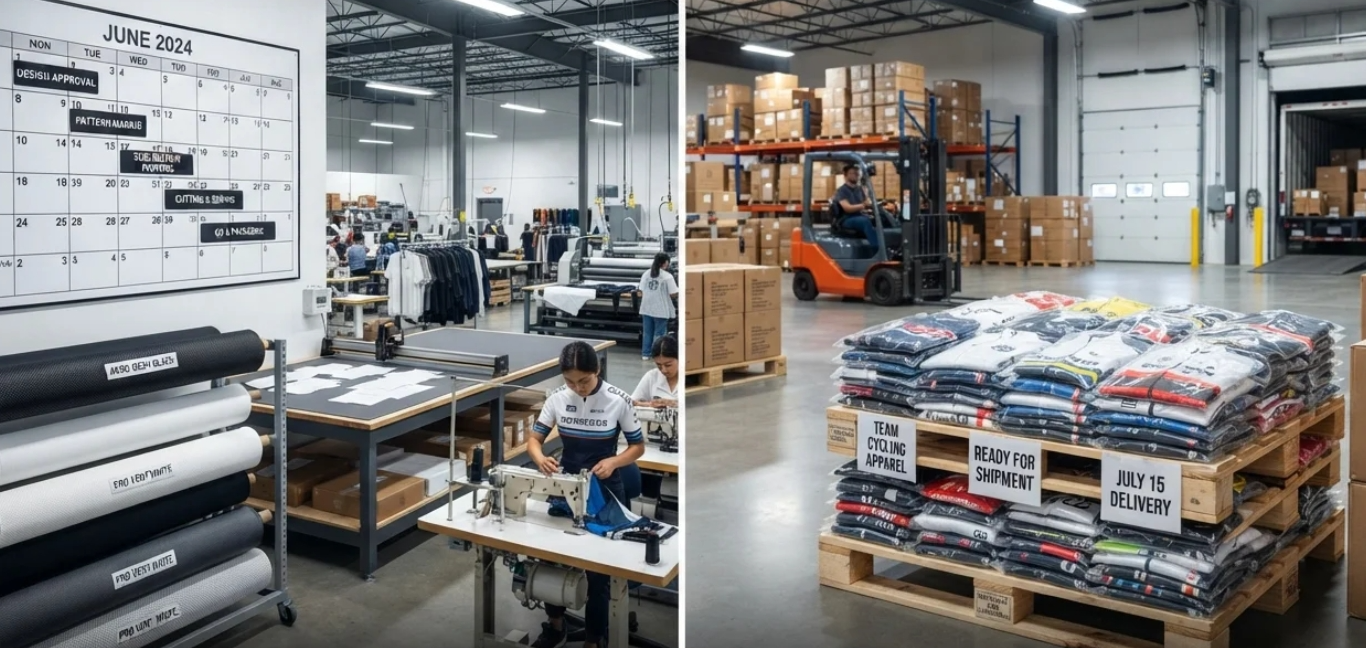
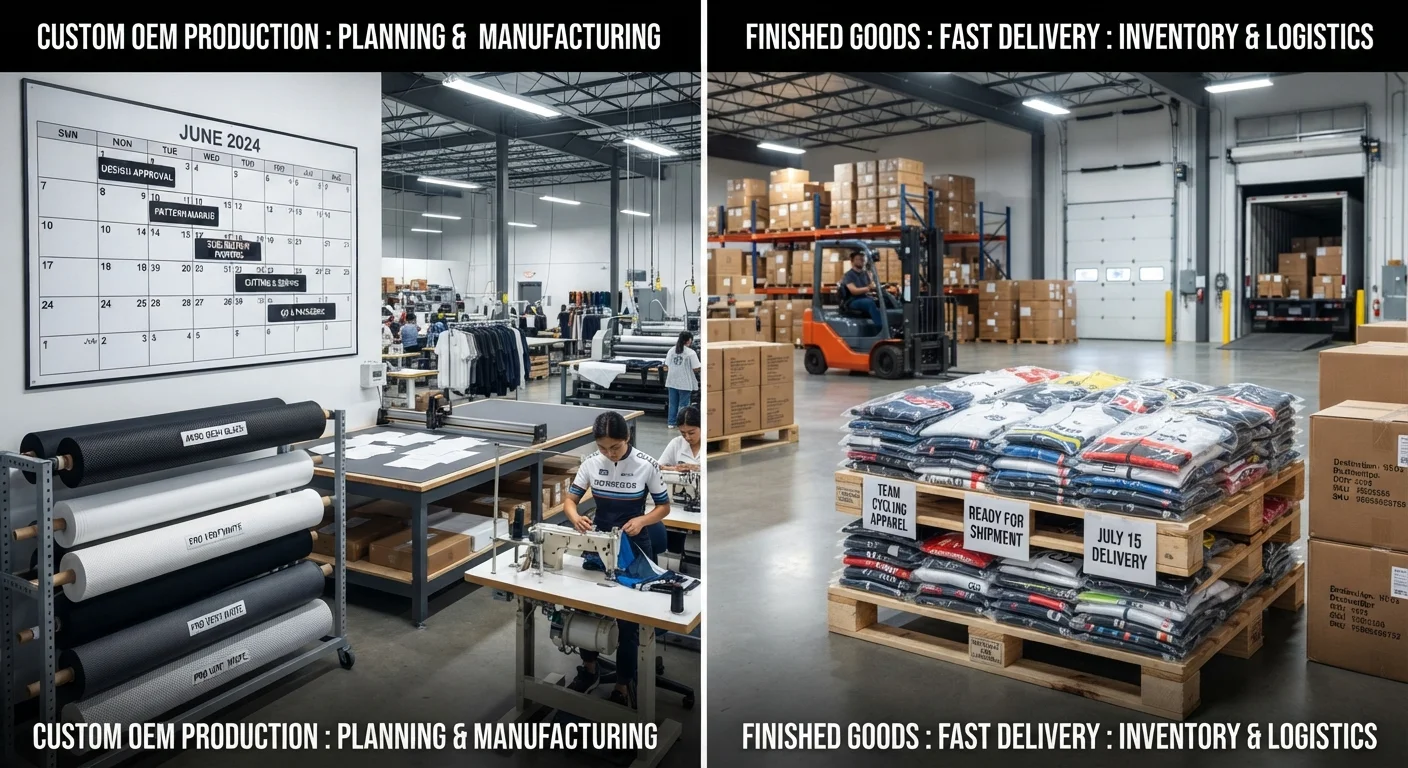
Twelve weeks. Twenty weeks. Sometimes more. That's the gap between an OEM cycling jersey order and one built on an ODM template. It's the difference between hitting your launch date and watching the racing season pass you by.
The Full OEM Timeline Breakdown
Custom production runs through five distinct phases, and each one adds weeks you don't get back:
Design and development : 2–8 weeks
Prototyping and sampling : 4–8 weeks
Tooling and pre-production : 4–10 weeks
Mass production : 6–16 weeks
Shipping and logistics : 4–8 weeks
Stack those together. A full custom OEM cycling jersey run can stretch from 20 weeks to well over 40, depending on complexity. Sample rounds alone eat up 1–3 weeks each, and most apparel products need multiple rounds before the fit locks in. Three rounds isn't unusual. That's 3–6 weeks just for samples before bulk production even starts.
Where ODM Cuts the Clock
ODM production skips the design and tooling phases because the pattern already exists. A typical clothing production schedule under this model looks like:
Enquiry and quotation : 1–2 weeks
Sampling : 4–8 weeks
Production : 3–5 weeks
Shipping : 1–2 weeks
That's a total of 12–20 weeks from enquiry to launch. Compare that to OEM's tooling phase alone, which can run 4–10 weeks before a single unit gets made. For simple styles using stock fabric with a factory you've already worked with, you can compress that further. Fast-track ODM runs sometimes finish in 8–10 weeks. Standard runs typically land at 12–16 weeks. Complex or custom orders, even within ODM, can still stretch to 18–24 weeks if you're pushing customization limits.
What Actually Drives the Delay
Once you're inside the bulk production window, the math gets granular. A practical breakdown looks like this:
Fabric/trim procurement: 3–5 days if in stock, 2–3 weeks if custom
Cutting: 1–2 days
Sewing: 7–14 days
Finishing and pressing: 2–3 days
Quality control: 1–2 days
Packing: 1–2 days
The formula is Lead Time = Queue + Setup + Run + Wait + Move. Anything under 10 days per stage counts as optimal. 11–20 days is acceptable. Cross 20 days and something's broken enough to need investigation.
Before production even starts, the biggest inflators are custom cycling jersey materials, working with a factory for the first time, extra sample rounds, tooling requirements, and customs delays on the back end. If your brand can't absorb a 20+ week runway, ODM's shorter cycle protects your launch window. If your OEM cycling jerseys need a signature fit that no template offers, build the extra weeks into your calendar now. Don't wait until your factory quotes you a date you can't hit.
Conclusion
Choosing between OEM and ODM shapes your margins, your brand identity, and how fast you get to market. If you need full creative control and don’t mind a longer lead time, ODM gives you that flexibility. But if speed and cost-efficiency are your priorities, OEM cycling jerseys deliver proven designs, lower minimums, and faster turnaround without sacrificing quality.
The real winners are the brands that ship smart, test fast, and scale with the right manufacturing partner behind them.
Audit your current production timeline, compare it against your growth goals, and reach out to a handful of OEM cycling jerseys suppliers this week. Request samples. Ask about MOQs.