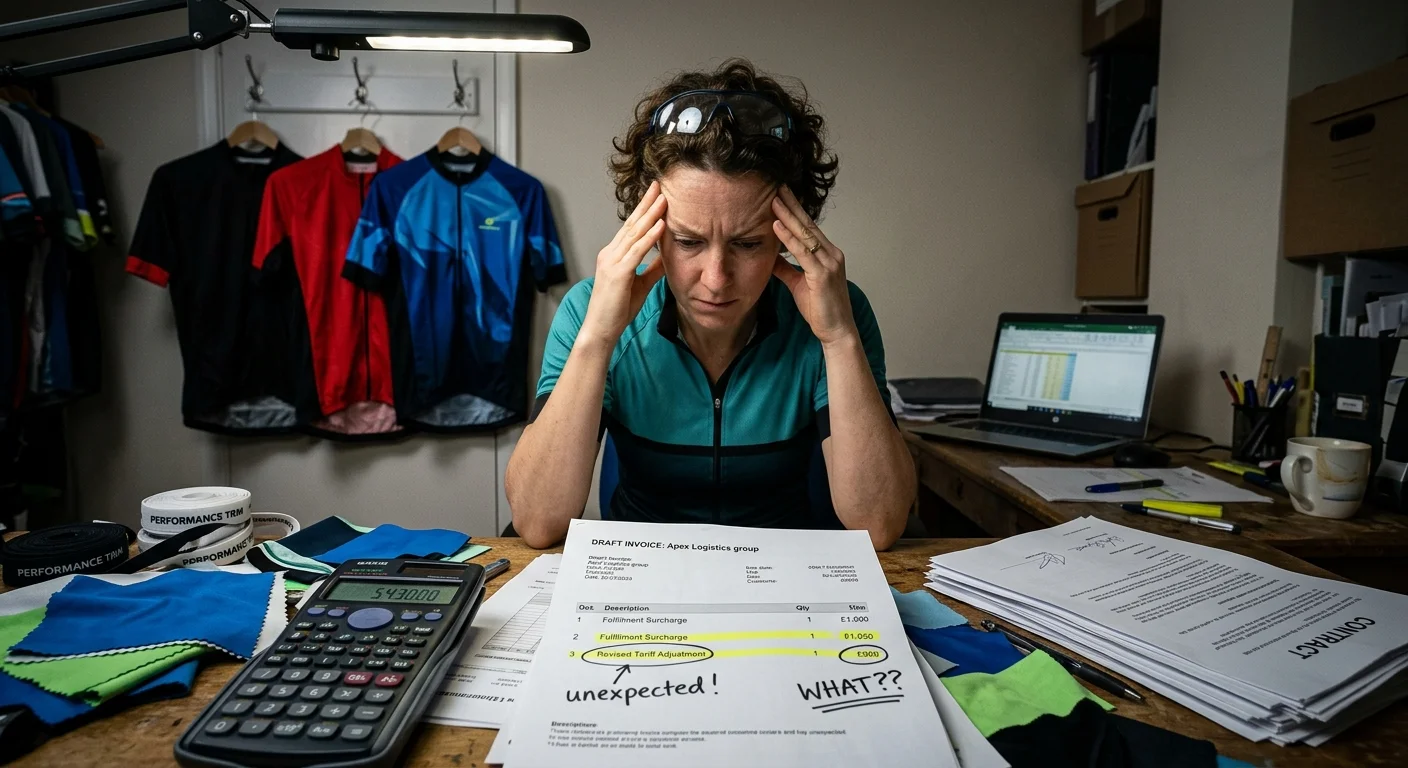
You got a quote. It looked reasonable. Maybe even competitive. So you placed the order — and then the invoices started arriving.
A sample fee here. A color-matching surcharge there. An "artwork setup" line item you never discussed. Your first custom cycling kit shipment cleared customs — and you'd spent 30–40% more than your original budget. You couldn't explain where the money went.
This isn't bad luck. It's the standard experience for brands entering custom cycling kit manufacturing without a full cost map. The pricing most manufacturers show you upfront is just the surface. Beneath it sit seven specific hidden costs that push up your per-unit spend. They don't announce themselves. They just show up on invoices. Knowing them before you sign anything separates a profitable launch from a budget shock. Let's break all seven down.
Hidden Cost #1: Design & Artwork Setup Fees — The Invisible Entry Ticket
Most manufacturers won't tell you this upfront — but you're already paying before a single jersey gets printed.
Design and artwork setup fees are the first line item that never appears in the headline quote. A factory quotes "$18 per cycling jersey." That number assumes your artwork is print-ready, color-separated, and optimized for sublimation printing. It usually isn't. Closing that gap costs money.
Here's what the real cost structure looks like:
Screen or plate setup : $35–$50 per color, per location
Per-color setup fees : $15+ per color on top of screen costs
Artwork prep / file cleanup : $75–$250 if your design isn't production-ready
Embroidery digitizing (for logos on hems or collars): $35–$75 per logo
Artwork revision rounds : $50–$200 per round after initial sign-off
Run the math on a modest 50-kit order with a 4-color design:
Fee Type | Calculation | Cost |
|---|---|---|
Screen setup | 4 × $40 | $160 |
Per-color setup | 4 × $15 | $60 |
Artwork prep | flat fee | $100 |
Total entry ticket | $320 | |
Per-unit impact | $320 ÷ 50 | +$6.40/kit |
That's $6.40 per kit that never showed up in your original custom cycling wear price breakdown . On a small run, setup fees can push total spend 2–3× above the advertised print cost .
How to Protect Your Budget
Always demand line-item quotes. Ask your cycling jersey OEM manufacturer to list each cost as its own line — screen costs, per-color fees, digitizing charges, and artwork revision policy. Keep them separate. A quote that bundles everything into "unit price" is hiding something.
Calculate the true per-unit cost using this formula:
True per-unit = (Setup Fees ÷ Quantity) + Quoted per-unit price
Test it across different order volumes. That same $320 setup fee costs $6.40/kit at 50 units — but just $0.64/kit at 500. This gives you real leverage. Use it to set your minimum order quantity for cycling apparel or to negotiate fee waivers on repeat orders.
One final red flag: any quote advertising "free artwork setup" deserves a closer look. Those costs don't disappear. They get buried inside inflated per-unit prices. So you pay more over time — you just never see the line item.
Hidden Cost #2: Pattern Making & Size Grading — Where Fit Customization Gets Expensive
Most cycling apparel manufacturers won't mention this in their sales pitch. Request a custom fit, and you've stepped into a separate billing universe.
Pattern making and size grading get priced as standalone line items. Costs climb fast as your size range grows or your design gets more involved.
The cost gap is striking. A commercial off-the-shelf pattern runs around $25 . A custom pattern built for your specific cycling kit design? Closer to $300 . That's a 12× difference before a single stitch is made.
Then grading begins. Every size you add multiplies the cost:
Basic computerized grading : $2–$5 per piece
Standard grading (1–6 piece pattern) : $15–$25 per size
More complex constructions (up to 8 pieces) : ~$30–$40 per size
Setup fees before grading starts : $15–$75
Run a simple scenario. You're producing custom bib shorts across 4 sizes at $10 per size. That's $40 in grading — before marker/nesting fees ($10 setup + $6.50 per size) push the total higher. One style can absorb $300–$600+ in pattern and grading work alone, without you noticing until the invoice arrives.
The Fit-Revision Trap
Rework cycles are where brands bleed budget. Poor patterning generates 10–30% excess fabric waste from re-cuts and repeated samples. Professional pattern services cut those correction costs by 50–80% — but only at the right project stage. Bring them in late, and you lose most of that advantage.
Three rules that protect your custom cycling apparel budget:
Lock in fabric specs before pattern work begins — GSM, stretch percentage, shrinkage tolerance — nail these down at the start
Define tolerance bands (±0.5 cm) to stop endless fit revision loops
Request a grading library from your manufacturer for repeat orders — it cuts out redundant setup fees on future runs
Fit customization isn't just a design decision. It's a cost multiplier that grows across every size you offer.
Hidden Cost #3: Sampling & Revision Rounds — The Budget Drain Before Production Starts
Here's a number that stops most brand founders cold: $45,000 . That's what 30 cycling kit styles cost in sampling alone — before a single sellable unit ships.
Not production costs. Not fabric. Not shipping. Just samples and revisions.
Each physical sample runs $200–$1,500 per style per round . The price depends on complexity and where it's made. Most styles need 2–4 rounds before production approval. Do the math:
Scenario | Per Style | 30-Style Collection |
|---|---|---|
3 rounds × $500/round | $1,500 | $45,000 |
4 rounds × $1,250/round | $5,000 | $150,000 |
That's $27,000–$150,000 in pre-production costs. None of it shows up in your per-unit quote.
Every Round Has More Than One Price Tag
The quoted sample fee is just the visible layer. Inside each revision round, you're also absorbing:
International courier fees : $30–$80 per express shipment
Fabric & trim waste from test cuts (not itemized in most quotes)
Internal review time : 2–4 hours per style per round measuring and documenting fit feedback
External lab testing — colorfastness or wash behavior issues can trigger a compliance check, and that costs extra
Geography pushes costs higher too. A sample round in Bangladesh runs around $40 . The same round in Italy? $350 . Run three rounds at each location. That's $420 per style at an Asian manufacturer versus $740 in Europe . The gap adds up fast across a full collection.
The Revision Loop That Kills Your Launch Timeline
Extra rounds don't just drain money. They drain calendar days. Each revision round adds 7–12 working days to your pre-production timeline. A standard three-round program already adds 4–7 calendar weeks before bulk production starts.
Scatter your feedback across emails and WhatsApp messages instead of sending one clear, consolidated list — rounds jump from 3 to 4–5 . That's 6–12 extra calendar weeks gone. Missed launch windows. Rush freight surcharges. Compressed bulk production schedules. One communication problem causes all of it.
How to Cut Sampling Costs by 60–80%
Brands using 3D digital sampling tools (CLO3D, Style3D) report 60–80% reductions in sampling spend. That's $10,000–$50,000 saved per collection . The numbers are straightforward:
Traditional 30-style workflow (3 physical rounds each): $45,000–$150,000
Digital-first workflow (2–3 virtual iterations + 1 physical confirmation per style): $9,000–$30,000
Net savings: $36,000–$120,000
No digital tools? Three rules still keep sampling costs under control:
Send a complete tech pack — measurements, construction specs, trim details — before the first proto. Partial specs mean extra rounds. No exceptions.
Consolidate all feedback into one list per round — no piecemeal edits, no follow-up messages sent separately.
Cap revision rounds in your contract — define 2–3 included rounds upfront. Set a clear per-extra-round fee ($200–$500 per style) and put it in writing.
The industry benchmark: sampling should sit at 10–15% of your total development budget . It creeps above 20% ? Your spec process or communication workflow has a real problem. Fix it before your next collection starts.
Hidden Cost #4: Fabric Waste Allowance & MOQ Traps
Fabric costs look straightforward on a quote sheet. They aren't.
Every cycling kit factory builds a waste allowance into your fabric consumption — and most of them never tell you that number. Mass production marker efficiency runs between 82–90% . That means 10–18% of your fabric gets cut away as waste before a single jersey is sewn. Edge losses, roll-end scraps, splicing overlaps, remnants — each one eats into your margin. You won't see it on any invoice line.
Here's what that looks like in real numbers. Say your cycling jersey pattern needs 0.12 m of shell fabric per unit. The factory adds an 8% waste allowance for partial rolls and custom color matching. You end up billed for 0.1296 m per unit instead of 0.12 m. On a 1,000-unit order at $5/m , that's an extra $48 you never planned for. Drop that to a 200-unit run, and the same absolute waste becomes a +5–10% per-unit fabric cost increase — fewer units means each one absorbs more of the loss.
Knit fabrics make this worse. Knits need a 5–7% shrinkage allowance built into the pattern. To get a finished body length of 70 cm in fabric with 6% shrinkage, the factory cuts at 74.5 cm — that's 6.4% more fabric per piece than your finished measurement shows. Add standard cutting-room waste of 3–5% on top, and knit programs end up running 10–12% above theoretical fabric consumption . Nobody flags it.
The MOQ Trap Is a Separate Problem — And It's Worse
Minimum order quantities don't just affect how many units you commit to. They distort your entire cost structure.
Look at this scenario. Your design needs 0.8 m of fabric per garment . Your realistic demand is 300 pieces . True fabric requirement: 240 m . The mill's minimum for a custom color? 400 m . You're now sitting on 160 m of surplus fabric — a 67% oversupply . At $4/m , that's $640 locked up in dead inventory . Your effective fabric cost per sold unit jumps from a theoretical $3.20 to $5.33 — a +67% increase from one MOQ mismatch.
Piece MOQs work the same way. Factory minimum is 1,000 units per style per color . Your forecast is 400. You order 1,000 to get the quoted price. Sell-through hits 60% — 600 units move . Your ex-factory cost was $6/unit , so total production spend is $6,000 . But 600 units generated the revenue, not 1,000. Your real cost per sold unit is $10 — not $6. That's a +67% cost inflation from one MOQ trap.
Brands launching custom bib shorts or sublimation printing cycling wear across multiple colorways get hit hardest. A fabric mill might demand 1,000 yards per color for a custom dye lot. Four colorways means 4,000 yards of committed fabric — enough to produce 26,000+ units — against an actual order of 400 pieces.
How to Stop the Bleed
The fix isn't complicated. It just requires asking the right questions before you sign anything.
Force fabric consumption transparency. Ask your cycling jersey OEM manufacturer for a full fabric consumption sheet per style. It should show net consumption, marker efficiency percentage, and every waste allowance category as its own line item. Any quote with a single fabric consumption figure is hiding something.
Run the surplus math before committing to MOQ. Calculate your forecast demand. Multiply by theoretical consumption. Compare that number against both the mill's yardage minimum (MCQ) and the factory's piece MOQ. Then run this formula:
Surplus % = (MOQ quantity − demand quantity) ÷ demand quantity × 100
That number goes above 30–40% ? Negotiate a pooled MOQ across colors — or switch to stock fabrics and cut the mill dye-lot requirement out of the picture.
Negotiate setup fees as a separate line item. Ordering below standard MOQ? Ask the factory to quote a flat setup surcharge instead of burying the inefficiency in higher unit prices. A clear $150–$300 one-time setup fee is almost always cheaper than absorbing a 5–20% per-unit uplift across the full order.
Fabric waste and MOQ traps together can push your real cycling kit fabric cost per meter 8–28% above baseline — with no single line item on your invoice to show for it.
Hidden Cost #5: Printing Techniques, Finishing Details & Trim Upgrades — Where Specs Meet Surcharges
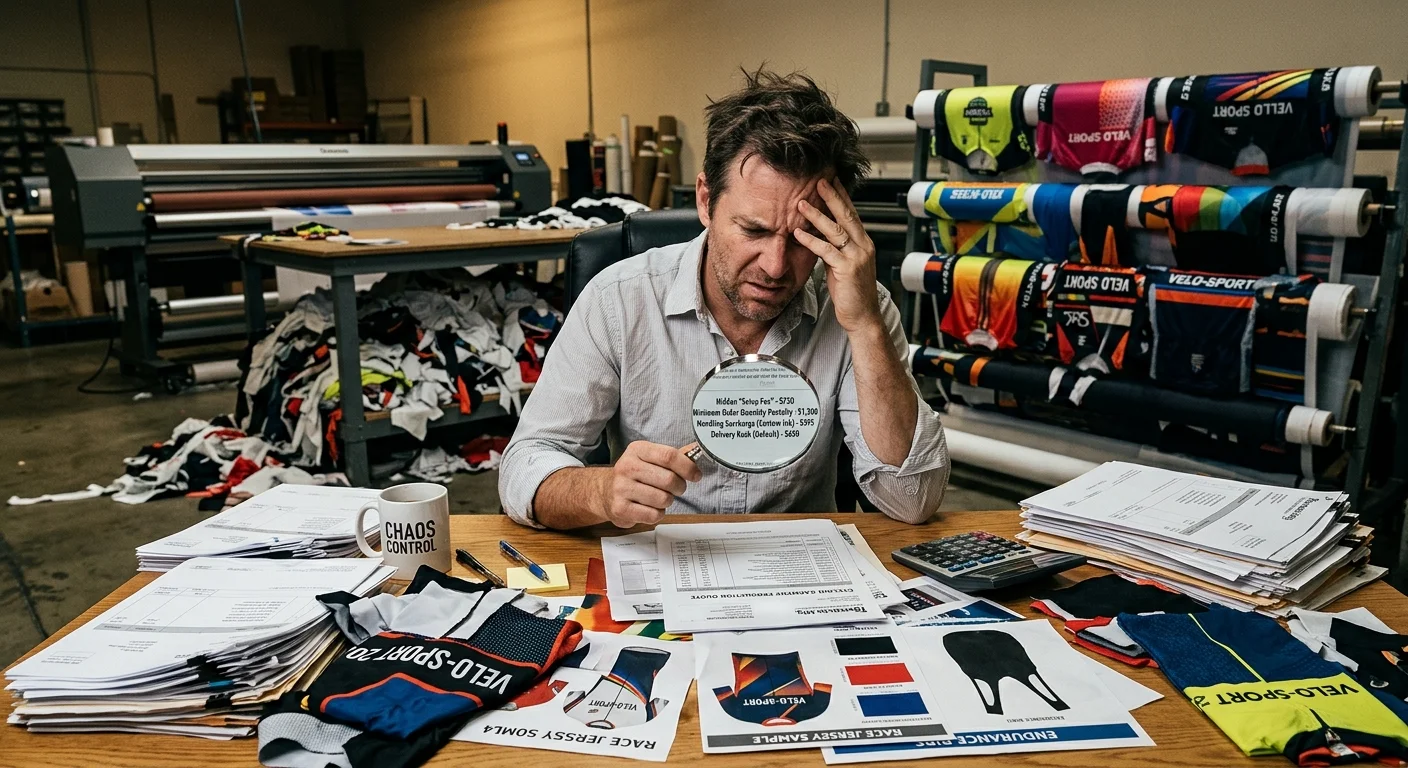
Sublimation printing looks simple on a quote sheet. It isn't.
your custom cycling kit design starts with a standard full-bleed jersey print. Add specialty finishes, Pantone-matched trim colors, reflective details, or heat-transferred logos — and you've crossed into surcharge territory. Each spec upgrade triggers its own fee stack. Most of those fees never appear in the headline unit price.
Here's the core problem. Manufacturers quote you a per-piece rate. What they don't show you is the fixed cost layer sitting underneath it: plate manufacturing, press setup, proofing, die tooling, color-matching. Those costs exist regardless of order volume. They get absorbed into your total — without a word.
The math is brutal at small quantities. Take a realistic sublimation printing cycling wear job with 4-color specialty details:
Fixed Cost Item | Typical Range | Example |
|---|---|---|
Plate/screen setup | $150–$600 per color | 4 colors = $800 |
Press setup fee | $50–$300 per job | $200 |
Color proof/press check | $100–$300 per event | $100 |
Total fixed costs | $1,100 |
Spread that $1,100 across 500 kits and you're absorbing +$2.20 per unit in fees that weren't in your quote. At 100 kits? +$11.00 per unit . Your quoted unit price just became a fiction.
The Finishing Upgrades Nobody Prices Honestly
Trim upgrades are where custom cycling apparel buyers get hit hardest. Each enhancement sounds minor on its own. Add them up and the numbers shift fast:
Custom die-cut woven labels or heat-transfer badges : $100–$500 per die tooling fee, adding ~$0.15/unit on a 2,000-piece run
Lamination or specialty coating on sublimated panels : +10–25% on base print cost
Pantone or custom color-matching surcharges : $50–$100 per color per job — most cycling jersey OEM manufacturers won't flag this until invoicing
Foil stamping or embossed branding details : die fees of $150–$500 plus +15–40% per-run premium on short runs
Combine three of those upgrades on a single style. Your real custom cycling wear price breakdown looks nothing like the initial quote. Hidden finishing surcharges can push total job cost 25–50% above the baseline print price . That gap shows up on your final invoice, not your opening quote.
The Formula That Exposes What You're Paying
Stop evaluating quotes on per-unit price alone. Use this instead:
True per-unit = (Plates + Setup + Finishing + Proofing + Shipping + (Variable per-piece × Qty)) ÷ Qty
Real example: $800 fixed costs + $0.12/unit variable on a 500-unit run = $1,400 total. That's $2.80 per unit — not $0.12. The actual cost runs 133% higher than what the quote surface shows.
How to Stop Getting Burned
Three moves protect your custom bib shorts production cost and keep spec-driven surcharges from wrecking your budget:
Send a complete spec sheet before requesting any quote. Include finish type, color count, trim details, label specs, and bleed requirements. Vague briefs generate low opening quotes and high final invoices.
Ask directly: "Is this your all-in price including setup, proofing, color-matching, finishing, and all tooling fees?" No clear yes? Request a full line-item breakdown.
Calculate your volume crossover point. For 4-color specialty printing, fixed costs justify the method above 1,500 units. Below that threshold, expect low-volume surcharges that can add $0.16–$0.40 per unit — with no line item telling you why.
The finishing details that make your cycling kit look premium are worth every dollar. You just need to know the real cost before you commit.
Hidden Cost #6: Packaging & Brand Labeling — Last Mile of Cost You Didn't Budget
Brands plan the fabric budget, printing costs, and sampling fees. Then the finish line hits — and the real packaging bill shows up.
Packaging and brand labeling run 8–12% of landed product cost for DTC cycling apparel brands. Most starting budgets set aside just 3–5% . That gap feels small on paper. It doesn't feel small when you see it in your margin report.
Here's the deeper problem: the quoted unit price on custom packaging covers just 40–55% of your true packaging cost . The other 45–60% hides in places no one brings up at the negotiation table.
Where the Hidden Charges Stack Up
Dimensional weight (DIM) penalties hit first. Carriers skip actual weight when your box ships by air. Use this formula: L × W × H ÷ 139. That result beats your product's actual weight? You pay on the bigger number. An oversized box on a 3 lb cycling kit adds $1.64 per shipment — quiet, every single order, no one flags it.
Custom print tooling adds another layer. Branded shipper boxes carry plate and tooling fees of $500–$3,000 per design . Spread across a small first run, that's $0.05–$0.20 per box in amortized cost sitting inside year one — never shown on the quote.
Kitting and branding labor piles on fast. Hand-placing tissue paper, stickers, and branded inserts takes 30–90 seconds per order . At standard warehouse labor rates of $18–$22/hour , that adds $0.23–$0.28 per order . Most brands never put this line in their model. It shows up in the margin anyway.
MOQ-driven inventory carrying costs round out the damage. Custom-printed packaging forces you to order 6–12 months of stock upfront . That capital locks into corrugated boxes stacked on warehouse shelves at $0.25–$0.60 per pallet per month . The boxes sit. The cost runs.
The Real Number
Brands that judge suppliers on unit price alone overspend by 20–35% once DIM penalties, damage claims, kitting labor, and storage costs load in. Your "cheap" box? It's not cheap.
Before you lock in any custom cycling kit order, build a per-order packaging BOM. List every piece — box, label, void fill, inserts, decorative elements. Assign a material cost and a labor cost to each line. That one exercise uncovers more hidden spend than most brands catch in a full supplier audit.
Hidden Cost #7: Shipping, Import Duties & Customs Delays—Costs That Arrive After Your Goods Do
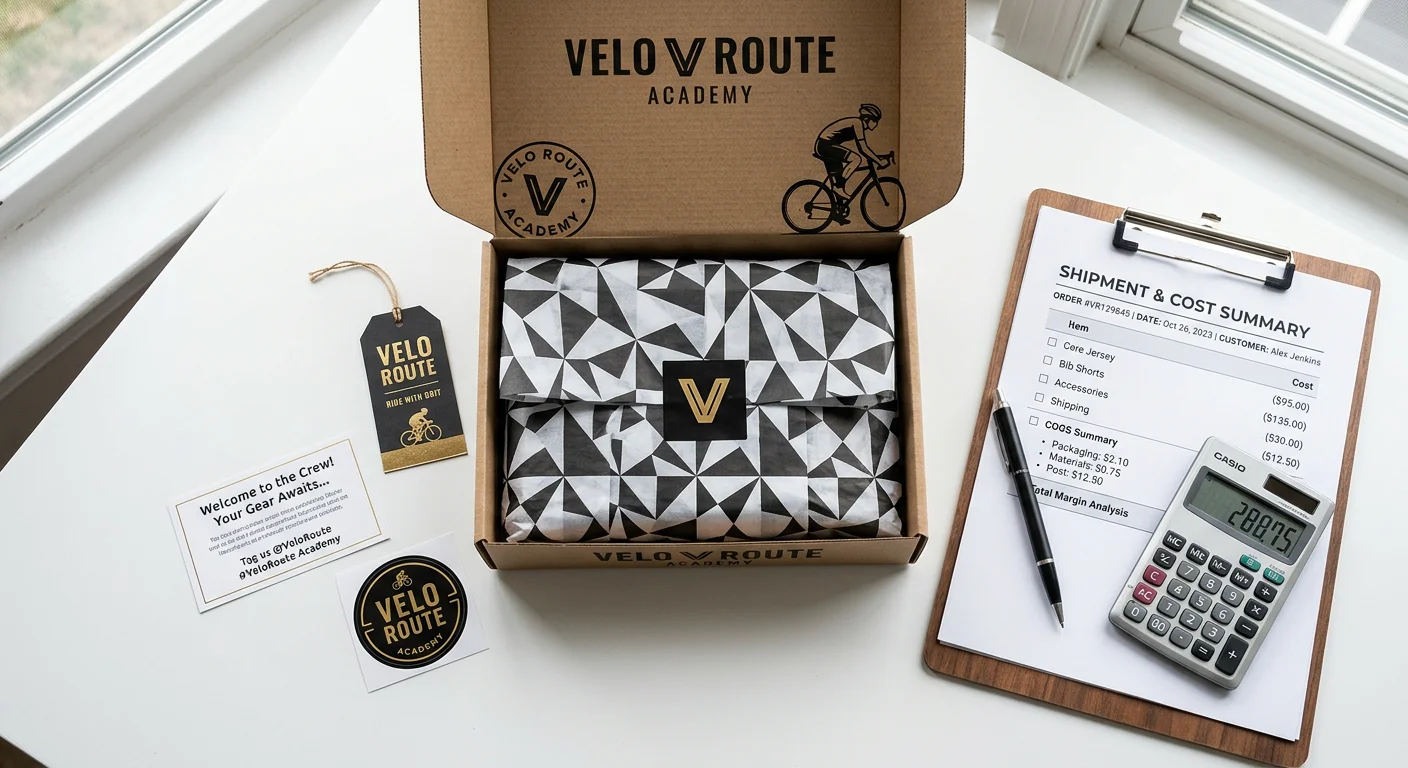
Your goods left the factory. Your invoice is paid. You're done, right?
Wrong. The most expensive phase of your custom cycling kit order often hits after the container ship leaves port.
Hidden customs charges — duties, taxes, brokerage fees, and processing costs — can push your total landed cost 50–100% above the original freight quote. Over 60% of apparel brands either overpay or underpay import duties. The result: 15–25% margin erosion from penalties, disputes, and surprise invoices.
The Fee Stack Nobody Quotes You
Here's what piles onto your shipment before it reaches your warehouse door:
U.S. Merchandise Processing Fee (MPF): 0.3464% of shipment value (min $27.75, max $538.40 per entry)
U.S. Harbor Maintenance Fee: 0.125% of shipment value on ocean freight
Fuel surcharge: 10–25% on top of your base freight rate — every time
Customs brokerage: $50–$200 per shipment, charged after delivery
Demurrage/detention: $100–$300 per container per day beyond free time
A 5-day customs hold at $200/day adds $1,000 per container . That number never shows up in your cycling apparel manufacturing lead time estimate.
One HS Code Error Costs More Than You Think
A wrong HS code classification is the most expensive paperwork mistake in sportswear manufacturing . It locks you into years of overpaid duty rates. Or it triggers back-charges, penalties, and audits for underpayment. Small invoice errors alone can flag a customs inspection. Add a $150–$300 inspection fee , plus demurrage for every day your cargo sits waiting.
Run this seven-step landed cost calculation before your next shipment:
Identify the correct HS code via WCO or your national tariff database
Build customs value the right way — product cost + freight + insurance + packing
Add destination duty rate + VAT/GST + MPF/HMF
Add brokerage estimate ($50–$200)
Add fuel surcharge (10–25% of freight)
Factor in demurrage risk: 3–5 days × $100–$300/day per container
Compare routes — pick the one where all components produce an acceptable total
Do this before you quote delivery dates or customer prices. Not after.
The Practical Fix
Get your freight forwarder to review all documentation 7–10 days before vessel departure . That one step catches HS errors, value gaps, and description mismatches before they trigger a customs hold. Strong duty management can cut post-arrival cost surprises by up to 34% per year — and that number builds across every order you ship.
Demand invoices that break out every line: duties, brokerage, fuel surcharge, demurrage, port fees. Your carrier bundles it all into one number? You lose the ability to audit it — and you lose all leverage to fix it next time.
FAQ: Custom Cycling Kit Manufacturing Cost — Direct Answers
Seven hidden costs. Dozens of line items. And still, the questions keep coming.
Here are direct, number-backed answers to what brands and team managers ask most before placing a custom cycling kit order.
Q: What does a complete custom cycling kit cost per rider?
Expect $70–$150 for entry-level, $150–$300 for mid-range club kits, and $300–$700 for race-grade. These price bands assume standard MOQs, normal design fees, and standard import taxes for EU/US buyers.
Q: How much does a custom cycling jersey cost ex-factory?
At 100+ units, factory-direct jerseys run $20–$30 per piece for mid-range. Race-grade jerseys start at $40+ . The cost split stays steady across tiers: fabric takes 40–45% , sublimation printing 25–35% , trims 10–15% , and labor 10–15% .
Q: How does MOQ affect my per-unit cost?
The gap is massive. A single custom jersey from a no-minimum supplier can cost €120+ . A 10-rider team order through a European supplier runs about €132 per rider — that covers jersey, bib, and design fee. Order 100+ units from an Asian OEM and your ex-factory cost drops toward $20–$30 per jersey . More volume, lower cost — every time, no exceptions.
Q: What non-product costs should I add on top of manufacturing?
Budget for these on every import order:
Design setup fees: 5–10% of order value
International freight: 8–12% of product value
Customs duties: 2–5% depending on origin country
VAT (EU imports): ~20% on landed value
A $65 ex-factory jersey lands at $78–$95 before brand margin. That lines up with retail prices of $120–$200 for premium pieces.
Q: What's the fastest way to cut manufacturing cost without sacrificing quality?
Three levers move the needle most:
Drop one fabric tier — switching from race-grade to mid-range fabric cuts per-jersey cost by ~20–25%
Consolidate trims across styles — standardized zippers and grippers cut trim costs by 10–35% through volume pricing
Hit volume thresholds — ordering at 50 / 100 / 150 / 200+ units unlocks 10–35% discounts on both fabric and trims
Q: What's the retail-to-manufacturing cost ratio for cycling apparel?
Premium cycling apparel retails at 3–5× factory manufacturing cost . A $40 race jersey ex-factory sells at $120–$200 at retail — the exact number depends on brand positioning and channel margins. Non-manufacturing costs — design, freight, duties, VAT — eat up 35–45% of total landed cost before any brand markup enters the picture.
Conclusion
Every quote a manufacturer sends you tells half the story. The other half hides in line items most brands never think to ask about. They only find out two weeks before launch — when the budget is already blown.
Here's the truth: the gap between a "competitive price" and your actual custom cycling kit manufacturing cost is not a mistake. It's a system. And now you know how it works.
Design setup fees, sampling rounds, fabric waste allowances, packaging surcharges, import duties — none of these catch an experienced manufacturer off guard. They should not catch you off guard either.
The brands that scale and stay profitable are not the ones with the lowest quotes. They're the ones who ask the right questions before signing anything.
Ready for a clear custom cycling wear price breakdown with zero hidden fees? Talk to our team at Runcyclingapparel.com — bring your specs. We'll walk you through every line item, one by one, so you know what you're paying for.