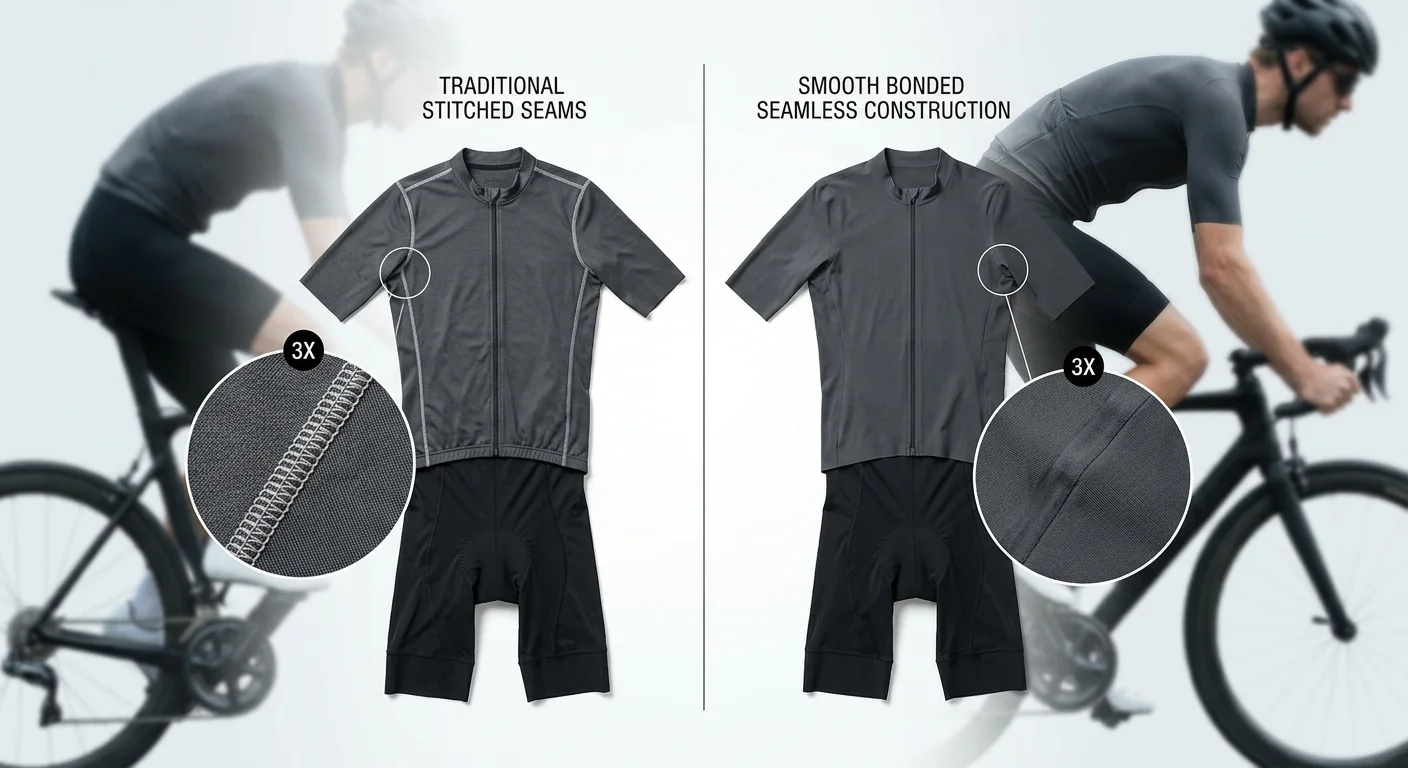
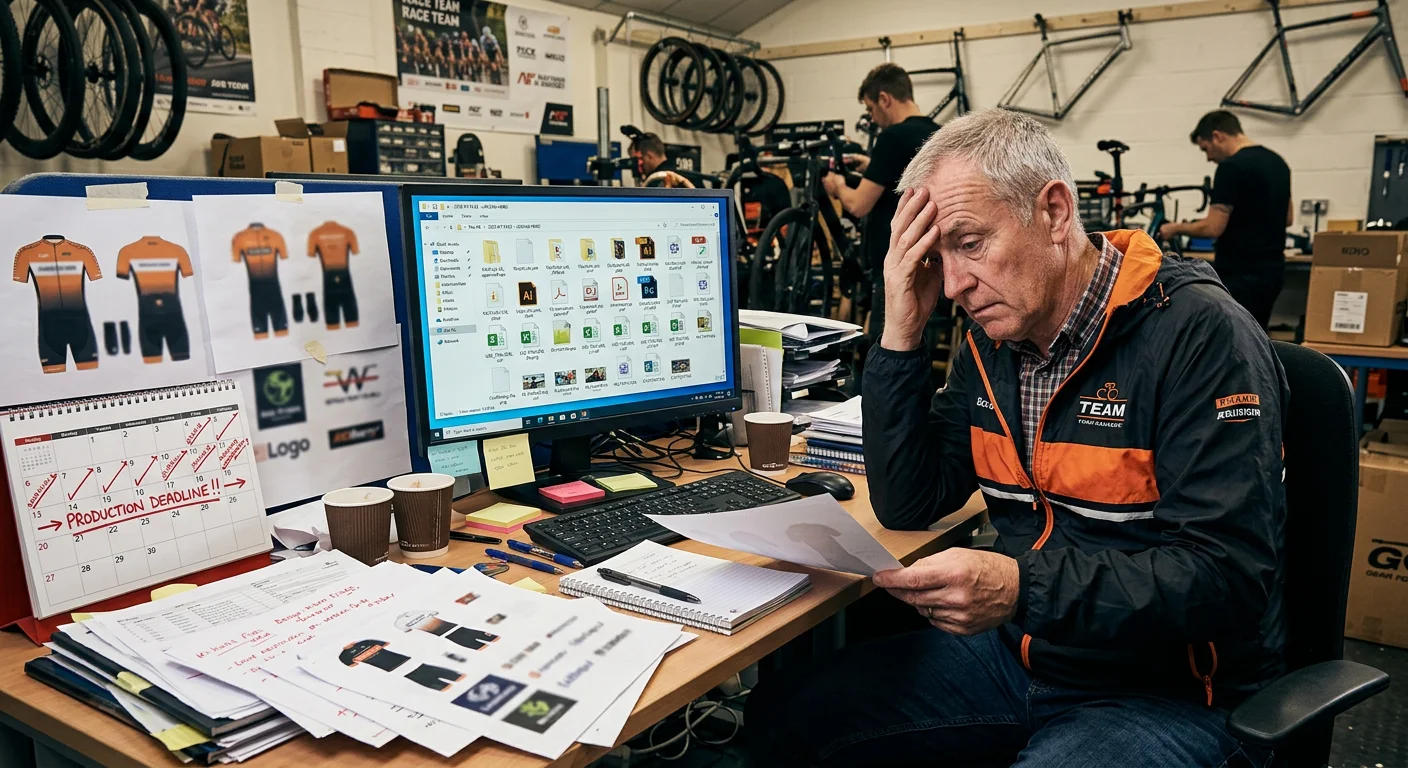
Picking the wrong supply model for your cycling apparel business doesn't just slow you down — it can drain your cash flow, leave you buried in unsold inventory, or cost you a client because your lead time ran three weeks too long.
Launching a private label cycling kit brand? Outfitting a club? Scaling a wholesale operation? The choice between made-to-order and in-stock cycling apparel is one of the biggest decisions you'll make before a single jersey ships.
Both models have real strengths. Both also carry pitfalls that are easy to miss at first glance.
This guide breaks down the two models head-to-head across cost, MOQ, lead time, and inventory risk. You'll walk away with a clear answer built around your specific situation.
Head-to-Head Comparison: Cost, MOQ, Lead Time & Inventory Risk
Four variables shape which supply model works for your situation: cost, minimum order quantity, lead time, and inventory risk. Get these right, and your operation runs lean. Get them wrong, and you're either sitting on $40,000 worth of unsold jerseys or losing club contracts because you can't deliver on time.
Here's how the two models stack up.
The Side-by-Side Breakdown
Dimension | In-Stock (MTS) | Made-to-Order (MTO) |
|---|---|---|
Production Trigger | Forecast-driven, built before orders arrive | Customer order triggers production |
MOQ | Higher — bulk runs spread per-unit costs | Lower — small batches and single-order production viable |
Unit Cost | Lower — economies of scale kick in | Higher — small runs, setup switching, and scheduling add cost |
Lead Time | Shortest — ships from stock right away | Longer — covers design, sourcing, production, and QC |
Inventory Risk | High — unsold stock, markdowns, obsolescence | Low — near-zero finished goods sitting idle |
Cash Efficiency | Lower — capital locked in physical inventory | Higher — cash moves after confirmed orders |
Customization | Limited — standard sizes, colorways, specs | Full control — fabric, cut, branding, sizing, construction |
Environmental Waste | Higher overproduction risk | On-demand production reduces surplus |
What the Numbers Really Mean
The unit cost advantage of in-stock production is real. Bulk manufacturing brings per-piece prices down. But that lower unit cost carries a hidden tax most buyers miss.
Holding inventory costs you 15–25% of its value every year. That figure isn't dramatic accounting. It covers warehousing, insurance, stock deterioration, and markdowns on slow-moving SKUs. Your cycling apparel sits in a warehouse for six months instead of three? That margin erosion adds up fast.
The cash dynamic is blunt:
- In-stock model : You convert cash into inventory first, then wait for sales to return it. The larger the stock position, the longer that recovery cycle.
- Made-to-order model : Production starts after an order is confirmed. Finished goods inventory pressure drops, and your cash stays liquid longer.
Your holding costs push toward that 15–25% annual threshold. Your sell-through predictability is low. In that case, the capital efficiency of made-to-order tends to outweigh the higher unit cost.
The Customization Gap Is Bigger Than It Looks
In-stock cycling apparel competes on price and speed. That's a fair strategy — but it's a crowded one. Standard cuts, generic colorways, and off-the-shelf fabrics put your product next to dozens of near-identical options at similar price points.
Made-to-order gives you control over fabric weight and performance spec, pattern and cut, sublimation design, sizing grids, and branded labeling . For cycling clubs building team identity, or brands staking out a clear market position, that control isn't a luxury. It's the product itself.
A Four-Step Framework to Make the Call
Before committing to either model, run this sequence:
Calculate unit cost difference — MTS bulk price vs. MTO per-piece quote. What's the real gap?
Calculate holding cost exposure — Take your potential inventory value and multiply it by 15–25% per year. Can your margins absorb that?
Assess lead time sensitivity — Does your customer base need same-week fulfillment, or can a 3–5 week custom production window fit into your sales process?
Evaluate brand differentiation need — Does your competitive position depend on fabric, fit, or branding control that a standard in-stock product can't deliver?
The model that wins on all four dimensions for your situation is the right answer. Most businesses won't find a clean sweep in one direction. That's why many cycling apparel operations end up running a hybrid of both.
Which Model Fits Your Business? Recommendations by Buyer Type
Three buyer types keep getting this decision wrong — and each one gets it wrong in a different way.
The startup brand over-commits to in-stock inventory chasing a lower unit cost. Then it spends six months discounting jerseys it can't move. The cycling club manager goes with made-to-order without checking lead time against the event calendar. The kit arrives two weeks after race day. The wholesale buyer locks into a single model when their customer base splits across both.
Here's how to match the right supply model to your situation.
The Startup Cycling Brand or First-Time Retailer
Go made-to-order. No exceptions at this stage.
Your biggest risk isn't unit cost — it's demand uncertainty. You don't have sell-through data yet. You don't have a proven size distribution or confirmed repeat buyers. Putting $15,000–$40,000 into in-stock inventory before any of that exists is how early-stage brands quietly burn through cash.
Made-to-order protects you here. Production starts after an order is confirmed. You carry near-zero finished goods risk. Yes, your per-unit cost runs higher. Compare that to holding costs eating 15–25% of unsold stock value every year — on inventory you can't move because you misjudged demand on your first run.
What to prioritize: - Find a sublimation Cycling apparel manufacturer with a low minimum order quantity (MOQ) — aim for under 10 pieces per design - Build your size data from real orders before scaling volume - Use the longer lead time (3–5 weeks for custom team cycling jersey production) as a selling point: buyers get exactly what they specify
Once you've got 3–4 seasons of solid sell-through data, revisit the model. Not before.
The Cycling Club or Team Manager
Made-to-order is your answer — but timing is everything.
Club and team orders have one hard constraint: the event date. Custom cycling club uniform production runs on a fixed timeline. Miss it, and the kit is useless no matter how good it looks.
Work backward from your first event. Standard on-demand cycling kit production takes 3–5 weeks from artwork approval to delivery. Add buffer for design revision rounds (most clubs underestimate this), shipping, and size exchanges. That puts your order placement at a minimum of 6–8 weeks before you need the kit in hand.
What clubs get wrong most often:
- Treating the quote date as the start of lead time — design approval is the real start
- Ordering one cut for a mixed-ability group without checking gender-specific sizing grids
- Picking a supplier on price alone without confirming they handle sublimation cycling apparel with full custom branding
Get it right and the payoff is real. A fully custom cycling kit — your colors, your logo, your fabric spec — builds team identity in a way that off-the-shelf gear can't touch.
The Established Retailer or Wholesale Buyer
Run a hybrid. Build it with intention.
At scale, the either/or question stops being useful. Mature cycling apparel operations stock in-stock inventory for their fastest-moving, most predictable SKUs — core colorways, standard cuts, proven size runs. Custom and low-frequency orders go through made-to-order production.
The split isn't random. It comes from sell-through data.
A practical framework for wholesale cycling clothing inventory decisions:
Identify your top 20% of SKUs by volume — these are your in-stock candidates. Bulk pricing and fast fulfillment matter here.
Flag anything with irregular demand, seasonal dependency, or high size variance — route these through made-to-order to avoid dead stock.
Set a sell-through threshold — a SKU that clears below 80% per season means the carrying cost math works against you. Move it to made-to-order.
The goal isn't to eliminate one model. It's to stop using the wrong model for the wrong products.
The Quick-Reference Decision Table
Buyer Type | Recommended Model | Primary Reason |
|---|---|---|
Startup / first-time brand | Made-to-order | Demand uncertainty; no sell-through history |
Cycling club / team | Made-to-order | Full customization; manageable one-time volume |
Established retailer | Hybrid | High-velocity SKUs in stock; variable demand on-demand |
Wholesale / B2B buyer | Hybrid (data-driven split) | Capital efficiency on proven lines; flexibility elsewhere |
The model that fits your business isn't a philosophical choice. It's a financial one — built on your real order data, your cash position, and how much demand uncertainty you're carrying into the next season.
The Real Pros & Cons Nobody Talks About
Most supply model comparisons stop at unit cost and lead time. That's where the obvious stuff lives. The decisions that cost people real money — or quietly save it — sit one layer deeper.
Here's what the standard breakdown misses.
Made-to-Order's Hidden Cost Isn't the Wait. It's What Happens Before Production Starts.
Everyone talks about MTO lead time. Fewer people talk about what drives it off the rails.
The real time-killers in on-demand cycling kit production aren't on the factory floor. They live in the front end: design confirmation, back-and-forth revisions, and late-stage change requests that reset the whole clock.
Sampling costs alone can run 3,000–8,000 RMB per round. First samples rarely pass on the first attempt. Two or three revision rounds is standard. Your cumulative sampling spend can hit 10,000–20,000 RMB before a single production unit ships.
Then there's the communication tax. Every unanswered query adds buffer time. Every approval that takes four days instead of two compounds across the full production timeline. Experienced sublimation cycling apparel manufacturers say the same thing: projects that arrive with unresolved specs — no finalized tech packs, no confirmed colorways, no material sign-off — take longer. Projects where the design is locked before the first message gets sent move faster. Every time.
The variables that blow MTO timelines:
Design finalization before enquiry — A vague brief sent to a custom team cycling jersey supplier isn't a starting point. It's the start of a delay cycle.
Revision control — A design change after sample approval doesn't just cost money. It triggers a full reset of production scheduling.
Communication bottlenecks — Multiple internal approvers, slow feedback loops, and misaligned contacts between client and supplier. That's where weeks disappear.
The fix is measurable. Projects that enter production with a locked design, one clear communication lead, and agreed milestone dates cut overall cycling apparel lead time by 20–30% . That's not an estimate. That's a repeatable outcome.
In-Stock's Hidden Risk Isn't Carrying Inventory. It's What Happens When It Doesn't Sell.
Wholesale cycling clothing inventory looks like an asset on day one. Around month five, it stops looking like one.
The risk isn't storage. The risk is the markdown spiral.
Seasonal cycling apparel that misses its sales window doesn't recover on its own. It moves into discount territory. Each discount round compresses your margin structure. Those margins don't bounce back when the next season opens.
Three profit erosion points MTS buyers tend to underestimate:
Seasonal write-downs — Stock that doesn't clear at full price becomes a clearance problem. Deeper discounts do more damage to your gross margin baseline.
Sustained margin compression — These aren't one-off losses. Repeated clearance cycles push buyer price expectations down. Your brand's perceived value erodes over time.
SKU dilution — Stocking similar products to chase volume breadth pulls you deeper into price-based competition. Differentiation shrinks. Slow-moving SKUs pile up carrying costs. The minimum order quantity cycling wear math starts working against you.
The 15–25% annual holding cost figure cited earlier is the financial ceiling. SKU dilution and discounting are how you hit it from below.
The Sustainability Angle Is a Real Business Argument, Not Just a Brand Story
Made-to-order cycling apparel has one structural advantage that holds up under financial scrutiny: near-zero finished goods waste.
No production runs ahead of confirmed demand. No excess inventory sitting in a warehouse drawing down capital. For cycling club uniform supply decisions and startup brands building their first custom cycling kit range, this matters on two levels — the financial side and the story you tell buyers.
For brands targeting premium or sustainability-conscious buyers , the "built to order, no overproduction" story hits differently than "we stocked 2,000 units and hope they sell." MTO gives you a procurement narrative that in-stock can't replicate.
A practical decision filter based on what's at stake:
High customization + unpredictable demand → MTO protects you from mismatched inventory
Strong seasonality + real markdown risk → Factor clearance losses into your true cost of goods, not just the production unit price
Frequent design changes → MTO's hidden costs rise fast. Control sampling rounds and freeze design changes as early as possible
Premium or sustainability brand positioning → MTO's zero-inventory story strengthens your pitch with B2B buyers and club managers alike
The supply model conversation doesn't end at cost per unit. It ends at total cost of ownership — including the expenses that never appear on the original quote.
How to Choose: A Practical Decision Checklist

Stop treating this as a gut-feel decision. Every cycling apparel business that picks the right supply model runs some version of the same structured process. They score their products against measurable criteria before committing capital.
Here's the framework. It's built around eight decision variables. Rate each one for your specific product or SKU on a 1–5 scale, apply weights, and let the numbers guide your decision.
The Eight Variables That Matter
1. Demand Predictability
Calculate your forecast error: |(predicted volume – actual sales)| ÷ actual sales × 100%. That number below 20%? You're in MTS territory. Above 40%? MTO protects you. Everything in between points toward a hybrid approach.
2. Lead Time vs. Customer Tolerance
Map your internal production cycle against what your buyers will wait for. Your manufacturing lead time runs longer than the customer's required delivery window? You need stock on hand — or pre-built semi-finished goods at minimum. Your production cycle sits at 60–80% of the customer's tolerance window? MTO stays viable.
3. Customization Complexity
Count your active variants. More than 50 configurations per SKU, with buyers specifying unique branding or cut? That's a clear MTO signal. Five variants or fewer, with your top style driving 70%+ of volume? Stock it.
4. Gross Margin vs. Obsolescence Risk
Margins above 40% paired with a product lifecycle under one year — that's a dangerous combination for MTS. The markdown spiral isn't theoretical. It's what happens when high-value seasonal cycling apparel misses its sell window. MTO cuts that exposure.
5. Order Size and Frequency
Four or more orders per month at small batch sizes pulls toward in-stock fulfillment. One bulk project order per month or less points toward MTO. The math on safety stock and reorder points works in your favor when replenishment is regular.
6. Supply Chain Stability
Single-source fabric suppliers with unpredictable lead times argue against finished goods inventory. Your critical material delivery window covers half or more of your total production cycle — and that supplier is volatile? Stocking finished goods is a bet you'll lose. It's not a question of if, but when.
7. Service Level Commitments
Running a 98%+ OTIF target for a wholesale account or B2B cycling club uniform contract? You need buffer stock or pre-built WIP. Project-based clients who lock in volume upfront give you the window MTO requires.
8. Product Lifecycle Stage
New designs, trial colorways, and end-of-life SKUs share one thing: unpredictable demand. Both belong in MTO until they prove otherwise. Mature, high-volume styles with consistent size distributions — those are your MTS candidates.
Turning the Scores Into a Decision
Assign weights across the eight criteria. Demand predictability and lead time sensitivity carry the most leverage for most cycling apparel businesses, so weight those higher. A practical starting split: demand predictability at 25%, lead time at 20%, margin/obsolescence risk at 15%, with the remaining five variables splitting the rest.
The decision rules are clear:
Average weighted score above 3.5/5 → In-stock is justified
Average weighted score below 2.5/5 → Made-to-order is the safer call
Score falls between 2.5 and 3.5 → Run a hybrid: stock your dominant colorways and proven size runs, push low-frequency configurations through on-demand production
Here's a practical example. A custom team cycling jersey design appears three or more times per year across different clubs? That configuration deserves semi-standard product treatment. Build modest WIP inventory and move it out of pure MTO. Repeat patterns earn hybrid status. One-off projects don't.
The checklist doesn't replace judgment. It sharpens it. Plus, it gives you something concrete to bring to a supplier conversation — not a vague brief and an open-ended timeline.
FAQ: Made-to-Order vs In-Stock Cycling Apparel
These questions come up in nearly every supplier conversation. Here are direct answers.
Q1: Can I order A single custom cycling jersey ?
Yes — but your supplier choice drives the price you pay.
No-minimum print shops (MOQ: 1–10 pieces): Accept single-piece orders. Highest per-unit cost. Best for solo riders or one-off sublimation runs.
Small-batch teamwear suppliers (MOQ: 5–35 pieces): The sweet spot for cycling clubs and small teams.
Factory-direct OEM manufacturers (MOQ: ~100 pieces per style/color): Lowest unit cost. Built for brands and large-volume buyers.
One number worth keeping: ordering 20–50 pieces of the same custom design cuts your per-piece cost by 30–40% compared to a single-unit order. Reorders of approved artwork often carry a lower MOQ than your first run.
Q2: How long does production take?
In-stock cycling apparel : Ships in 3–7 business days . No production queue. You're drawing from finished inventory.
Made-to-order / custom sublimation cycling kits : End-to-end timeline runs 35–75 days — from first design brief to delivery. Production alone after artwork approval takes 2–8 weeks . Santini's custom kit program runs at about 60 days from order confirmation to your door.
The lead time clock starts at artwork approval — not when you send your first enquiry. Design revisions are where timelines fall apart fast.
Q3: What's the MOQ for custom cycling apparel ?
The industry range is wide: 1 to 500 pieces , based on supplier type.
Supplier Type | MOQ | Best For |
|---|---|---|
No-minimum print shop | 1–10 pieces | Solo riders, trial orders |
Small-batch teamwear brand | 5–35 pieces | Clubs, small teams |
Factory-direct OEM supplier | ~100 pieces/style | Brands, wholesale buyers |
For in-stock wholesale cycling clothing, plan on 10–50 pieces per style as the standard wholesale entry point.
Q4: How big is the price gap between the two models?
It depends on order size and what's included in your quote.
Custom/MTO cycling apparel pricing scales with volume. Moving from a single-piece no-minimum jersey to a small batch of 5–35 pieces cuts per-unit cost by 30–40% . Push volume to 100+ pieces through a factory-direct OEM program and the unit price drops further. At that point, a custom kit can land in the same price range as branded in-stock apparel at retail.
Watch the hidden cost items on MTO quotes. Setup fees, artwork charges, sample rounds, and freight often sit outside the headline price. Get a full all-inclusive written quote before you commit.
In-stock kit carries none of those development costs. You're buying finished goods at wholesale rates — faster and simpler. The trade-off: zero design control and the inventory risk that comes with pre-built stock.
Q5: Which model gives me better quality control?
Both models can hit high quality standards. The difference is where the risk sits.
Made-to-order sublimation cycling apparel puts you in control of the spec — fabric weight, chamois type, fit, and construction. Reputable OEM cycling kit suppliers target defect rates under 2–3% on bulk production runs. The risk front-loads early. A weak tech pack or a late-stage design change can compromise output before production starts.
In-stock ODM cycling apparel uses a design that's already proven. You're buying a tested product. The trade-off is a low customization ceiling — logo placement and minor colorway adjustments are about as far as you can go.
Sourcing directly? See our OEM/ODM Cycling Apparel Manufacturing program for MOQ, lead times and private label options.
Conclusion
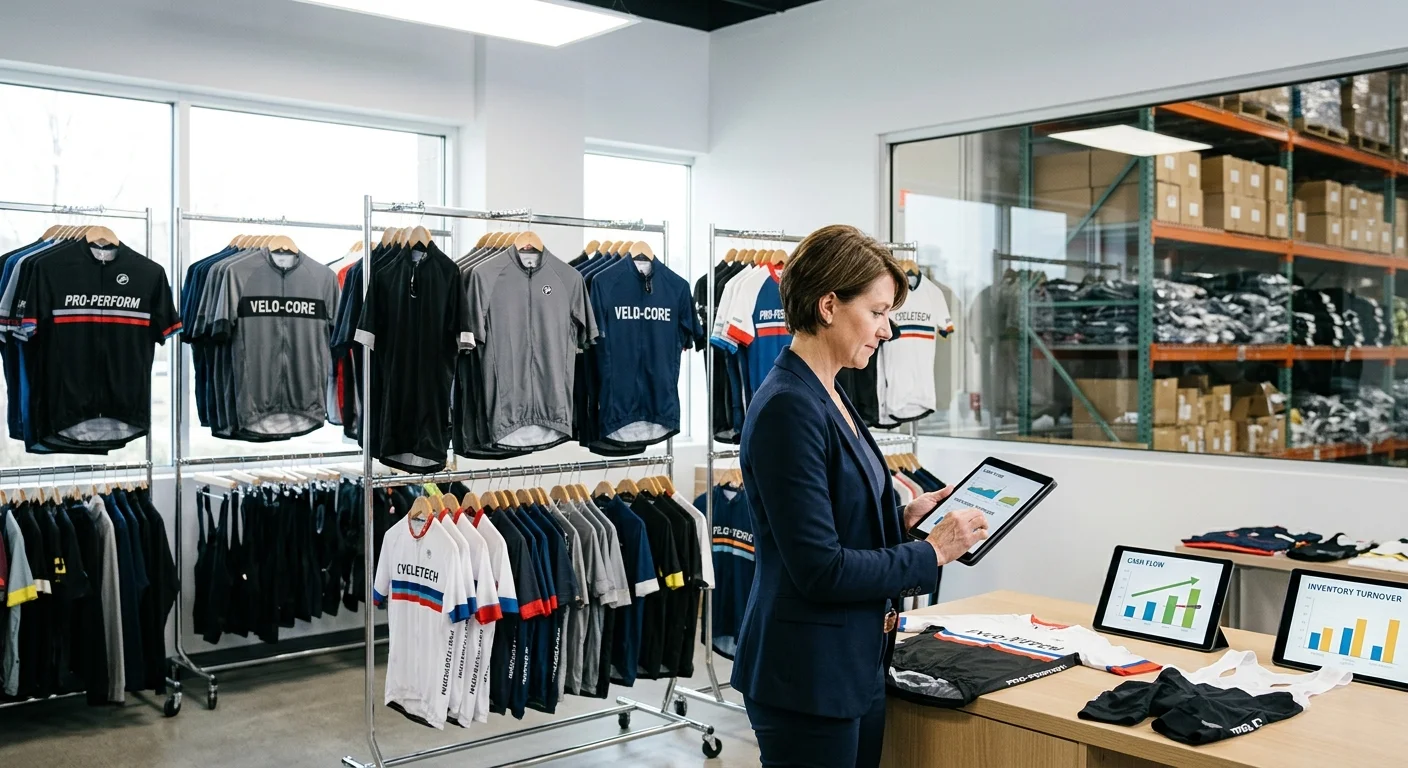
The right supply model isn't the one with the lowest unit cost. It's the one that matches your risk tolerance, cash flow reality, and growth stage.
Still building momentum? On-demand cycling kit production keeps your capital flexible and your warehouse empty. Scaling fast with proven sellers? In-stock inventory boosts your margins and speeds up fulfillment. Most serious operators run both at the same time. That's not indecision — that's smart business.
What kills cycling apparel businesses isn't the "wrong" model. It's choosing without understanding the tradeoffs. Lead times, MOQs, deadstock write-offs — these details matter.
You now have the framework to choose with clarity.
Ready to put it into practice? Browse Runcyclingapparel.com to explore both made-to-order and in-stock programs. Or reach out to discuss which fulfillment model fits where your business is right now.
The best decision is an informed one. Make yours count.