You got your first cycling jersey OEM quote and thought: finally, I know my numbers. Then the invoice arrived — 35% higher than anything you'd planned for. Sample fees you never approved. A color calibration charge buried in line 14. A fabric MOQ surcharge that showed up three weeks before production.
I've been through this exact scenario more times than I'd like to admit. The quoted price in a cycling apparel OEM deal is just the opening act. The real cost story plays out across twelve hidden nodes — from "yes, let's work together" all the way to "your order has shipped." Each node quietly adds to your bill.
This guide breaks open every single one of them. You get:
Real numbers at each stage
Negotiation scripts you can use directly
Three full cost simulation tables built for budgets from $500 to $10,000+
By the end, you'll know your actual landed unit price before you sign anything.
Exclusive proofing and initial production development costs
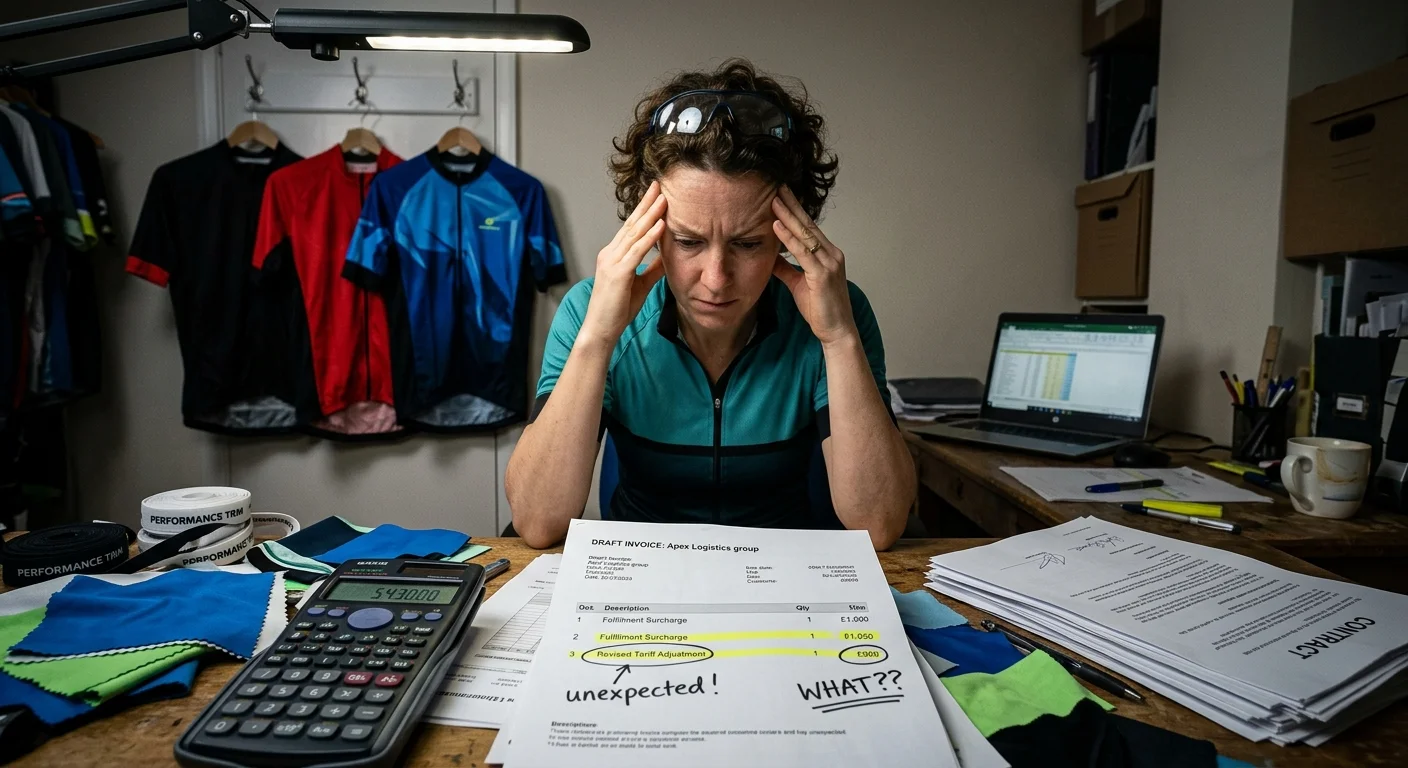
Most factories won't tell you this upfront. The moment you request a custom cycling jersey with a new style number, you've triggered a development charge — whether or not that word shows up anywhere in the quote.
This fee has several names on a PI: sample fee, development charge, prototype cost, pattern making fee. Different label. Same pocket it comes from — yours.
What triggers the charge:
First order with a new factory, or any new style number at an existing one
Requesting the same design across two or more fabric platforms (e.g., Italian MITI high-stretch + domestic warp-knit mesh) — factories treat each as a separate sample fee, each at 20–40% of the base development cost
Complex vector artwork, multi-panel color gradients, sponsor logo placement, or structural panels like sleeve darts or mesh zoning — these need a pattern maker, print engineer, and CAD software working together. Factories price that work at a premium.
2025–2026 realistic cost ranges:
Jersey Type | Sample + Development Fee | Typical Refund Terms |
|---|---|---|
Standard team jersey / sublimation kit | USD $45–$120 / style | 50–100% offset if bulk ≥ 100 pcs |
Race-grade / aero construction (mesh panels, compression zones, TT suit) | USD $130–$180 / style | 50–70% offset if bulk ≥ 200 pcs |
That "Free Sample" badge on Alibaba listings? Read the fine print. It almost always means free only if your bulk order clears the MOQ threshold. Fall short of 100 pieces — or USD $1,000–$1,500 — and the fee becomes a non-refundable line item. No offset. No negotiation after the fact.
There's a subtler version of this that trips up repeat buyers. Some factories charge no sample fee at all. Instead, they bury the recovery cost inside the unit price — running USD $0.40–$0.90/pc above comparable market rates. On a 500-piece run over two years, that gap adds up to USD $300+. That's close to one full mid-tier development fee, paid in small amounts you never tracked.
Negotiation scripts that work:
Locking in the refund commitment:
"Can you confirm the sample fee is offset in full against the first bulk order at ≥50 pieces, per-style per-colorway? Please add this to clause 3 of the PI."
Preventing duplicate charges on revisions:
"We're adjusting fabric weight or zipper spec only — the pattern structure stays the same. Does that count as the same style, with no second development fee?"
Reducing wasted sampling rounds:
"Can you send video footage and Pantone calibration records during sampling? That way, we approve color matching before physical samples ship."
Benchmarking across suppliers:
"Does your sample fee cover pattern drafting, print plate setup, 1–2 physical samples, and basic stretch/wash testing? What's the lead time, and what does rush sampling cost?"
One rule I follow without exception: refund or offset terms go into the PI before I approve samples. No written clause, no deal. Verbal commitments from a sales rep disappear the moment production starts.
Color Separation, Plate Setup & Print Mold Fees
Here's something that catches even experienced buyers off guard. A factory quotes you USD $14/piece FOB on a full-sublimation cycling jersey. That number is accurate. But on a 20-piece first run, there's a USD $100 fixed plate-and-artwork cost underneath it. Spread across 20 units, that's an extra $5 per piece before a single thread gets cut. Your "USD $14 jersey" just became USD $19.
That's how color separation fees, plate setup charges, and cutting die costs work. They're the most invisible line item in any cycling apparel OEM production chain.
What You're Paying For
Full-panel sublimation jerseys don't print like a t-shirt screen. Every design goes through a multi-stage technical process:
Artwork intake and layer audit (AI / PDF / CDR file checking)
Color separation — CMYK breakdown or spot-color + gradient processing
CTP plate output / digital heat-transfer paper layout
Multi-size nesting (grading all sizes onto a single print run) + alignment mark generation
Cut file / die-cut calibration for the automated cutting bed
Factories bundle all of this under different invoice labels: Artwork Setup Fee, Color Separation Fee, Opening Mold Fee, Plate Charge, or One-Time Pattern Setup. The name changes every time. The fixed cost doesn't.
2025–2026 industry-verified price ranges:
Charge Type | Realistic Range | When It Applies |
|---|---|---|
Simple logo / partial print plate | USD $30–60 / set | Small-area branding, no full-panel coverage |
Standard full-sublimation jersey + bib shorts set | USD $80–150 / set | Most team kit OEM orders |
Complex multi-gradient / sponsor-heavy race kit | USD $150–200 / set | Aero suits, camo patterns, multi-panel color bridging |
Hidden per-unit amortization (sub-50 pcs) | USD $0.50–1.20 / piece | Factory "includes setup in price" |
Diminished per-unit amortization (50–500 pcs) | USD $0.20–0.50 / piece | Scaling effect kicks in |
Near-zero per-unit cost (500+ pcs, same artwork) | USD $0.20 / piece | One-time cost spread across large volume |
The sub-50-piece scenario is where the real damage happens. Factories don't invoice this as a separate line item. The PI just reads "unit price includes artwork setup" — and you never see the $100 fixed cost buried across your 20 units at $5 each.
The Reorder Trap Nobody Mentions
The plate fee problem doesn't end at the first order. It resets — unless you lock it in writing.
Two specific scenarios bleed money on repeat orders:
1. Same design, new sizes. Adding a 4XL to an existing run should cost a minor grading adjustment — USD $20–40 — not a full new mold fee. Without a written clause, factories default to billing you the full $80–150 again.
2. Sponsor logo swap, same layout. Replacing one sponsor badge with another on an otherwise identical jersey shouldn't trigger a full re-separation charge. It often does. The factory rebills the entire artwork setup fee because the file changed — even slightly.
Negotiation Scripts That Close These Gaps
Locking the one-time structure:
"Can you confirm the artwork setup fee for this jersey + bib shorts set is charged once per artwork — not per color, per panel, or per printing plate? Please specify this in the PI."
Protecting the cut file across seasons:
"After sample approval, can the cut file be used at no additional charge for repeat orders in the following season, provided the base pattern remains unchanged?"
Capping size grading fees:
"If we add a new size to the existing run without changing the base pattern, would that be charged as a minor grading adjustment in the USD $20–40 range rather than a full new setup fee?"
Separating setup cost from unit price:
"Could you quote unit price excluding the artwork/mold cost, with setup listed as a separate fixed line item? We want to evaluate total cost across different MOQ scenarios ourselves."
Preventing the logo-swap re-bill:
"If we change only the sponsor logo placement on the same layout next season, would that require a new separation charge — or is it covered under the original setup?"
One rule that saves real money over time: get the factory to confirm in writing that the cut file belongs to your account, with no expiration. Factories often treat these files as their own assets. But those files came from your design, your artwork, and your pattern brief — they belong to you.
Multiple Rounds of Color Calibration Fees
Three rounds of color matching. Each one "almost there." Each one billable.
This is the quiet budget killer experienced cycling jersey OEM buyers learn to fear. It's not expensive per round. The problem is it stacks up while your production timeline falls apart around it.
Most factory quotes include one free color matching round. That line reads something like: "Color Matching Fee: Included (1 lab dip / 1 strike-off up to 3 colors)." Round two? That's on you. Round three? Also on you — plus you've just lost 7–10 days of production schedule you didn't plan for.
What Triggers a Second (or Third) Round
Four conditions generate extra color calibration charges in cycling apparel OEM production. Know them up front. That's the difference between a clean production run and a surprise invoice.
Trigger A: You provided RGB values instead of a Pantone reference.
No Pantone C/U number, no physical color swatch — the factory's first-pass color hit rate drops fast. Expect 2–3 lab dip rounds before production color gets confirmed. Every round after the first costs money.
Trigger B: Fabric lot changes between sampling and bulk production.
Sublimation printing and disperse dyes are sensitive to fabric coating, GSM, and moisture absorption rate. A different fabric batch — even from the same cycling apparel supplier — shifts the dye curve. Factories protect themselves with contract language like "color deviation due to fabric lot variation is excluded from warranty." Translation: the rematch fee lands with you.
Trigger C: You need tight color tolerance (ΔE CIELAB ≤ 0.5–0.8).
Standard sportswear OEM color matching targets ΔE ≤ 1.5–2.0. Push that to ≤ 0.5 — which high-end cycling kit brands do more and more — and you're in precision territory. That level requires extra calibration rounds almost by default. Factories charge more for that precision.
Trigger D: Repeat orders placed 90+ days after the last bulk run.
Dye bath, fabric batch, ambient temperature — all of it shifts over time. Factories treat color re-verification on a seasonal reorder as a brand new color matching job. They call it a testing fee or color calibration fee. You call it an unexpected line item at month four.
The Real Numbers (2025–2026 Verified Ranges)
Color Calibration Scenario | Cost Range | Notes |
|---|---|---|
Round 1 (included in base quote) | $0 | Covers 1 lab dip / strike-off, up to 3 colors |
Round 2 onward — small logo, ≤180gsm, single color | $25–$35 / color / round | Triggered by target color change or tolerance miss |
Round 2 onward — full-panel sublimation, 3+ colors | $40–$60 / color / round | Cross-fabric calibration (e.g., 140gsm + 260gsm) |
Seasonal reorder color re-verification (ΔE ≤ 0.5 requirement) | $40–$75 / color / batch | Includes spectrophotometer re-test + ICC profile adjustment |
Those numbers look manageable on their own. They're not, once you add up everything around them.
The Hidden Cost Behind the Calibration Fee
The calibration invoice itself is the small part. On a 5,000-piece cycling jersey run with two extra color matching rounds at $40 per round, your direct out-of-pocket is $80 — $0.016 per piece. Negligible.
What's not negligible:
Wasted strike-off fabric : Each failed calibration round burns 50–100 meters of test fabric at $2.50–$3.50/meter. That's $125–$350 per failed round, folded straight into your total.
Production slot delay : Every extra round pushes your print machine scheduling back 7–10 days. Miss a delivery window in peak season, and the downstream costs blow past the calibration fee itself.
Per-unit amortization of the full calibration cost package : Factories run their own numbers. One complete extra calibration round plus a partial reprint works out to $0.35–$0.60 per piece across the full order. They use that figure to adjust your future pricing.
Here's a useful reference point: professional display device color calibration in the consumer space runs about ¥999 per session — charged per visit, per unit, no exceptions. Apparel factory color calibration costs less per round, but the per-occurrence billing structure works the same way. Bring that mindset into negotiation.
Negotiation Scripts That Lock the Boundaries
Get these commitments in writing before sampling begins. Verbal agreements on color calibration disappear the moment the factory's print schedule fills up.
Locking what "included" means:
"Does the base quote include 1 round of lab dip / strike-off with D65 light box checking? Can you confirm how many colors are covered in that free round, and at what rate you charge from round two onward?"
Clarifying the fabric lot clause:
"If color deviation is caused by fabric lot variation — different dye lot or absorbency — will the extra calibration rounds be charged, or does your factory absorb that cost? Please specify in the PI."
Protecting reorder color standards:
"Can we sign a Batch Color Standard Retention Agreement? We'd need you to retain our approved physical color swatch and LAB data for at least 24 months, so seasonal reorders don't trigger a full re-verification charge."
Nailing tolerance accountability:
"If color difference exceeds ±0.5 CIELAB from our approved standard, who covers the reprinting and recalibration cost? We need that responsibility assigned in the contract — clearly, not left open."
Separating calibration from unit price:
"Could you quote color matching as a standalone fixed line item rather than bundled into unit price? We want to model total cost across multiple order scenarios."
One clause worth adding word-for-word to every PI: "Color calibration fee: Round 1 included at no charge for up to [X] colors. Rounds 2+ charged at $[Y] per color per round. Calibration triggered by factory fabric lot changes is the factory's responsibility."
That single sentence has saved cycling apparel OEM buyers hundreds of dollars per season — not by cutting the cost, but by making it visible and traceable before production starts.
Fabric MOQ Surcharge: The Fee That Hides Inside Your Unit Price
Factories don't lie about this one. They just never mention it.
Pick a functional cycling jersey fabric — high-stretch nylon, Italian antibacterial yarn, reflective fiber blends. You're not just buying material. You're triggering a dye bath. And dye baths have minimums.
Most warp-knit and weft-knit dyeing mills set their minimum dyeing quantity (MTQ) at 300 kg per color per style . Premium functional yarns — Italian antimicrobial nylon, compression-grade elastane blends — push that floor to 500 kg/color. Now do the math on a 350-piece jersey run.
Each jersey uses about 1.3 m² of fabric. So 350 pieces generates about 455 m² of cut fabric. Depending on GSM, that comes out to 70–90 kg of dyed material — less than a third of the mill's 300 kg threshold. The mill flags it as a small-batch dye run ( small-lot dye bath ). The surcharge kicks in.
What that looks like on your invoice:
Scenario | Quoted Fabric Cost | Actual Fabric Cost | Difference |
|---|---|---|---|
Standard polyester, common stock color | ~$5.40/pc | ~$5.40/pc | $0 |
Functional nylon + custom Pantone, 350 pcs | ~$5.40/pc | ~$7.80/pc | +$2.40–3.20/pc |
Italian antimicrobial yarn + compression knit, sub-300 kg | ~$6.20/pc | ~$9.00+/pc | +$2.80–3.50/pc |
The factory's original quote assumed you'd hit MTQ. You didn't. That $2.40–3.20/piece gap is the dye mill's small-batch penalty. The OEM cycling apparel factory absorbs it first, then passes it to you. It shows up as a named surcharge — or gets folded into the fabric unit price with no explanation at all.
Three conditions that almost guarantee this fee triggers:
Imported functional yarn (Italian, Swiss) with any color below 300 kg/color
Reflective yarn or special functional coatings — high setup losses on small runs
Custom Pantone colors that need a dedicated trial dye batch with no reuse opportunity
Negotiation scripts:
Forcing line-item transparency:
"Does this fabric sourcing cost already include the small-batch dye surcharge and a dyeing/cutting waste rate of 8–12%? Please break out net fabric consumption, waste percentage, and MOQ surcharge as separate line items."
The stock base + digital print workaround:
"Say we switch to your existing stock base fabric with full-panel digital sublimation printing — same design, no custom dyeing. Does that remove the MOQ surcharge? Please quote both options side by side."
Locking GSM tolerance to prevent repricing:
"Please confirm that a GSM variance of ±5 within the specified weight won't trigger repricing or extra surcharges. If it goes beyond that range, how do you calculate the adjustment?"
Here's one habit worth building now: ask every factory to quote two options — custom dye versus stock base fabric plus digital print. On sub-500-piece runs, the stock-plus-sublimation route often comes in $1.80–3.50/piece cheaper. You also get faster lead time and zero MTQ risk.
The surcharge itself isn't unreasonable. Dye mills have real fixed costs on small batches. What's unreasonable is finding out three weeks before production starts — after your margin model is already locked.
Pattern Revision & Cutting Table Adjustment Fees
The signed PP sample sitting on your desk isn't a finish line. It's a pressure point.
Request even a minor structural change after that signature — a 2 cm hem extension on the jersey back, one extra splice line on the bib shorts side panel — and you've triggered a two-stage billing event. Most buyers never see it coming. Stage one: pattern revision fee . Stage two: cutting table adjustment fee . Two separate charges. They often appear on the same invoice line, buried inside a vague "adjustment cost" entry.
Here's what you're paying for, and why the number is larger than it looks.
What Triggers the Charge
Factories draw a hard line between changes that affect the pattern structure and changes that don't. That distinction determines whether the factory has to rebuild the entire cutting marker from scratch.
Changes that trigger both fees: - Hem length adjustment ≥1.5 cm (affects the full back-panel arc on cycling jerseys ) - Armhole curve modification ±3–8 mm (not a seam allowance tweak — actual contour change) - Zipper repositioned ≥1 cm or changed to a different length spec - Any splice line added or removed — a single new colored panel on bib shorts is enough - Any change that increases or decreases the total number of pattern pieces
Changes that don't trigger the fee:
- Logo or print placement shift ≤5 mm (artwork layer only, pattern intact)
- Seam allowance adjustment ≤2 mm with no change to the outer silhouette
- Zipper pull style or color swap, no structural change
That second list matters in negotiation. Factories sometimes bundle non-structural artwork adjustments into a blanket "revision charge." Push back. Get the distinction written into your PI before sampling begins.
The Cutting Marker Problem Nobody Explains
This is where the real money goes.
A pattern piece changes shape — even by a small amount — and the existing cutting marker becomes invalid. The marker is the nesting layout that controls how fabric gets cut. A good marker runs at 82–85% fabric utilization on a standard cycling jersey run. Rebuild it from scratch after a structural revision, and that number drops.
Take the reference cost model: original marker at 84% utilization, post-revision marker at 82.2%. Fabric cost is USD $6.00/m at 0.7 m per piece. That 1.8 percentage point drop adds $0.08/piece in direct fabric waste — before you count the pattern maker's time or the cutting room rescheduling.
The full breakdown on a 300-piece run:
Cost Component | Range | Per-Unit Impact (300 pcs) |
|---|---|---|
Senior pattern maker, 1–2 hrs at $15–25/hr | USD $15–50 fixed | $0.05–$0.17/pc |
Marker re-layout, 0.5–1 hr + software | USD $8–20 fixed | $0.03–$0.07/pc |
Fabric utilization loss (1–2 pp drop) | ~$0.08/pc | $0.08/pc |
Production disruption, line reset, first-piece re-check | Soft cost | $0.70–$0.90/pc |
Total realistic adjustment | USD $0.80–1.20/pc |
That last row is what the factory charges. The first three rows are what justifies it.
2025–2026 Verified Price Ranges by Order Tier
Order Size | Typical Charge Structure | Range |
|---|---|---|
50–200 pcs (club team / pre-order) | Per-unit surcharge | USD $0.80–1.20/pc |
50–200 pcs (pattern only, no marker rebuild) | Fixed one-time fee | USD $50–120 / revision |
300–1,000 pcs (team kit / event jersey) | Fixed fee + per-unit add-on | USD $80–150 fixed + $0.10–0.20/pc |
Race-fit / aero construction (any volume) | Premium per-unit surcharge | USD $1.00–1.80/pc |
The aero/race-fit number deserves a separate note. Aggressive position cuts — compressed sleeve caps, anatomic bib shorts with gripper-calibrated leg panels, multi-layer back pockets — require tighter grading tolerances across every size. A single hem adjustment on a race-fit jersey spreads through the entire size run. Factories price that cascade at $1.00–1.80/piece on top of the base FOB. That number is legitimate. What's not legitimate is finding out about it on the invoice.
Negotiation Scripts That Lock Your Exposure
Get these confirmed in writing before PP sample approval, not after.
Defining the free revision window:
"After PP sample sign-off, do you offer any free structural revision rounds before triggering a pattern revision fee? If so, how many rounds, and what's the per-revision charge beyond that?"
Separating structural from non-structural changes:
"We're adjusting logo position or zipper pull color only — no pattern piece change. Does that trigger a revision fee? Please confirm that non-structural changes are excluded from the pattern revision billing."
Requesting marker transparency:
"Can you share the cutting marker and fabric utilization percentage before and after any revision? We want to verify the efficiency gap that drives the adjustment cost."
Capping the aero premium:
"For race-fit construction, is the additional pattern adjustment fee a fixed per-unit add-on or variable? Quote it as a separate line item, distinct from base FOB."
Protecting against mid-production repricing:
"Changes requested after PP approval but before cutting begins — is the adjustment fee fixed at the agreed rate? What's the surcharge if changes come after cutting has started?"
One clause worth adding verbatim to every PI on custom cycling kit orders: "Pattern revision fee is triggered by structural changes to pattern pieces only (contour, splice lines, zipper spec). Non-structural changes (print placement ≤5mm, seam allowance ≤2mm, zipper pull style) are excluded. All revision charges listed as separate fixed line items, not embedded in unit price."
That clause won't eliminate revision costs. It makes every one of them visible — and challengeable — before it hits your margin.
Retail-Grade Custom Packaging Fees
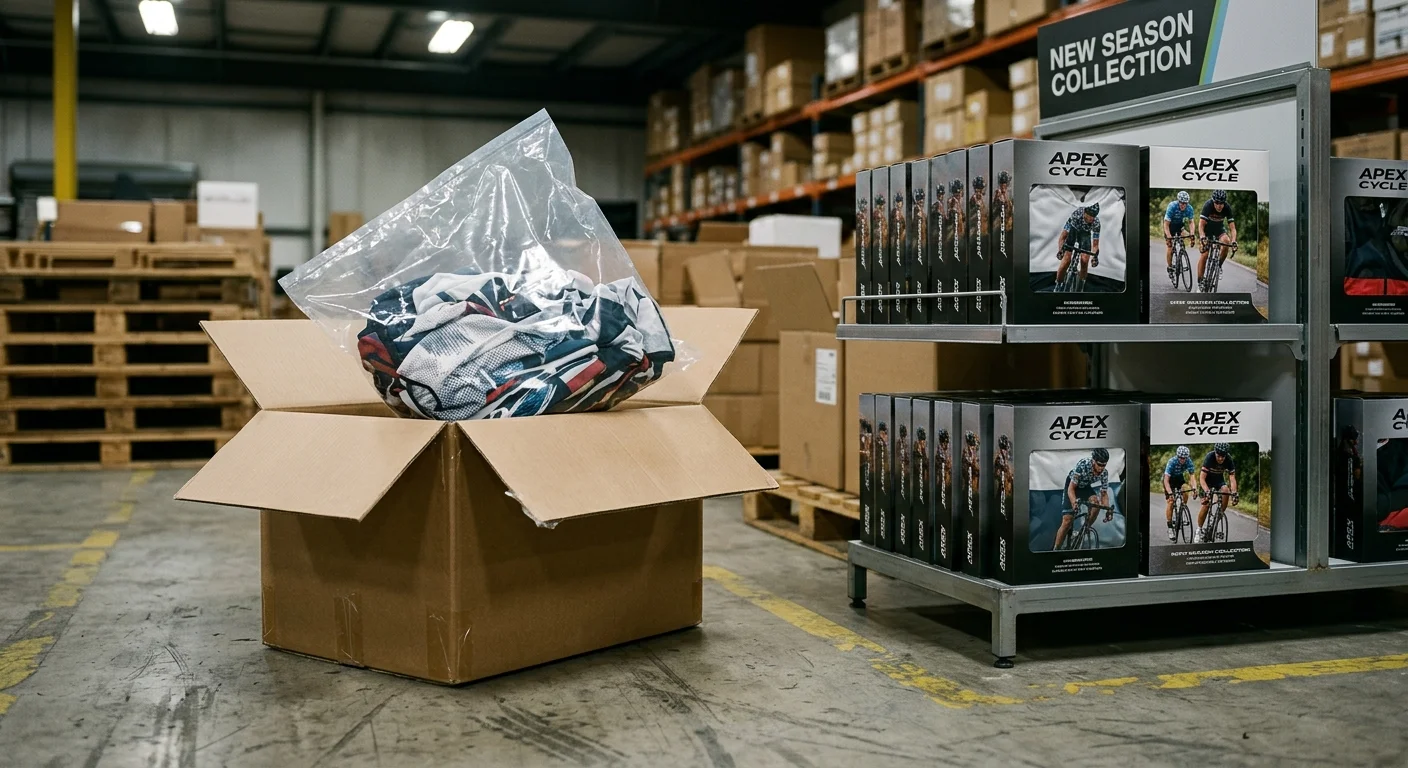
The invoice said "standard export packing included." What arrived was a transparent PE bag and a generic brown carton. Accurate on paper. Useless on retail shelves.
That gap — between what factories call "included packaging" and what retail-ready means in practice — is one of the most consistent hidden charges in cycling jersey OEM production. Most buyers find out after the PI is signed.
Here's what "standard export packing" covers in a typical cycling apparel OEM quote:
A basic OPP or PE bag: USD $0.02–0.05/piece
A generic corrugated outer carton with standard shipping marks: USD $0.20–0.40/piece amortized
That's it. No branded hangtags. No custom care labels. No printed zip-lock polybags. No size stickers. No eco-compliance logos. No RFID trackers.
Ask for anything beyond that list, and you've triggered a separate billing event. Most factories won't bring it up until you're three weeks into production.
What "Retail-Ready" Costs
Here's a real scenario from a cycling kit OEM negotiation. Initial FOB quote: USD $8.50/piece , with "standard export packing" noted in the remarks. The buyer then asked for what any D2C cycling brand would treat as baseline retail packaging:
Branded hangtag + care label + size label
Custom printed matte zip-lock polybag with logo
Simple paper insert card with eco-compliance icons
Manual tagging and bagging labor
The factory came back with this itemization:
Packaging Component | Added Cost |
|---|---|
Branded hangtag + care label + size sticker | USD $0.35–0.50/pc |
Custom printed zip-lock polybag | USD $0.30–0.45/pc |
Paper insert + eco-compliance printing | USD $0.08–0.15/pc |
Tagging / bagging / QC labor | USD $0.20–0.35/pc |
Total retail packaging add-on | USD $1.00–1.80/pc |
On a 500-piece cycling jersey run, that last row means USD $500–900 in unbudgeted spend . Unit cost jumps from $8.50 to $10.30 . Packaging alone takes up 17.5% of the landed unit price — not the 5–8% most buyers set aside in their heads. That's where profit margins go.
The Three Packaging Tiers and Their Real Price Ranges
Not every buyer needs the same packaging level. Here's how costs break down by tier across 500–3,000 piece runs (2025–2026 verified ranges):
Tier 1 — Basic Retail-Ready (shelf-ready from bulk)
Branded hangtag + care label + custom poly bag + size sticker + basic eco mark.
USD $1.00–2.20/piece total added cost
FSC paper stock + 4-color printing + spot UV/foil finishing pushes toward the $1.80–2.20 ceiling
Watch for MOQ traps: hangtags and care labels often require 3,000–5,000 pcs/style minimum , adding $0.10–0.20/piece to small orders
Tier 2 — Eco Compliance + Digital Traceability
REACH / OEKO-TEX compliant labels, multilingual care label reformatting, serialized QR codes or RFID.
Multilingual care label rework + third-party compliance testing amortized: +USD $0.08–0.15/piece
Serialized QR / anti-counterfeit tags (≥10,000 units): $0.03–0.06/piece
Low-frequency RFID hangtag / sticker (inlay + application labor): $0.22–0.35/piece
Combined Eco + RFID add-on: +USD $0.25–0.40/piece above Tier 1
Tier 3 — Custom Retail Box / Blister Tray / Gift-Grade Packaging
For premium cycling kits priced at the high end of retail.
Component | 500–1,000 units | 1,000–3,000 units |
|---|---|---|
4-color printed corrugated gift box | $1.20–1.80/pc | $0.80–1.40/pc |
Inner tray (flocked / vacuum-formed) | $0.60–1.50/pc | $0.60–1.50/pc |
Premium rigid lid box + foil + UV coating | $2.50–4.00/pc | $2.50–4.00/pc |
Full gift-box assembled landed cost | $3.00–4.50/pc | $2.50–3.80/pc |
One cost that rarely comes up: die-cut molds and print plate setup fees for custom boxes. First-order tooling runs USD $80–300/mold — charged once, then spread across units. On a 500-piece box run, that adds $0.16–0.60/piece before the box itself is counted.
The Costs Hiding Behind the Costs
Experienced cycling apparel OEM buyers still miss these secondary charges buried inside packaging decisions:
Multi-language label version management : Some factories charge $0.03–0.05/piece per extra language version on care labels — per country market, no announcement
Assembly labor per operation : Inserting hangtags, folding into boxes, applying silicone grip strips — factories bill this at $0.10–0.30/piece per operation
Third-party certification cost-sharing : A single REACH or OEKO-TEX audit report runs USD $150–800 . The factory may pass that cost to you. At low order volumes, that translates to $0.10–0.30/piece
Negotiation Scripts That Lock the Packaging Scope
Get packaging defined before production starts. Once the cutting room is running, your leverage is gone.
Confirming what FOB includes:
"Please confirm whether your FOB price includes hangtags, poly bags, and care labels — or just a simple PE bag and export carton. Define 'standard export packing' line by line."
Getting an itemized retail packaging quote:
"We need retail-ready packing — branded hangtag, printed zip-lock polybag, care label, size sticker. Quote it as a separate line item per piece, broken into print materials, accessories, and labor."
Splitting eco-compliance responsibility:
"For REACH / OEKO-TEX compliance labeling — who handles testing and certification? We can provide existing certification reports. Do you still require independent re-testing? List per-report cost and lead time as separate line items."
Containing RFID scope creep:
"RFID or serialized QR needs to be broken out: inlay cost, printing, encoding, and application labor — each as a separate line item. No bundled per-piece markup without itemization."
The bulk-pack-plus-local-packaging option:
"Can you ship bulk packing without retail packaging at the factory, and we handle retail-grade packaging at the destination? Quote both options side by side so we can compare total landed cost against domestic packaging costs."
Add this sentence to every PI, word for word: "FOB unit price includes [specific list]. All retail packaging components — hangtags, poly bags, care labels, compliance labels, RFID — are quoted as separate fixed or per-unit line items and are not embedded in the base FOB price."
That one clause turns packaging from a surprise invoice into a cost line you can plan around. That's the version of this fee that belongs in a margin model you can trust.
Full Inspection & Rework Costs
"QC Included" — three words that have cost cycling apparel OEM buyers hundreds of dollars per order. Most never noticed.
Here's what that phrase means inside most factories: a line worker glances at the finished jersey, cuts a few visible threads, and marks it passed. No AQL table. No sampling protocol. Quality control happened — on paper. In practice, you're flying blind.
Factories default to AQL 2.5 (major defects) / 4.0 (minor defects) sampling inspection as their outbound standard — not 100% inspection. That's industry-normal. The problem starts when batch defects cluster. Common culprits on cycling jerseys: reflective strip edge lifting, sublimation print misalignment, loose thread at collar seams, and silicone hem grip delamination after washing. These aren't random one-off defects. They're systemic — one appears, many follow.
A third-party Final Random Inspection catches a defect rate above 4.5% on a 5,000-piece cycling jersey run. The cost cascade looks like this:
Cost Component | Calculation | Total |
|---|---|---|
Internal rework (225 defective pcs × $1.00/pc) | Re-ironing, re-stitching, reflective strip replacement | $225 |
Factory full-inspection labor (10 workers × 1 day × $30/person) | Spread across 5,000 pcs ≈ $0.06/pc | $300 |
Third-party re-inspection (1 man-day) | ≈ $0.03/pc | $150 |
Visible cost subtotal | $675 / $0.135 per piece | |
Production slot disruption (3-day line reset, opportunity cost) | Delayed new orders + overtime recovery | +$0.30–0.40/pc |
Realistic total impact | ≈ $0.65/pc above quoted FOB |
That "QC Included" promise just cost you $0.65 per piece — on top of an $8.20 FOB. No one invoiced it as a line item. It vanished into rescheduling chaos and absorbed labor hours.
What Triggers the Full-Inspection Upgrade
Three conditions turn a routine AQL sample check into a 100% full-inspection event:
AQL threshold breach on clustered defects. Sample 200 units, find 9 failing pieces (4.5% rate) — AQL 2.5 rejection is automatic. The factory must reinspect everything before release.
Brand or campaign risk sensitivity. Race sponsorship jerseys, e-commerce launch kits, event-branded cycling apparel — buyers mandate zero visible defects reaching market, and put it in the contract. One AQL fail triggers mandatory full inspection plus rework. The factory pays.
Prior order defect history. A previous cycling jersey order with >2% customer-reported defect rate puts you in a different contract tier. Experienced buyers write this straight into the PI: "If AQL inspection fails, factory bears 100% reinspection and rework labor, or accepts third-party on-site full inspection at factory's expense."
2025–2026 Verified Cost Ranges
Third-party full inspection (SGS / Intertek / QIMA / BV):
Scenario | Cost Range | Per-Unit Estimate |
|---|---|---|
Standard man-day rate (China / Vietnam / Bangladesh) | $120–250/man-day | — |
Cycling jersey inspection throughput | 400–600 pcs/man-day | $0.24–0.50/pc |
Factory cooperation overhead (space, repackaging) | Absorbed by factory | +$0.05–0.10/pc |
Internal rework cost (factory-side, not outsourced):
Defect rate ≤ 2–3%: most factories absorb the cost in-house, nothing gets itemized
Defect rate > 3% on labor-intensive positions (zipper, reflective strip, silicone hem): $0.80–1.60/pc
Full seam-rip and re-stitch required: rework time hits 25–30 min/pc, pushing cost to $1.50+/pc
Root-cause fabric or print failure (requires re-cut, reprint): this exits "rework" territory — it enters partial write-off + supplemental production , with unit losses no standard cost model covers well
Negotiation Scripts That Lock Accountability Before Production
Get these in the PI — not in an email thread from the sales rep, not in a WeChat message.
Locking the AQL standard in writing:
"Does your QC process follow a formal written AQL 2.5/4.0 table? Can you confirm that reflective strip adhesion, print registration, thread trimming, and seam integrity are all named inspection items — not left to inspector discretion?"
Defining what 'QC Included' covers:
"Your quote reads 'QC Included' — does that mean first-piece confirmation, in-process patrol inspection, and final AQL sampling? Or just final sampling? Please break these out as separate line items on the PI."
Assigning reinspection cost responsibility:
"If third-party final inspection fails AQL 2.5/4.0, who covers the reinspection man-day fee and factory-floor access cost? We need that responsibility assigned to a named party in the contract."
Establishing a defect-rate remedy mechanism:
"If post-delivery defect rate exceeds 2% based on AQL 2.5/4.0 criteria, are you open to either: (a) deducting the defective-unit value from the next payment, or (b) adding replacement units to the next cycling jersey order at no charge?"
Protecting against functional defect liability:
"For functional defects — zipper failure, reflective strip delamination — can we agree to a 60-day post-receipt warranty window covering free replacement or credit?"
One clause worth adding word-for-word to every PI on cycling jersey OEM production with reflective or silicone elements: "QC Included covers first-piece confirmation + in-process patrol inspection + AQL 2.5/4.0 final sampling on all named defect categories. Any full-inspection or rework triggered by AQL failure is the factory's cost responsibility unless defect cause is buyer-supplied material."
That sentence costs nothing to add. On a 5,000-piece run hitting a 4.5% defect rate, it protects $3,250 in margin.
Hidden Logistics & Customs Markups
The shipping quote looks clean. One number. Door to door. Done.
It isn't done.
Between a factory's FOB price and your actual landed unit cost sits a layer of fees that most freight intermediaries never mention. They're not hidden in the criminal sense — they're hidden in the structural sense. The quote is built to keep those fees out of sight until the invoice lands on your desk.
Here's what that looks like in practice. A cycling jersey bulk order leaves China at an EXW price of $9.80/piece . The DDP estimate is $2.00/piece — sea freight, customs, final-mile delivery. Projected landed cost: $11.80 .
What you actually receive:
Markup Node | Estimated | Actual | Delta |
|---|---|---|---|
Doc Fee + THC + Brokerage + port charges | $0.50/pc | $0.80/pc | +$0.30 |
Final-mile (volumetric weight recalculated at 1:200 vs 1:167) | $0.60/pc | $0.90/pc | +$0.30 |
Peak season surcharge (no space locked in advance) | $0 | $0.10/pc | +$0.10 |
Total logistics cost | $2.00/pc | $2.70/pc | +35% |
Actual landed unit price | $11.80 | $12.50 | +5.9% |
That 35% overrun on the logistics line is where the damage lives — not in the jersey itself.
The Five Nodes That Drive the Overrun
1. Customs Agent Fee Fragmentation
The initial quote gives you one number — "clearance fee, around ¥XXX." Then it splits on arrival. You'll see document translation ¥100–300/shipment, express clearance surcharge ¥200–800/shipment, coordination fee ¥200–500/shipment, and inspection service fee ¥300–800/container. That last one gets charged even when customs never touches the cargo. It's the classic low-quote-to-win-the-business, bill-the-rest-later move.
2. DDP Intermediary Markup
About 60% of DDP service providers have no proprietary freight channels. They resell. That reselling adds 18–25% on top of first-tier market rates across sea freight and customs segments. Nothing gets itemized. You see it as one DDP total — running 10–20% above what the market rate should be.
3. Peak Season Surcharge Exposure
Q3–Q4 on Europe/US routes. No space locked in advance. Peak Season Surcharge plus emergency slot premium pushes head-haul sea freight costs up 15–30%. For cycling jersey bulk orders — high value, light cargo — that lands at +$0.50–0.80/piece on your unit price.
4. Destination Port Charges
Five line items show up in nearly every shipment. Almost none get quoted upfront:
THC : $150–300/FCL container; $8–18/CBM for LCL
Doc Fee : $30–80/shipment, plus potential $100–150/shipment once "release fees" are stacked
Brokerage : $50–120/standard; jumps to $150–250 when "compliance review" language appears
Port storage overage : $30–80/container/day or $5–15/CBM/day after the 3–7 day free window
Reasonable benchmark : port + customs + final-mile combined should fall within 2–4% of cargo value — anything above that, ask for a line-by-line breakdown
5. Volumetric Weight Manipulation
Air freight and express carriers use a volumetric divisor of either 1:167 or 1:200. A quote that says "volumetric weight applies" without naming the divisor leaves room to use the worse number against you. The gap between the two: 20% higher effective freight cost . That's not a rounding error.
Negotiation Scripts
Forcing DDP cost transparency:
"Can you break your DDP quote into four separate line items — ocean freight, import duty, brokerage/customs handling, and final-mile delivery? Label the pricing unit for each (per shipment / per piece / per CBM / per container)."
Locking the volumetric divisor:
"Please confirm in writing which volumetric weight divisor applies — 1:167 or 1:200. We need that specified in the contract, not left to carrier discretion at time of booking."
Pushing back on customs fee fragmentation:
"Your clearance fee — does it include document handling, coordination, and inspection service fees? List each component as a separate line. We won't accept post-shipment additions under any of these categories."
Hedging peak season exposure:
"For Q3–Q4 shipments, can you lock freight space and rate at booking? Give us a quote with and without space reservation so we can weigh the risk cost."
Add this clause to every PI that involves DDP terms:
"DDP unit price is itemized as: [ocean freight $X/pc] + [import duty $X/pc] + [brokerage/port charges $X/pc] + [final-mile $X/pc]. No post-shipment additions permitted under any line item without written buyer approval."
Without that clause, the shipping cost you modeled and the cost you pay are two different numbers.
Currency Fluctuation & Forward Hedging Reserve
A $15.00/piece FOB quote locked in January. By the time your final payment clears in March, the RMB has moved from 6.90 to 6.65 — and your real unit cost just became $15.56. That 3.7% swing didn't show up on any invoice. It eroded your margin without a trace, between the date you signed the PI and the date the wire cleared.
This is the hidden cost nobody builds into their landed-cost model. Not because it's obscure — but because it feels abstract until it hits you.
What creates the exposure:
The gap between PI signing and final payment on a typical cycling jersey OEM order runs 30–90 days. The RMB/USD rate moves during that window. Factories quote in USD but settle costs in RMB. They absorb that rate movement — then pass it back to you. It shows up either as an explicit "exchange rate adjustment" or gets folded into your next season's pricing with no clear label.
2025–2026 realistic cost ranges:
Hedging Scenario | Cost Range | Per-Unit Impact ($15 jersey) |
|---|---|---|
No hedge — factory absorbs & reprices next order | — | $0.30–0.80/pc untracked |
Forward contract (1–3 month tenor, Chinese bank) | 0.8–1.5% of order value | $0.12–0.23/pc |
PBoC risk reserve (rate 0–20% of notional) | Variable by cycle | Up to $0.25/pc at peak reserve |
Built-in volatility buffer (industry standard) | 1.5–3% gross margin | $0.23–0.45/pc at $15 FOB |
The mechanism behind the number:
China's central bank has adjusted the forward FX risk reserve ratio between 0% and 20% multiple times since 2020. At 20%, a $100,000 forward position requires a $20,000 reserve. That raises the factory's effective hedging cost and squeezes the margin they quote you. Reserve rates drop back to 0% and that pressure eases. The problem? You won't know which rate applies on the day you sign.
Negotiation scripts that work:
Locking a fixed rate in the PI:
"Can we add a fixed exchange rate clause — 6.90 as the base — with any movement beyond ±1.5% split 50/50 between us? Please add that to clause 4 of the PI."
Shortening the exposure window:
"Can we restructure to 30% T/T deposit + 70% LC at sight? Or split the final payment into pre-shipment and port-arrival tranches to cut the single exposure period?"
Making hedging costs visible:
"If your FOB price includes a forward hedging reserve, please break it out — we need it listed as a separate line item at 0.8–1.5% of invoice value. We can't model margin without that number."
Multi-currency matching:
"We sell into the euro zone. Can you support EUR settlement? That cuts one conversion layer for both sides."
One practical rule: on any cycling jersey OEM order with a settlement cycle over 45 days, budget a 2% currency buffer into your landed cost before you set the retail price. Not as a contingency — as a fixed input. The RMB's documented trading range of 6.7–7.2 against the dollar produces swings that can wipe out a 3–5% net margin target. That's not a tail risk. It's the base case.
Design IP Registration & Filing Fees
Nobody budgets for this until they're staring at a $450 line item they didn't see coming.
Your cycling jersey carries a custom logo, team crest, or licensed artwork? That creates an IP exposure — plus a paper trail of compliance costs. Most OEM cycling apparel factories won't bring this up. You have to ask.
What You're Paying For
IP filing fees break into three separate tracks. Each track has its own price structure:
Copyright registration (design/artwork):
Filing Type | Cost Range |
|---|---|
China Copyright Protection Center (per design) | ¥500/piece ≈ $70/design |
Series registration (2nd piece onward) | ¥100/piece ≈ $14/design |
Blockchain timestamp / e-certificate (B2B platform) | ¥50–¥300 ≈ $30–$80/design |
US Copyright Office — single work, online | $35–$55/work |
US Copyright Office — contract/license filing | $105/document |
Rush processing (special handling) | $550/document |
Trademark registration (official fees):
Jurisdiction | Official Fee | With Agent (All-In) |
|---|---|---|
China | ~¥300/class ≈ $42 | $150–$250/class |
United States (TEAS Plus) | $250/class | $350–$500/class |
EU (EUIPO single mark) | €850 first class | $300–$400/class avg |
Customs IP protection filing:
The administrative fee is waived at most Chinese customs offices right now (Huangpu confirmed: ¥0). Your real cost is agent service fees — ¥800–¥2,000/IP item — plus document preparation and translation at ¥300–¥800/filing .
The $0.15/Piece Cost Nobody Models
One-time registration isn't the whole story. Licensed IP designs also carry a per-unit recurring charge: the authorization traceability label. These are NFC tags, anti-counterfeit codes, or "Licensed by [Brand]" printed hangtags with serialized QR codes.
Industry range: $0.05–$0.20/piece . At $0.15/piece on a 500-piece cycling jersey run, that's $75. It won't show up in the unit price. It will show up in your margin.
Run the math on a small-batch order:
Cost Item | Amount |
|---|---|
US copyright registration + license contract filing | $105 + $550 = $655 |
China copyright registration (1 main + 2 variants) | ¥1,500 ≈ $210 |
Customs filing agent fee | ~$200 |
Traceability labels (500 pcs × $0.15) | $75 |
Total one-time compliance cost | ~$1,140 |
FOB base (500 pcs × $12) | $6,000 |
Compliance cost as % of order value | ~19% |
Most buyers set aside 2–3% for compliance. The real number runs 8–19% depending on jurisdiction scope. That gap is where budgets break.
Negotiation Scripts That Protect Your IP and Your Margin
Lock ownership before production starts:
"Before sampling begins, can we execute a written IP Ownership and Confidentiality Agreement? It should confirm that all custom logo files, pattern artwork, and vector source files belong to us — with no factory right to retain, display, or reproduce them beyond this order."
Separate filing costs from unit price:
"IP registration or customs filing fees on our design should be quoted as standalone fixed line items — not embedded in the FOB unit price. We need to model compliance cost on its own across different order volumes."
Clarify label scope:
"Do your quoted packaging costs include IP traceability labels or licensed artwork hangtags? Break out the per-unit label cost as a separate line item — inlay, printing, encoding, and application labor each listed on its own."
Add this clause word-for-word to every PI that involves custom artwork:
"All design files, pattern artwork, and IP registration documents generated for this order are the exclusive property of the buyer. The factory holds no rights to display, license, or replicate designs beyond the agreed production scope."
Skip that sentence, and your logo ends up on someone else's cycling jersey next season.
After-Sales Returns & Defect Buffer Costs
Five percent sounds small. On a 500-piece cycling jersey OEM order at $22 FOB, that number turns into $55 in size exchange losses — before you ship a single replacement.
Most custom cycling jersey manufacturers never mention this in the quote. The buffer cost sits in your margin model. Or it doesn't, until it's too late.
The Three Cost Nodes That Hit Every B2B Order
Size exchange rate (3–5% of order value)
Asian and European sizing diverge more than factories admit. A "Medium" in a Chinese domestic pattern runs 1–2 cm narrower through the shoulders than the same tag in a European club kit. High-stretch fabric makes it worse. It loses recovery after warehouse compression. Your size exchange rate climbs toward 5% by default. Budget $0.45–$0.80/piece as a fixed input — not a contingency.
Reverse logistics ($3.50–$6.00/piece)
Cross-border return freight on cycling apparel OEM orders almost never appears in the quote. It always gets paid, though. Who pays is negotiable. Who absorbs it by default? You do.
Defective stock write-down (15–30% discount)
Pieces that can't sell at full price need a recovery path. Plan ahead and local refurbishment plus secondary-channel sales can recover 70–85 cents on the dollar. Skip the plan, and that inventory sits at cost until it doesn't.
What a Real Cost Cascade Looks Like
Buffer Component | Rate | Per-Unit Impact ($22 jersey) |
|---|---|---|
Size exchange buffer | 5% of order value | +$1.10/pc |
Reverse logistics (buyer-absorbed) | $4.50 avg / returned piece | +$0.22/pc at 5% return rate |
Defect write-down (20% discount, 3% batch defect rate) | 3% × $4.40 loss | +$0.13/pc |
Safety stock overhead (5–10% reserve, warehouse) | Amortized across run | +$0.15–0.20/pc |
Total realistic after-sales buffer | ≈ $0.95–1.60/pc above FOB |
Team kit and group purchase orders run higher. Twelve riders with twelve different fits make size confirmation hard to pin down. Miss the sizing deadline and you're looking at a 12% budget overrun the contract never covered.
Negotiation Scripts That Contain the Damage
Locking size tolerance in the PI:
"Please include a standard size measurement chart with an accepted deviation range of ±1 cm per dimension. Any garment outside that tolerance is the factory's responsibility to replace."
Defining the exchange window:
"For same-size exchanges within 30 days of delivery, can you confirm a zero-cost swap on units within the agreed defect threshold — no reverse freight charged to us?"
Building the redundancy pool:
"Can we add a 1:10 buffer arrangement — 10% extra units on core sizes at no additional unit cost, used to offset size exchange and defect losses?"
Splitting reverse logistics responsibility:
"Please confirm in the PI who absorbs return freight costs — buyer, factory, or split — and at what per-piece rate. We won't accept open-ended liability on this line."
One clause worth adding word for word: "Size exchange rate buffer capped at 5% of order quantity. Reverse logistics responsibility assigned to [factory/buyer] at $[X]/piece. Defective units exceeding 2% batch rate are eligible for replacement in the next production run at no additional FOB charge."
Leave that clause out, and the after-sales cost in your cycling kit production budget stays a guess. Put it in, and it becomes a number.
Cross-Timezone Communication & Production Delay Costs
Eighteen days. A cycling jersey order ran 18 days past its confirmed delivery date. The factory made a good product. The problem? A version confirmation email sat unanswered for three working days across a 7-hour time difference. By the time production restarted, the spring race series launch window had closed.
That's the real cost. Not a line item. A missed season.
What drives the delay:
Design feedback lag — Every unanswered confirmation past 24 hours squeezes the production chain: fabric intake, cutting, sublimation printing, sewing, packaging. Miss one node, and every node behind it shifts.
Repeated pre-production sample revisions — Each round of structural changes resets the cutting schedule. Three revision cycles on a 45-day lead time can eat up 12–15 days before a single jersey gets cut.
Holiday shutdowns — Chinese New Year, Diwali, Christmas. Factories stop. Logistics slow. Confirmation loops freeze. No buffer days in the contract means your order joins the restart queue behind everyone who planned ahead.
Line insertion — A larger order lands, and your run gets bumped. Promised delivery becomes late delivery. No invoice. No explanation.
2025–2026 verified cost ranges:
Cost Node | Industry Range |
|---|---|
Standard production lead time (apparel OEM) | 30–45 days |
Sample lead time (negotiation anchor) | ~15 days |
Delay penalty clause (B2B standard) | 0.5–1%/week of order value |
Communication overhead (internal tracking labor) | $0.05–$0.12/person-day (light-touch); much higher with multi-round revisions |
Missed seasonal window loss (cycling kit) | 20–22% of material cost equivalent |
Seasonal products — cycling jerseys, race kits, event apparel — don't just have delivery problems. They have revenue problems. An 18-day delay on a spring kit launch means missed race registrations, missed club group-buy windows, and shrinking retail shelf time. Add emergency air freight, repackaging, and line-insertion surcharges on top of that. The total loss runs well past any standard delay penalty clause.
Negotiation scripts that lock accountability:
"Can you provide a milestone Gantt chart covering: sample approval / fabric intake / cutting / sublimation printing / sewing / packaging / shipment? We need each node with a named responsible party."
"Does the contract trigger an automatic discount — say 2% per week — if delivery exceeds the agreed date by 7+ days? Or do you absorb emergency airfreight costs? We need that written into clause 5."
"Can we set up a dedicated WhatsApp or Slack project group with a fixed Wednesday progress sync? All approvals go in writing — no verbal sign-offs."
"For Chinese New Year / Christmas shutdowns, can we pre-write buffer days into the contract with a confirmed post-holiday restart priority?"
Clause worth adding word-for-word to every PI:
"Production milestones confirmed per Gantt chart. Buyer feedback SLA: 24-hour warning / 48-hour escalation / 72-hour schedule revision trigger. Delays exceeding 7 days incur [X]% per-week deduction or factory-absorbed expedited freight. Holiday shutdown windows and post-holiday priority restart confirmed in writing at order placement."
Communication overhead doesn't show up in most budget models. Chasing updates across time zones, coordinating overnight approvals, managing multi-department loops — none of it gets tracked. It should. At $0.05–$0.12 per person-day for routine follow-up, a 45-day production cycle with cross-timezone coordination adds up fast. Add revision rounds and escalations, and that number climbs higher.
Build the timeline into the contract before you sign. Not after the jersey is late.
$500–$2000 Small-Batch Implementation Cost Simulation (Fleet & Startup Brands)
30 pieces. That's where most cycling teams and startup kit brands begin — not 500, not 200. Thirty jerseys, one design, one factory quote that looks tidy on paper.
The table below runs the numbers on that exact scenario.
Order baseline: Standard short-sleeve sublimation jersey. 150–180gsm polyester knit. Single design across S–XL. FOB Guangzhou/Shenzhen. Factory base quote: $18.50/piece .
Hidden Cost Node | Per-Unit Impact |
|---|---|
Sample fee amortized (30 pcs) | $1.20 |
Pattern development fee | $0.95 |
Color calibration overage | $0.40 |
Fabric MOQ surcharge | $2.10 |
Retail packaging upgrade | $1.50 |
Full inspection reserve | $0.35 |
Freight + import duties | $1.85 |
Currency buffer (1.6%) | $0.30 |
After-sales defect buffer | $0.60 |
Hidden cost subtotal | $9.25 |
Real landed unit price | $27.75 |
Add a ±5% variance band for freight and fabric price shifts. Your real planning range lands at $26.50–$29.00/piece .
Total cash out on 30 units? Closer to $900–$1,100 . That's once you count design coordination, wire transfer fees, and sample shipping — not the $555 the FOB invoice shows.
That $18.50 quote wasn't wrong. It told half the story. The other half lives in that $9.25.
$2000–$10000 Medium-Batch Implementation Cost Simulation (Regional Distributors & Club Alliances)
150 pieces. That's the number where cycling apparel OEM economics start making sense — and where the hidden cost structure turns dangerous.
Order baseline: Race-grade short-sleeve jersey. High-gauge mesh main fabric with functional splice panels. Full-panel sublimation plus rubber number printing. Branded hangtag + care label + individual gift box. DDP factory quote: $22.00/piece .
Hidden Cost Node | Per-Unit Impact |
|---|---|
Sample fee amortized (150 pcs) | $0.25 |
Plate/mold setup fee | $0.30 |
Color calibration overage | $0.20 |
Functional fabric MOQ surcharge | $0.50 |
Retail packaging (gift box + tags) | $1.80 |
Third-party QC inspection | $0.45 |
Logistics & customs increment | $2.10 |
Currency hedging reserve | $0.15 |
After-sales defect buffer | $0.35 |
Communication delay buffer | $0.18 |
Hidden cost subtotal | $6.28 |
Real landed unit price | $28.28 |
Add a ±3.5% variance band. Your real planning range lands at $27.30–$29.27/piece .
Total cash commitment on 150 units runs between $4,095–$4,390 — not the $3,300 the DDP invoice shows.
The One Negotiation Window Most Buyers Miss
The 150–400 piece tier is where packaging and QC terms are open for negotiation. Below 80 pieces, factories won't budge. Above 800, their processes lock in too tight to flex. This middle band is different. Factories will trade concessions to secure your order confirmation. That means waived hangtag mold fees, two free color calibration rounds written into the PI, and shared third-party inspection costs.
Put it in writing. Ask for it by name. That one conversation saves you $0.80–1.20/piece before production even starts.
$10,000+ Large-Batch Implementation Cost Simulation (National Agents & Cross-border DTC Brands)
At 800 units, the math looks clean. The DDP quote is locked. The packaging is sorted. The factory confirms production slots. Then the actual invoice lands — and the number is $22.01 instead of $16.80.
That $5.21 gap is what this table is built to expose.
Order baseline: Race-grade aero cycling jersey, 800 pieces, single colorway, full size run M–XXL. Competitive DTP retail packaging (custom gift box, hangtag, size label, insert card, FBA-compatible). DDP locked at $16.80/piece , 30% deposit + 70% pre-shipment balance.
Hidden Cost Node | Per-Unit Impact |
|---|---|
Sample fee amortized (800 pcs) | $0.06 |
Pattern development fee | $0.08 |
Color calibration (Pantone + strike-off) | $0.05 |
Fabric MOQ surcharge (bulk offset) | $0.00 |
Custom retail packaging (gift box + tags + labor) | $2.20 |
Third-party AQL inspection | $0.25 |
Logistics & customs buffer | $1.65 |
Currency hedging reserve | $0.12 |
After-sales return buffer (4% rate) | $0.15 |
Project management overhead | $0.05 |
Hidden cost subtotal | $4.61 |
Real landed unit price | $21.41 |
Add a ±2.8% variance band for freight timing, supplemental duties, and currency swings. Your real planning range: $20.82–$22.01/piece .
Total cash commitment on 800 units: $16,656–$17,608 . Budget $17,000–$17,500 as your working capital anchor — not the $13,440 the DDP invoice shows.
Where the $4.61 Comes From
Two line items drive 83% of that hidden cost total.
Custom retail packaging at $2.20/piece is the heaviest single cost. A competitive gift box setup includes 300–350gsm greyboard, full-color print, branded hangtag set, insert card, custom polybag, and assembly labor. That combination does not drop below $2.00/piece at 800 units — no matter how hard you negotiate. The one lever that works long-term: standardize your box dimensions across SKUs. That way, the same die-cut mold covers every reorder. That single decision cuts packaging unit cost 10–20% on the second run .
Logistics and customs buffer at $1.65/piece reflects reality, not pessimism. DDP quotes price on today's tax rate and today's volumetric calculation. Port congestion surcharges, minor duty adjustments, and document discrepancies all add supplemental billing after the ship sails. Build the buffer into your retail price now — not after the customs broker sends the reconciliation.
The fabric MOQ surcharge lands at zero here because 800 units at race-grade volume hits minimum dyeing thresholds. Drop below 300 pieces on the same fabric? That line item jumps to $0.50–$0.80/piece, fast.
The One Clause That Protects the Whole Model
Add this to every DDP contract at this order tier, word for word:
"DDP unit price is fixed at $[X]. Any variance in fuel surcharge, port handling, volumetric recalculation, or supplemental duty exceeding 3% of the contracted DDP value requires written buyer approval before additional billing."
Without it, your $16.80 DDP quote has soft edges. With it, the number holds.
Sourcing directly? See our OEM/ODM Cycling Apparel Manufacturing program for MOQ, lead times and private label options.
Conclusion
Every factory quote looks clean on paper. But the real number — the one that decides whether your cycling jersey OEM venture makes money or loses it — only shows up after you've run the full cycle at least once.
You don't have to learn that lesson the hard way.
The twelve hidden cost categories in this guide aren't rare exceptions. Most manufacturers treat them as standard practice. They just never advertise it. Placing a $500 trial run or a $10,000+ bulk order? The gap between quoted price and actual landed cost runs 20–40% wider than most buyers expect. That gap shrinks once you know where to look.
Before you reply to your next factory email, pull up the key question checklist. Run the numbers through the relevant cost simulation table. A cycling apparel supplier who hesitates on the color matching fee — or dodges questions about minimum order quantity surcharges — is showing you something. That hesitation tells you how transparent the rest of the relationship will be.
The best negotiation happens before you wire a single dollar.