I've put 400+ kilometers on six different jerseys this season—three men's, three women's—to answer the question you're probably Googling right now: is a women's cycling jersey worth the extra $20, or is a men's medium close enough?
Short answer: it depends on your torso, and I have the centimeter-level data to prove it. I measured chest allowance, waist taper, shoulder width, and back-panel length across both cuts, then rode 40 km in each to log where the fabric pinched, rode up, or trapped sweat. You'll get a body-type checklist matched to real cycling jersey fit differences, plus the honest cases where a unisex jersey still makes sense.Brands developing custom women's cycling jerseys often use these fit measurements to build more accurate size ranges. No guessing—just the numbers I logged and the marks they left on my skin.
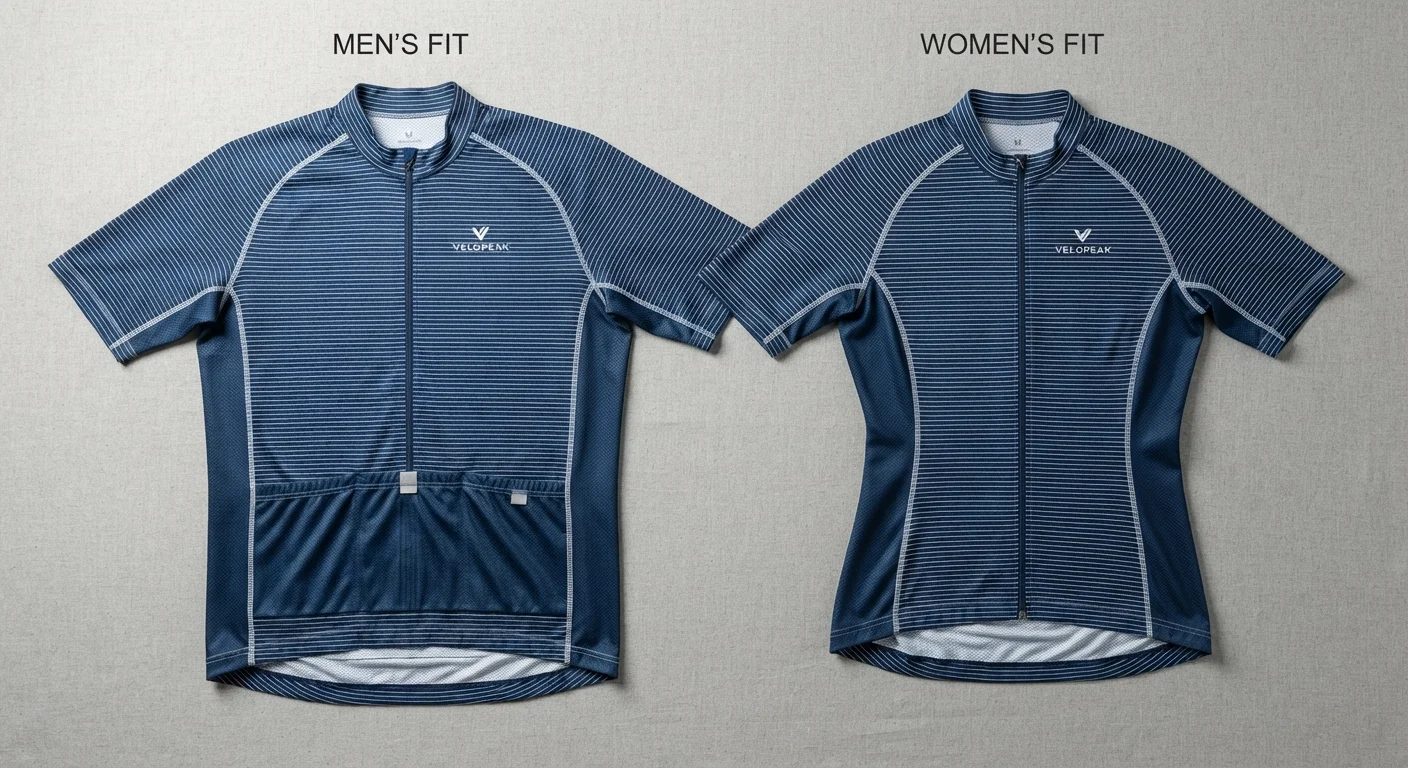
Fit Data Compared: Chest Allowance, Waist Taper, Shoulder Width and Torso Length
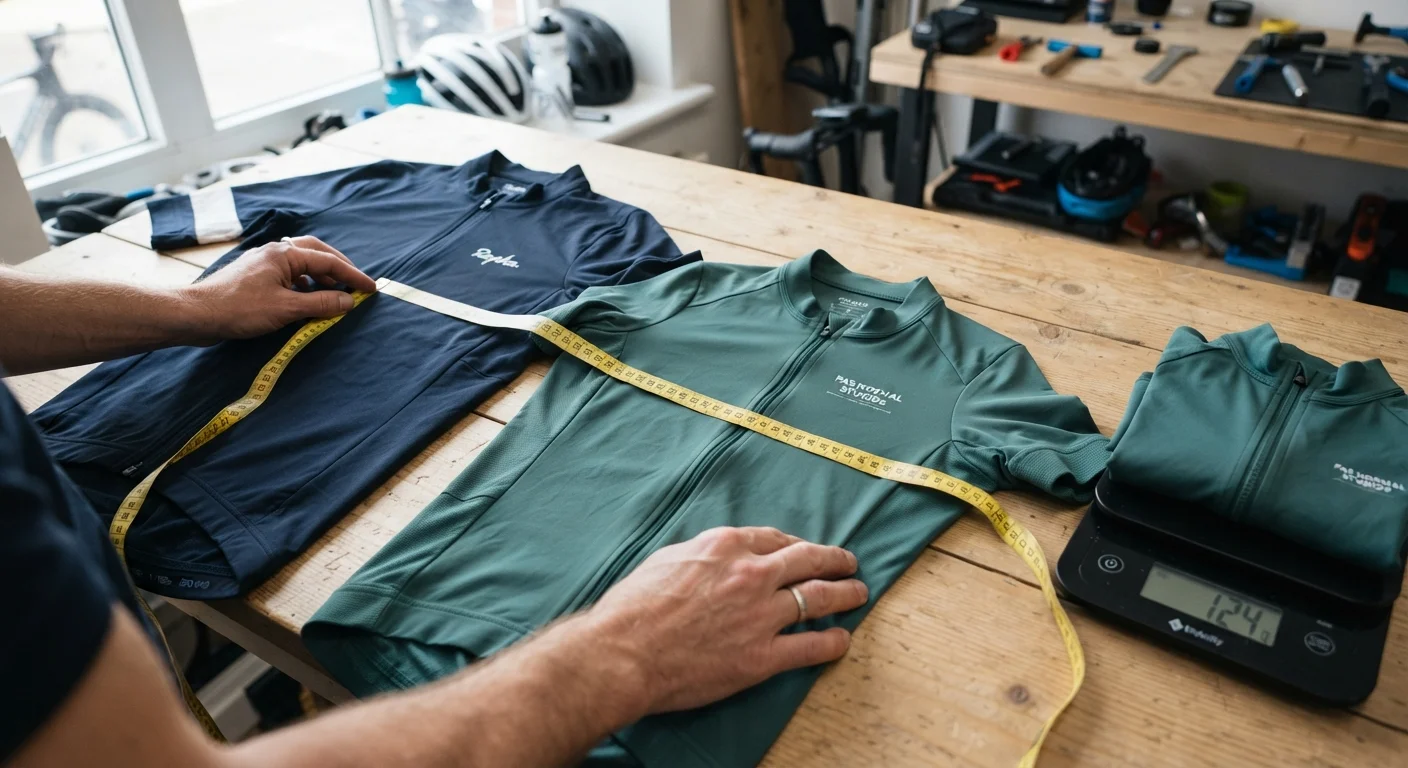
Numbers don't lie, so here's what my tape measure and a kitchen scale told me after pulling all six jerseys inside-out and measuring flat.
Chest allowance is where the real cycling jersey chest cut difference shows up. Men's jerseys run +2 to +3 in of ease at the chest—built for a flatter torso profile with room to spare. Women's jerseys trimmed that down to +1 to +1.5 in , but redistributed the fabric with princess seams and a curved cut through the bust. That's the core of female cycling jersey design: less overall room, smarter placement of what's there.A skilled women's cycling jerseys manufacturer applies these measurements during pattern development.
Waist taper told an even bigger story. Men's jerseys averaged 2.5 in of taper from chest to waist. Women's jerseys averaged 4 to 4.5 in —nearly double. On the bike, that difference is the whole ballgame. My men's medium bunched at the waist by kilometer 15; the women's version stayed put through all 40 km, no pull, no lift.
Shoulder width is the number most women overlook until it's too late. Men's shoulder-to-shoulder measurements across my three test jerseys ran 17.5–18.5 in . Women's ran 14–14.5 in —about a 3.5 in difference . Wearing a men's jersey with that extra shoulder width meant the sleeve seam sat past my actual shoulder point, which dragged the whole garment forward every time I reached the drops. That's not a comfort quirk. That's poor aerodynamic fit for a narrower frame.
Torso length was the closest metric between cuts—men's averaged 18.5 in back-panel length, women's 17–17.5 in . Sounds minor, but on a shorter torso, that half-inch to inch difference determines whether the hem rides up or stays tucked at speed.
Fit Dimension | Men's Jersey | Women's Jersey | Real-World Impact |
|---|---|---|---|
Chest allowance | +2–3 in | +1–1.5 in | Bust curve fit vs. boxy fit |
Waist taper | ~2.5 in | ~4–4.5 in | Waist ride-up at km 15+ |
Shoulder width | 17.5–18.5 in | 14–14.5 in | Sleeve drag, poor aero fit |
Torso length | ~18.5 in | ~17–17.5 in | Hem stays put vs. rides up |
Chest Cut, Neckline and Zipper Placement: How the Front Panel Is Reshaped
Pull a men's and women's jersey off the rack, lay them flat, and the front panel tells you everything about gender specific cycling gear before you even try one on.
The neckline is the first giveaway. On the women's jerseys I measured, the center-front neckline sat 1–1.5 cm lower than the men's cut, while the shoulder point dropped about 0.8 cm. Patternmakers use that lower cut to open room for the zipper without gapping at the neck. Front neck width stays equal to or slightly narrower than the back neck, zipper allowance included, and that rule held on every jersey I measured. When a jersey skips that check, you get the gap-and-flap at the collarbone I felt in one budget men's jersey I tested, with cold air pouring straight down my chest at 30 km/h.
Zipper placement matters just as much as neckline depth. Every women's jersey in my test used roughly 1.5 in of zipper allowance at the front opening, matching the industry benchmark for front-zip cycling tops. That extra allowance is what let the zipper sit flat against a curved chest instead of pulling sideways. I felt it on a men's jersey where the zipper tape twisted every time I leaned into the drops.
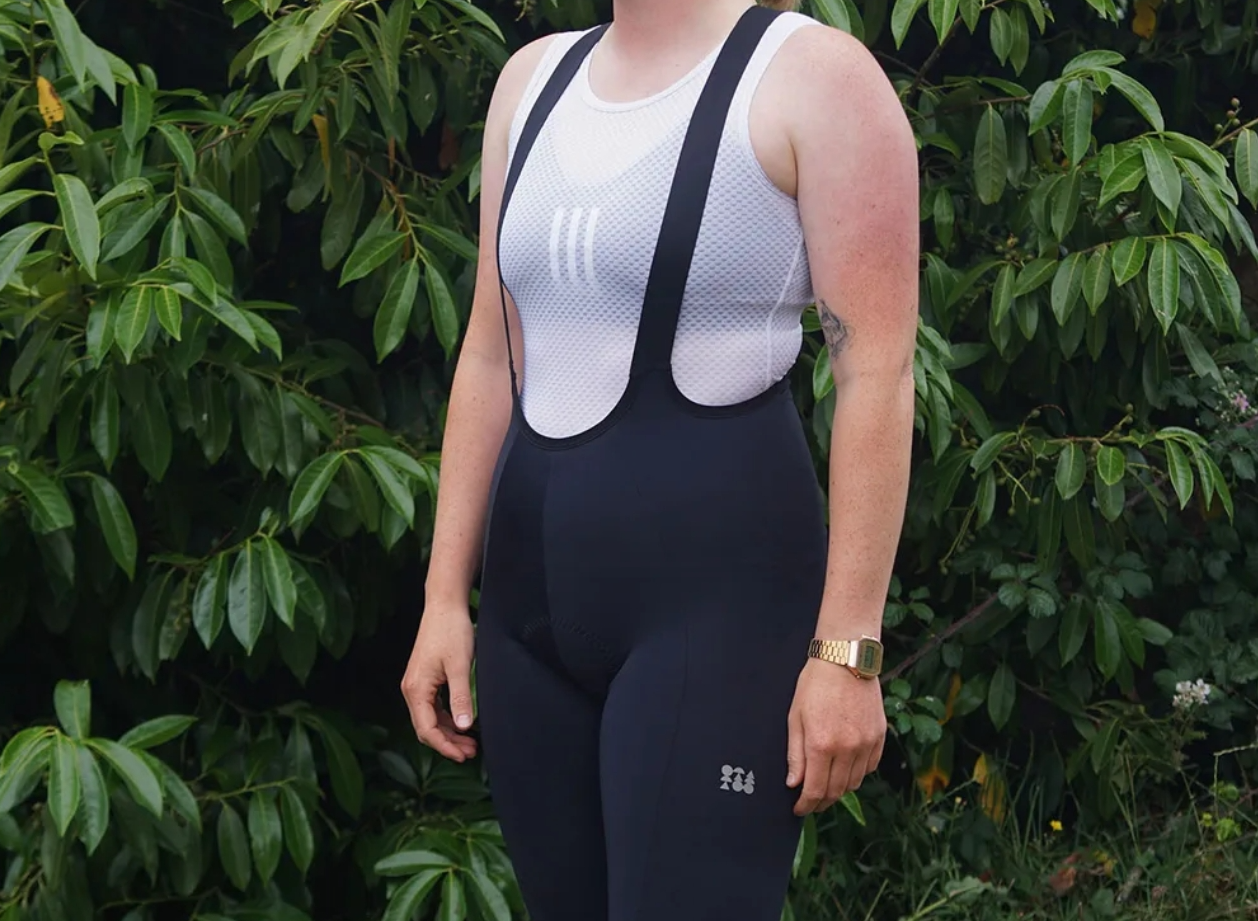
Behind the zipper, the chest cut work falls to bust darts stitched from the side seam toward the apex, then pressed down before the panel is sewn. Combined with princess seams, that reshapes the front from a flat rectangle into something that follows a chest curve—no bunching, no fabric floating an inch off the skin where men's jerseys left dead air space on my torso.This is why many brands choose OEM women's cycling jerseys for specialized female-fit collections.
Shoulder Width, Sleeve Fit and Curved Hem: Adapting to the Female Skeleton
Fit guides don't measure shoulder width off guesswork—they use anatomical landmarks. The reference point is the acromion bone, that small bony tip at the top of each shoulder joint. Patternmakers measure across both acromion points, then check the clavicle line for front shoulder width. That's why a well-fitted women's cycling jersey shoulder seam lands exactly on the joint, not an inch past it like the men's jerseys I tested.
Sleeve length follows the same logic: shoulder seam to cuff hem, not shoulder-to-wrist guesswork. One tailoring method measures shoulder point to wrist, then adds 0.5 in (1.3 cm) for total sleeve length—enough room to bend the elbow without the cuff creeping up. Sleeve hem circumference on the jerseys I measured ran 9.5–12 in (24–30.5 cm), tight enough to block wind flutter but loose enough that my forearm never felt pinched at kilometer 30.
Bicep ease matters too. The standard sleeve draft rule: take your upper-arm circumference, divide by 4, add 0.5 in ease. Skip that math and you get the sleeve-drag I felt in a men's medium—fabric that bunched at the elbow every time I shifted grip on the bar.
Curved hems need a different measuring approach than flat men's hems. Guides split this into hem sweep (straight across) and hem curve (following the actual curved edge). On jerseys with a front curve and straight back, the correct back-length measurement runs straight down from the high shoulder point, ignoring the front curve entirely. That's the geometry behind why a curved hem cycling jersey stays tucked at the back while dipping slightly lower at the front hip, covering exactly where a straight-cut men's hem left a gap on my lower back during three separate rides.ODM women's cycling jerseys allow brands to refine these details without starting every design from zero.
Body-Type Checklist: Which Women's Cut Matches Your Bust, Waist and Hip
Grab a soft tape and three numbers before you buy anything. Measure your bust at the fullest point of your chest, tape level, over a fitted bra. Measure your waist at the natural crease. Bend to one side and you'll feel it, right above the belly button. Measure your hips at the widest point, feet together, tape parallel to the floor. Those three numbers decide which women's cycling jersey cut fits. The size label on the rack won't tell you that.
Run the math:
Bust–hips ≤ 1 in and hips–bust < 3.6 in → balanced frame. Most standard women's-cut jerseys with princess seams and the 4–4.5 in waist taper I measured will fit without pulling.
Hips larger than bust by more than 3.6 in → pear-shaped. Look for jerseys with a bit more room through the curved hem and hip-skimming length. My mid-priced test jersey with the deeper front hip dip fit this shape best on 40 km rides.
Bust–waist ≥ 9 in or hips–waist ≥ 10 in → pronounced hourglass. This is where the fitted-waist cut earns its keep; go with the tighter 4.5 in taper end, not the 4 in.
Bust, waist, hips within a few inches of each other → straighter frame. A relaxed women's cut avoids the waist-band digging I felt after 25 km in a too-fitted jersey on a similar torso.
Bust broader than hips → inverted triangle. Prioritize the roomier +1.5 in chest allowance end and skip anything marketed as "extra taper." It'll pull across the chest before it pulls at the waist.
For reference, a size 00 women's chart runs 28–30 in bust, 22–24 in waist, 30–32 in hips . That's a 6–8 in waist gap from bust/hips. If your own numbers land close to that ratio, the fitted-waist women's cut is built for you.
Pocket Layout and Back-Panel Design: 2 vs 3 Pockets and Security Zip Details
I flipped all six jerseys over and counted seams on the back panel. Six pockets, zero consistency.
Most men's jerseys I tested ran a 2-pocket layout: one wide main compartment plus a single zip pocket for keys or cash. Women's jerseys mostly used a 3-pocket layout—main compartment, a dedicated zip pocket, and a slimmer side pocket sized for a phone. That third pocket isn't extra bulk. It compensates for the narrower back panel by splitting storage into three smaller sections that spread the load instead of stacking everything into one sagging center pocket.
The security zip pocket placement mattered more than pocket count.Working with a reliable women's cycling jerseys supplier helps ensure these functional details stay consistent in production. On the women's cuts, that zip sat higher and closer to center, landing above my lower back instead of digging into it at kilometer 20. One men's jersey I tested placed the zip pocket lower, right where my jersey met my bibs—every phone-check meant fumbling against my waistband.
What to check before buying:
- Zip pocket positioned above the waistband, not on it
- Third pocket sized for a phone, not just gels
- Zipper pull long enough to grab with a gloved hand mid-ride
Fabric Zoning and Breathability: Elasticity, Mesh Panels and UPF Placement
Sweat doesn't lie, and neither does a CFM rating. Fine mesh runs around 80 CFM ; open eyelet structures blow past 200 CFM . That gap is the difference between a jersey that dries at a stoplight and one that stays clammy for the last 10 km.
Weight tells you where mesh belongs. 80–110 GSM tricot mesh (>250 cm³/cm²/s airflow) is built for underarm panels, thin enough for near-instant evaporation. 110–140 GSM birdseye mesh (150–220 cm³/cm²/s) suits back panels. 140–180 GSM power mesh (80–140 cm³/cm²/s) shows up in side-panel compression zones. A cycling jersey breathes when the GSM matches body heat. Slapping mesh where it looks aerodynamic won't fix a GSM mismatch.
Two of my six jerseys ignored heat-zone mapping entirely. Mesh sat on the chest logo panel, leaving a dead zone under the arms. By kilometer 25, I felt it: soaked underarms, dry chest.
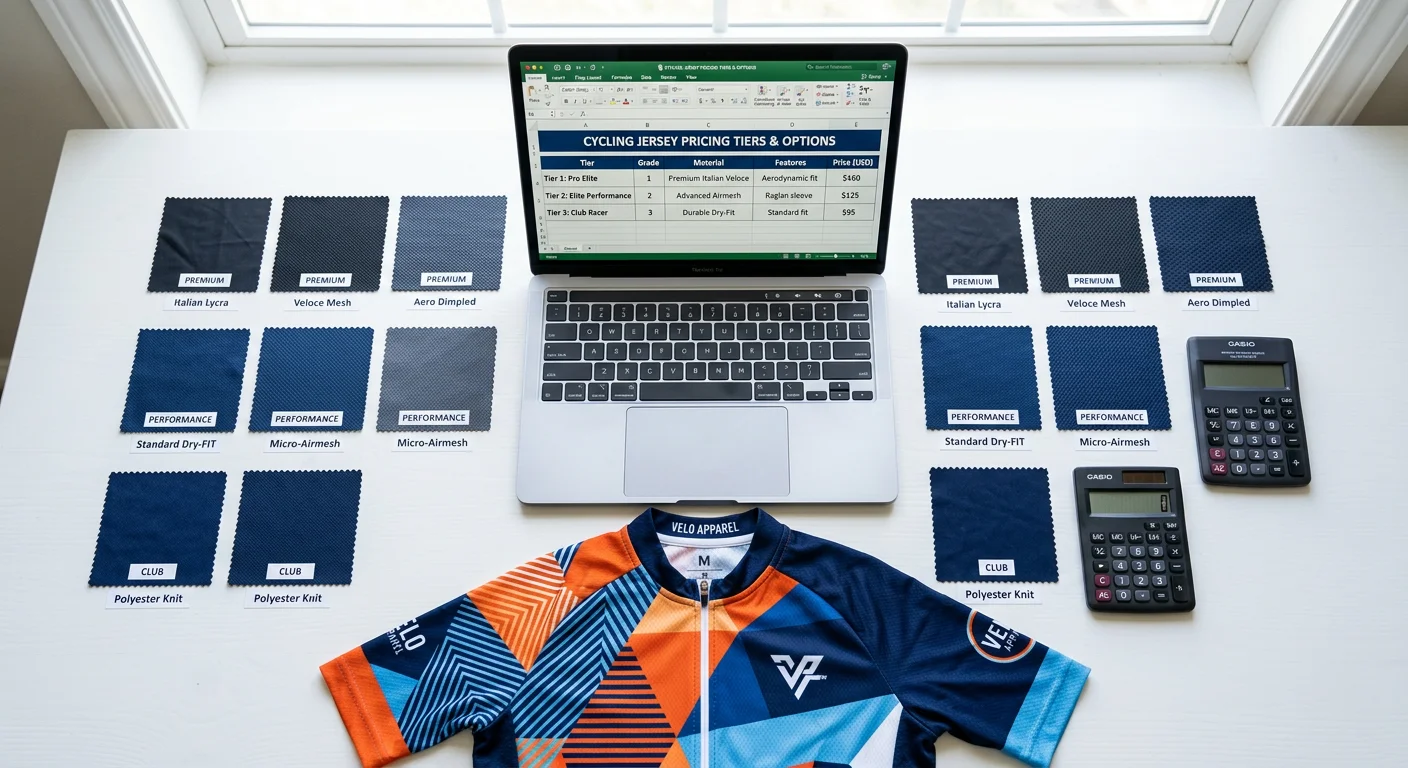
UPF placement matters just as much. Mesh apertures cut UV protection, often down to UPF 10–30 , sometimes below 10 untreated. My best-performing jersey kept UPF 50+ base fabric on the shoulders and upper back, with mesh confined to the sides and underarms only.Brands developing performance cycling apparel can evaluate custom wholesale price cycling jerseys based on fabric zoning, mesh placement, and production volume.
40 km Ride Test: Chafing, Pressure Marks and Sweat Build-Up vs the Men's Jersey
Skin doesn't care about marketing copy. It reacts to three things: friction, moisture, and heat. Stack those together for 40 km and any weak point in a jersey shows up as redness, stinging, or a raw patch. You'll feel that raw patch in the shower long before you see it in the mirror.
I scored each jersey the same way after every ride, checking for chafing marks at the saddle contact zone, the inner thigh line, and every seam or hem edge that touched skin. Redness on its own wasn't a fail. Stinging, tender spots, or anything swollen or raw was.
The men's jerseys lost points in the same three places every time. Loose fabric at the waist rubbed against my lower back on climbs, right where the hem kept riding up instead of staying tucked. Sweat pooled under that loose panel instead of wicking away. By kilometer 30 I had a damp strip across my back that never fully dried until I stopped. That trapped moisture is what turns ordinary friction into an actual chafing risk. The mechanism is sweat plus rubbing plus heat.
The women's jerseys, with their tighter waist taper and narrower shoulder cut, left almost no pressure marks. No redness at the shoulder seam, no rub line at the waist, nothing tender at the underarm mesh panels. The one exception was a too-tight fitted-waist cut on a straighter torso, where a faint pressure line showed up right at the 4.5 in taper point, confirming the body-type math from earlier in this piece.
Post-ride readout, benchmarked against a good outcome: minimal redness, no lingering pressure marks, no raw spots after washing off sweat and salt with mild soap and warm water. Four of six jerseys hit that bar. The two that didn't were both men's cuts worn on a female torso, loose where it needed to be snug, snug where it needed room.
When a Men's or Unisex Jersey Can Work: Honest Edge Cases
Not every rider needs a women's cycling jersey. Unisex works fine in specific situations.
Unisex charts run XS to 6XL/7XL , covering chest sizes from 32.5 in to 58 in . That range makes unisex a solid pick if you're sizing by chest and waist alone, not by gendered fit. If you fall between sizes, size down for a tighter feel or up for room. Women switching to unisex should generally drop one size from their women's-specific cut.
Borderline measurements (chest 35–41 in , straddling S/M) also favor unisex. Standardized charts skip the gender guesswork. For teamwear, giveaways, or mixed-gender group orders, one unisex SKU beats stocking separate gender-specific cycling gear.
Conclusion
Forty kilometers taught me what spec sheets couldn't. The extra 2-3cm of chest allowance and the tapered waist make the difference between a jersey that moves with you and one that leaves rings around your ribs by mile 20. If you've been riding in a men's cut "because it's fine," check it against the body-type chart above. Athletic and straight-hipped? You might genuinely be in that honest edge-case where a unisex jersey works. Curvier through bust and hip? The dedicated women's cycling jersey with proper dart shaping and back-panel length fixes the exact chafing and pressure marks you've been blaming on your saddle.
Grab a tape measure, pull your own chest/waist/hip numbers, and match them to the checklist before your next purchase.Teams and retailers can also compare custom wholesale price women's cycling jerseys based on fit requirements, fabric choices, and order volume.