Your customer service inbox has that one message you keep dreading: "This looks exactly like the jersey from [competitor brand]." You check, and they're right—same cut, same fabric weight, same seam placement, just a different logo slapped on. Most cycling brands quietly ignore this moment, chalking it up to "the market" instead of recognizing it as a data point. But product uniqueness isn't a feeling—it's measurable. When you're stuck comparing cycling clothing manufacturers , white label vs in-house production decisions shouldn't be guesswork based on vibes and vendor sales pitches. Here is a breakdown of the exact signals—repeated templates across competitor stores, shifting customer feedback, MOQ thresholds—that tell you precisely when white label stops building your brand and starts erasing it, plus what to do about each one.
The 5 Quantifiable Red Flags That Signal White Label is Hurting Your Brand
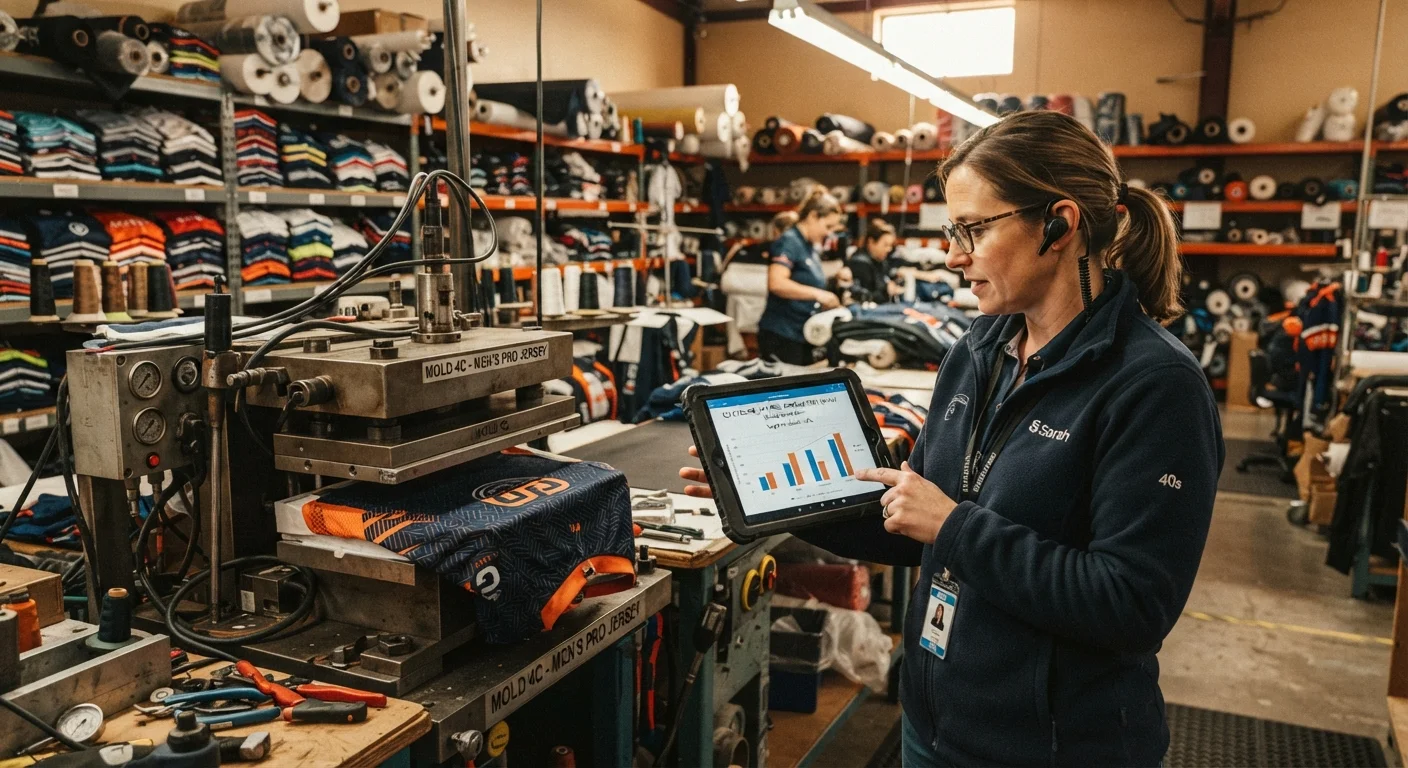
Numbers don't lie the way sales reps do. These five thresholds separate normal supplier variance from a dissolving brand identity.
1. Batch-to-batch variation exceeding 15%. Suppliers without rigorous quality management produce 15–25% variation between production runs. Past that ceiling, roughly 20% of your inventory becomes unsellable—wrong shade of black, slightly different chamois padding, inconsistent seam tolerances. Customers notice even when they can't explain why.
2. Return rates climbing above 5–8%. This isn't just a fit issue. It signals that your product-market fit is cracking, or that quality control has gone soft. Compare against your margins: private-label cycling apparel nets 20–40% on Amazon FBA and 25–45% DTC. A return rate above 8% eats that margin alive.
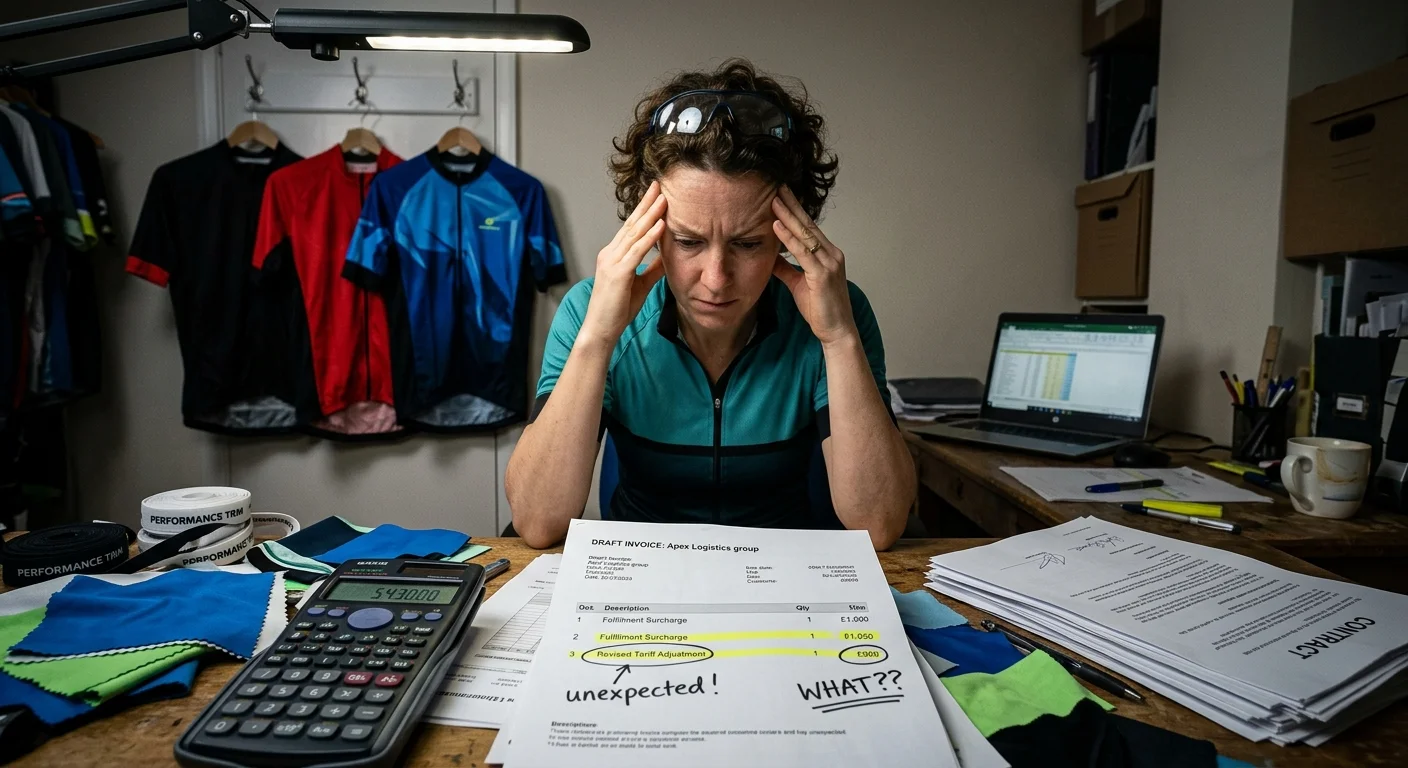
3. Net profit dropping below 18%. Treat this as your financial tripwire. Industry benchmarks suggest keeping net margin at 25% or higher after all costs—ads, promos, and the inevitable QC failures. Below 18%, you're not running a brand anymore. You're subsidizing your white label cycling apparel manufacturer's efficiency.
4. Supplier communication turning vague or slow. Watch for missed deadlines, non-answers to direct questions, or refusal to run sample-to-production matching checks. One-off delays are noise. A pattern of three or more instances in a quarter is a meaningful failure signal, not bad luck.
5. Missing compliance documentation. No CE, RoHS, REACH, or spec sheets on file means you're one customs hold or safety complaint away from a shutdown. If your factory can't produce test reports on request, that's not a paperwork gap—it's an operational blind spot with your brand's name on it.
Track these five metrics monthly. When two or more trip simultaneously, white label has stopped protecting your margins and started eroding your brand equity.
How to Quantify the "Critical Point" When White Label Must Be Upgraded
Gut feeling gets you nowhere. You need a scorecard with baseline, target, and warning thresholds for each KPI, checked in real time. A quarterly review arrives too late to matter.
Track these operational triggers.
Defect rate above 2% is a problem. Top-tier cycling apparel private label factories hold defects under 1%. Some operations tolerate up to 2% as a floor, but cross that line and your quality control is no longer stable.
On-time delivery below 95% is the industry standard for dependable supply chain control. Fall under it and your white label setup can't support scale or premium retail partnerships.
Lead time exceeding 60 days, or turnaround slower than 7–10 days for anything time-sensitive, kills your ability to react to seasonal demand or fast competitor moves.
Capacity nearing the supplier ceiling means you're one bad season from stockouts. Common cycling clothing MOQ requirements sit well below true capacity limits, but if your order volume closes in on your cycling apparel manufacturer's stable output, the risk is real.
Missing ISO 9001 or REACH certification is a compliance wall for any brand selling into the EU. Not optional paperwork.
Watch the upgrade conversion rate. When you introduce a premium tier or semi-custom cycling apparel option, healthy conversion sits above 20% and excellent conversion above 30%. If it falls below 20%, the market doesn't see enough difference to pay more yet.
Upgrade the moment two or more thresholds breach simultaneously, especially quality plus delivery or capacity plus compliance. That combination marks where the current model stops being economically reliable.
White Label, Semi-Custom, or Full OEM: Cost, Control, and Differentiation Tradeoffs
Three production models, three different bets on your brand's future. Pick wrong and you either bleed cash on capacity you don't need, or bleed identity on templates you can't own.
White label wins on speed and price. You pull from a cycling apparel manufacturer's existing catalog, so MOQ sits at 50–300 units, sometimes up to 500, and launch takes 2–6 weeks. Startup cost stays low, with comparable benchmarks putting it in the ₹20K–₹60K range. The catch is that exclusivity is none or minimal—customization stops at branding and packaging. You're choosing convenience over ownership.
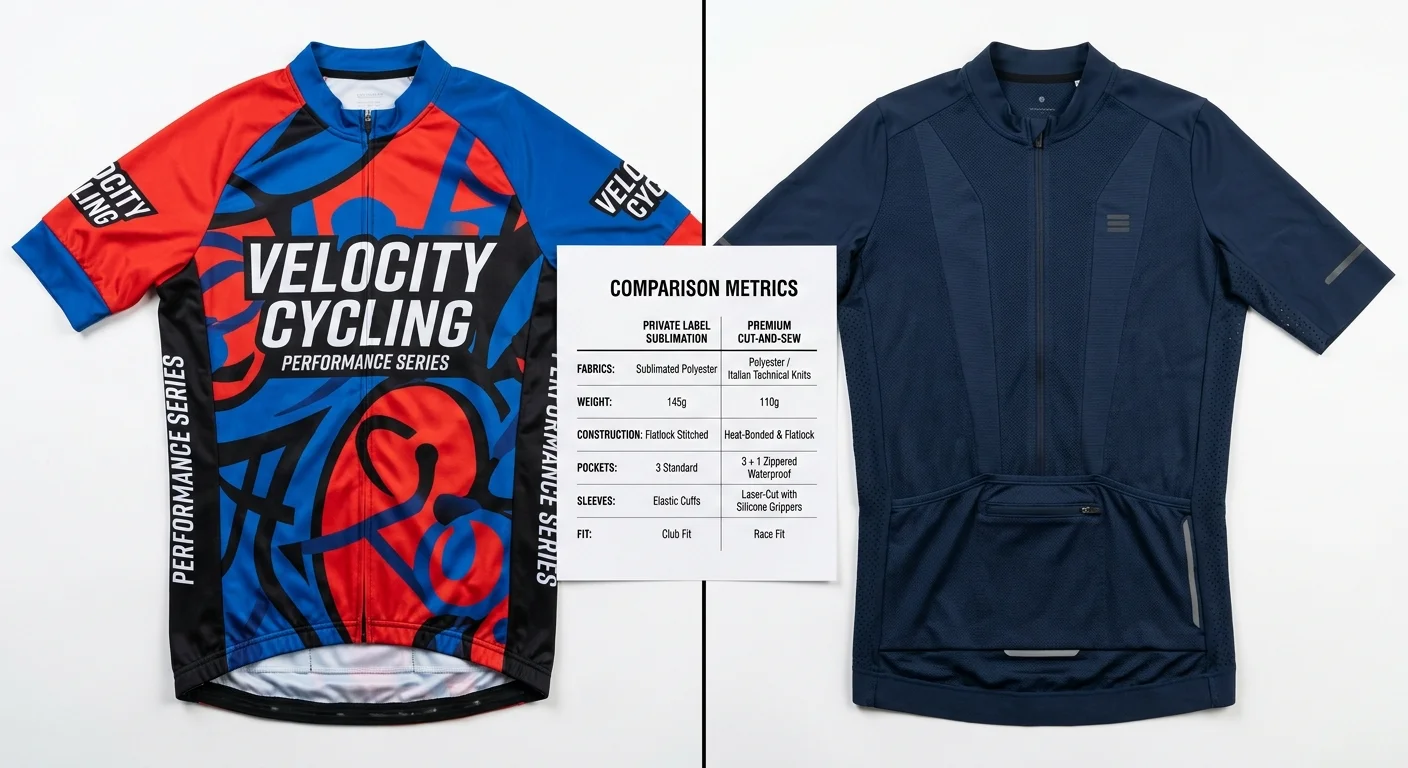
Semi-custom (ODM-style) is the middle tier most brands skip too fast or arrive at too late. The factory starts from a base design, but you adjust fabric blend, print, finish, or feature details. MOQ climbs to 300–1,000 units, occasionally 5,000, with timelines around 4–12 weeks. Cost lands in the ₹35K–₹1.2L zone. You get partial exclusivity, enough to stop looking identical to competitor shelves but not enough to lock out copycats.
Full OEM is where cycling apparel supply chain control becomes real. The product is built to your spec from the ground up, with proprietary fabric weight, seam construction, and documented performance claims. MOQ starts at 3,000–10,000+ units, lead time runs 8–16 weeks, sometimes 3–6 months for complex builds. Tooling alone can run $2,000–$20,000+ before a single unit ships. Cost benchmarks show ₹5L–₹20L+. This tier actually creates a cycling brand competitive advantage, because nobody else is selling your exact spec.
Stay white label while testing demand, move to semi-custom once you need margin and moderate uniqueness, and commit to full OEM only when you're ready to defend product IP and absorb higher switching costs for the long game.
The White Label → Semi-Custom Transition: When to Negotiate Exclusive Patterns & Fabrics
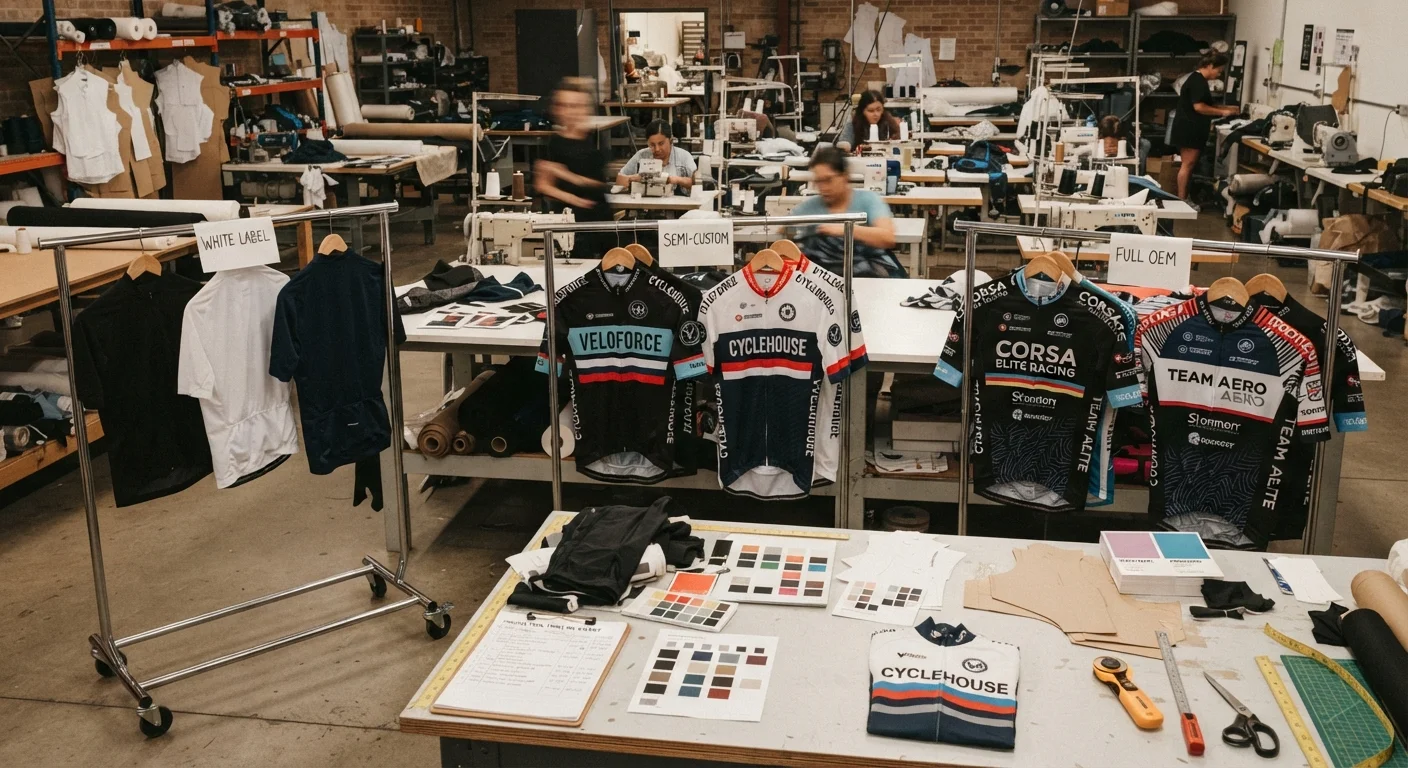
The math tells you when to move, not your gut. White label ships in 2–4 weeks at 30–200 units per style. Semi-custom uses an existing base pattern with new colorways or trims, but stretches to 45–75 days and pushes MOQ to 100–500+ units per style. That gap exists because pattern tweaks, fabric sourcing, and line setup cost real time.
Fabric exclusivity has its own math. Custom-woven or custom-dyed programs trigger mill minimums, not garment MOQs. Expect 800–1,000 meters minimum for custom-woven fabric, or 300–500 pieces per colorway for custom-color runs. Stock-fabric OEM runs 35–42 days; swap in custom fabric and lead time jumps to 48–58 days.
Negotiate exclusivity the moment you can commit to 100+ units per SKU and absorb 1–3 sampling rounds. One EU benchmark: $22.50–$31.00 FOB per unit, 8–10 weeks, 150-unit MOQ, one pattern-tweak round, GRS-certified fabric.
Start with the cheapest wins first. New colorway on a proven base pattern. Fabric upgrade on an existing silhouette. Fit tweaks without touching the core block. Exclusive print repeat or reserved dye lot.
None of this requires full custom cycling apparel development. It just requires enough volume to make the factory say yes.
The Semi-Custom → Full OEM Transition: When to Co-Develop a Brand-Specific Product Line
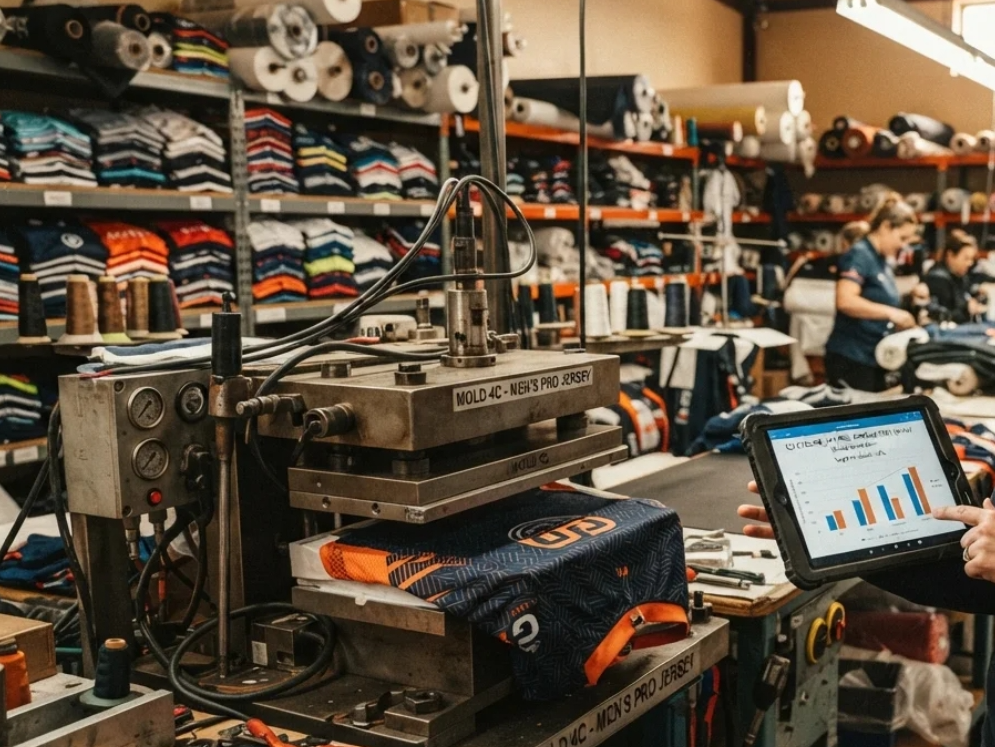
Tooling amortization is the gatekeeper. One sourcing benchmark pegs the trigger point at roughly 70% of your manufacturer's custom-production threshold. Hit that with consistent quarterly reorders, and full OEM becomes a math decision.
Semi-custom sits at 100–500 units with 25–45 day turnaround from brief to export. Full OEM starts at 500–1,000+ units, and private mold development often demands 1,000+ before anyone quotes you. Lead time stretches from 4–8 weeks to 8–16 weeks, and tooling alone can push total timelines to 12–23 weeks. Custom mold development adds another 30–60 days before you even see a sample. Expect a 30–60% cost premium over private label for tooling, prototyping, and compliance testing.
Move only when reorders justify tooling amortization, margin uplift beats those added costs, and your launch calendar can absorb the longer cycle. For proprietary geometry, dedicated mold ownership, or spec-level performance claims competitors can't reverse-engineer, you need full OEM.
Full OEM → In-House or Controlled Production: When to Invest in Your Own Small-Scale Capacity
Break-even math decides this, not ambition. The formula is simple: total in-house cost equals outsourced cost when (F_{in} + V_{in}Q = P_{out}Q + S_{out}). Below that volume (Q), OEM stays cheaper. Above it, with dependable utilization, in-house wins.
Use a 3–5 year payback as your threshold. One supplements brand projected 600k units in year one, 1.2M in year two. Staying outsourced at 600k avoided roughly $1.5M in CAPEX. Full in-house only made sense against the 1.2M volume and that payback window.
At low-to-medium volumes, contract manufacturing still wins because it spreads compliance and overhead across multiple clients. In-house startup CAPEX runs $500k–$1.2M for comparable setups, sometimes higher.
Insource for control when you need proprietary formulations, tighter QC, IP protection, or schedule ownership over cycling clothing MOQ requirements. Insource for scale when utilization is sustained and margins justify it.
The safer path: build a small controlled line first. One diagnostics project qualified 44 prototype units before scaling into ongoing in-house production with no factory buildout required. Underutilized facilities kill margins fast, so validate demand through OEM, then insource only the bottleneck.
Practical Self-Checklist: Is White Label Still Right for Your Brand Right Now?
Five questions decide this.
Cash flow: Can you launch with 50–500 units without straining working capital?
Margin: Is gross margin holding at 30–50%, with net margin at 25–30%+ after ads and logistics?
Differentiation: Can you separate the product through packaging, bundling, or channel strategy? The base template can't do it alone.
Reorder speed: Can you restock fast enough to outrun copycats matching your SKU?
Compliance load: Is your category manageable? Supplements and skincare push MOQs to 500–5,000 units.
Two or more "no" answers means you're near the limit of what white label can do for your brand.
Conclusion
White label is a phase, not a moral failure. But staying in it past the point of diminishing returns is a strategic error. The five red flags in this framework—pattern overlap, retention language, MOQ thresholds, margin compression, and repeat-buyer churn—let you replace gut feeling with a hard number you can actually track. Once your team confirms you’re seeing three or more, the question isn’t whether to upgrade. It’s whether you go semi-custom now, or wait six months and negotiate a full ODM from a weaker position.
Cycling apparel private label factories will always default to shared templates. That’s their margin model, not yours. Your job is to know which threshold moves you from renting a design to owning one. Pull out the self-checklist, score your brand this week, and take the result straight into your next supplier call. That conversation is what protects your pricing power.