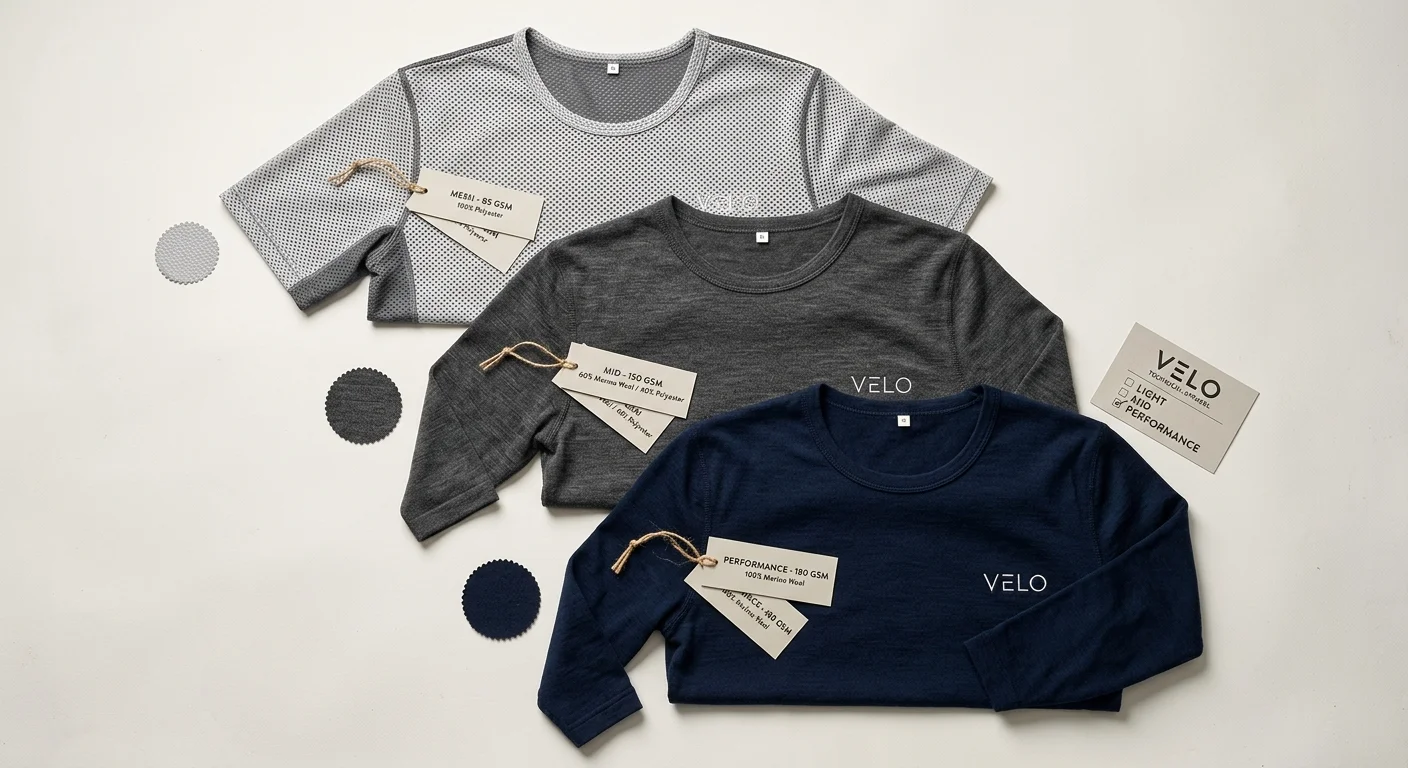
Your jersey causes that sticky, clammy feeling three hours into a ride. The specs that decide whether it performs or punishes are grams per square meter, stretch percentage, and moisture transfer rate. Most riders never check them.
Not all breathable cycling fabric is the same, and "moisture-wicking" on a tag doesn't tell you much. A customized lightweight polyester cycling jersey behaves nothing like a merino wool blend. On a six-hour gran fondo, a 4-way stretch fabric built for criterium racing feels wrong.
This breakdown compares seven fabric types using real GSM numbers, stretch percentages, and wicking performance so you can match material to mileage instead of guessing and sweating it out.
Polyester / Polyester-Spandex Cycling Jersey Fabric
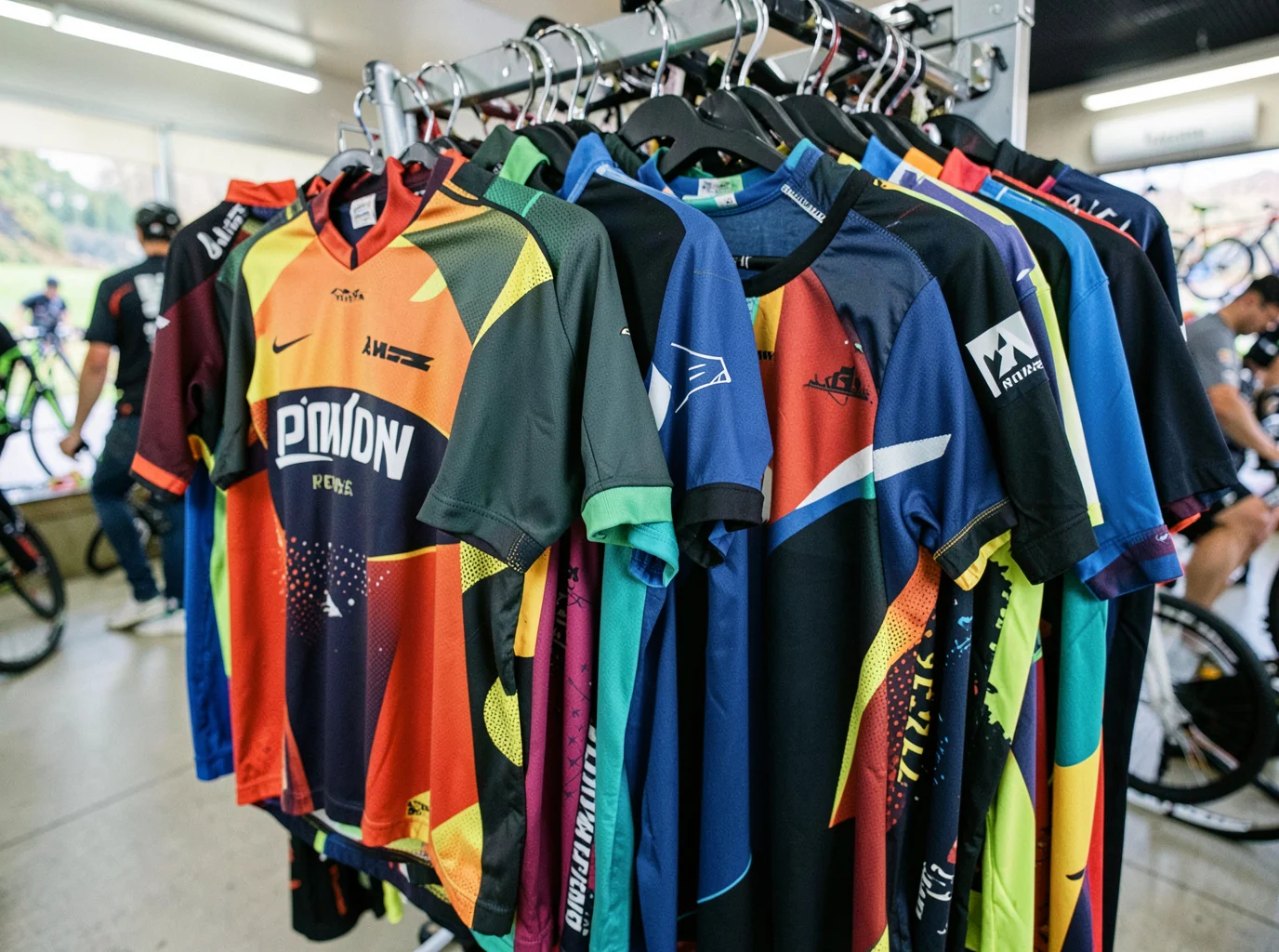
Nine out of ten jerseys hanging in a bike shop are built on this blend, and there's a reason it dominates. The industry standard runs 85–90% polyester with 10–15% spandex, and the sweet spot for road cycling, gravel, and club kits sits at 150–180 GSM. For July heat, go with 100–130 GSM and mesh panels for extra airflow.
Polyester is hydrophobic. It barely absorbs water, so sweat gets pushed to the surface instead of soaking into the yarn. With fine-denier filament construction and capillary channels, you get a cycling shirt that dries 40–50% faster than cotton.
For race and training jerseys, 150–180 GSM balances stretch, opacity, and durability. Summer riding calls for 100–130 GSM with open-knit zones for maximum airflow. Team kits get exceptional dye-sublimation results—the fabric holds color through repeated washes (look for ISO 105 grade 4+).
Compared to nylon-spandex blends, polyester-spandex is better for printability and wicking, making it the go-to for custom cycling club jerseys where vibrant branding matters as much as performance.
Nylon / Nylon-Spandex Cycling Jersey Fabric
Crash on gravel and you'll understand why nylon exists in cycling apparel. This fiber wins on abrasion resistance, hand feel, and stretch recovery—the three things polyester struggles with.
The standard blend runs 80/20 nylon-spandex (sometimes 84/16), delivering true 4-way stretch fabric cycling performance with 15–20% built-in stretch that holds shape ride after ride. Tensile strength sits at 9.5 g/denier, and nylon offers 40% better abrasion resistance than polyester. A 500D nylon sample survived 710 abrasion cycles before failing—polyester's benchmark tops out around 30,000–45,000 Martindale cycles in a different, less friction-heavy test, so context matters here.
Where nylon-spandex belongs:
- Mountain biking and rough trails
- Saddle contact zones, shorts, leggings, protective panels
- Compression fit fabric cycling at 200–240 GSM (firmer recovery blends run 220–260 GSM with 18–25% spandex)
Nylon retains more moisture than polyester and costs about 20% more per metre. But for smooth, second-skin compression pieces where durability beats drying speed, nylon-spandex outperforms every other option on this list.
Lycra / Spandex / Elastane Blend Fabric
Pure Lycra can stretch 400–700% before breaking. For jersey shopping, recovery matters more—how well the fabric snaps back after you get off the bike. Industry benchmarks require >95% elastic recovery with less than 5% permanent deformation after a 50% stretch cycle. Testing standards like GB/T 3820-1997 (50% fixed elongation, 60-second hold, ≥85% recovery pass rate) and ISO 20932-1:2010 (three stretch cycles, ≥80% recovery required) confirm this.
Lycra alone is a poor choice for jerseys. It's hydrophobic, barely wicks moisture, and works better as a stretch skeleton than a standalone fabric. That's why it's almost always blended at 2–20% into a base fiber, usually polyester or nylon.
Common cycling blend ratios include 70–80% polyester + 18–22% elastane for jerseys and bibs that need strong 4-way stretch, 80–90% polyester + 10–20% Lycra for balancing sweat wicking with compression fit, and 85% nylon / 15% Lycra or 76% nylon / 24% Lycra for higher-compression race shorts and skinsuits.
More Lycra means a tighter, more supportive fit, but airflow drops fast. Fabrics need ≥400 mm/s airflow to avoid feeling stuffy; anything under 200 mm/s will trap heat on a summer ride. That's why 5–10% Lycra blends suit endurance riders chasing breathability, while 15–20% blends favor sprinters who want maximum compression over ventilation.
Merino Wool Cycling Jersey Fabric
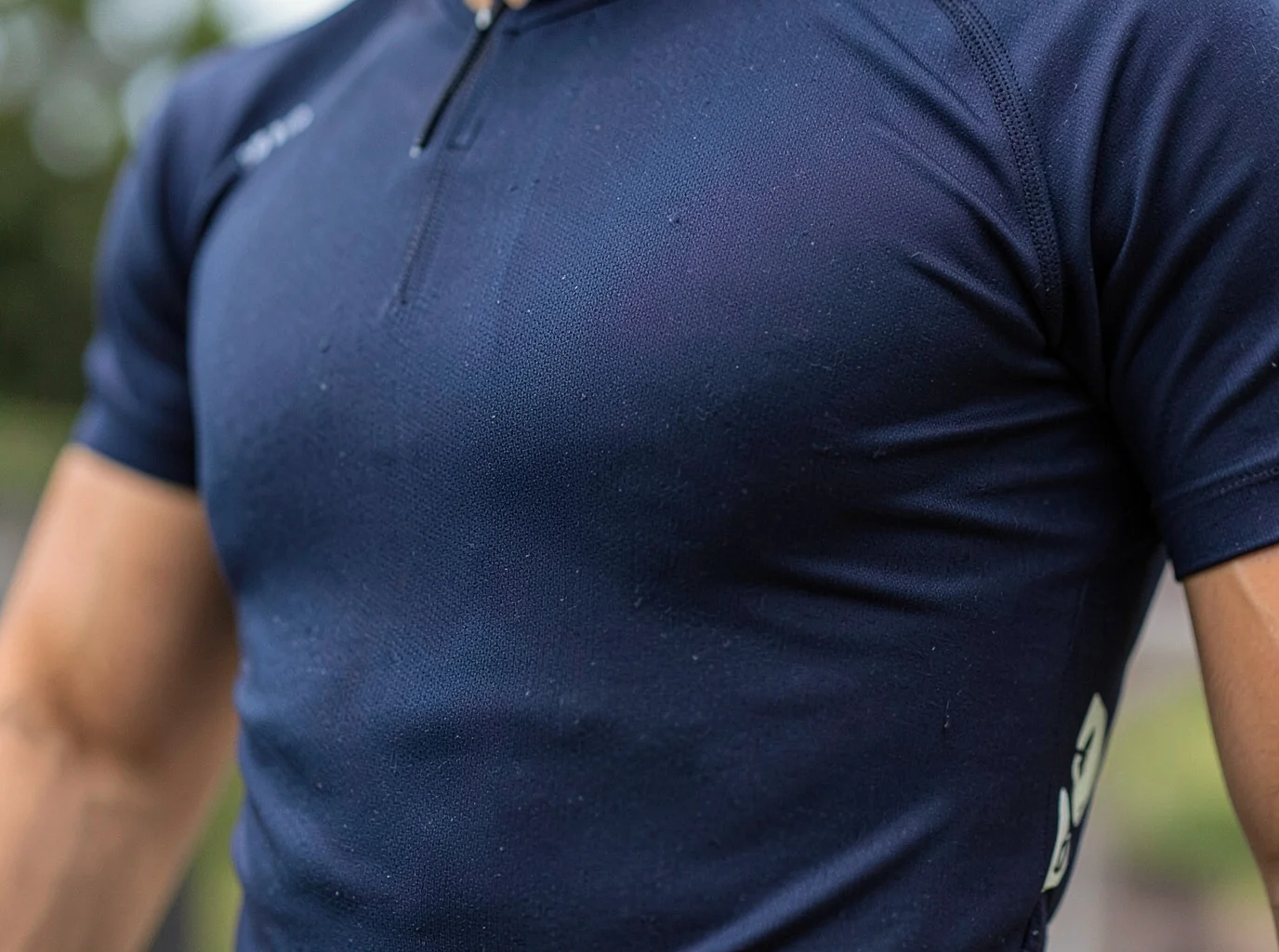
Three days into a bikepacking trip, most synthetic jerseys start to smell like a locker room. Merino wool doesn't have that problem, and the reason comes down to fiber structure. Merino's scaly surface and hydrophilic core pull sweat vapor into the fiber itself instead of leaving it sitting on your skin. Less moisture on the surface means less food for odor-causing bacteria. Woolmark also notes merino absorbs odor molecules directly, then releases them when you wash the jersey—not before.
Merino can hold 30%–33% of its own weight in vapor without feeling damp against your skin.
Typical GSM ranges for merino cycling jerseys:
- 140–180 gsm : lightweight, built for spring, summer, or high-output riding
- 200–240 gsm : versatile, mid-weight option for shifting conditions
- 250 gsm : winter-weight, built for cold-weather rides
The tradeoff is drying speed. Synthetic fabric dries in about 30 minutes; merino takes 90–120 minutes , roughly 2–3x slower, because moisture moves into the fiber instead of just across the surface. That slower dry time, combined with merino's heavier weight, is exactly why you won't see it much in race jerseys. Racers need fast evaporation and minimal mass, not temperature regulation.
Merino wool cycling jersey fabric earns its price tag for temperature swings, cold-to-cool riding, commuting, gravel, and multi-day bikepacking . It stays wearable longer between washes than anything synthetic.
Pricing sits in the mid-to-premium bracket. Santini merino jerseys run around €169, Ornot's 145 gsm merino cycling shirt lists at $95, and merino blends land near $155. Across the market, merino apparel typically falls between $50–$180, with pricing tied to fiber micron count and blend ratio.
Pure merino is rare in performance cycling gear today. Most brands land on roughly 50% merino / 50% recycled polyester , usually in the 145–170 gsm range. This split keeps merino's odor control and temperature stability while adding faster drying and better durability. It's the practical middle ground for riders who want comfort without racing-jersey compromises.
Coolmax Technical Polyester Fabric
Standard polyester dries fast but moves sweat away from the skin slowly. DuPont engineered Coolmax to fix that. The fix is structural. Coolmax fibers use a four-channel (tetrachannel) cross-section instead of the round shape found in ordinary polyester, with grooves running lengthwise that boost surface area by roughly 20%. Those channels drive capillary action, pulling sweat off your skin and spreading it across the fabric surface for faster evaporation. No chemical topical treatment required; the wicking is baked into the fiber geometry itself.
That's the key difference from generic polyester cycling jersey fabric. Regular polyester repels water but doesn't actively transport it. Coolmax does both. Industry benchmarks cite moisture transport up to 50% faster than cotton and drying times 3–5x quicker.
Coolmax earns its place in endurance and hot-weather rides where sweat output stays high for hours, in base layers, inner jersey panels, socks, and fitted undershirts, and in mesh or jacquard knits at lower GSM for maximum airflow.
Raw fiber pricing runs $1.21–$1.95/kg, sitting at a premium over bulk polyester. That premium comes from the licensed fiber tech and third-party wicking validation, so it's worth requesting MMT (moisture management test) data before bulk sourcing, since blend ratios and knit structure vary widely between Cycling Jersey suppliers claiming "Coolmax-style" performance.
Bamboo Fiber / Bamboo Blend Fabric
Bamboo's marketing hype outruns its lab results. "Antibacterial" is the selling point everyone repeats, but the science doesn't hold up. Native bamboo fiber shows 0% inhibition against E. coli , S. aureus , and C. albicans in multiple studies — no natural antimicrobial effect at all. Processed bamboo viscose fares better but inconsistently: one sample hit 37.45% inhibition against S. aureus , while other tests on similar fibers showed anywhere from 8–95% reduction for K. pneumoniae and 3–50% for S. aureus . That's not a stable claim you can build a jersey around.
Where bamboo does perform is wicking ratio. One fabric test found 100% recycled bamboo outscored both cotton and polyester on transfer wicking. Good capillary spread. But that's not the same as fast drying or staying dry under heavy sweat load. Bamboo's breathable cycling fabric qualities come from fiber-level moisture absorption and loose knit structure, not from hydrophobic fibers that push sweat outward like Coolmax or polyester-spandex blends.
Bamboo works best for sensitive skin, commuting, weekend rides, low-to-moderate intensity, and brands leaning into eco-conscious positioning. Skip it for long climbs, high heat, competitive racing, and anything with sustained heavy sweat output.
When you're buying, ignore the "bamboo" label alone. Check GSM, knit density, one-way wicking test results, shrinkage after wash, and pilling resistance — especially in bamboo viscose/cotton, bamboo viscose/polyester, or bamboo viscose/spandex blends.
Recycled Polyester Fabric
Sustainability claims sell jerseys, but the fabric science underneath them matters more. Recycled polyester (rPET), made from post-consumer plastic bottles or textile waste, performs almost identically to virgin polyester at the same GSM, same weave, same finishing.
Lab and supply-chain data back this up. Samples of recycled and virgin polyester show negligible variation in tenacity, elongation, luster, shrinkage, and pilling resistance when matched on structure and finish. For cycling jerseys, the target range is 120–140 GSM, the same sweet spot that lightweight polyester cycling jersey material occupies. At that weight, rPET holds up to quick-dry finishing and repeated wash cycles just like its petroleum-based counterpart.
Three credentials separate verifiable rPET from vague claims:
GRS certification (Global Recycled Standard) verifies recycled content and chain of custody
Transaction Certificates (TC) provide batch-level traceability documentation
Oeko-Tex Standard 100, often paired with GRS, covers chemical safety compliance
Sourcing typically runs through GRS-certified mills across China and Southeast Asia, quoted FOB with fiber, fabric, and finished-garment pricing handled separately.
For clubs and teams, the modest price premium over virgin polyester buys a verifiable sustainability story for sponsors, race-day merchandise, and ESG messaging. Market growth projections land between 6.77% and 14.48% CAGR for 2026–2035, with the sector expected to reach USD 31.33bn–37.91bn by 2035. rPET production also cuts energy use by roughly 30–50% compared to virgin polyester, with some reports citing CO2 reductions as high as 70–80%—numbers worth requesting LCA backup for before quoting them to sponsors.
When you buy, request GRS certificates plus TC documentation, confirm 120–140 GSM performance data against a virgin polyester equivalent, and market it as "certified recycled content" rather than vague "eco-friendly" language that buyers increasingly distrust.
Weight, Stretch & Wicking Comparison Table (7 Fabrics Side-by-Side Comparison)
Screenshot this matrix before your next Cycling Jersey supplier call or team meeting. GSM tells you weight. Lower means lighter. Stretch depends on the spandex or Lycra ratio and the knit, not just the fiber type. And quick-dry cycling performance comes from fiber chemistry, not weight.
Fabric | Typical GSM | Stretch/Recovery | Wicking Speed | Best Use |
|---|---|---|---|---|
Microfiber Polyester | 80–120 gsm | Moderate; often spandex-blended for fit | Strong ; the default sweat wicking fabric technology | Summer/race jerseys |
Polyester + Spandex (90/10) | 150–180 gsm (up to 310 gsm in insulated versions) | High; true 4-way stretch fabric cycling at 5–18% spandex | Strong, tied to polyester ratio | Training, race, compression fit fabric cycling |
Nylon + Spandex | 180–220 gsm | High; built for compression and abrasion | Moderate-strong | Mountain/gravel, high-wear zones |
Merino Wool Blend | Mid-to-heavy weight range | Moderate; blending improves shape retention | Moderate; wins on odor and temp control, not speed | Fall/winter, long-distance |
Spandex/Lycra | 5–18% blend component, not standalone | Extreme; 90–95% recovery rate | Weak-moderate | Fit and rebound, not wicking |
Bamboo/Modal Blends | 140–200 gsm | Moderate; soft hand, variable stretch | Moderate | Casual, comfort-focused rides |
Open-Mesh Polyester | 100–150 gsm | Moderate | Very strong ; built for max evaporation | Underarm/back panels, heat zones |
Fast decision rules: For lightweight cycling jersey material, stay under 120 GSM. For an all-rounder, 150–180 GSM balances support and airflow. For durability, 180+ GSM nylon-spandex blends hold up best. Recovery above 90% means a snug, non-sagging fit. Look for that number when you see a spandex cycling jersey blend on a spec sheet.
How to Choose the Right Fabric for Your Riding Scenario
Temperature decides everything. Match the fabric to the thermometer first, then adjust for intensity.
Riding temperature → fabric weight:
- Above 68°F (20°C): lightweight polyester, 100–150 GSM
- 59–68°F (15–20°C): light long-sleeve or lighter midweight knit
- 50–59°F (10–15°C): 150–200 GSM midweight jersey, often paired with a base layer
- Below 50°F (10°C): thermal or brushed fabric, 230–260+ GSM
Below 50°F, layering matters more than the jersey fabric itself. A merino base layer under a thermal jersey beats one heavy piece every time.
Then factor in intensity. Racing and high-output efforts call for the lightest GSM that still holds shape and opacity, typically 100–140 GSM microfilament polyester. Endurance rides, where pace varies and weather shifts over six or eight hours, do better at 150–200 GSM. That extra weight buys durability and steadier insulation, which matters more than shaving grams when you're in the saddle all day.
Budget tiers, roughly:
- Entry: 100% polyester, fine for commuting and casual summer riding, but weaker wicking and hand-feel
- Mid-tier: polyester-spandex blend, 150–200 GSM, the strongest all-around value for stretch, fit, and comfort
- Premium: microfilament polyester with mesh zoning, or brushed thermal fabric for winter-specific builds
Before you order, ask for specifics. Get the GSM number. Confirm the polyester-to-spandex ratio. Ask if the inner face is brushed for cold-weather kits. Request UPF 50+ for anything worn in direct sun for hours. Vague terms like “premium” or “breathable” on a spec sheet mean nothing without numbers behind them.
Practical Buying Guide by Priority Need
Eighty percent of B2B jersey orders default to polyester-based systems, and that number isn’t an accident. Look at what teams actually reorder, and the pattern holds across every category.
If sweat is the problem, pick polyester or polyester-spandex. It dries faster, weighs less, and moves moisture more efficiently than anything else on this list. Tag it for hot-weather training, interval sessions, and race kits where quick recovery between efforts matters.
If stretch and fit are the priority, go nylon-spandex or Lycra. This blend delivers stronger rebound and a tighter, more compressive shape. It suits race-fit cuts, mountain biking, and any panel that takes repeated abrasion. Nylon outlasts polyester under friction.
If odor control and temperature swings matter more than speed, merino wins. The tradeoff is higher cost, slower drying, and less durability over time. This is the fabric for multi-day tours and riders facing wide temperature ranges on a single ride.
For team and club orders, default to a hybrid build. Run polyester as the main body for sublimation printing and cost control, then add spandex or mesh panels at the underarms, sides, or sleeves for stretch and airflow. This structure balances price, print quality, turnaround time, and comfort—exactly what sponsors and bulk buyers care about.
One-page rule: polyester for volume, nylon-spandex for performance upgrades, merino for premium long-distance kits.
Conclusion
The fabric you pick decides whether you're still comfortable at mile 40 or peeling a soaked jersey off your back. Match the material to your mileage. Polyester and Coolmax fabrics handle everyday training with their sweat wicking technology and low GSM weight. A 4-way stretch cycling blend earns its place for climbs and sprints where compression fit matters most. Merino wool is the smart pick for cooler, longer rides where odor control matters more than raw speed.
Don't guess your way into a fabric mismatch. Pull up the comparison table, cross-reference it against your typical ride distance and climate, and shortlist two options max. If you're outfitting a team or club and need custom cycling team or club suits tailored to your riding conditions, reach out to Runcyclingapparel 's team. We'll help you spec the right fabric before you commit to a bulk order.