Most procurement managers walk into custom cycling apparel supplier negotiations knowing their target price point but not their target GSM range. That gap is exactly where factories build in 15-30% margin on "premium" fabric that performs no better than a mid-tier polyester spandex blend.
If you've ever gotten a quote listing "high-quality breathable cycling fabric" with zero technical backup, you already know how hard it is to push back without sounding like you're guessing.
This guide fixes that. You'll walk away with a scenario-based comparison of fabric performance across summer endurance rides, winter training, and race day, plus a concrete checklist covering moisture-wicking grades, UPF ratings, and colorfastness standards you can drop straight into an RFQ.
Decision Starting Point: Riding Scenario Determines Fabric Performance Priorities
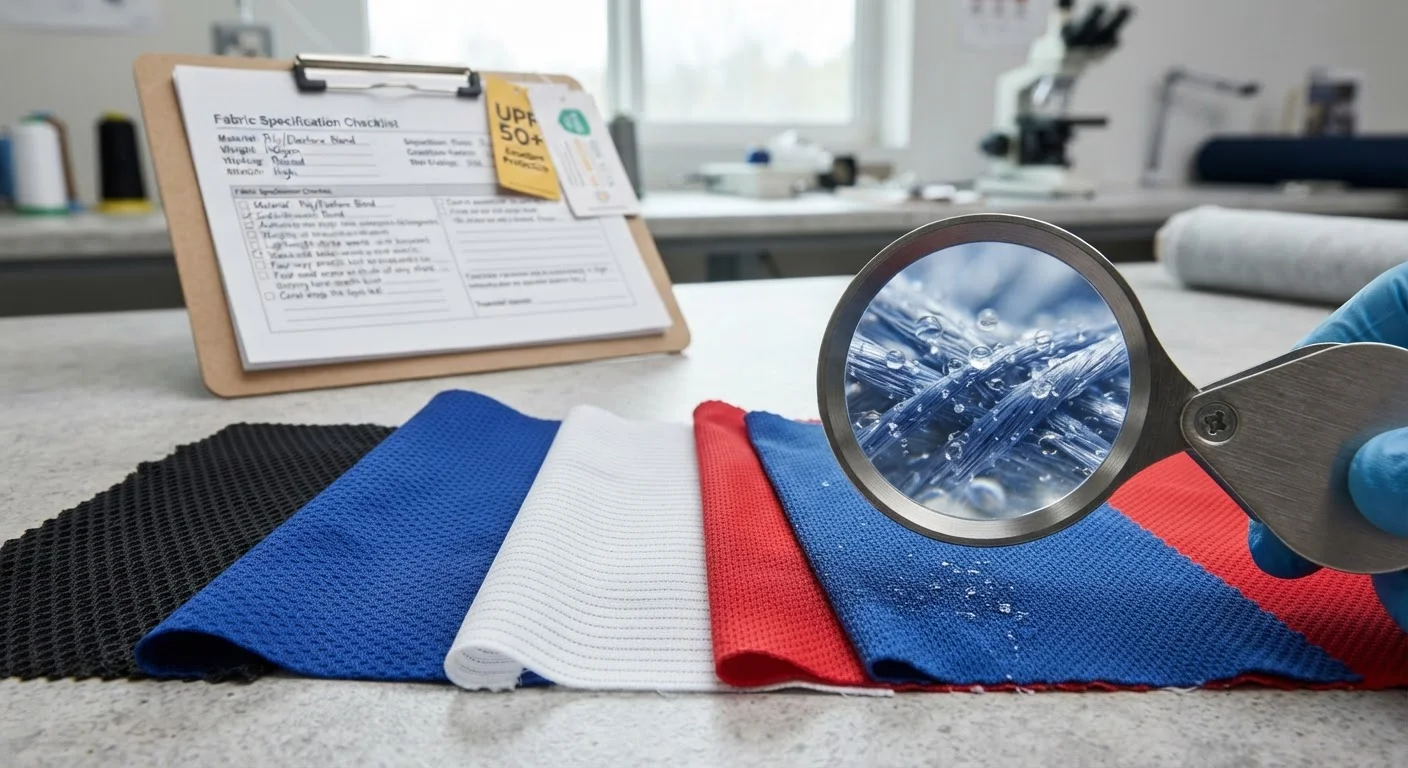
Fabric priorities shift the moment you change the riding scenario. There's no universal best blend, only the best fit for how the garment gets used.
Road/high-intensity riding puts moisture-wicking and stretch ahead of everything else. Most performance jerseys use 85/15, 87/13, or 90/10 polyester-spandex blends, with GSM between 75 and 120.
Long sun exposure and summer rides push UPF rating to the top. You get UPF 30 on back panels and UPF 50+ on primary fabric zones.
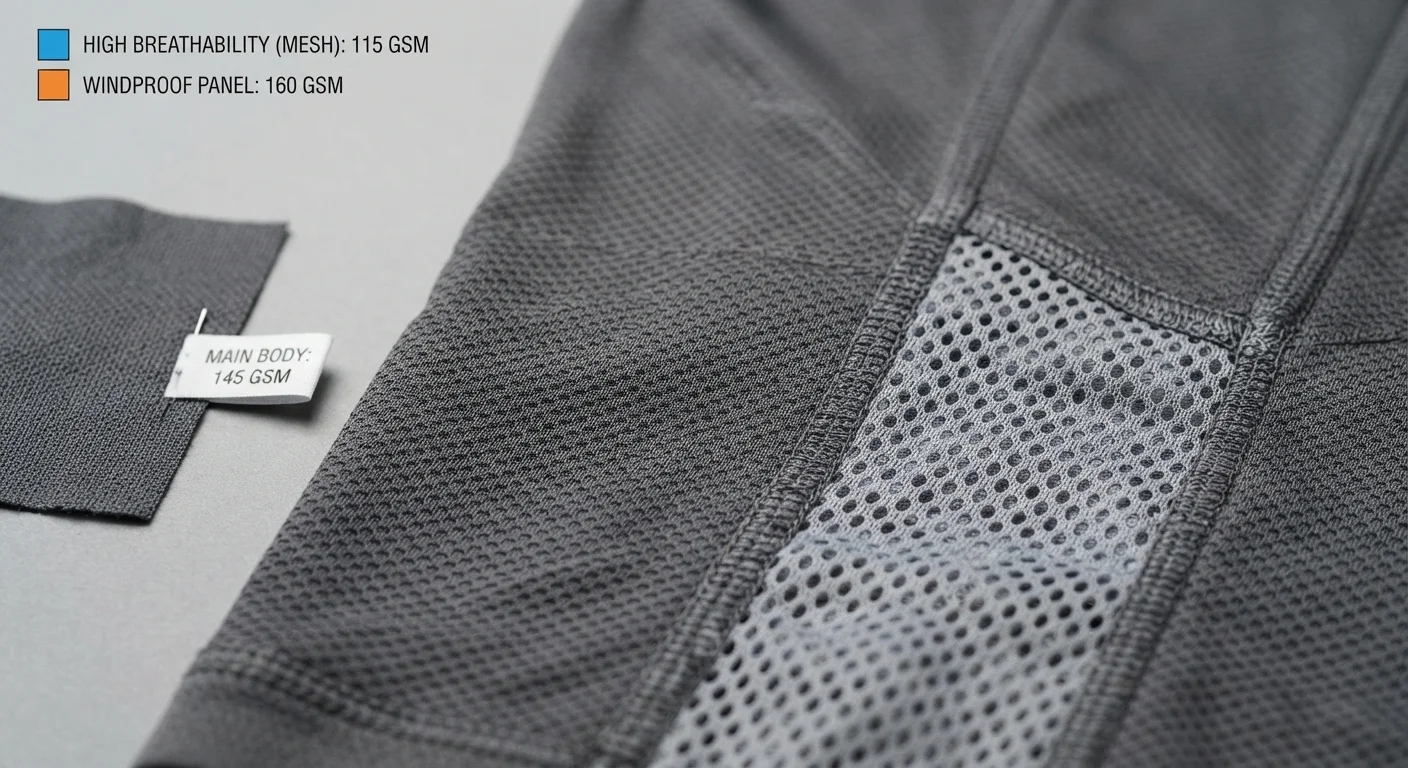
High-heat climbing and endurance rides work better with lighter, zone-specific builds. You'll find 75 GSM sleeves, a 115 GSM torso, and 120 GSM mesh side panels for heat dissipation.
Race-day and aggressive posture riding needs 15-29% elastane content, in blends like 72/28 or 70/25/5. This gives you full range-of-motion stretch without fabric drag.
Gravel and mixed terrain calls for tougher blends. A 51% polyester, 41% merino wool, 8% elastane mix balances durability, warmth, and UPF 30+ protection.
Breaking Down Fabric Base Structures: Polyester vs Nylon vs Lycra Blends vs Re-cycle Fibers
Every fabric spec sheet boils down to four base structures. Get these wrong, and no amount of GSM tweaking will save your garment.
Polyester (Polyester/rPET) absorbs almost no moisture—around 0.4% . That's why it dries fast, holds color well, and works for sublimation printing. It's your go-to for quick-dry cycling material at scale. Under equal GSM and fiber structure, GRS-certified rPET performs nearly identically to virgin polyester, so "recycled" doesn't mean "weaker" here.
Nylon (Recycled Nylon) absorbs 4-5% moisture—ten times more than polyester. That trade-off buys you softness, tensile strength, abrasion resistance, and better stretch recovery. This is why nylon dominates tight-fit gear, swimwear, and high-load equipment where fabric gets stressed repeatedly.
Lycra/Spandex blends aren't a standalone fiber category—they're a functional add-in. Spandex itself stretches up to 500% elongation , but it doesn't manage moisture. Common polyester/spandex blend ratios run 85/15, 92/8, or 88/12 (±2%) . Higher spandex content means tighter compression fabric for cycling, but costs climb too.
Re-cycle fibers just change the source material, not the performance category. Whether you're getting rPET or recycled nylon (like ECONYL®) determines the baseline behavior. GRS-certified recycled fabrics can hit ISO 105 colorfastness grade 4-5 , matching virgin fiber performance when structure and yarn count stay equal.
Quick Reference: Base Fiber Comparison
Property | Polyester/rPET | Nylon/Recycled Nylon | Spandex Blend | Re-cycle Fiber |
|---|---|---|---|---|
Moisture absorption | ~0.4% | ~4-5% | Depends on base fabric | Matches base fiber |
Abrasion resistance | Good | Stronger | Depends on ratio | Near-virgin performance |
Elastic recovery | Needs spandex | Better | Strongest | Matches base fiber |
UV/colorfastness | Usually higher | Slightly weaker | Depends on base | Up to grade 4-5 |
Best use case | Training jerseys, sublimation prints | Compression shorts, high-wear panels | Leggings, tight tops | Eco jerseys, recycled swimwear |
Cost-sensitive bulk orders → lean polyester. Need durability under repeated stretch → lean nylon. Want compression fabric for cycling with true four-way stretch fabric performance → add 8-15% elastane regardless of base fiber.
Decoding the Core Specs: GSM Weight Range and Stretch Direction Count
GSM weight and stretch direction count determine 90% of how a cycling jersey feels and performs. Miss either one on your spec sheet, and you're negotiating blind.
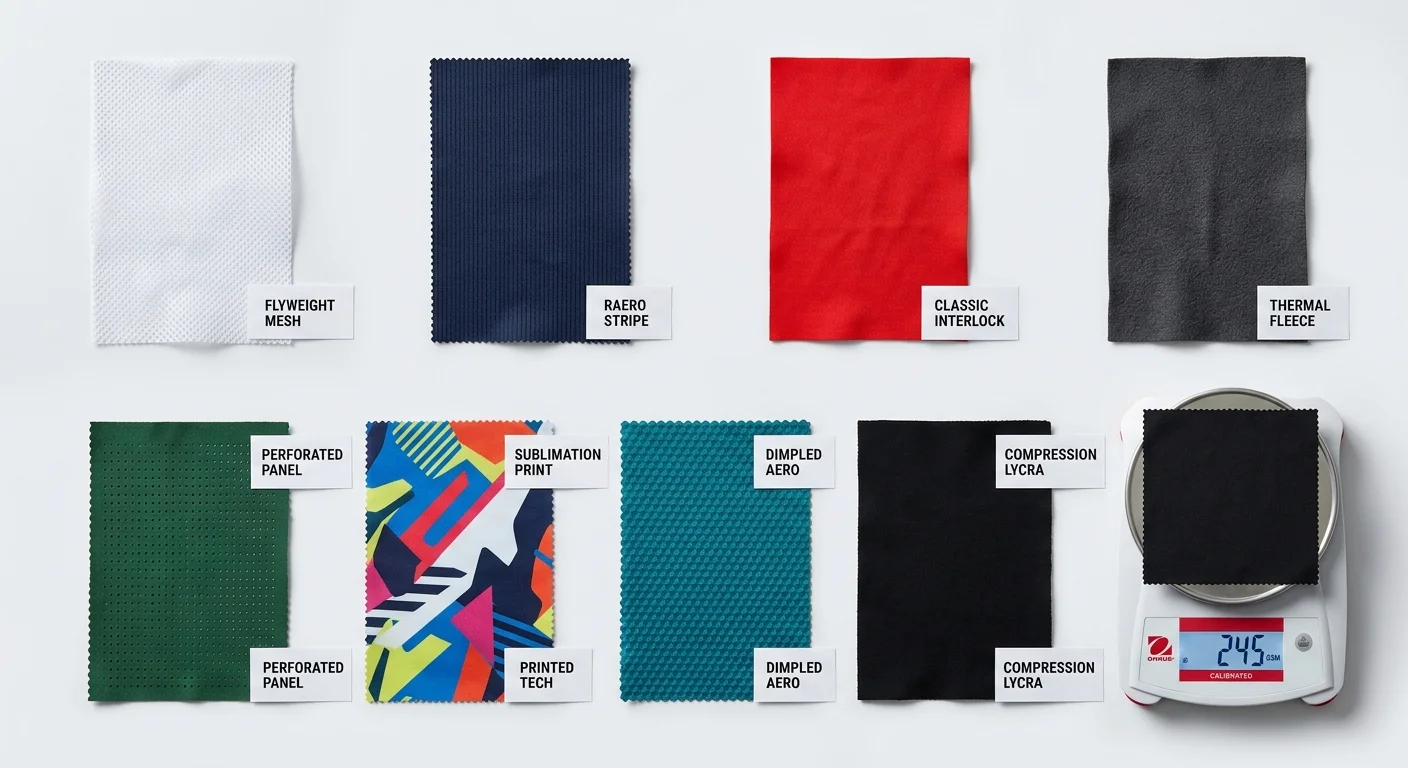
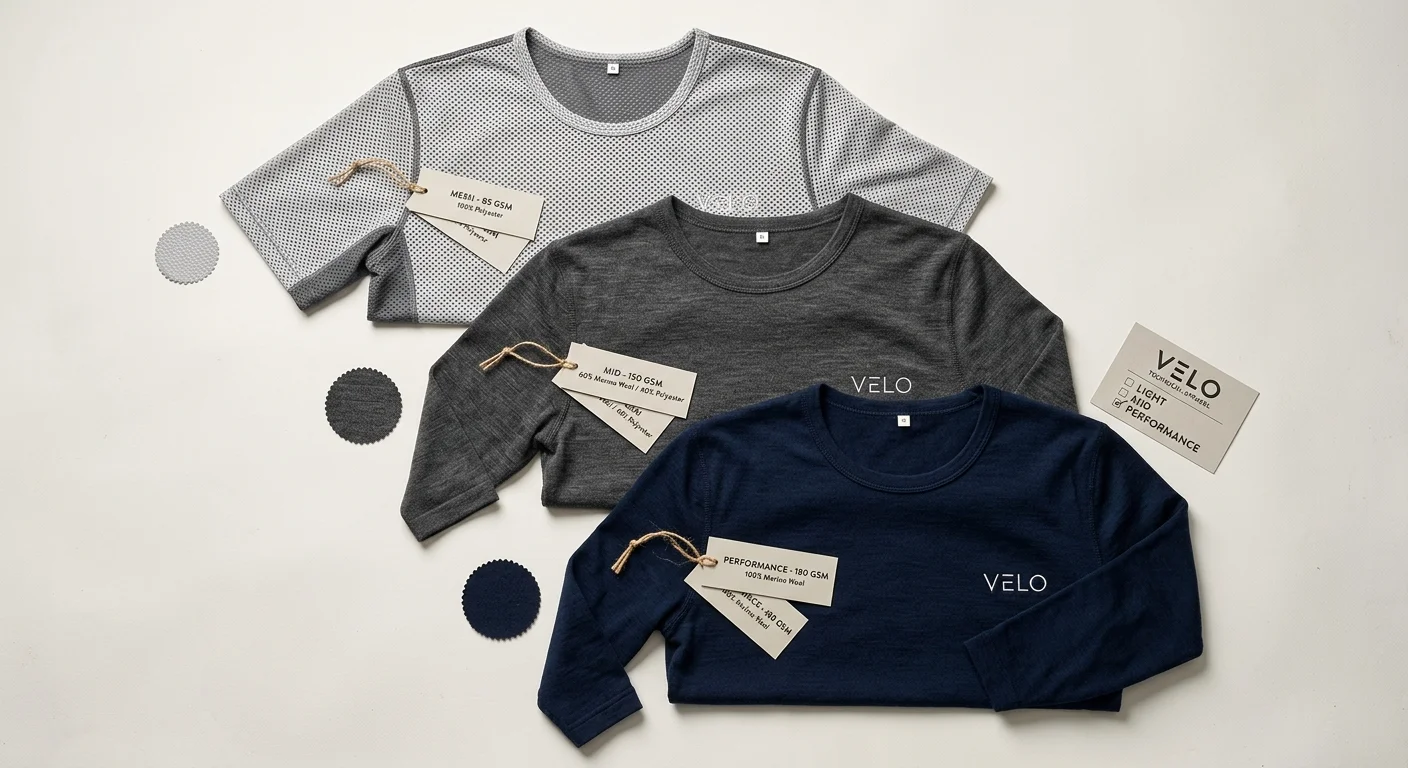
GSM (grams per square meter) falls into four practical tiers across the textile industry: ultra-light (30–100 GSM), light (100–170 GSM), mid-weight (170–340 GSM), and heavy (400+ GSM). For context, a standard cotton T-shirt sits at 160–180 GSM. Fleece and hoodie fabric climbs to 200–400 GSM. Cycling apparel stays in the light-to-mid range, so generic “sportswear GSM” quotes from customized high-performance fabric cycling suits suppliers rarely match what your garment needs.
Stretch direction matters as much as weight. Fabrics come in three types: 1-way stretch pulls in one direction only (warp or weft); 2-way stretch pulls horizontally and vertically, common in basic tees; 4-way stretch pulls in both warp and weft simultaneously, the standard for performance jerseys, yoga wear, and swimwear.
For customized high-performance fabric cycling apparel , four-way stretch fabric is the baseline. Anything less restricts pedaling motion and creates fabric drag at the shoulders and knees during aggressive riding positions.
Procurement Combinations That Work
Use Case | GSM Range | Stretch Type |
|---|---|---|
Summer base layer | 120–180 GSM | 2-way or 4-way |
Performance jersey | 180–260 GSM | 4-way |
Winter thermal layer | 220–380 GSM | 2-way |
Utility/gravel panels | 240–350 GSM | Low or no stretch |
Lower GSM means lighter, more breathable fabric, better for summer; higher GSM means warmer, more structured fabric, better for winter and high-wear zones. More stretch directions give more freedom of movement but also higher yarn cost and tighter production tolerances. That’s your leverage point when a factory tries to upcharge for “premium stretch” without specifying which direction it stretches.
Quantifying Moisture Management: Wicking Grades and Quick-Dry Testing Standards
"Moisture-wicking" means nothing on a spec sheet unless it's backed by a test number.
The industry standard is AATCC TM195 (Liquid Moisture Management Properties of Textile Fabrics). It tracks absorption rate, wetting time, spreading speed, one-way transport capability, and OMMC (Overall Moisture Management Capacity). China's equivalent is GB/T 21655.2-2019, effective since January 2020. It uses the same dynamic moisture transfer logic.
In 2025, AATCC released TM217, adding image-based analysis for vertical and horizontal wicking. This gives suppliers a more precise way to quantify how moisture spreads across the fabric surface, useful if you want lab-verified proof.
Numbers You Can Put in Your RFQ
Metric | Target Value | Test Method |
|---|---|---|
Water absorption time | < 2 seconds | AATCC 79 |
Wicking height | ≥ 8 cm / 15 min | Industry benchmark |
Wicking grade | Grade 3 (≥100mm = "Very Good") | Standard wicking scale |
OMMC rating | High (>0.5, verify with lab) | AATCC TM195 |
"Quick-dry" and "moisture management" aren't the same thing. TM195 measures how water moves through fabric, not final drying time. For true quick-dry cycling material, pair AATCC 79's absorption time with TM195's transport data.
When requesting quotes, always specify the test standard, sample condition (pre/post-wash), test direction (warp/weft), and testing humidity. Skip this, and lab results from different cycling apparel suppliers won't be comparable, leaving you negotiating with mismatched data.
UV Resistance & Color Retention: UPF Rating, Lightfastness, Sublimation Fastness
A UPF 50+ label sounds impressive until you realize most cycling apparel suppliers never test wet performance—and that's where sun protection fails on a sweaty ride.
UPF 15, UPF 30, and UPF 50/50+ are the three tiers under AATCC TM183, AS/NZS 4399, and DIN EN 13758-1, rated "good", "very good", and "excellent" respectively. The math behind these numbers matters more than the label. UPF 15 blocks 93.3-95.9% of UV rays. UPF 30 pushes that to 96-97.4%. UPF 50+ blocks 97.5-98%+, with some outdoor shade fabrics reaching UPF 80.
For UV protection cycling material, always request both dry and wet UPF values. Wet fabric changes how UV passes through, and that gap can undercut your protection claims mid-ride.
Colorfastness Numbers That Prevent Fading Complaints
Lightfastness runs on an 8-grade scale, grade 8 being best. Set your minimum at grade 5-6 for anything facing regular sun exposure.
For sublimation printing fabric cycling, sublimation fastness matters separately from lightfastness. Target grade 4 to 4/5 minimum—that's the "good to very good" range most performance dye systems hit at 210°C processing temperature.
RFQ-Ready Combination
UPF 50+ (dry and wet tested)
Lightfastness ≥ grade 5, preferably 6
Sublimation fastness ≥ grade 4
Special Functional Fabric Bundle: Compression Fabric, Windproof Fabric, Anti-Bacterial Fabric
Three fabric categories get bundled together as "premium" on quotes, but each needs its own spec line, otherwise you're paying for features you can't verify.
Compression Fabric: Recovery Rate Matters More Than Tightness
Stretch recovery after repeated washing defines functional compression fabric for cycling, not initial tightness. Set your target GSM by compression grade, then confirm elongation percentage separately for warp and weft in both directions. Spandex content needs to run higher than standard knits, but the exact ratio depends on knit structure. Put "post-wash stretch recovery" in your spec sheet, along with width and length dimensional stability after laundering, plus acid perspiration and rub colorfastness for skin-contact panels.
Windproof Fabric: Balance Over Density
Windproof fabric uses tighter weave, coatings, membranes, or surface treatments instead of raw thickness. Ask for air permeability rate, moisture vapor transmission, GSM, tear strength, and post-wash performance retention together. A windproof panel that blocks air but traps sweat fails just as fast as one with no wind resistance at all.
Anti-Bacterial Fabric: Get the Reduction Percentage in Writing
Anti-bacterial cycling fabric claims mean nothing without a test standard attached. ISO 20743:2013, AATCC 100, and JIS L 1902 are the three you'll see most often, sometimes paired with China's GB/T 20944.2/3. For general-use antibacterial textiles, Taiwan's functional textile system requires a bacteriostatic activity value ≥2.2 with a halo test. Medical-grade claims should hit ≥99% bacterial reduction under AATCC 100, alongside that same ≥2.2 activity value under JIS L 1902.
Real custom cycling apparel supplier samples back this up: unwashed antibacterial compression fabric hit 99.9% reduction against S. aureus and 99.76% against E. coli. That's the benchmark to request, tested pre- and post-wash.
RFQ Line Items for This Fabric Group
Category | Required Spec |
|---|---|
Compression | GSM + warp/weft elongation % + post-wash recovery rate |
Windproof | Air permeability + moisture vapor transmission + post-wash performance |
Anti-bacterial | ISO 20743 / AATCC 100 result, S. aureus & E. coli reduction % |
Safety | OEKO-TEX Standard 100 or equivalent chemical screening |
If a supplier can't return numbers for each line, they're quoting on guesswork, same as you were before this checklist.
8 Core Fabric Technical Spec Requirements (Ready to Use in Sourcing Documents)
Paste this checklist into your RFQ, and those vague quotes will stop showing up in your inbox.
1. Fabric Category/Construction — Woven, knit, or non-woven, plus the specific weave: plain weave, rib, interlock, mesh, or fleece.
2. Fiber Content Ratio — Exact percentages, e.g. 95% cotton / 5% spandex. If substitutions are allowed, spell out the acceptable tolerance range in writing.
3. Weight (GSM) and Tolerance — Target value plus tolerance, e.g. 180 GSM ±5%. Skip the tolerance and suppliers will blend in batches of different weights without telling you.
4. Finished Fabric Width — Specify the finished width, the minimum acceptable width, and whether selvage is included.
5. Finishing/Functional Requirements — Brushing, sanding, anti-pilling, moisture-wicking, water repellent, coating, bonding/laminating, enzyme wash, or whether printability is required.
6. Color/Pattern Specifications — Pantone codes, approved color swatches, approved print strike-offs, and color tolerance range. Flag in-stock colors separately.
7. Performance Metrics — Shrinkage rate, color fastness, abrasion resistance, tear strength, tensile strength, elastic recovery, pilling grade, dry/wet rub color fastness.
8. Compliance and Certifications — GOTS, OEKO-TEX Standard 100, GRS, and test standards such as ISO 105 (color fastness), ISO 5077 (shrinkage), AATCC 81/ISO 3071 (pH value).
Industry Benchmark Thresholds You Can Cite Directly
Metric | Standard Threshold |
|---|---|
Shrinkage Rate (Knit) | ≤5%, target ≤3% |
Shrinkage Rate (Woven) | ≤3% |
Wash Color Fastness | Grade 4 minimum |
Light Color Fastness (Outdoor) | Grade 6 or above |
Rub Color Fastness (Dry/Wet) | Grade 3-4 or above |
pH Range | 4.0-7.5 |
Weight Tolerance | ±5% (e.g. 550 GSM ±27.5 g/m²) |
RFQ Template (Copy and Use Directly)
Product/Application: ___
Fiber Content: ___
Fabric Construction: ___
Weight: ___ ± ___%
Width: ___ cm, minimum ___ cm
Finishing: ___
Color: Pantone code ___ / Color swatch approval required Y/N
Performance: Shrinkage ≤__%; Color fastness ≥__; Pilling ≥__; pH __-__
Certifications: ___
Test Standards: ___
Packaging: roll length, tube type, labeling/markings
That's all eight fields. The gap between guessing a price and negotiating one backed by data is exactly that big.
Scenario-Based Comparison Matrix and Cost Tradeoff Decision Guide
Factories don't lose deals on price. They lose them on TCO math procurement teams never bother to run.
Build a weighted decision matrix. Stop comparing unit prices in isolation. Set total weight at 100 points, split across your priorities. For typical cycling apparel, quality gets 30%, delivery/lead time 25%, cost 20%, and reliability 25%. Adjust these percentages based on scenario risk, not gut feeling.
Score Each Fabric Option Against Your Priorities
Criteria | Weight | Polyester-Spandex (85/15) | Nylon-Spandex (78/22) | rPET Blend |
|---|---|---|---|---|
Cost | 20% | 8/10 | 5/10 | 7/10 |
Moisture-wicking | 30% | 9/10 | 6/10 | 9/10 |
Stretch recovery | 25% | 6/10 | 9/10 | 6/10 |
UPF/colorfastness | 25% | 8/10 | 7/10 | 8/10 |
Multiply score × weight, sum the columns. Whichever total wins gets the order. The cheapest quote does not automatically get it.
TCO Beats Unit Price Every Time
A lower per-meter price that triggers higher rejection rates, faster pilling, or shorter garment lifespan will always cost more once you calculate true TCO. Break TCO into four buckets: creation cost (fabric price, MOQ, tooling), operational cost (defect rate, PPM, rework), change cost (switching suppliers, requalification), and exit cost (disposal, warranty claims).
For race-day gear, push reliability and stretch recovery weighting above cost. For bulk summer training orders, cost and delivery lead time can carry more weight. Defects tolerance is naturally higher on lower-stakes garments. That's the tradeoff logic factories expect you to know before you ever open a negotiation.
Recycled Fiber Fabric vs. Virgin Polyester Fabric: A Full Comparison of Cost, Performance, and Certification
rPET fabric runs 5-20% more expensive than virgin polyester at the same specs. Per meter, that's roughly USD 0.02-0.15/meter in price difference, with higher recycled content and heavier GSM pushing you toward the upper bound. Raw material pricing backs this up: 2026 data pegs recycled polyester around €3,209/ton against €3,640/ton for virgin, though that's a regional benchmark, not a finished-fabric quote.
Certification adds another layer of cost. GRS certification alone can add 8-15% to recycled polyester pricing. One cost model breaks it down further: certification line items run about $65 for recycled polyester versus $15 for virgin. Other supply chain data puts GRS certification cost at 3-5% of total recycled polyester cost.
Performance Gap Is Smaller Than the Price Gap
Don't assume "recycled" means "weaker." At matched yarn count, weave structure, GSM, and finishing, rPET and virgin polyester perform almost identically. Mechanical performance sits at 85-95% of virgin polyester in some technical references, with both fibers sharing a melting point range of 110-130°C .
The granular data shows:
- Breaking strength : rPET at 3.2-4.2 cN/dtex vs virgin at 3.5-4.5 cN/dtex
- Elongation at break : rPET at 25-40% vs virgin at 20-35%
- Whiteness : virgin scores 84-90, rPET scores 75-82
That whiteness gap matters if you're printing light-colored sublimation designs on cycling fabric. Color consistency and batch-to-batch stability lean slightly in virgin's favor. But for most performance jersey builds, tear resistance, abrasion, and dimensional stability depend more on yarn count and finishing than on recycled versus virgin status.
Certification Types You'll Actually Negotiate Over
Three certifications dominate recycled fabric sourcing:
GRS (Global Recycled Standard) : The most complete system. Covers recycled content, supply chain traceability, plus environmental and social compliance at the factory level.
RCS (Recycled Claim Standard) : A lighter-weight version. Focuses on recycled content and chain traceability, without GRS's full factory audit requirements.
TC (Transaction Certificate) : Issued per batch. This is your proof that a specific shipment's recycled claim actually traces back.
Brands selling into EU and North American retail programs typically demand GRS + per-batch TC + third-party testing as a combined requirement. If your supplier can't produce a TC for the batch you're buying, the GRS certification on their letterhead means nothing for that specific order.
Side-by-Side Comparison for Your Spec Sheet
Metric | Recycled Fiber (rPET) | Virgin Polyester |
|---|---|---|
Procurement cost | +5-20% | Baseline |
Certification | GRS / RCS / TC common | Usually none required |
Recycled content claim | 20-100%, premium tier 90-100% | 0% |
Strength/abrasion | 85-95% of virgin, near-matched at equal specs | Baseline |
Melting point | 110-130°C | 110-130°C |
Whiteness/color consistency | 75-82, slightly weaker | 84-90, more stable |
Typical finished-garment markup | +5-12% | Baseline |
Which One Should You Actually Order?
Pick the fiber that matches what you're optimizing for:
Lowest price wins : Stick with virgin polyester. It's the more stable baseline.
ESG story matters to your buyers : Go GRS-certified rPET, and demand per-batch TC traceability in your PO terms.
Performance close to virgin, sustainability checkbox needed : Target high recycled-content rPET matched to identical yarn count, weave, and finishing as your virgin benchmark.
Procurement teams get into trouble when they assume rPET automatically costs 20% more and performs 20% worse. Ask for the batch TC, match the yarn count spec, and that gap shrinks fast.
Templates for Questioning Suppliers: RFQ/RFI Documents with Concrete Parameters
Every fabric spec you've collected is useless if it never lands in a formal document the factory has to respond to in writing. That's the line between procurement pros and people who "chat" with suppliers over WeChat.
Split your RFQ into four blocks: technical specs, compliance, pricing, and implementation/support. Keep it to 5-15 questions. More than that, and response rates drop.
Core RFQ fields to include:
- Scope/product name, detailed specs or tech drawings, quantity/batch size, target lead time
- Delivery location, quote currency, tax assumptions, payment terms
- Packaging/labeling requirements, warranty/return policy
- Quote validity period, response deadline
RFI questions worth asking:
- "Provide 2-3 client cases similar to this order, each above [amount], with project scale, region, and delivery outcome."
- "List MOQ, standard lead time, expedited lead time, and available shipping terms."
- "Break down pricing by unit price, volume discount tiers, and any add-on fees."
- "State certifications held and their validity dates."
Ask for responses in Excel, with yes/no fields for hard requirements and open fields for context. That format alone kills 90% of the vague answers you'd otherwise get back.
Conclusion
Choosing the right high-performance fabric for custom cycling apparel means matching hard numbers to real riding conditions. Whether you're outfitting a summer endurance team that needs breathable cycling fabric with top-tier moisture-wicking ratings, or a winter squad that demands wind resistance over airflow, the GSM range, stretch direction count, and UPF rating you specify will determine whether your jerseys hold up or fall apart after 20 washes.
Pull the technical spec sheet from this guide and turn it into a written RFQ. Don't let a supplier talk you into "premium" fabric without backing it with lab-tested numbers. Ask for certifications. Request swatches with documented GSM and colorfastness ratings. That single step separates buyers who get overcharged from buyers who negotiate like they've been in textile sourcing for a decade, even if this is your first order.