You've stood in front of your closet before a ride. The aero suit hangs in the back. You’ve stood in front of your closet before a ride. The aero suit hangs in the back. Riders looking into custom race-day cycling kits often run into the same question before upgrading their setup.Is it worth pulling on — or does your trusty jersey do the job just fine?
Whether you call it an aero suit or a skinsuit, here's the truth: the answer depends on where you're riding, how fast you're going, and what you're willing to sacrifice for those extra seconds.
A well-fitted aero suit can save you 30–60 watts at 40km/h in controlled wind tunnel conditions. But none of that matters on a two-hour coffee ride with nowhere to stash your phone.
This guide cuts through the marketing noise with:
Real, quantified data
A scene-by-scene equipment matching matrix
Budget-tiered recommendations
You'll make the right call in the next five minutes — not after three more hours of research.
Quantified Aero Gains: Wind Tunnel Data and Real-World Speed Differences
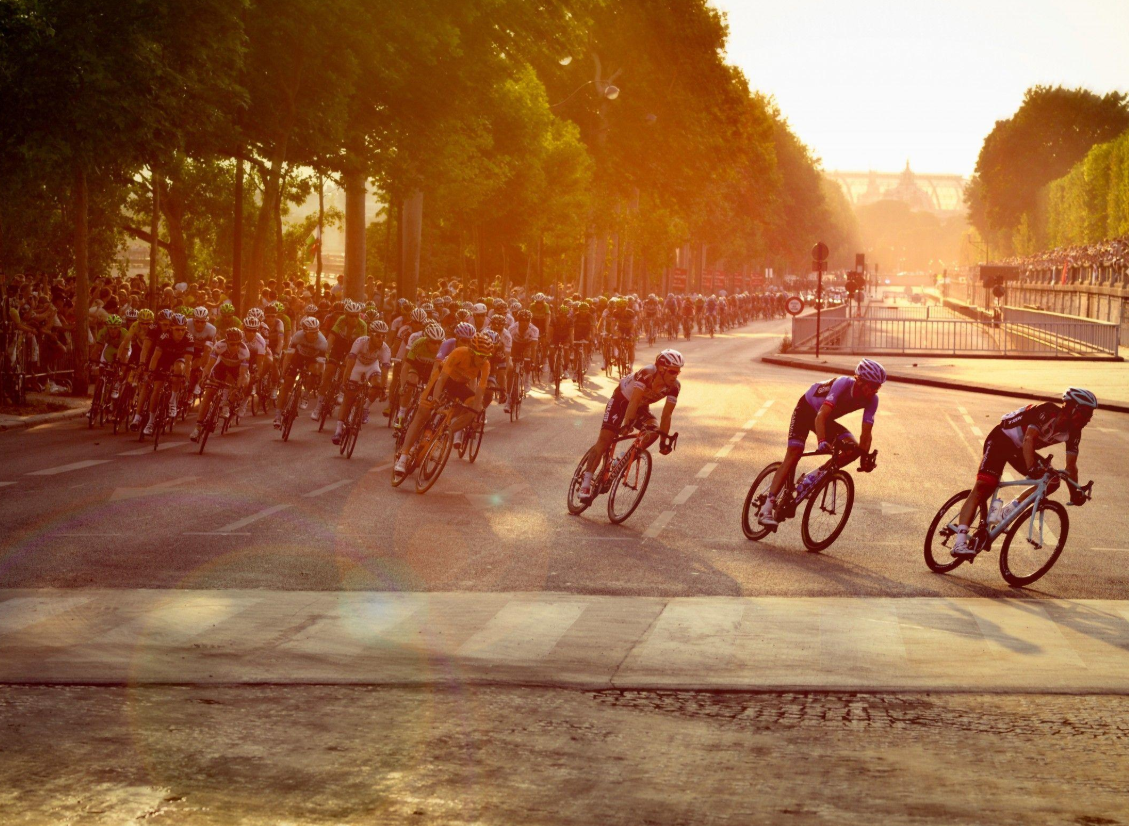
Aerodynamic drag scales with the cube of your speed . Every kilometer per hour you add above 30 km/h hits you harder than the last. That's not marketing copy. That's physics, and it's the foundation for everything in this section.
The Wind Tunnel Numbers That Matter
Wind tunnel testing shows 10–30 watts saved from clothing and position changes at race speeds around 45 km/h. Here's what that means in real terms:
A 10 W reduction at 45 km/h equals 0.4 km/h faster . That's invisible in training. It's decisive in a sprint finish.
Switching from a standard hoods position to an aero hoods position alone measured 33.5 W faster at 30 km/h . One position change. Bigger than most equipment upgrades.
A rain cape worn loose and flapping tested at 29 W slower than riding bare. That's a parachute strapped to your back.
That last number deserves a second read. Thirty watts. Lost. To one flapping layer. The aero suit's core job is the opposite: cut every piece of fabric that catches air badly , and the gains add up fast.Many OEM cycling apparel programs now focus heavily on aerodynamic panel mapping and low-flutter sleeve construction because even small drag reductions become measurable above 40 km/h.
What Happens on Actual Roads
Lab conditions are controlled. Real roads aren't. That's why field testing data matters more to most riders.
In controlled loop testing at 200 W , a one-piece race suit gave a 48-second advantage over a two-piece jersey-and-bib-shorts kit across 30 minutes of riding. For larger or heavier riders — where fabric flutter tends to be more noticeable — that gap grew closer to 1 minute 25 seconds at around 175 W.
Put 48 to 85 seconds into the context of your last race. That's not a small edge. That's a podium position.
The Speed Threshold You Need to Know
Most guides skip this part: aero clothing gains only become significant above certain speeds .
Speed Range | Aerodynamic Impact | Practical Verdict |
|---|---|---|
Below 28 km/h | Minimal drag penalty | Jersey works fine |
28–38 km/h | Moderate gains | Aero suit helps, not critical |
38 km/h+ | Steep drag increase | Aero suit delivers real ROI |
Wind-tunnel testing points to the same conclusion: clothing gains matter most at 38 km/h and above . Below 28–30 km/h, the time savings shrink to near-zero.
Translating Watts Into Race Time Over 40 km
Planning a time trial or a fast criterium? Here's the benchmark range:
20–60 seconds saved over 40 km from an aero clothing change at typical amateur TT speeds
30–90 seconds saved in fast 40–45 km/h TT scenarios where clothing, position, and equipment improvements all combine
A pinned race number costs 0.5 W — small, but if you're chasing seconds, it counts
Why One-Piece Construction Drives the Gains
The skinsuit's structural advantage isn't just about exotic fabric. It fixes three specific problems:
Waistband overlap between jersey and bibs — testers pick up turbulence here every single time
Seam interruptions across the back — each one breaks up smooth airflow
Fabric flutter at the lower back hem — the biggest drag source in a standard jersey at race pace
Textured rear panels and a tighter race fit aren't style choices. They're the details wind tunnels keep confirming , race after race, test after test.
The bottom line: riding above 38 km/h in a competitive setting means the time savings are real, measurable, and repeatable. The next sections answer whether your specific race scenario makes the trade-offs worth it.
Practicality Trade-offs: Storage, Temperature Control, and On-Bike Livability
Speed gains are only half the equation. The other half is everything between the start line and your front door — and that's where the aero suit starts losing ground fast.
Pocket Space: The Problem Nobody Talks About in Wind Tunnels
A standard road jersey from Castelli, Rapha , or Assos gives you three open rear pockets plus a zip pocket. That's about 1.5–2.0 liters of usable storage — enough for a smartphone, three to four gels, a folded wind vest, and your emergency tire kit. The elastic hems and angled openings let you grab things one-handed at 35 km/h without drifting into oncoming traffic.
An aero road suit cuts that capacity by 30–40%. The pockets sit higher on the back. They're built into pre-tensioned aero panels. Load more than 300–400 grams — a mini pump, your phone, and a couple of bars — and the fabric pulls off its designed tension line. You've just brought back the flutter and drag you paid to eliminate.
Pure TT suits go further: no rear pockets at all. A professional cycling clothing manufacturer will usually design TT suits and endurance jerseys around completely different storage and ventilation priorities for this reason.You're relying on a saddle bag, a top-tube bag, or a support car. For a 40 km time trial with a feed station, that works. For a three-hour training ride with a café stop mid-route, it doesn't.
The practical rule: self-supported for more than 90 minutes? The jersey wins on storage before you even unzip it.
Bathroom Stops and On/Off Convenience
Every glossy gear review skips this topic. But it matters a lot on race day — and even more on training days.
Two-piece jersey and bibs let you strip the top with your helmet still on, gloves still on, shoes still on. Café stop, office arrival, post-climb cool-down — all done in 60 seconds. Women's drop-tail bib systems from most major brands add less than 20 grams of hardware. You can make a pit stop without removing a single extra piece of clothing.
A one-piece aero suit means unzipping, peeling from the shoulders, and often pulling your helmet off if the neck fit is snug. Riders report bathroom stops taking 2–3 times longer in a skinsuit than in a two-piece kit. Add a race radio cable, a heart rate strap, and a pinned number — what should be a 90-second roadside stop turns into a minor ordeal.
For women in non-drop aero suits, it's worse. Full upper removal is the norm. That's awkward at any roadside, let alone a cramped café bathroom.
Temperature Range: Where the Aero Suit Gets Exposed
Aero suits are built around one assumption: you're moving fast, in warm conditions, with strong airflow cooling you down. Most brands target a comfort window of 18–28°C at race intensity. Outside that window, the design starts working against you.
Here's what happens below that range:
You add a gilet or arm warmers. Those layers cover the textured shoulder and sleeve panels built to manage airflow at 5–15° yaw angles. You've just insulated the surfaces doing the aerodynamic work.
On long climbs at 12–18 km/h, airflow drops off sharply. The suit's underarm ventilation is already reduced to cut drag. Heat and humidity build up fast — more so than in an open-mesh jersey.
Pull a rain shell over a skinsuit and sweat has almost nowhere to go. Sweat rate climbs. Comfort drops faster than it would in a jersey-plus-separate-base-layer setup.
A good summer race jersey runs 90–120 g/m² open mesh on the side panels. A thermal jersey scales up to 180–220 g/m² with brushed or membrane fabric. Add arm warmers and a base layer, and a single jersey covers a 10–25°C range across a ride with shifting conditions. The full-length zip lets you dump heat on climbs and close back up on descents in seconds — without touching pocket geometry or storage capacity.
The aero suit offers none of that flexibility.
Fit, Compression, and Long-Ride Livability
Aero suits are cut for one position: aggressive drops, elbows bent at about 90°, back flat. Sit upright, move to the hoods for a long section, or reach back for a pocket — you'll feel the suit pull across your chest and stomach. That tension is intentional. It keeps the fabric smooth at 40 km/h. It also makes a four-hour ride feel more and more uncomfortable after a big feed stop.
The compression panels in race-oriented suits often run at 18–22 mmHg. Over 4–6 hours, some riders feel pressure at the stomach during soft-pedaling. Every seam becomes noticeable. In stop-and-go traffic, commuting, or easy group rides at 25–28 km/h, the suit stops feeling like kit. It feels like a restriction — making pocket access awkward and turning café stops into mini-transitions.
Jersey fits — Regular, Endurance, or Slim — are built for multi-posture use. They move with you across hoods, tops, and brief seated climbs. No cutting into armpits. No restricted breathing after a long lunch.
The Practical Decision Framework
Situation | Jersey + Bibs | Aero Suit |
|---|---|---|
4–6 hour self-supported ride | ✅ Clear winner | ❌ Storage and comfort issues |
Café stops / office arrivals | ✅ Off in 60 seconds | ❌ 2–3× longer stop time |
Variable temps (10–25°C) | ✅ Full zip + layering | ❌ Narrow comfort window |
Long climbs at low speed | ✅ Open zip, dump heat | ❌ Limited ventilation |
Race day, 1–4 hours, 18–28°C | ⚠️ Functional, not optimal | ✅ Built for this |
TT / criterium with support | ❌ Drag penalty | ✅ Maximum ROI |
The aero suit's trade-offs aren't dealbreakers. They're design choices built for a narrow, specific use case. Stay inside that use case, and the suit earns every dollar. Step outside it, and the jersey handles real-world riding in ways no skinsuit can match.
Scenario-Equipment Matching Matrix: 6 Real-World Riding Contexts
Six riding scenarios. Six different answers. Stop searching for a universal rule that doesn't exist.
The matrix below maps your actual riding context — speed, drafting dynamics, duration, and off-bike demands — to the kit that makes sense. Go through each scenario. Find the ones that match your week. You'll have your answer before you finish this section.
Scenario 1: Individual Time Trials and Non-Draft Triathlon
This is the one scenario where the skinsuit debate is over.
At 40–50 km/h with zero drafting, aero clothing is the highest-ROI equipment decision you can make. It beats wheels, beats helmets, and beats frame upgrades for most amateur riders. Wind tunnel data show 20–40 watts saved at 45 km/h versus a standard jersey-and-bibs setup. Over a 40 km TT, that's 60–90 seconds for mid-pack riders and 30–60 seconds for well-positioned elites .
Check any national-level TT start list since the mid-2010s. The podium finishers are in skinsuits. Not sometimes — every single time.
Verdict: One-piece aero skinsuit. Non-negotiable at any competitive level.Several high-end teams now work through ODM performance cycling apparel development to fine-tune sleeve texture, seam placement, and rider-specific fit before major events.
Scenario 2: Criteriums and Short Road Races
Drafting changes the math here, but it doesn't kill the case for a race suit.
Buried in a 60-person peloton, drafting absorbs 30–40% of your air resistance . So the gap between your skinsuit and a well-fitted race jersey gets smaller. But criteriums aren't 45 minutes of sitting in. They're 45 minutes of repeated corner exits, short accelerations, and opportunistic attacks — all at 40–45+ km/h with bursts well above that .
Sprinters and riders who plan to attack or bridge gaps still get 5–15 watts at 45 km/h from an aero race suit. That's enough to hold a small gap or finish a closing sprint faster. Riders planning to stay sheltered and sprint from the group? A fitted race jersey with bibs works fine. You also get pockets and better heat management on hot days.
Verdict: Race suit or skinsuit for aggressive riders and sprinters. Jersey + bibs acceptable for bunch-position riders.
Scenario 3: Gran Fondo and Long Road Races
Speed is the deciding factor here. It splits riders into two very different kit choices.
Your group holds above 32–35 km/h average on flat or rolling terrain ? Aero clothing keeps paying off across 4–6 hours. Exposed sections, crosswinds, and paceline work put you in the wind enough that fabric choice adds up to real minutes over time — not just seconds.
Drop below 30 km/h average — hilly routes, heavier riders, back-of-pack pacing — and the math flips. At those speeds, the aero suit's tight comfort range, fewer pockets, and restricted zip access start working against you. Three large rear pockets, a full-length zip for long climbs, and a chamois built for 4–7 hours in the saddle matter far more than shaving drag at 27 km/h.
There's a middle option worth knowing: high-end aero road jerseys from brands like Castelli, Rapha, and Assos close most of the aerodynamic gap. They still give you full pocket space and layering flexibility. These aren't a compromise — they're the right tool for this exact scenario.
Verdict: Aero suit for front-group riders averaging 32+ km/h. Jersey + bibs for everyone else. Aero road jersey as a strong middle ground.
Scenario 4: Interval Training and Fast Group Rides
Don't wear your race suit every day. But don't leave it on the hanger every day either.
Structured efforts above 40 km/h — threshold blocks, VO2 work, rotating pacelines — these are the sessions where using a skinsuit pays off. Two to three targeted sessions in the final weeks before your event let you check chamois comfort, confirm your aero position holds under fatigue, and cut surprises on race day. Riders who pin a number for the first time in a suit they've barely worn learn this the hard way.
For base miles, zone 2 work, and standard group training, stick with jersey and bibs. Your suit stays out of unnecessary wash cycles. You also get the pocket space and layering options that long training days need.
Verdict: Race suit on 1–2 key race-specific sessions per week in the final build phase. Jersey + bibs for everything else.
Scenario 5: Weekend Social and Endurance Group Rides
At 24–30 km/h with café stops, route photos, and casual conversation, you're not in an aerodynamic situation. You're in a lifestyle situation.
The physics are straightforward: aero drag scales with the cube of speed. At 26 km/h with upright posture and frequent coasting, the performance gap between your skinsuit and a quality fitted jersey is tiny. The comfort, convenience, and social awkwardness of a one-piece suit, though? That's very real. Torso restriction, bathroom stops, and sitting in a café in a race skinsuit — no drag number fixes that.
Verdict: Standard jersey + bib shorts. A race-cut jersey for those wanting a snug fit without the full skinsuit commitment.
Scenario 6: Commuting and Utility Riding
This one isn't close.
Stop-start speeds of 20–28 km/h , red lights, building transitions, and locking your bike outside a supermarket make the skinsuit's narrow design pointless. Aero gains at those speeds are near zero. On top of that, the practical demands stack up fast: you need zippered pockets for keys and cards, reflective panels for visibility, fabric tough enough to survive a messenger bag, and a top you can wear through an office building without standing out.
Verdict: Cycling jersey with sturdy bibs or commuter-specific tops. Focus on breathability, pockets, and reflective detailing — not aero.
The Full Matrix at a Glance
Riding Scenario | Typical Speed | Drafting? | Recommended Kit | Key Reason |
|---|---|---|---|---|
Individual TT / Non-Draft Tri | 40–50 km/h | None | ✅ Aero skinsuit | 20–40 W saved; 60–90 sec over 40 km |
Criterium / Short Road Race | 40–45+ km/h | Heavy | ✅ Race suit; jersey acceptable | Aero pays in breaks and sprints |
Gran Fondo / Long Race (fast) | 32–38+ km/h | Partial | ✅ Aero suit or aero jersey | Compounding gains over hours |
Gran Fondo / Long Race (moderate) | Under 30 km/h | Partial | ✅ Jersey + bibs | Comfort, pockets, and layering win |
Intervals / Fast Group Training | 40+ km/h efforts | Variable | ✅ Suit for key sessions | Race-day position and chamois testing |
Social / Endurance Group | 24–30 km/h | Light | ✅ Jersey + bibs | Negligible aero gain; comfort dominates |
Commuting / Utility | 20–28 km/h | None | ✅ Jersey + commuter shorts | Practicality, visibility, durability |
The pattern is clear: the faster you go, the more solo time you spend in the wind, and the more your outcome is measured in seconds — the stronger the case for an aero suit . Everything else is jersey territory. A well-chosen jersey handles it better in almost every way.
Budget Tiers and Investment Sequencing: How to Choose Your Kit Right Now
Most cyclists waste money in the wrong order. They buy a $300 aero suit before they own a bib worth wearing for four hours. Then they wonder why race day still feels terrible from the waist down.
Here's the smarter approach: comfort comes first. Aerodynamics come second. A race skinsuit is the last thing you buy — not the first.
Tier 1: Under $100 — Fitted Kit That Leaves Casual Wear Behind
Target spend: ~$55–70 on a race-cut jersey, ~$30–45 on discounted mid-tier bibs.
This upgrade gives you the biggest bang for the least money — and most riders sleep on it. Switching from loose casual clothing to a fitted cycling kit cuts 20–40 watts of drag at 40 km/h . That's 60–120 seconds over 40 km at the same power output. No skinsuit needed.
What to look for in a jersey at this price:
- Race or slim fit — minimal fabric flutter above 30 km/h
- Laser-cut sleeves — no thick stitched cuffs disrupting airflow
- Standard three rear pockets — habits you'll carry into every tier above this
- Full-length YKK zipper — essential for heat management on hard efforts
- Smooth front panels with mesh side inserts — the baseline for breathability
Skip the supermarket bibs. Buying through a trusted cycling apparel wholesaler can sometimes get riders access to previous-season race-cut kits at significantly better value than retail pricing.Find last-season models from recognized cycling brands at $30–45 . Look for multi-density foam chamois, flatlock seams, and wide leg grippers. The pad quality jump from entry-level to mid-tier is dramatic. You'll feel it straight away.
One thing to buy first: bibs before jersey. Chamois discomfort kills training volume faster than any aero disadvantage will.
Tier 2: $100–$250 — Your First True Race Kit
Two paths, both solid.
Option A — Premium two-piece: $80–120 jersey + $90–130 bib shorts. Total: $170–250. You get temperature flexibility, full pocket access, and a chamois rated for 3–6 hours at race intensity.
Option B — Aero road suit: $150–230 from a reputable brand's race line. One-piece build with rear pockets, textured shoulder panels, and a proper race chamois — no TT-suit trade-offs.
The performance gap between these options and Tier 1 is real, but specific. Aero testing puts road suits at 10–25 watts saved versus a standard race jersey and bibs at 45 km/h . That's about 20–45 seconds over 40 km at steady power. In a criterium or tight local road race, that margin is what separates bridging a gap from watching it open.
Go with the two-piece premium kit if:
- You train far more than you race
- Your weight or fit is still changing
- Temperature swings across your ride season are significant
Go with the aero road suit if:
- You already own decent bibs and want the next aero step
- Your calendar includes crits, short road races, or hard group rides where small gaps decide results
The textured fabrics at this price point are built for real Reynolds numbers. Dimpled and ribbed panels on shoulders and sleeves are tuned for 25–45 km/h — the range where most amateur racing takes place.
Tier 3: $250+ — Wind-Tunnel-Validated Race Suits
This tier makes financial sense in three specific situations:
You sustain above 35 km/h in race-type efforts
You can hold an aero or TT position for two-plus hours without posture collapse
You race where top-10 time gaps are under 10–20 seconds across 40–60 km events
Off-the-shelf elite suits run $250–400 . Custom CFD- or wind-tunnel-tuned options push $400–700+ . Panel zones map to your body's airflow profile — smooth fabrics at low-turbulence zones, ribbed or dimpled textures at the shoulder, upper arm, and lower back for boundary-layer control.
The performance ceiling is real: 30–60+ watts versus club-level loose kit at 45 km/h . But the gain over a quality Tier 2 aero suit often shrinks to 5–15 watts . That's worth the cost, but set aside for when those seconds change your actual result.
These suits last, too. Race them on race days and key race-simulation sessions. A $300 skinsuit stays competitive for 2–4 seasons . The per-race cost works out better than most riders expect.
The Correct Sequencing (Whatever Your Budget)
Priority | What to Buy | Why It Comes First |
|---|---|---|
1st | Quality bib shorts ($80–120 target) | Chamois comfort drives training consistency |
2nd | Race-cut performance jersey | Aero fit + pockets + position-specific length |
3rd | Aero race suit | After speed and race goals justify it |
Quick budget breakdown:
~$80–100 total: One mid-tier bib ($50–60) + one sale-priced race-fit jersey ($40–50)
~$150–200 total: $90–120 bib + $60–80 performance jersey — or, if you already own decent bibs, stretch to a $150–180 aero road suit
~$300–400 total: Full premium two-piece kit, or one quality two-piece setup plus an entry-level race suit if your event calendar calls for it
The bottom line: don't buy a skinsuit before you're fast enough to feel the difference . Your race-pace average is still under 30 km/h? Spend that next $200 on better bibs and a fitted jersey. It will outperform a $300 skinsuit every single time.
Cycling Jersey vs Skinsuit — FAQ
Is a skinsuit always faster than a jersey?
At race speeds above roughly 40 km/h, yes — wind tunnel testing in this comparison shows 10–30 watts saved from clothing and position changes, and drag scales with the cube of speed, so the gap widens the faster you go. Below that speed, or on longer rides where you need pockets and layering, a jersey usually wins on practicality.
How much time does an aero suit / skinsuit actually save?
A 10-watt reduction at 45 km/h works out to about 0.4 km/h faster — invisible in training, but decisive in a sprint finish or a tightly contested time trial.
Can a loose jersey actually be slower than no jersey at all?
Yes in extreme cases — a rain cape worn loose and flapping tested 29 watts slower than riding bare in this data set. Fit and flutter matter as much as garment choice.
Sourcing your own race-day kit? See our Custom Cycling Jerseys Manufacturer line, or if you race triathlon compare our One-Piece vs Two-Piece Tri Suits breakdown.
Conclusion
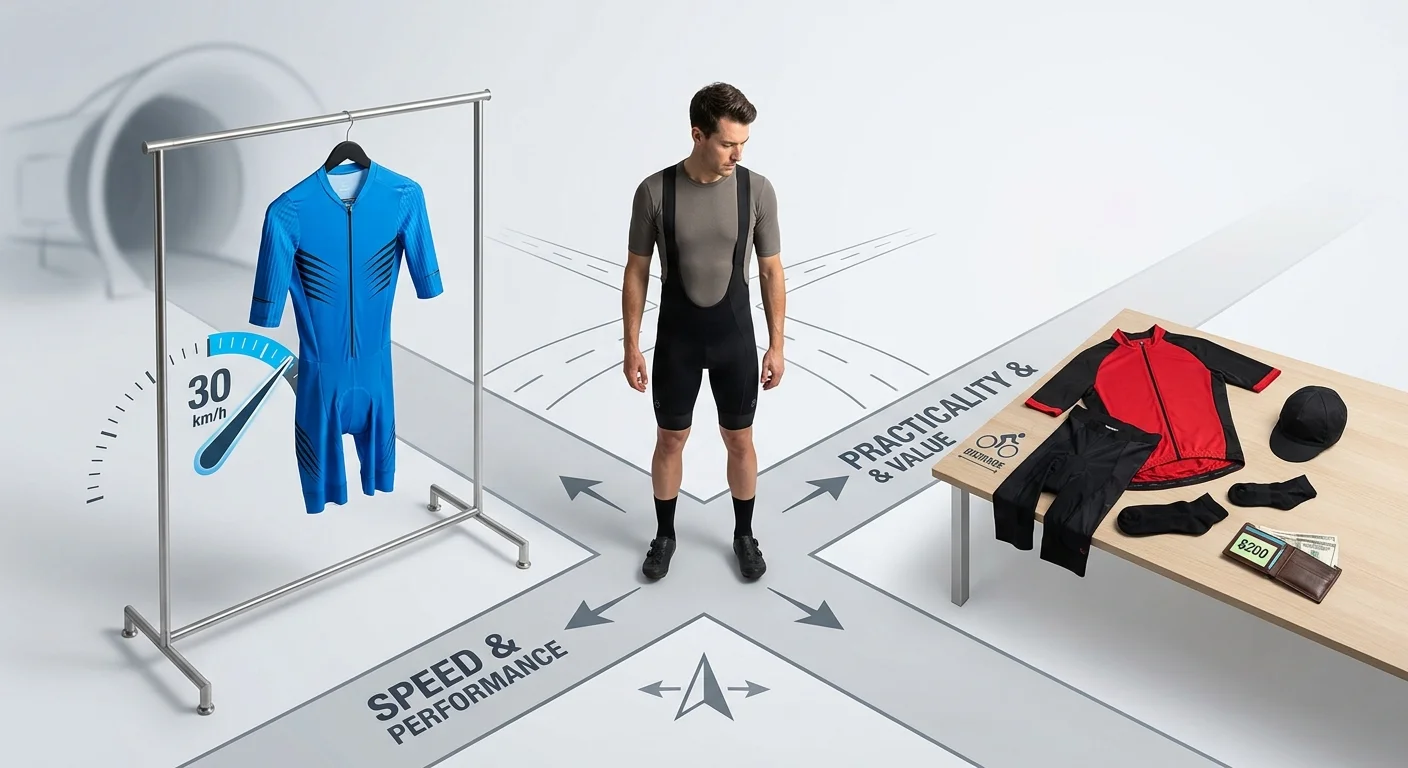
The data doesn't lie — an aero suit will make you faster on race day. But speed without context is just expensive discomfort.
Here's what matters most: racing fewer than 10 times a year? A premium aerodynamic cycling jersey with a race-cut fit gives you more value per dollar than any skin suit can. Save the one-piece for the races that count — criteriums, time trials, and A-priority events where every watt matters.
The real decision isn't jersey versus aero suit. It's knowing which tool fits which moment in your race calendar.
Start with the scenario-matching matrix in this guide. Lock in your budget tier.Riders comparing brands for team orders or bulk purchases should also compare long-term durability and wholesale price cycling kit options before making a final investment. Then make one deliberate purchase — not two mediocre ones. Your fastest race day cycling outfit isn't the most expensive option on the shelf. It's the one you picked with a clear reason and a specific race in mind.
That's the upgrade most riders never make.