You found a jersey that looks fast. Two hours in, you're spending the entire climb fighting the hem as it creeps up your lower back. Or the opposite happens — you sized up for more room, felt human on the bike again, then watched your buddy's aero jersey cut through a headwind while yours ballooned like a windsock at 55 km/h.
Fit is the variable nobody talks about enough. Get it wrong and it doesn't just cost money — it ruins rides.Riders investing in custom race fit and club fit cycling jerseys quickly learn that fit affects performance far more than graphics or branding.
This guide gives you a real-world comparison of race fit vs club fit cycling jerseys across seven measurable dimensions. Each one is matched to your riding type, hours on the saddle per week, and body build. So you can make the right call before the package shows up at your door.
7-Dimension Real-Ride Performance Comparison

Seven dimensions. That's all it takes to separate a jersey that works with your body from one that fights you for four hours straight.
The table below isn't a spec sheet — it's a record of what happens when fabric meets effort, wind, sweat, and gradient. Read each row against the kind of riding you do, not the riding you imagine doing when you're browsing at midnight.Leading cycling apparel manufacturers design race and club fits around completely different riding dynamics.
Dimension | Race Fit | Club Fit | What You'll Feel |
|---|---|---|---|
Underarm Mobility | 20–30% 4-way stretch; armhole 2–4 cm narrower | 10–20% stretch; armhole 2–4 cm wider | In the drops pushing 300 W, race fit stays taut with zero fold lines. Club fit creates a small fabric catch at the lat. You notice it most during out-of-saddle sprints, as your upper body rocks side to side. |
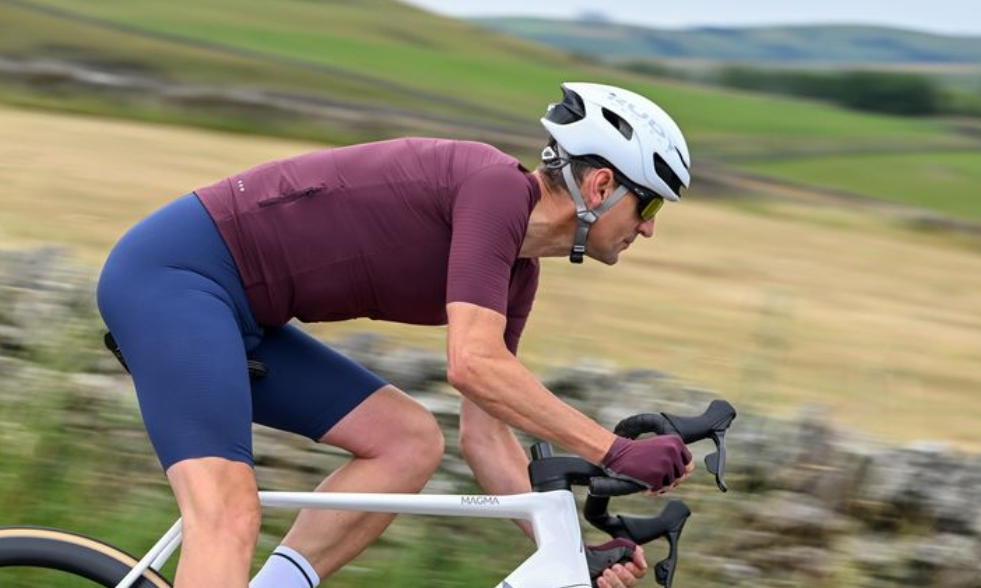
Waist Contour Fit | Hem 2–6 cm smaller than natural waist; 360° silicone gripper | Hem matches waist with 0–2 cm ease; partial or no silicone | Above 30 km/h, race fit keeps the front panel flush against your bibs. That's where the real aero gain lives — 5–15 W saved at 40–45 km/h. Club fit lets the lower abdomen panel move in and out with each gust. It's not dramatic. It's just always there. |
Back Drop Length | Drop tail 3–5 cm longer than front; covers lumbar at 10–20° torso angle | Drop tail 2–3 cm longer; calibrated for 30–45° upright posture | On a steady 8% climb at 65 rpm, race fit stays anchored — no bib mesh, no cold gap. Club fit rides up 1–2 cm as you alternate sitting and standing. Below 15°C, you'll feel that exposed strip of lower back on every descent. |
Sleeve Opening Tension | 40–55 mm gripper band; 3–8% negative ease on mid-bicep | 20–30 mm band; 0–3% negative ease | Above 45 km/h on descents, race sleeves stay still. Club sleeves flutter 3–5 mm in the airstream — a small flap sound, a subtle tug at the outer arm. Not a watt-killer, but it lodges in your head on a long descent. |
Forward Posture Alignment | Front panel 2–4 cm shorter; shoulder seams rotated forward for aggressive bar drop | Symmetrical front-to-back; minimal tension when upright | At a torso angle of 35–45° to horizontal, race fit lies flat across the chest. Club fit builds a 1–3 cm fabric pouch at the solar plexus. At 40 km/h into a crosswind, it flaps. You feel it pulling at the collar and shoulder seam. |
Wicking & Temperature Regulation | Direct skin contact; 90–130 g/m² micro-mesh panels; dries 20–40% faster in airflow | 2–5 mm air gap across torso; 120–160 g/m² fabric; fewer mesh zones | Above FTP, race fit feels drier. Sweat moves fast onto airflow. Below 60% FTP or in cold weather under 18°C, that tight contact feels like a cold compress on a long easy section. Club fit's air gap shields you here — though after a hard interval followed by a mellow roll, moisture pools at mid-back for 10–20 minutes longer before clearing. |
Pocket Accessibility | Pockets sit 3–5 cm above iliac crest; 10–12 cm openings; ~1 L total | Pockets 1–3 cm above iliac crest; 12–14 cm openings; more relaxed tension | Load race fit pockets with 2 gels, a tube, CO₂, and a mini tool (~280 g) and they sit flat over gravel at 28 km/h. Club fit makes mid-ride grabs easier — with long-finger gloves especially. Push past 400–500 g though, and the pockets sag and sway, tapping your lower back with every pedal stroke. |
One Pattern Worth Noting
Read that table top to bottom and a clear split emerges. Race fit delivers its biggest advantages between 35 and 55 km/h — the speed range where fabric behavior stops being theoretical and starts costing or saving real energy. Below that threshold, on easy social rides or commutes, club fit's small design freedoms stop being compromises. The wider armhole, the relaxed hem, the lower-tension pockets — these become genuine comfort features.
The dimension where this shows up most is wicking. At low intensities in cool weather, tight skin contact works against you . The air gap in a club fit cycling jersey acts as a micro-buffer. That's why a semi-fitted cycling jersey can feel warmer and less clammy on a 16°C morning group ride than a full aero cycling jersey doing the same job.
None of this means one jersey is better than the other. The jersey is only as good as the match between its design and your riding conditions. The fabric doesn't care what you planned to do today — it responds to what you're doing right now.
Scenario-Based Fit Performance on the Bike
The jersey doesn't know what kind of ride you planned. It only knows what you're doing right now — and the gap between those two things is where most fit mistakes happen.
Below are five real riding scenarios. For each one, the fit question isn't abstract. It has a physical answer that shows up in your power file, your RPE, and how your back feels at hour three.
Racing and Threshold Training
Above 38 km/h, a 0.010 drop in CdA saves 40 to 60 seconds over 40 km at constant power. A well-fitted race jersey delivers that over a loose alternative. That's not a marginal gain. That's a podium position in a crit or a personal best in a TT.
The catch is sizing. Go one size too small on a race fit cycling jersey and you pay a real price: compressed ribs, restricted diaphragm, and a hard ceiling on how deep you can breathe during VO2max intervals. Experienced fitters catch this at 8 to 12 minutes into a hard effort block. That's the point where a chest that's too tight starts costing you more than the aero gains are giving back.
The rule of thumb is simple: pick the smallest size that still allows a full overhead arm lift and a deep, unrestricted inhale . Sleeves should stay anchored as you rotate your torso in the drops. If they ride up, go down a size.Many performance brands now develop OEM/ODM cycling jerseys optimized for aggressive riding posture and aerodynamic efficiency.
Weekend Group Rides and Fast Paceline Cruising
Fast club rides run at 30 to 36 km/h. That's the speed range where fabric behavior becomes measurable. A race fit jersey keeps your shoulder and sleeve profile stable as you rotate through the paceline. That matters for your own drag — and for the two or three riders sitting on your wheel. A cleaner silhouette produces smoother airflow off your back. Riders two through four save 20 to 30 percent of their required power compared to riding exposed.
Club fit is still a valid choice here — but for specific reasons, not general comfort.
Four-hour rides with frequent snacking: The extra torso volume lets you reach back to jersey pockets without zipper stress.
Temperature swings on the move: A roomier chest handles layering a gilet in a way a compressed race fit can't.
Mixed efforts — stretching mid-climb, surging through a junction, soft-pedaling to the café: Less collar pressure and zipper tug in a club fit matters more than the small aero penalty.
Gran Fondo and Long-Distance Endurance
Four to eight hours on the bike changes everything. A race fit that felt sharp at hour two can turn punishing by hour five — especially as your core fades and you start slumping onto the bars. Lower-rib compression, neck tension, the feeling of the jersey fighting your posture instead of supporting it — these aren't dramatic complaints. They build up in the background, then hit all at once on a long final descent.
The smarter endurance approach isn't ditching race fit principles. It's softening them in targeted spots. Keep shoulders and sleeves snug — that preserves most of the aero benefit. Add 1 to 2 centimeters of ease at the belly and waist. That extra room absorbs the postural shifts that stack up over a full day in the saddle.
The CdA trade-off is 0.003 to 0.008 compared to a pure race fit — about 5 to 10 watts of aero cost. For an eight-hour ride, most riders take that trade without second-guessing it.
Pocket stability matters more here than in any other scenario. You need high-stretch fabric that holds 0.5 to 1 kg of cargo — gels, tools, a phone, a rain layer — without pulling the neckline down or pushing the hem up. That's the spec that separates a good long-distance jersey from a frustrating one.
Commuting and Urban Riding
Below 25 km/h, with traffic stops at every kilometer, the aero case for a tight cycling jersey falls apart. Stop-and-go city riding never reaches the speed range where fabric drag accounts for 25 to 40 percent of total resistance. At 15 to 20 km/h, the difference between race fit and club fit is a few watts at most.
What matters in urban riding:
Thermal management during low-speed segments
Freedom of movement — shoulder-checking, mounting, dismounting, over and over without restriction
Backpack compatibility — a race jersey's seams and zipper aren't built for messenger bag pressure all day
A semi-fitted cycling jersey with technical wicking fabric and enough room to layer under a rain jacket handles all of this. You also don't arrive at the café looking like you just crossed a finish line.
Climbing and Heat Management
On long climbs at 8 to 15 km/h, gravity is the main resistance force. But heat management is what limits your performance — especially above 25°C with full sun.
Race fit cycling jerseys earn their place here, though not because of aerodynamics. Close skin-to-fabric contact in a lightweight mesh jersey (90 to 120 g/m²) boosts wicking and convective heat loss as air moves across the fabric. Less trapped air means less insulation during 60-minute threshold climbs. It also stops sweat-soaked fabric from sagging and creating chafe during out-of-saddle efforts.
Club fit's air gap is a real comfort feature in cool weather. In humid heat, it becomes a problem. Trapped warm moisture blocks evaporative cooling and pushes your heart rate up for the same power output. In dry air below 18 to 20% humidity , evaporation stays efficient enough that a club fit holds up. In humid summer heat, it doesn't.
Higher-end cycling brands have developed "climbing jerseys" that address this directly: race-like torso fit paired with ultra-light, highly breathable fabric. Cooling takes priority over pure aero at low climbing speeds. The fit still stays close enough to prevent billowing on the descent.
The Pattern Across All Five Scenarios
Riding Scenario | Recommended Fit | Primary Reason |
|---|---|---|
Racing / TT / Threshold | Race fit | CdA reduction is measurable and consequential above 38 km/h |
Fast group rides / pacelines | Race fit (with 1–2 cm belly ease) | Silhouette stability in paceline; posture variability for mixed-tempo effort |
Gran Fondo / all-day endurance | Club or semi-fitted | Pocket capacity, layering, posture fatigue after 3–4 h |
Commuting / urban | Semi-fitted | Aero irrelevant; backpack compatibility, thermal management at stops |
Climbing / heat | Race fit or climbing-specific | Convective cooling, no sagging fabric, wicking at sustained effort |
These five scenarios point to the same conclusion: the real fit decision isn't race versus club in theory — it's about the speed range you sustain and how long you hold it . The dividing line sits at 28 to 30 km/h, maintained for meaningful stretches. Below that threshold, club fit's extra freedom is a genuine performance feature. Above it, that same freedom becomes drag.
BMI & Posture Aggressiveness Adaptation Matrix
Body shape and riding posture are two variables most jersey guides skip over. That's a real problem. The same race fit that works on a 68 kg climber can feel punishing on someone carrying more torso mass — and the difference has nothing to do with willpower or fitness level. It comes down to physics, spinal geometry, and where fabric tension lands when you're bent over the bars.
The matrix below connects three things: your BMI band, how far forward you lean on the bike, and which jersey fit works for that combination.Experienced cycling apparel suppliers often recommend different jersey cuts based on posture flexibility and torso shape.
Rider Build (BMI) | Upright Posture (0–10° lean) | Endurance Posture (10–15° lean) | Aggressive/Race Posture (>15° lean) |
|---|---|---|---|
Lean / Athletic (<22) | Club or race fit both viable. Aero gains are minimal at low speeds anyway. | Race fit ideal — low torso volume means no abdominal restriction at this angle. | Race fit is the top choice. High postural stability lets you go deep into flexion with little breathing compromise. |
Average / Standard (22–26) | Club fit preferred. Race fit can cut into the lower abdomen in an upright position. | Semi-fitted or "club-race hybrid" — sizing up one race fit often normalizes compression. | Race fit works with a strong core and regular training. Limit drop to 15–20° on long rides. |
Power / Stocky (26–29) | Club fit is the practical default. Tight race cuts cause chest compression and reduce diaphragmatic expansion at low intensities. | Club fit with extended back drop. Race fit works only if cut to your chest-to-waist ratio. | High risk. Deep flexion beyond 20–25° is hard to hold without back or knee overload. Use relaxed club fit with reinforced hem grippers. |
Higher Girth (>29) | Club or relaxed fit. Prioritize breathing room; avoid narrow silicone hem grippers. | Club fit, conservative lean. Race fit causes fabric pooling at the lower abdomen, which increases friction against the thighs mid-pedal stroke. | Not a viable option. Focus on a higher stack, shorter reach cockpit — and a relaxed jersey with wide, soft grippers. |
Maximum Lean Angle by BMI (Rule of Thumb for Non-Racers)
Studies show postural stability drops as BMI rises — tracked by center-of-pressure displacement and spinal deviation under load. That instability puts a hard ceiling on how far forward you can lean. Push past it and your lower back or knees start to compensate.
BMI <22: Sustainable 2–4 hour lean of 20–30°. Race fit is the safe default.
BMI 22–26: Sustainable lean of 15–25° if well-trained; otherwise 10–20°. Semi-fitted or sized-up race fit for rides over three hours.
BMI 26–29: Sustainable lean of 10–18°. Club fit with extra back length; no pro-cut race jerseys unless custom-made cycling race jerseys.
BMI >29: Sustainable lean of 0–12°. Relaxed club fit with minimal compression throughout.
One practical note: for BMI ≥26, skip narrow silicone hem strips. Wider, softer hem bands and a slightly longer front zipper take pressure off your midsection in riding position. That pressure is invisible in front of a mirror — you only feel it on a trainer at your actual torso angle.
The Posture–Compression Feedback Loop
Here's what most fit guides miss: hem-gripper tension and zipper stress don't scale linearly as BMI and lean angle climb together — they compound. At BMI 26+ with a 15° forward lean, the abdomen folds at the hip crease. A race jersey's short front panel piles tension right at that fold. It doesn't just feel uncomfortable. It can quietly cut into how deep a breath you take during hard efforts.
Say you're dropping the stem 5–10 mm to get a more aggressive cockpit position. Do the core work first. Don't assume a race fit jersey will just adapt around that change. The jersey is the last variable to adjust, not the first.
3-Variable Decision Framework: Ride Type, Weekly Hours, Body Build
Three variables. That's the whole equation. Not your budget, not the brand, not what the fastest rider in your group is wearing. Just ride type, weekly hours, and body build — give honest answers to each one, and you'll land on the right jersey fit faster than scrolling through any number of reviews.
Work through the three steps in order. Two variables pointing the same way? You have your answer. They conflict? There's a resolution rule at the end.
Step 1: What Does Your Riding Look Like?
Not the riding you're aiming for. The riding you do most weeks.
If 60% or more of your time is at threshold, VO2max, or sprinting (RPE 7 or higher, heart rate above 85% max): you're in race-fit territory.
- Higher speeds mean more aero benefit from a close-fitting jersey
- Better moisture transfer at high sweat rates
- Less fabric flutter breaking your focus on descents
If 50% or more of your rides are at conversational pace — café stops, coasting, easy group miles (RPE 5 or below): club fit is your default.
- Lower average speeds make the aero case for a tight cycling jersey pointless
- Comfort over hours matters more
- Freedom of movement matters too — like reaching into a pocket while soft-pedaling.Buying multiple cycling jerseys at wholesale price makes it easier for clubs and teams to separate race-day and training kits.
If your riding is mixed — gravel, XC, commuting, weeks that swap between hard intervals and long easy days — don't decide from Step 1 alone. Let Steps 2 and 3 carry the decision.
Step 2: How Many Hours Per Week Are You Riding?
Count everything: indoor trainer sessions, commutes, weekend rides.
Under 4 hours per week: Go with club fit, full stop.
At low volume, your body hasn't built the tissue tolerance for race-fit compression. A tight cycling jersey takes 5–10 rides before high-tension panels start to feel normal. Club fit settles in within 1–3 rides.
Beyond that, without frequent saddle time, a race jersey's elastic tension around the shoulders and abdomen creates a specific kind of fatigue:
- Shoulder tightness around the 45-minute mark
- A "breathing against the fabric" feeling that drains you before the effort does
Want something racier for the odd hard interval session? Try a compressive base layer under your club jersey. That's a better move than switching to a full race fit.
4 to 8 hours per week: This is where a two-jersey setup starts making real sense.
Use race fit on days with at least 20–30 minutes of Zone 4 or harder work planned
Use club fit for everything else — endurance days, recovery rides, easy leg-turners
There's a psychological benefit too. Saving race fit for hard days builds a real performance association. You pull it on, and you know what the day is.
Over 8 hours per week: Club fit becomes your everyday jersey. Race fit becomes a precision tool.
High volume stacks up the small friction points that come with tight cycling jerseys:
- Underarm seam irritation
- Waistband compression marks
- Low-grade hip flexor discomfort from a constricted hem over long hours
Club fit for base mileage stops that wear from building up. On very high-volume weeks, cap race-fit days at three per week — unless you're genuinely lean and have zero comfort issues.
Step 3: What Are Your Measurements?
Most fit guides go vague here. Here's a direct way to think about it.
Stand in your natural posture — no pulling in. Take two measurements:
- Chest circumference at nipple line
- Waist circumference at narrowest point
If your chest-to-waist ratio is above 1.25 (for example: 100 cm chest, under 80 cm waist) or your BMI is under 24 : race fit patterns are cut for your proportions.
- The front panel won't bow at the zipper
- The abdominal section won't bunch while you're seated
- Race fit works across intensities and volumes — you still need to respect the weekly hours logic from Step 2
If your chest-to-waist ratio is 1.15 or below (chest 105 cm, waist 91 cm or more) or your BMI is over 26 : the structural risks of race fit are real and worth taking seriously.
You'll notice:
- A visible S-curve or bowing at the zipper while standing relaxed
- Shoulder fabric pulling from the neck toward the sleeve head
- Red pressure marks at the shoulder seam after 60 to 90 minutes
These aren't just comfort complaints. Chronic trapezius tension and low-grade shoulder compression affect recovery between rides. Club fit is the practical default here.
Variables in Conflict: The Resolution Rule
Ride Type | Weekly Hours | Body Build | Recommended Fit |
|---|---|---|---|
High intensity | Under 4 h | Any | Club + compressive base layer |
High intensity | 4–8 h | Ratio >1.25 or BMI <24 | Race on hard days, Club elsewhere |
High intensity | 4–8 h | Ratio ≤1.15 or BMI >26 | Club (race fit for events under 90 min only) |
High intensity | Over 8 h | Ratio >1.25 or BMI <24 | Race 2–3 days/week, Club as base |
High intensity | Over 8 h | Ratio ≤1.15 or BMI >26 | Club as default |
Endurance / café pace | Any | Any | Club |
Mixed terrain | 4–8 h | Ratio >1.25 or BMI <24 | Race for events, Club for mixed days |
Mixed terrain | Any | Ratio ≤1.15 or BMI >26 | Club |
One conflict comes up a lot: high intensity paired with a higher BMI or low chest-to-waist ratio . The default is always club fit. Hard riding doesn't cancel out body build — it makes the mismatch worse. You're breathing harder against the compression at the exact moment unrestricted breathing matters most.
The framework keeps pointing to club fit but you want a more performance-oriented feel? Add a structured, lightweight compressive base layer underneath. You get core stabilization, less fabric movement, and better sweat channeling — no anatomical mismatch risk from forcing a race-fit jersey onto a build it wasn't cut for.
Race fit compression cannot correct anatomy. That's the core principle this whole framework rests on. Body build and weekly hours both pointing to club fit? Don't size up in a race jersey and hope for the best. Choose club fit, add a better base layer, and stop leaving performance on the table.
Use accurate chest and waist measurements. Answer the three steps honestly. This framework clears up about 80% of cycling jersey fit decisions — no try-on needed.
Real-World Sizing Pitfalls & Mitigation Strategies
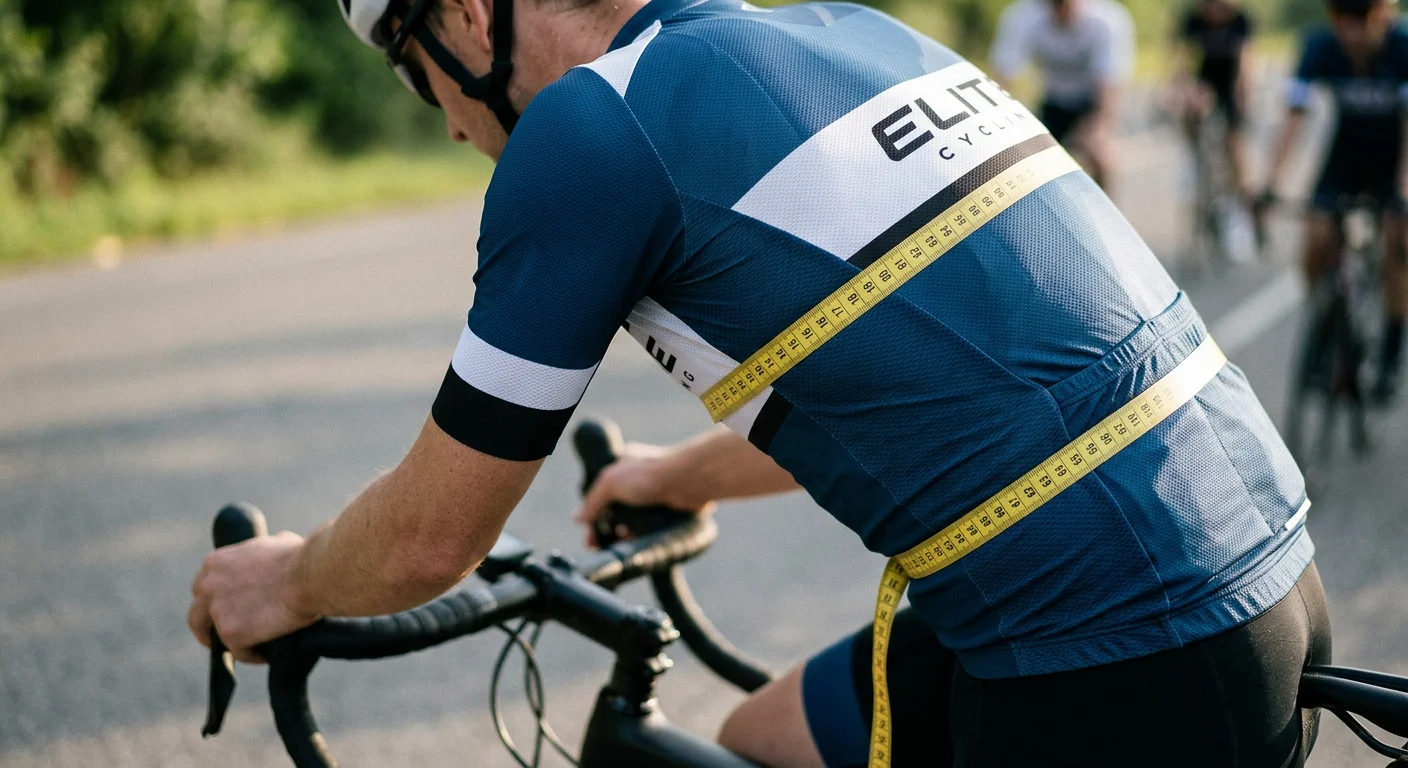
A wrong-sized cycling jersey is a quiet mistake. You don't notice it at kilometer 20. By kilometer 80, it has taken over your entire ride.
Three pitfalls come up again and again. Each one has a clear warning sign and a real fix.
Pitfall 1: Sizing Up in Race Fit Instead of Switching to Club Fit
This is the most common one. Your chest lands right at the upper boundary of a race size, so you go up a size. It feels logical. It isn't.
Sizing up in a race-fit jersey adds circumference, not torso length . In riding position, that extra girth pulls upward. Your effective back drop shortens by 1 to 3 cm , depending on the brand. Sleeve grippers shift 1 to 2 cm toward the elbow, away from the widest part of your arm — that increases flutter. Shoulder seams drift past the acromion and rotate backward. In photos, you'll see diagonal creases running from the collarbone toward the armpit. That's the tell-tale sign the jersey is resting on your upper arms instead of sitting across your shoulder caps.
The fix: Your chest or waist is within 1 cm of the upper limit for a race size? Don't go up. Switch to a club fit instead. Use race fit only when both chest and waist measurements sit at least 2 to 3 cm inside the size range — and mild torso compression at rest feels comfortable, not something you're just tolerating.
On-bike confirmation test: In your normal riding posture, grab the rear hem at center and pull downward. You should feel gripper resistance after 5 to 10 mm of movement. Pull 20 mm or more before feeling resistance? The jersey is too loose — and sizing up has made it worse, not better.
Pitfall 2: Ignoring the Aero Cost of a Loose Jersey
A ballooning jersey feels harmless. It isn't. Wind-tunnel and track testing show that a loose-fitting jersey adds 3 to 5 watts of drag at 35 km/h compared to a snug fit. Two things cause this: chest fabric that inflates and collapses in the wind, and straight-cut sleeves that wrinkle at the shoulder in the drops — acting as small parachutes at yaw angles.
Over a 50 km ride at 35 km/h — about 85 minutes — an extra 4 watts of drag equals 21,600 additional joules of work . That's half a gel to a full gel's worth of energy burned, all because of how your jersey behaves in the wind.
The audible test is worth using here. During paceline sections at 30 to 40 km/h, a slapping or flag sound from your chest or sleeves is a clear sign of aero loss. Load your pockets with two bottles and a few gels, then get onto chipseal. Pockets bouncing more than 2 to 3 cm up and down while seated? Your back panel is too relaxed for high-speed group riding — and the hem lifts off your shorts every time you stand.
The fix: Run the zipper-bow check. Zip the jersey in riding position. Measure the gap between the zipper line and your sternum. The bow exceeds 1.5 cm at mid-chest with empty pockets? You're hanging fabric off your shoulders instead of loading the panels the right way. Downsize — or switch to a tighter cut.
Pitfall 3: Underestimating Compression Fatigue on Long or Consecutive Rides
A race-fit jersey that feels sharp on a two-hour ride can turn punishing by hour four. Here's the mechanism: high-elastane torso panels press hard against the lower ribs and upper abdomen. After two to three hours at endurance or tempo intensity, riders shift toward shallower, chest-led breathing — the diaphragm hits resistance at the bottom of each inhale. Perceived exertion climbs at constant power. It feels like a fitness problem, but it's fabric.
The warning signs build in the background and are easy to miss:
Dull ache or mild numbness along the costal margin — that line where your lower ribs curve toward the front — during or after the ride
Feeling "short of breath" at sweet-spot intensity despite a normal heart rate, with a need to force belly expansion against the jersey on every breath
Pulling the hem down or unzipping mid-climb more than once or twice per 20-minute climb
On multi-day rides, this gets worse fast. Day one feels fine. By days two and three, mild rib soreness shows up early, and breathing already feels restricted before you've warmed up. Compression that's fine for a crit becomes a real drain across four to six consecutive hours.
There's also a fabric issue that develops over long rides. Sweat saturates the elastane and heat builds up — the jersey "relaxes," adding 1 to 2 cm of effective back length. But torso compression doesn't drop at the same rate. The front panel stays tight while the back hem creeps up toward the lumbar curve. Pockets sit higher and tighter against your hip hinge. Reaching back for a gel on a climb takes more shoulder effort than it should.
The fix: On rides beyond four hours — or on stage days two and beyond — switch to a semi-fitted jersey with 2 to 4 cm more chest circumference than your race cut. Keep sleeves snug enough to prevent flutter, but make pocket access and full abdominal expansion the priority. Before each long stage, do three to five full diaphragmatic breaths with the jersey zipped. No sharp pressure at the lower ribs is the standard to hit. That simple check catches the breathing restriction you won't feel until it's already costing you watts.
Execution-Ready Decision Flowchart & Quick-Reference Checklist

Every framework in this guide comes down to one moment. You're on a product page. Your cursor hovers over "Add to Cart." You have sixty seconds before your brain talks you into the wrong choice.
Here's the system that stops that from happening.
Step 1: What Does Your Next Three to Six Months Look Like?
Not your ideal riding life. Your real one.
60% or more of your rides involve structured intervals, fast group efforts, or pushing at or above threshold — and your average tarmac speed sits above 30 km/h — go to the Body Build Check below.
60% or more of your rides are endurance, touring, commuting, or recovery — where comfort and on/off-bike utility matter more than aerodynamics — go straight to the Weekly Volume Check .
Can't decide? You're a 50/50 split? Take the endurance route. Unless you race or chase segments, the endurance path is the honest answer for most riders.
Branch 1: Body Build Check (Racing & Fast Group Riders)
Three measurements. Five minutes. No guesswork.
Take these standing relaxed, shirt off:
- Chest circumference at the fullest point
- Waist at navel height — not your trouser waist, not held in
- Height and weight for a quick BMI reference
Then run two checks:
Waist-to-chest ratio:
- Waist is 90% or less of chest (e.g., 90 cm waist against a 100 cm chest) → lean or proportional
- Waist exceeds 90% of chest, or you have a blocky midsection → stocky or higher waist
BMI quick filter:
- BMI 25 or under with no abdominal overhang in cycling stance → count as lean
- BMI 28 or over, or strong abdominal projection when bent forward on the bike → count as stocky
Now photograph your riding posture. Have someone take a side-profile shot while you're on the bike, hands where they sit 80% of the time. Estimate your torso angle — how far your back drops from vertical.
Build | Torso Angle | Decision |
|---|---|---|
Lean or proportional | ≤10° from horizontal | Race fit confirmed |
Lean or proportional | >10° from horizontal | Club fit |
Stocky or higher waist | Any angle | Club fit locked |
One hard rule: a stocky build doesn't get overridden by riding fast. Higher intensity makes a mismatched race jersey worse, not less of a problem. You're fighting fabric compression at the exact moment you need full breathing capacity.
Branch 2: Weekly Volume Check (Endurance & Commuter Riders)
Count everything over a four-week rolling average: indoor trainer, commutes, weekend rides. All of it.
Under 4 hours per week → Full club fit, no exceptions.
Your body hasn't built the tissue tolerance for race-fit compression. A tight cycling jersey needs five to ten rides before high-tension panels feel normal. Club fit settles in within one to three rides. At low volume, the aero argument falls apart in practice.
4 hours or more per week, with at least one threshold effort per week → Club fit as your base, one or two race jerseys for hard days.
This is the two-jersey setup that works. Club fit handles endurance rides, recovery days, and mixed-terrain sessions. Race fit comes out for interval blocks, fast group rides, and events. The split isn't just practical — it builds a real performance association. You pull on the race jersey and your brain already knows what kind of day it is.
Pre-Purchase Checklist: Four Checks Before You Click Buy
1. The tape measure test
Chest circumference sets your baseline size. Waist mismatch drives your fit-class decision — not downsizing.
Chest measures as a Medium but waist measures as a Large? Choose Club Large . Go for Race XL only if you race and can tolerate high torso compression.
Waist runs two full size bands above your chest? Skip race fit for that model. Choose club fit in your waist size, and look for bibs with high lateral stretch.
2. The product copy scan
Two minutes on the product description tells you most of what you need.
"High-stretch / comfort fit / relaxed performance" → size true to chest, the cut forgives mismatch
"Pro fit / compressive / second-skin / aero race cut" → between sizes by chest or waist runs one band larger? Size up one — or switch to a club fit model
3. The hem gripper match
Primary Use | Gripper to Choose |
|---|---|
Road racing, crits, fast tarmac | Wide silicone gripper (40–50 mm) |
Gravel, touring, commuting, endurance | Soft elastic hem, light or no silicone |
Road and gravel split down the middle | Silicone race jersey for tarmac days; elastic club jersey for everything else |
4. The on-bike bow test
Zip the jersey in riding position. Measure the gap between the zipper line and your sternum at mid-chest with empty pockets. A bow over 1.5 cm means the jersey hangs off your shoulders instead of loading the panels the right way. No amount of pocket weight fixes that.
The 60-Second Decision Script
At the product page and need a fast answer? Here's the full script.
0–10 seconds: Racing and fast groups, or endurance and commuting?
10–25 seconds: Jump to the right branch. Racing → Body Build Check. Endurance → Weekly Volume.
25–40 seconds:
- Body Build branch: lean or stocky? Torso flat or upright? Lean plus flat back → race fit. Anything else → club fit.
- Volume branch: under 4 hours → all club. 4 hours or more with intensity → club base plus one or two race jerseys.
40–55 seconds: Pull up your chest and waist measurements against the size chart. Chest sets the baseline. Waist mismatch by one band → Club in the larger size, or Race one size up with full awareness of the trade-off.
55–60 seconds: Silicone hem for fast tarmac. Elastic hem for everything else.
That's it. Your decision rests on three anchors — posture angle , weekly training load , and chest-to-waist ratio — not on what looks fastest in the thumbnail, and not on what your fastest friend is wearing. Those anchors hold up every time. They don't shift based on your mood or how strong the brand copy sounds.
Conclusion
The right cycling jersey fit isn't about chasing what the pros wear. It's about what works for you — grinding up that third climb with 80km still on the odometer.
Here's the truth: your riding posture knows what your wishlist doesn't. Fewer than six hours a week in the saddle? Back angle stays upright? A relaxed fit bike jersey will outperform any aero cycling jersey for your needs — wind-tunnel numbers aside. Cross that threshold where speed feels personal and every ride has a target, and race fit stops being vanity. It becomes function.
Use the decision matrix. Trust the three variables. Still on the fence? That's your body telling you the club fit wins.
Buy the jersey that fits the rider you are right now. You can upgrade the fit as the riding upgrades you.Many cycling teams also choose private label cycling jersey programs to balance comfort, aerodynamics, and long-term kit consistency.