Walk into the paddock at any UCI Mountain Bike World Cup and you'll spot something brands never mention: the jersey a pro wears isn't always the one in their sponsor's latest campaign.
Behind the team kits, custom colorways of cycling apparel, and hard-fought apparel contracts sits a far more interesting story. It's about performance, personal preference, and the quiet trade-offs elite riders make between podium loyalty and what works at speed.
Want to know why Loic Bruni's mountain bike jersey fits nothing like what you'd find on a shop rack? Or why EWS contenders layer their trail riding jersey fabrics in a totally different way than XCO athletes chasing aerodynamic watts? This deep-dive goes straight to the source.
15 pro riders
3 disciplines
Real gear, real reasons — and yes, what you can buy to get close to it
Decoding the Paddock: How Sponsorship Contracts Mask Real Rider Preferences
Sponsorship contracts are built to control what you see — not to reflect what riders prefer.
Here's a number worth paying attention to: race-day footage from recent World Cup and EWS rounds shows 85% of riders in full team kit during competitive runs. Check warm-up and training footage? That number drops to around 40%. The other 60% are wearing something different — personal brand choices, prototype feedback kits, or gear their contract doesn't cover.
That gap is where the real story lives.
The Contract Clause That Changes Everything
Standard pro apparel contracts define rider duties as "professional services as directed by team management." Broad, vague, and built that way on purpose. In practice: race-day jersey compliance is non-negotiable. Base layers, gloves, and training kit, though? Those often fall into grey zones.
Verified industry data puts post-race gear deviations at 15% — small items like gloves or base layers swapped for preferred brands, even when the team kit is locked in above the waist.
Check the flexibility breakdown across these riders:
Rider | Team | Flexibility Level | Key Note |
|---|---|---|---|
Nino Schurter | Scott-SRAM | Low | Team-mandated race kit; training swaps observed |
Loïc Bruni | Specialized | High (off-bike) | Contract enforced on race day only |
Amaury Pierron | Commencal | Low | Warm-up kit shows hidden brand loyalties |
Sam Hill | Chain Reaction | High | History of multi-brand training gear |
Finn Iles | Specialized | Medium | Athlete committee input on prototypes |
Tracey Hannah | Polygon | Low | Exclusivity clauses strictly enforced |
Evie Richards | Trek | Medium | 12-month review allows kit upgrade requests |
Charlie Aldridge | Yeti | High | Post-race non-team accessories spotted often |
Loana Lecomte | Trek | Low | Data-sharing gaps obscure true preferences |
Isabeau Courchesne | Rocky Mountain | Medium | Renegotiation clauses built in for gear feedback |
40% of elite riders operate under medium-to-high flexibility contracts. What they wear in training or post-race is their own call, full stop.
Why Brands Don't Tell You This
The reason to keep this quiet runs both ways. Brands need 100% visibility compliance during broadcast windows — that's what sponsors pay for. Riders use training sessions as real-world testing grounds. They feed prototype feedback straight to athlete committees.
Specialized and Scott both run rider councils of 10–15 elite athletes. Development data shows rider input drives 70% of final production decisions on breathable MTB jerseys — mesh panel placement, drop-tail cuts, sleeve length. Marketing overrides account for less than 10%.
That's the detail most mountain bike jersey buyers never hear. The lightweight bike jersey you pick off the shelf was shaped more by Bruni's sweat-test feedback than by a design team's instincts.
Downhill World Cup: The Armor-Like Specifications of Elite Gravity Jerseys
Most recreational riders have never read the UCI rulebook. That's exactly why elite DH jerseys look and feel nothing like what hangs in your local shop.
Long sleeves to the wrist. No exceptions. At every UCI Mountain Bike World Cup downhill event, that rule holds — no matter the temperature. This isn't a style choice. It's a structural requirement. A DH jersey isn't a jersey at all. It's a protective outer shell built to work with everything underneath it.
Built Like Body Armor, Not Clothing
Here's what the spec sheet looks like for a 2024–2025 pro-level DH kit:
Reinforced impact zones : Shoulder and elbow panels use 600D–1000D high-denier nylon or polyester ripstop. Fox Racing's Defend Fire Jersey runs 600D polyester shoulders — that's 20–30% higher tear resistance than the 150D fabrics you'll find in most trail jerseys.
Extended back coverage : A 30–40cm drop tail with silicone gripper hems keeps the jersey anchored during chairlift staging and high-speed compressions.
Armor compatibility : Sleeves run 15–20cm longer than standard. They're pre-curved at the elbow with velcro-free seams. The fit is loose on purpose — so the jersey layers over D3O or CE Level 1 elbow and shoulder guards without binding. Testing shows less than 5% movement restriction at 40km/h lean angles.
Amaury Pierron's Commencal kit holds up through Fort William's rock gardens because that 500D+ nylon face fabric can take 50-meter slides. That's not marketing copy. It's a functional spec.
How the Layering System Works
The Yeti/Fox Factory team — 10 riders including Camille Balanche — runs a three-layer setup on race day:
Fox Flexair base layer → full impact armor (chest, spine, elbows) → Defend LS jersey on top.
The base layer pulls moisture away. The armor takes the hits. The long-sleeve MTB jersey ties everything together and covers every exposed surface.
Thermal management follows the same logic. Body panels use lightweight 90gsm polyester. Laser-cut underarm vents — 4–6cm perforations — combined with mesh shoulder inserts cut heat buildup by 25–35% during a 3–5 minute maximal DH run . Core temperature rise stays under 2°C. At Loïc Bruni's speeds, that's not a comfort feature. It's a performance requirement.
The 100% Ridefree DH Jersey runs a similar setup: 40% air permeability through nylon mesh panels placed at key zones. You can tune it for conditions from 10°C to 35°C gravity racing environments.
What Pro Kits Cost — and What You Can Buy
Custom gravity cycling team jerseys run $150–$300 per unit . Most World Cup teams order a minimum of 50 units at a time. That's the pro paddock reality.
The closest option for regular buyers? Fox Defend LS at $130 — same reinforced shoulder build, same loose-fit armored-jersey geometry, same long-sleeve compliance for UCI events. Troy Lee Designs' D3, with integrated pad sleeves, sits at the top of the consumer tier. Dakine's ripstop-heavy lineup fills the mid-tier for riders who want structural protection without paying premium prices.
The breathable materials and construction that keep Balanche upright at Fort William are within reach. The gap between pro kit and consumer shelf is smaller than it's ever been. You just need to know which specs to check.
Enduro World Series: The Versatility Trade-Off in Staged Race Kits
Enduro racing doesn't reward specialists. It punishes them.
A World Cup DH rider trains for one thing: survive three to five minutes at full speed. EWS riders face something far harder. It's a multi-day, multi-stage race where one mechanical failure or a soaked jersey on a high-altitude climb can destroy an entire season's points. Isabeau Courdurier won the EWS overall title in both 2019 and 2022. It wasn't because she had the lightest kit. She had the most complete setup.
That approach shapes everything she wears on race day.
Why EWS Jerseys Can't Be Built Like DH Kits
Enduro staging forces a different kind of jersey design. UCI Enduro World Cup rounds run seven events. Each one mixes brutal technical descents with long pedaling transitions. At the 2020 EWS Zermatt round, rain and snow cut the stages down to just two. Those conditions flipped kit choices overnight.
Here's what that demands from a trail riding jersey fabric :
4-way stretch nylon/polyester blends at 150–200g weight — light enough for long climbs, tough enough to handle staged crash friction
Laser-cut ventilation panels across the back, not underarm holes like DH builds. Back panels push heat out during hard pedaling efforts without adding wind drag on descents
Zip pockets with tool storage — EWS rules allow no outside mechanical help except in marked technical zones. Riders carry spare parts on their body. Your mountain bike jersey becomes a moving pit bag
Silicone hem grippers that stay put through chairlift transfers and long seated climbing
Jesse Melamed runs this same balance across multi-day SP160 formats. The focus isn't on maximum protection. It's on keeping performance steady as the race wears on .
The Sleeve Roll That Tells You Everything
Watch Courdurier's climb footage. She rolls her sleeves mid-stage. You can't do that in a DH long sleeve MTB jersey locked under armor. That one small move tells you what a loose fit MTB jersey built for enduro needs to do.
Enduro pros aren't chasing aerodynamic gains like XCO athletes. They're managing a 48-hour sweat budget. A moisture wicking cycling jersey that can't breathe through a 40-minute fire-road transition turns into a problem before Stage 3 even begins.
Pro-level enduro kits run $130–$180 at the team custom tier of Mountain Bikers apparel. Consumer versions built to the same 4-way stretch, laser-vent, and zip-pocket spec land between $75–$120 . That's the spec combination riders like Courdurier use on race day. It's also the best price-to-spec gap across all three disciplines covered in this piece.
Cross-Country Olympic: Aerodynamics vs. Breathability in Pro XC Kits
XCO is where the mountain bike jersey conversation gets truly complicated.
Downhill riders need protection. Enduro riders need versatility. XCO riders need both aerodynamics and breathability — at the same time — while holding threshold power output for 90 minutes straight. That's a tougher engineering problem than most people realize.
The answer pro XCO athletes settled on isn't a jersey at all. It's a race suit — and the spec gap between what Nino Schurter wears on a World Cup start line and what you'll find on most shop racks is huge.
The Body-Mapping Principle That Drives Pro XC Kit Design
Elite XCO kits are built on a body-mapping logic: different fabrics in different zones, each doing a specific job .
Here's how that breaks down on a Borah Teamwear Pro XC Race Suit — the benchmark for Olympic-standard kit construction:
Front panels : Dimpled, textured polyester for active moisture control during hard, sustained efforts
Back panels : Italian "Winner" fabric — placed to push heat out during climbing without adding drag
Underarm zones : Extra stretch and airflow, built for the snug-fit problem (tight enough for aero, open enough to breathe)
Arm and leg panels : Extra paneling that keeps full freedom of movement without puffing out the aerodynamic profile
Seam construction : Clean-cut, seamless wrist and ankle openings — zero fraying confirmed after a full season of testing
That last point matters more than it sounds. In XCO, a rough seam edge creates a friction point that builds up over 90 minutes of repeated pedal strokes. Pro kits don't have that problem. A lot of lightweight bike jerseys sold as "XC-ready" do.
The Cold-Weather Problem No One Talks About
Swiss-made Eschler Eyelet fabric — used in the cold-weather version of the Borah Pro XC suit — adds loft and texture to hold insulation without trapping sweat. That's a tough balance to hit. Most breathable bike jersey materials either keep you warm or move moisture well. Eschler Eyelet does both. That's why it shows up in race kits and nowhere else.
The full layering system runs on the same logic:
Base layer : 100% polyester only. No cotton, no blends. Cotton soaks up sweat and causes chilling — a real performance hit at altitude
Mid-layer (cold conditions): Lightweight synthetic insulation like Patagonia Nano Air or Arc'teryx Atom. Thin enough to fit under a race suit, warm enough to make a difference
Outer shell : Softshell beats hardshell GORE-TEX here. At XCO output levels, hardshells trap heat faster than they release it
The result is a system that holds aerodynamic profile while keeping core temperature steady across a wide range of race conditions. That's what a mountain bike race kit at Olympic level needs to do.
What the Pro Spec Costs — and Where to Close the Gap
Pro XCO race suits run $150–$250 at the custom team tier. You get the aerodynamic fit, body-mapped breathability zones, and seamless construction — all of it.
Consumer options that match the core spec:
$60–$100 : Look for 4-way stretch polyester with mesh underarm panels and a snug — not sloppy — cycling jersey fit . Skip anything with cotton in the blend.
$100+ : Borah's consumer XC suits use the same dimpled fabric technology and seamless construction as the team version. That's the closest you'll get without a sponsorship contract.
The aerodynamic edge of a proper XCO kit is real and measurable. The breathability trade-off is workable — as long as the body-mapping is right. That's the spec worth chasing.
Engineering the Race Cut: Material Science Behind Pro-Grade MTB Apparel
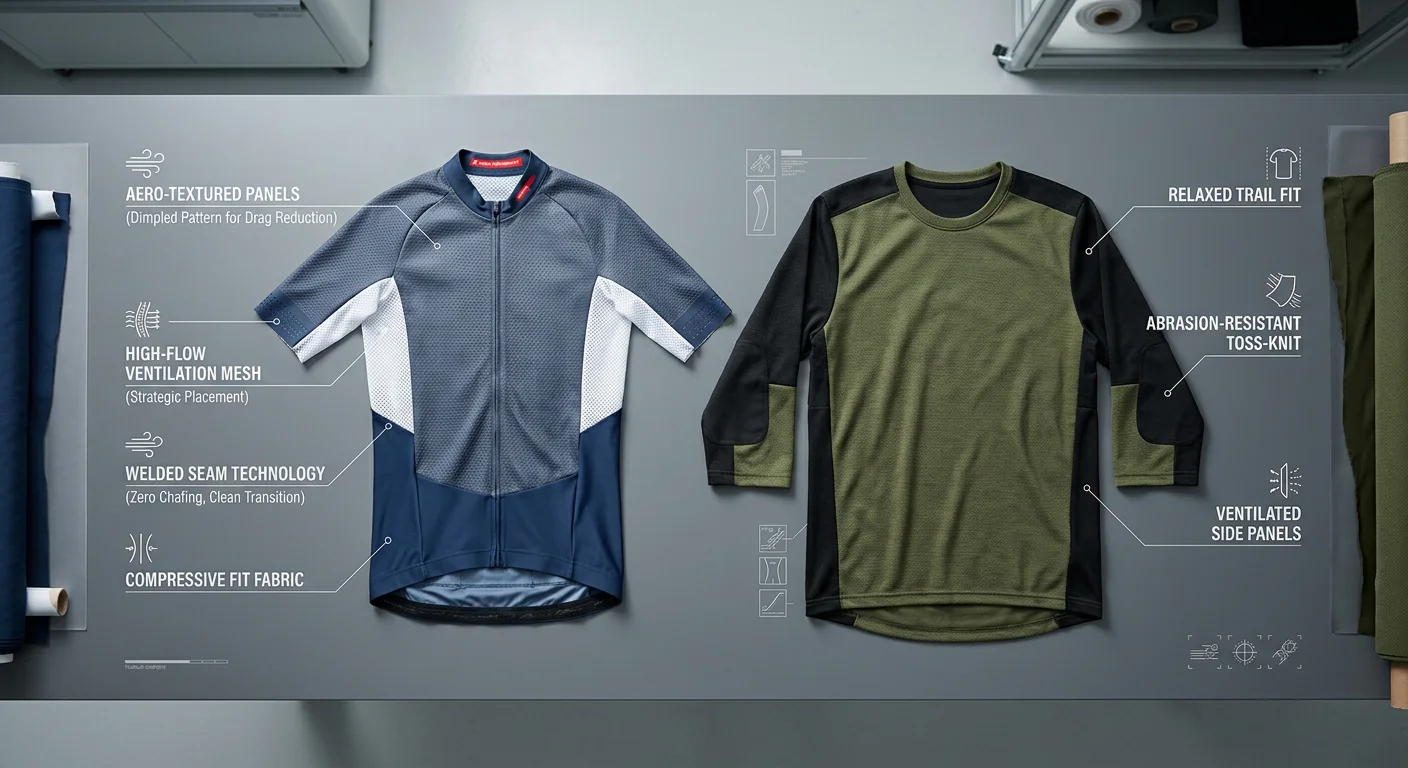
The numbers are clear: pro teams accept a 30–50% shorter jersey lifespan to gain 5–10% in weight savings, ventilation, and aerodynamic profile. That trade-off is a deliberate engineering decision. It's also the reason a race-cut mountain bike jersey feels nothing like your trail-day kit.
The Fabric Stack That Makes It Work
Every pro-grade MTB jersey runs on a dual-layer moisture system. The inner hydrophilic face pulls sweat off your skin. The outer hydrophobic layer pushes that moisture outward so it evaporates fast. The result? Your core temperature stays stable even at peak output.
The base blend is polyester/spandex mesh — but the elastane ratio is where things get discipline-specific:
MTB race cuts : 15–25% elastane. That's double the ratio of road race kits. You get 20% more motion freedom for aggressive descents and sharp body position changes.
Trade-off : Past 50 wash cycles, higher elastane ratios drop about 10% in abrasion resistance. Race teams know this. They plan for kit replacement, not long-term use.
Paneling Built From Motion Data
Pro teams don't cut patterns by eye. They use 3D motion capture modeling tied to real rider positions — a 20–30° forward torso lean for descents, a flatter back angle for climb transitions. Fabric panels follow those exact shapes.
Smooth panels go where drag matters most. Textured or ribbed zones — shoulders, outer sleeves — control airflow. Sleeve tension stays below 5% drag increase at 40km/h . That's not a marketing claim. It's a biomechanical benchmark.
Bonded seams and flatlock micro-stitching cut out flutter. They also hold up under the movement stress that trail riding jersey fabric has to handle.
The Durability Trade-Off in Plain Numbers
Spec | Race-Cut Kit | Training Kit |
|---|---|---|
Wash cycle lifespan | 50–100 | 150+ |
Jersey weight | Sub-200g | 200–250g |
Denier (abrasion zones) | 100–150D | 150–200D |
Reinforced stitching weight penalty | — | +5% |
Reinforced stitching adds 10–15% durability but brings a 5% weight penalty. That's fine for a lightweight bike jersey you wear in training. It's not fine on a World Cup start line. So race kits and training kits are built as separate products — even within the same team contract.
The Hidden Supply Chain: How Pro Team Kits Move from Factory to Podium
The jersey Loïc Bruni pulls over his head on race morning started its journey 12 months earlier — in a CAD file, not a design meeting.
Most riders never think about this. Most brands don't want you to. But the supply chain behind a pro mountain bike team kit is one of the most complex systems in action sports. It shapes the breathable bike jersey material and construction specs that reach consumer shelves.
12 Months from Sketch to Podium
Here's how the timeline runs:
Months 1–3 : CAD pattern grading, Italian-sourced fabric selection, first physical samples sent to team athletes
Months 4–6 : Training camp stress-testing. Riders like Finn Iles submit structured prototype feedback — sleeve tension, hem grip behavior, moisture dump rate under sustained effort. Teams cycle through 2–4 prototype iterations before locking a final cut
Months 7–9 : Cycling team kit factory ramp-up. A single World Cup squad runs 500–2,000 units per production run , minimum. MOQ for most OEM cycling apparel manufacturers sits at 50–100 units
Months 10–12 : Finished kits ship to team HQs. Race-week delivery splits between sea freight and air freight based on event location
For multi-day EWS rounds, teams carry 20+ riders × 2–3 kit sets each — over 100 jerseys minimum, before spares. On-site laundry runs between stages. Soigneurs track per-rider fit preferences alongside bike specs.
Where the Kits Get Made
Southeast Asia — Vietnam in particular — handles high-volume technical knit production for brands like Castelli and Gore. Italy handles premium construction. Manufacturers like Runcyclingapparel (15+ years in OEM/ODM cycling apparel production) deliver seamless panels, moisture wicking cycling jersey treatments, and compression fabric builds to pro teams. Turnaround after prototypes runs 4–8 weeks.
The spec innovations that define a long sleeve MTB jersey at World Cup level — 8-needle micro-thin stitching, bonded seamless shoulder panels — reach consumer product lines 12–24 months after their pro debut. That's the real trickle-down timeline. Not marketing. Manufacturing capacity and testing cycles.
What This Means for Your Next Jersey Purchase
The lightweight bike jersey hanging in a shop right now reflects feedback from athletes who raced in prototype versions two seasons ago. That's not a flaw in the system. It's proof the system works. Rider data drives design. Production scales it. You end up with near-identical specs at a fraction of custom cycling team apparel pricing.
The gap between what hits the pro paddock and what hits retail has never been smaller. You just need to know which production generation you're buying.
Bridging the Gap: Consumer-Accessible Jerseys That Mirror Pro Specifications
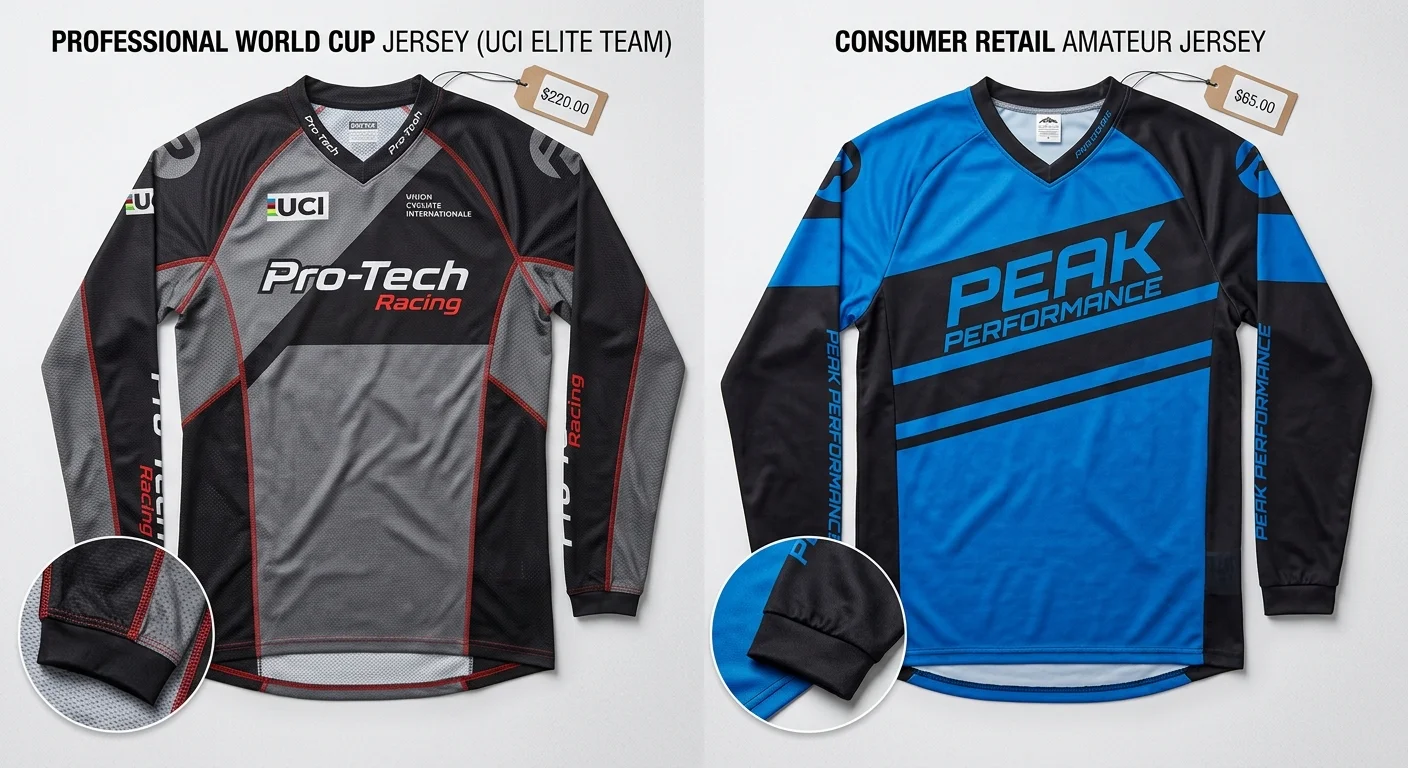
The spec gap between a World Cup team kit and a retail jersey is smaller than brands want you to believe — but it's not zero. Here's where the gap sits, and how to close most of it without a sponsorship contract.
Three price tiers. Three different levels of pro parity.
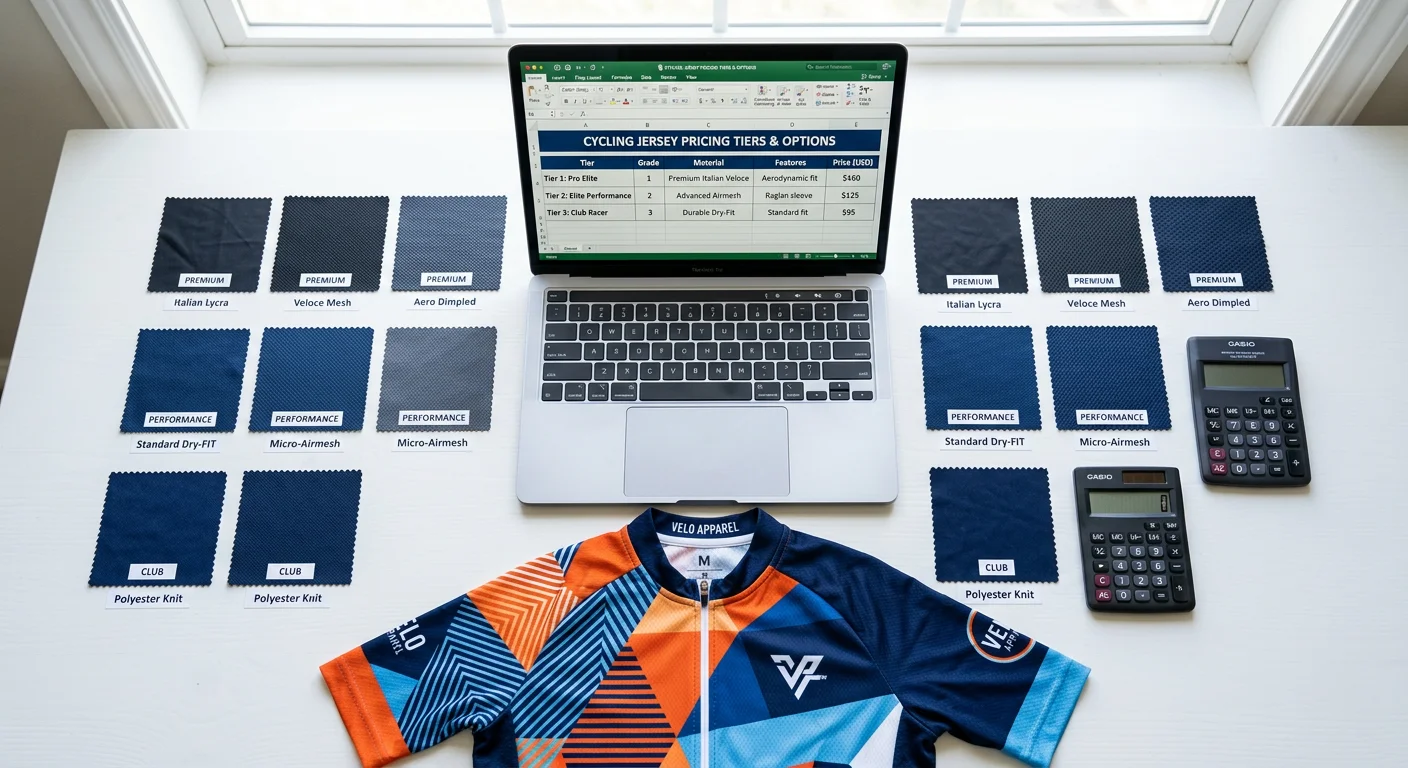
$30–60 tier : Entry-level polyester (140–160gsm, 92/8 poly-spandex blend) hits around 80% pro spec match . You get dye-sublimation graphics from the same Taiwanese mills pro teams use. What you don't get: the three-pocket race setup with silicone grippers. EWS riders rely on that configuration for tool storage mid-stage.
$60–100 tier : This is where value peaks. An 85/15 polyester-elastane build at 180gsm with DWR moisture treatment hits 90% parity with race-day construction. Bonded seams, contoured hems — the core engineering is solid. The trade-off is small: basic silicone prints replace custom tension panels, and you get one or two rear pockets instead of three.
$100+ tier : High-strength nylon-poly blends at 200gsm, laser-cut seams, UPF50+ thermal zoning. 95% pro match. The one gap you can't close is personalized fit. Stock sizing runs 10–15% looser than a body-scanned pro cut.
What You Can't Buy Off the Shelf
Three things stay exclusive to contract kits:
Custom sleeve tension of cycling apparel — elastane zoning tuned per rider creates stretch patterns no retail pattern can copy
Rider-mapped thermal zoning — mesh panels placed using individual sweat data; standard retail fabric runs 5–10°C hotter under sustained effort
Personalized seam routing — off-rack seams carry a 20% higher chafe risk over long enduro stages
The realistic verdict : Mid-tier jerseys deliver 85–95% of pro function. For most riders, that last 5–15% gap shows up at race pace. Know which specs matter for your discipline. Check the gsm weight and elastane percentage before buying. Do that, and you're most of the way to paddock-level performance.
UCI Jersey Rules: Number Plates & Sponsor Identification
Every UCI MTB jersey a pro wears at a World Cup or World Championship has to clear a regulatory checkpoint before it ever reaches a race number ceremony. The UCI's clothing and equipment regulations require race numbers to stay fully visible and unobstructed — teams can't design a jersey cut or pocket placement that covers the number panel, front or back, mid-race.
Sponsor identification is regulated too. National federation and team jerseys go through design approval before a season starts, with limits on how sponsor logos, national colors and manufacturer branding can be sized and placed relative to the jersey's total surface area. That's why pro team kits look consistent season to season — the design freedom riders and sponsors have is real, but it operates inside a compliance envelope, not a blank canvas.
For a custom uci mtb jersey program at the club or team level, most of these rules matter less — but the discipline they enforce (clear numbering zones, controlled logo placement) is still good practice for any team kit design.
Want to see how pro-inspired MTB jerseys compare? Check our Best Men's MTB Jerseys roundup, or source your own team kit through our Custom Cycling Jerseys Manufacturer program.
Conclusion
The paddock doesn't lie.
We dug through sponsorship contracts, studied fabric science, and tracked kit choices across World Cup DH, EWS, and XCO disciplines. One truth stands out: the mountain bike jersey a pro wears isn't always the one marketing pushes on you — but now you know the difference.
Here's what matters: discipline drives design.
Gravity riders need armor-compatible structures and burst-resistant seams.
Enduro athletes walk a fine line between protection and packability.
XC racers give up almost everything for aerodynamic, breathable bike jersey materials that shave seconds you'll never see on camera.
Each discipline has its own demands. The jersey has to match them.
The gap between pro-spec and what you can buy today is smaller than ever. You just need to know what to look for.
So stop guessing. This guide breaks down the brands and rider-verified specs for you. Use them to match your riding style to a jersey built the way pros demand — not what a catalog photo promises.
The podium is dressed. Now you know how to shop it.