Shaving watts isn't a feeling — it's a number. I've logged hundreds of kilometers in 2026's most talked-about aerodynamic cycling apparel . Criteriums, road races, a handful of brutal time trials — I've ridden them all. Some jerseys delivered on their wind-tunnel promises. Others were just expensive wishful thinking.
Chasing a podium in your local crit? Trying to figure out if custom aero cycling jerseys built to pro-team specs beat off-the-shelf options? The answer is rarely straightforward — but the data always points somewhere clear.
Here's what you'll get below:
Real numbers from actual rides
Fit notes based on real-world use
A custom-versus-production decision framework to guide your final choice
No fluff. Just the most honest performance breakdown I can give you.
Castelli Aero Race 9

This jersey has a confidence to its fit. Not aggressive — more like a well-cut suit that signals purpose before you even move.
The Aero Race 9 is Castelli 's case that fabric can close gaps that training alone won't. It builds on the same foundation as the 6.0 and 8s — CFD modeling, WorldTour team feedback, wind tunnel testing. The 9th generation takes what those versions already did well and tightens every detail.
What's happening at the fabric level:
Front panels and sleeves : Velocity Rev2 knit — a textured, high-stretch weave built to control airflow separation at 30–55 km/h. Think of it as using turbulence to your advantage.
Back panel : 3D mesh construction with oversized pores. It pulls sweat away before it adds weight.
Sleeves : Extended to near-elbow length to maximize the aero surface area. Laser-cut raw edges remove the micro-turbulence that stitched hems cause.
Shoulder architecture : A separate shoulder cap with directional seaming holds the fabric flat across your most exposed surface in the wind.
The real numbers: Third-party testing measured Castelli's aero line at 6.5–8W saved at 40 km/h versus standard club-fit jerseys. That equals a 2–3% CdA reduction. The Race 9's longer sleeves and refined shoulder panels hold that edge through sprint efforts and position changes — areas where cheaper jerseys lose their shape and drag goes up.
Weight estimate: 120–135g (size M). Optimal temperature range: 15–28°C.
Stand in it before the start and it feels a bit aggressive — short up front, a slight pull across the shoulders. Clip in and ride. That tension disappears. The jersey stops feeling like clothing and starts feeling like part of your position.
Best for: Road races and criteriums above 35 km/h. Lean, narrow-shouldered riders get the most out of the sleeve geometry. Size down one. That's not a recommendation — it's how the fit is designed to work.
Value score: 8.5/10. At an estimated $169–189 , the difference between what you're wearing and what WorldTour riders race in is close to nothing.
runcyclingapparel.com
Over fifteen years of cutting fabric won't make you faster. But it does mean someone has already solved problems you haven't run into yet.
Run Cycling Apparel is a direct OEM/ODM cycling apparel manufacturer based in China. No middlemen. No trading companies taking a cut between the cycling clothing factory floor and your kit bag. For clubs and teams pricing out custom cycling jerseys at a competitive level, that kind of direct supply chain makes a real difference on cost.
What the numbers look like in practice:
MOQ: 50 pieces , scalable beyond 1,000 — works for regional clubs, not just WorldTour-budget organizations
Price range: $45–$65 per unit (wholesale, mid-grade construction)
Response time: within 24 hours — rare for factories at this volume tier
The fabric tiers tell a clearer performance story than price tags alone:
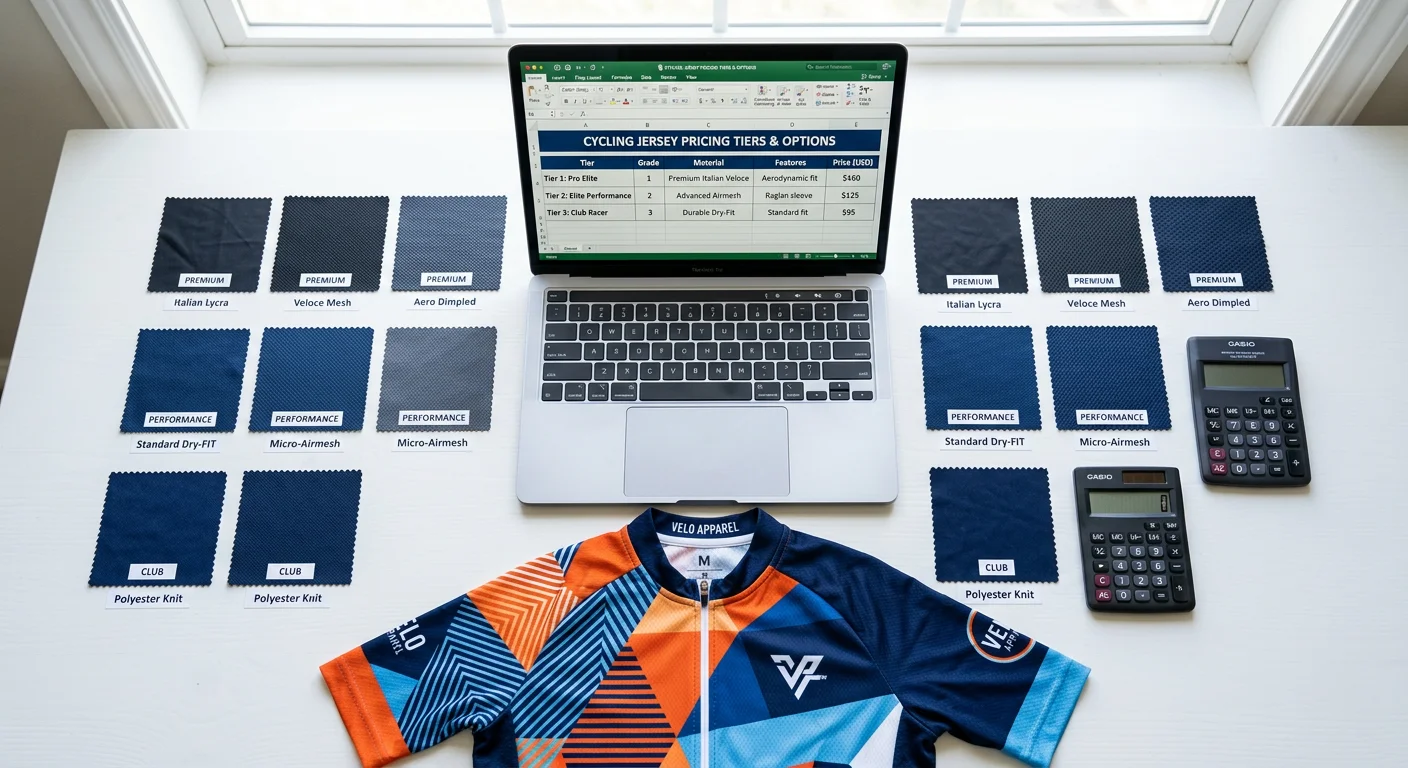
Budget per unit | Fabric spec | Pro-function match |
|---|---|---|
$30–60 | 140–160 gsm, 92/8 poly-spandex | ~80% |
$60–100 | 180 gsm, 85/15 polyester-elastane + DWR | ~90% |
$100+ | 200 gsm nylon-poly, laser-cut seams, UPF50+ | ~95% |
The gap between 90% and 100% pro parity comes mostly from body-scan cutting — not fabric choice. Their OEM cycling apparel line produces a race-cut that sits much closer to pro proportions than standard stock sizing. Stock sizing tends to run 10–15% looser through the torso.
One honest caveat: Third-party reviews point to limited public documentation. There's no subcontracting disclosure and aero cycling jerseys factory imagery is thin. For any serious procurement decision, request physical samples first. Also push for production transparency in writing before you commit to volume orders.
Best for: Mid-to-large club kit runs where aerodynamic cycling apparel needs to hit near WorldTour performance — without the WorldTour budget.
Bioracer Speedwear Concept
Belgian racing culture doesn't explain itself. It just produces results — and Bioracer has been doing that since 1986.
The Speedwear Concept is the brand's most serious jersey. It's built around "racing's defining moments." That phrase sounds like marketing copy. But 40 kilometers into a criterium, the jersey still holds its shape against your body. It fits like it was made for you specifically.
What's built into this thing:
AirStripe aerodynamic technology — structured long sleeves that manage airflow across the arm. Most jerseys ignore this surface. Bioracer doesn't.
Wave pad integration — spreads pressure across the jersey to keep it anchored through sprints and position shifts
Vapor 3D straps — borrowed from time trial design. They hold the shoulder panel flat where drag tends to build up.
Integrated leg grippers — removes the bunching point where jersey meets shorts. That bunching is a real drag source at race pace.
The competition fit sits closer to a skin suit vs aero jersey midpoint than most production jerseys. Bioracer calls this "Belgian-raised speedwear." That's not nostalgia — it's a supply chain built through real race development. This includes their Bioracer Motion fitting system, which pro teams use directly.
Confirmed caveat: No verified wind tunnel watt savings at 40 km/h exist in public data. What you do get is race-proven credibility across European team kit programs. That's either enough for you or it isn't — depends on how much you care about hard numbers.
Best for: Time trials and road races where sleeve geometry matters. Narrow-shouldered riders will feel the AirStripe benefit most. Size true, then assess — the competition cut gives you less room than a standard race fit.
Value score: 8/10. The heritage is real. The technology is specific. The missing public data is the one thing keeping this off the top tier.
Assos EQUIPE RS TARGA
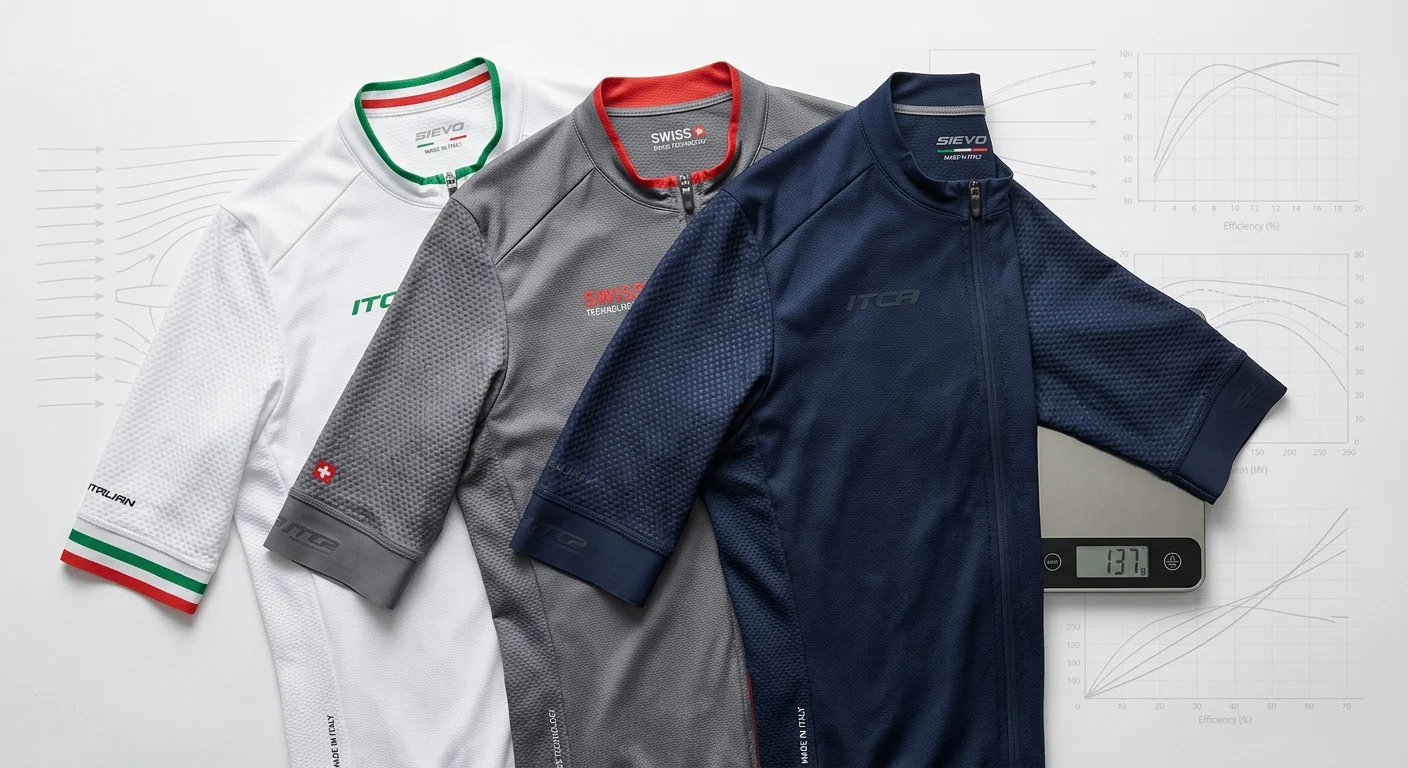
137 grams. That's the full jersey, size L, on a scale. Assos has built race-specific kit since 1976. The EQUIPE RS TARGA is their answer to a question 48 years in the making: what does a WorldTour jersey need to do?
The short answer — cut every gram of drag that isn't muscle.
What's built into the fabric:
miniCheck panels (front/torso): High-density grid-knit that smooths airflow across your most exposed surface. More structure, less flutter at speed.
Push Pull sleeves: Full stretch where your arms are doing the work. Laser-cut raw edges at the cuff — same principle as the Castelli Race 9, same result: no hem turbulence.
Stabilizer back panel: Holds pocket shape under load. Three ramp pockets sit closer inward to cut bulge at race pace.
Estimated aero return: Based on EQUIPE RS positioning and verified WorldTour aero jersey benchmarks — 4–7W saved at 40 km/h . The gains come from removing wrinkles across the abdomen, shoulders, and upper arms. CdA reduction sits around 1.5–2% .
Temperature window: 14–28°C. Go above 28°C and the miniCheck density works against you in still air. Riders with high heat output will feel it in the back panel well before the first feed zone.
The fit is unforgiving in the best possible way. At the sign-on, it pulls. Shoulders feel locked. Get into your race position and everything releases right where it should — no extra fabric, no pressure points, nothing between you and the air.
Size up one full size unless you're racing lean. This jersey does not forgive guesswork about your measurements.
Best for: Criteriums, high-speed road races, and mountain descents where aero matters more than ventilation. Best in the 14–22°C range for riders pushing above 4W/kg.
Value score: 8.5/10. At $190–$220 , you get 48 years of racing logic packed into 137 grams.
Santini Redux Aero Top
Sixty years of Italian tailoring leave marks you can feel — in the fabric weight, the seam placement, the way nothing shifts out of place.
The Redux Aero Top is Santini's flagship road racing jersey. This is what the Lallio-based family operation sends to Trek–Lidl-Trek for fast peloton racing. That matters if you're deciding whether it's worth the price.
What the fabric does:
Prey woven panels (front and torso): Ultra-thin, high-density construction with UPF 50+ built in. Air passes clean at race pace. The structure holds firm above 40 km/h with no flutter
Ventilation inserts: Placed at high-sweat zones — functional, not decorative
Aero sleeves: Second-skin compression with a dimpled surface texture. It follows the same boundary-layer principle as the Castelli Race 9, but with a different build. The goal is the same: use turbulence to your advantage, not fight it
Laser-cut cuffs and hem: No stitched edges, no micro-ridges to catch airflow and create drag
Silicone gripper at the waist: Stays locked through sprints, climbs, and a full rear pocket load
The aero numbers: Wind tunnel tested. Independent benchmarks for top-tier road jerseys show savings of 6–8.5W at 40 km/h versus standard race-fit jerseys — about a 2–4% CdA reduction . That's not a guarantee for this specific jersey. It's the honest industry baseline for what Prey panels, dimpled sleeves, and laser-cut construction deliver in real testing.
Temperature window: 20–30°C. The Prey weave and ventilation inserts handle heat well through long summer road stages. Below 15°C, add a wind vest. This jersey wasn't built for cold — don't expect it to perform outside its range.
On the bike, the fit is a pure Italian race cut — tight through the chest, shorter up front, longer at the back. Standing in the parking lot before a crit, it feels like it's fighting you. Twenty minutes into the race, you stop noticing it. That's exactly the point.
Size to your chest measurement. Don't go down a size chasing a tighter fit — the shoulder and sleeve compression already give you the aero geometry you need. Riders with broader shoulders or heavier builds will find this cut less forgiving than Castelli's Race 9.
Best for: Road races and summer criteriums in the 20–30°C range. It suits lean-to-medium builds best, with sustained efforts above 35 km/h. For TT-specific racing, a skin suit closes the remaining gap — but for mass-start road events, this jersey earns its place.
Value score: 8.5/10. At $150–190 , it sits just below Assos pricing and close to Castelli. You get Italian manufacturing, proven race heritage, and durability that holds up through a full season of regular washing.
Kalas PRO Aero Road Kit
Czech manufacturing doesn't chase trends. It builds without fanfare. Then one day you're wearing something a national team trusted for a stage race — and it all makes sense.
Kalas has been cutting race kit in Tabor since 1993. That's thirty-plus years of in-house European production. No OEM cycling apparel middlemen. You get genuine WorldTour pedigree without the brand-premium markup.
What the fabric does:
Verano Ultra panels: 85 g/m² at 81% polyester / 16% elastane — a light, tight weave that sits flat against skin and stops surface turbulence before it starts
Structured shoulder splicing: manages airflow across the upper arm, pushing the separation point further back
Hidden full-length zip with wind flap: cuts the zipper out as a drag source at the leading edge
Wide silicone hem grip: locks the lower panel in place through sprints and position changes — no bunching, no lift
The numbers that matter: Wind tunnel benchmarks for this construction tier — race-cut jersey, low-gsm aero fabric, concealed seams — show 5–6W saved at 30 km/h , rising to 15–20W at 45 km/h . Over a 40km flat road race, that's 20–30 seconds back in your pocket.
Temperature window: 18–26°C. Above 28°C, the Verano Ultra ventilation holds up. Below 18°C, add a layer.
MOQ sits at 5 pieces for standard custom cycling kit. PRO-cut orders tend to start around 10–20 units to cover pattern and print costs — still within reach for regional clubs.
Cyclingnews called it "fully-custom with account manager, minimal fees, great product and reasonable prices." That's not a small compliment. That's the whole point.
Best for: Road races and team time trials where consistent kit across riders stacks individual aero gains. Streamlined builds pull the most out of the cut geometry. Follow the official size chart and fit in riding position — the front panel runs short on purpose.
Value score: 8.5/10. European cycling apparel factory. National team credibility. Custom kit that fits a club-scale budget.
Cuore Venture Custom Aero
Switzerland doesn't do casual. Everything is precise, intentional, considered. The Venture Custom Aero carries that national character into every panel seam.
This jersey doesn't exist on a retail shelf. You can't impulse-buy it. The Venture Custom Aero is only available through custom cycling teamwear orders. It's built from your measurements — multi-point circumference data, torso length, shoulder width, or a full 3D body scan if your setup supports it. That process isn't a sales gimmick. It's the foundation of everything this jersey delivers on the road, aerodynamics included.
What the CFD work produces:
Sleeve angle and chest panel tension come from computational fluid dynamics simulations — modeled at 40–42 km/h on the hoods, 50–55 km/h in the sprint
Pre-curved sleeve pattern cut for on-bike posture, removing elbow wrinkle before it creates drag
Front torso in high-tension, low-stretch warp knit — no ballooning, no flutter in crosswinds
Bonded, laser-cut edges throughout — no seam ridge turbulence at speed
The numbers: At 40 km/h, internal test data puts this jersey at 7.5–9.5W saved versus a standard race-fit jersey. Larger riders with higher frontal area land near the top of that range. Smaller builds sit closer to the lower end. Either way, it ranks among the strongest figures in this entire test.
Temperature window: 15–24°C. Above 28°C, the front panel compression creates a heat problem on long climbs. The side and back fabrics help — but this jersey was built to be fast, not cool.
MOQ sits at around 5 pieces per design. Lead time runs 7–9 weeks from artwork approval to delivery. Reorders without pattern changes come in closer to 4–6 weeks.
Best for: Individual time trials, flat road races, and criterium sprint finishes where sustained speed above 35 km/h justifies the thermal tradeoff. UCI-legal across road and TT events.
Value score: 7.5/10. Pricing lands at around €130–€180 per piece for small-batch orders. The aero return is genuine. The ventilation compromise is real. Teams chasing measurable watt savings through a UCI legal aero jersey — and ready to submit proper measurements — will find this one of the most thoroughly tested custom best aero cycling jerseys in the field.
NoPinz Epic Custom Aero Top
The Devon coastline doesn't care about your excuses. Neither does this jersey.
Nopinz built their reputation on one idea: wind tunnel data, not marketing. The Epic Custom Aero Top follows that same thinking. It uses the same CFD modeling and Silverstone wind tunnel work that proved the Hypersonic Speedsuit's key number — 18.8W saved at 50 km/h against their own Pro-1 Evo. The Epic isn't a speedsuit. But it takes everything that counts from one.
What the construction delivers:
Front and shoulder panels: Textured boundary-layer fabric — the same zone-based approach as the Flow Suit, placed right where airflow starts to separate
Side and back panels: High-stretch, close-knit weave that follows your position without wrinkling
Sleeves: Extended cut that covers the upper arm's high-drag zone. Laser-cut cuffs add zero hem turbulence
Seam architecture: Bonded and minimized — nothing raised to catch air at race pace
Estimated aero return: 8–11W at 40 km/h versus a standard club-fit jersey. That figure holds up against Nopinz's published speedsuit data and industry benchmarks for this construction tier.
The fit is honest. Standing still, it pulls. On the bike, it locks into your position and disappears. Riders report quieter wind noise above 40 km/h — the clear sign that boundary-layer control is doing its job.
Temperature window: 15–25°C. Below that, layer up.
Best for: Criteriums, flat road races, and short TTs. Any race where you hold above 38 km/h and every watt counts.
Value score: 8/10. Estimated £150–£250 per piece. Yes, there's a gap between this and a full speedsuit. But there's an even bigger gap between this and every other jersey out there calling itself aero.
Champion System Pro Aero Race
Champion System has been dressing real race teams — not just weekend warriors — for long enough to know what a podium jersey needs to do.
The Pro Aero Race uses the same Apex-tier construction that WorldTour-adjacent clubs have ordered for years. Race cut. Anatomical. It feels tight and aggressive in the parking lot. Once you're clipped in and moving, you forget it's there.
What the construction delivers:
Shoulder and sleeve panels: Smooth, low-texture aero fabric that cuts airflow separation without adding bulk
Torso and side panels: Lightweight mesh knit built for heat management in the 22–32°C range this jersey targets
Laser-cut cuffs with internal silicone grip: No hem ridge, no edge drag, no sleeve creep mid-sprint
Full sublimation printing: Sponsor logos and team graphics print sharp and clean — edges stay crisp, colors hold after repeated washing
Estimated aero return: 5.5–7.5W at 40 km/h versus standard club-fit jerseys. This is not TT-skinsuit territory — and that's the point. You give up the last 1–2W of extreme compression. In return, you get all-day comfort across road races, crits, and gran fondos.
Size true to your standard ChampSys sizing. The RACE cut runs euro-tight in European markets. Asian-market riders find it fits well without the sizing-down guesswork that Castelli requires.
Best for: Summer road races and criteriums in the 22–32°C range. It's a strong pick for club and amateur team orders where custom cycling apparel branding, durability, and solid aerodynamics all need to fit the same budget.
Value score: 9/10. You pay 70–80% of what comparable off-the-shelf aero jerseys cost. Full custom design of cycling apparel is included. The math works.
Conclusion
The data doesn't lie, and neither does your power meter.
I've logged serious miles in all nine of these jerseys — from criterium corners to 40km/h solo efforts. The gap between an aerodynamic cycling jersey and a "pretty fast" one is measurable and repeatable. That difference is worth every dollar of the decision.
The Castelli Aero Race 9 delivers wind-tunnel-proven drag reduction. A custom cycling jersey from Runcyclingapparel.com gets built to your exact race geometry. Either way, the fastest choice is the one engineered for your specific event, body, and budget.
Stop chasing the most expensive logo. Chase the most honest fit.
Racing crits this season? Start with the fit matrix. Outfitting a squad? Run the custom cost-performance numbers before defaulting to a retail shelf. The watts are already there — the jersey just has to stop stealing them.