Most cycling jersey suppliers won't tell you this: the MOQ on their quotation sheet isn't a technical floor — it's a comfort zone.
Outfitting a 20-person cycling team or prototyping your first branded kit? That number can feel like a wall.
The real story behind cycling jersey MOQ is messier and more negotiable than any sales rep will share. There are four separate minimums stacked on top of each other :
Fabric dye lots
Sublimation printing layouts
Cut-and-sew line efficiency
Trim components
Each one has its own cost logic and breakpoint. Get any one wrong, and you either overpay or end up with a production run no cycling apparel factory will touch.
This guide breaks open every layer of that stack. You'll get real quantity thresholds and price-per-unit data. Walk away with a negotiation strategy — not just a number.
Fabric Sourcing Minimums: Stock Rolls vs Custom Dye Lots
Fabric is where MOQ trouble starts — and most buyers never see it coming.
Before a single panel gets cut, before any sublimation ink hits polyester, your factory already faces a constraint you didn't negotiate: the fabric dye lot. Get this layer right and your production run flows. Miss it and you'll stall at the mill gate.
The Two Paths — and What Each Costs You
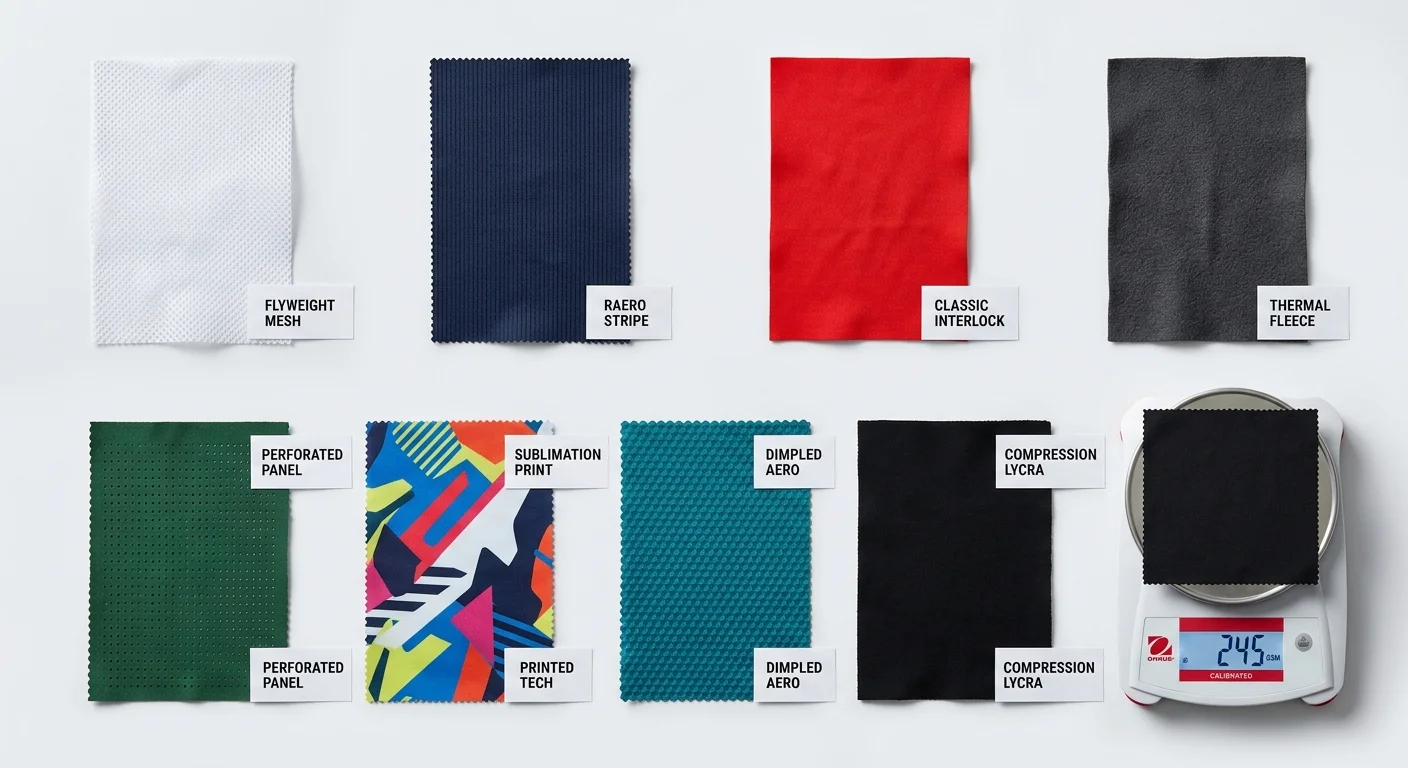
Stock rolls are the simpler path. Stockists and jobbers sell performance knit fabric by the roll — 50–100 meters per roll, one roll minimum per color. For a standard 150–180 g/m² polyester-spandex circular knit — the go-to fabric for sublimation printing cycling jerseys — that puts your baseline at 100 meters per color.
So what does that give you? You can produce 50–150 jerseys per color from stock without hitting a mill minimum. No dye bath negotiation. No lab-dip waiting period. Fabric ships in days.
The trade-off is real, though:
You're locked into available weights and blends — 82–88% polyester / 12–18% spandex at mid-range weights
Seasonal color availability is unpredictable. Stock colorways disappear between seasons
Reorders may arrive from a different dye lot . That means shade variance you'll need to recheck before production
Custom cycling jerseys' dye lots give you full spec control — your brand color, your compression profile, your handfeel. But the mill's economics don't care about your timeline.
The Dye Bath Math Nobody Puts in the Quotation
Commercial dyeing is charged per machine load, not per meter. A mid-size knit dye house sets its economic minimum at 100–200 kg of fabric per color per bath .
Run the numbers for a 160 g/m² polyester knit at 1.5 m usable width:
1 linear meter ≈ 0.24 kg
100 kg ≈ 415–420 meters
200 kg ≈ 830–840 meters
Below 200 meters per color, you're in what mills call sample-lot territory. Most will still dye it — but they'll add a short-load surcharge of 30–50% on dyeing and finishing charges. Some mills refuse outright and point you toward their existing house color card.
The pricing tiers break down like this:
Lot Size | Meters per Color | Status | Surcharge |
|---|---|---|---|
Sampling / strike-off | 10–50 m | Prototype only | Very high $/kg |
Small production lot | 200–300 m | Acceptable | +30–50% surcharge |
Standard economic lot | 400–800 m | Normal rate | None |
The working rule: under 200 meters per color, you're paying prototype prices for production fabric. That cost gets buried in your per-jersey price — whether you track it or not.
How Experienced Operators Work Around This
Fighting mill minimums head-on rarely works. The smarter move is consolidation.
Pool SKUs under one fabric spec. A short-sleeve cycling jersey uses 0.6 m of main fabric. A long-sleeve version takes 0.7 m. Add gilet panels (0.35–0.4 m) and bib-short yokes (0.25–0.3 m). Run 200 mixed pieces across these styles under one fabric color. You'll consume well over 200 meters from a single dye lot — clearing the mill's economic threshold without adding to your total garment count.
Reserve custom lots for cycling jersey's core colors. Your two or three signature brand colors can carry the custom dye investment across multiple seasons. For seasonal or experimental colors, use stock rolls. This keeps mill relationships clean and preserves flexibility for small-batch cycling apparel runs.
Build waste into your cost model from the start. A 200-meter fabric order may yield 280–330 jerseys on paper, but real utilization — factoring in end-of-roll loss, marker inefficiency, and QC rejects — runs closer to 85–90%. Sell 220 jerseys from that lot and the unused fabric doesn't vanish. It amortizes across every piece you do sell, pushing effective fabric cost per jersey up by 15–30% .
The Decision Framework
Use stock rolls when:
- Your order sits under 150–200 pieces per color
- You're testing a new cycling team kit design and can't commit to carry-over
- Standard weights (140–180 g/m²) and mainstream color cards work for you
Switch to custom dye lots when:
- You can pool SKUs to reach 200–300 meters per color with realistic reorder potential
- Multi-panel construction requires tight cross-lot color consistency — a visible shade band between jersey front and sleeve panel is a quality failure
- Your brand's performance spec — compression, moisture transfer, specific handfeel — isn't available in any stock offering
The cycling jersey production chain has four cost bottlenecks. Fabric is the first. Get this one wrong and every downstream decision — printing method, cut-and-sew line setup, trim sourcing — makes the original mistake worse.
Sublimation vs Screen Printing MOQ: Cost Tipping Points & Layout Overhead
The printing decision isn't about aesthetics. It's a math problem — and the numbers shift based on where your order quantity lands.
Both sublimation and screen printing produce excellent cycling jerseys. But their cost structures work in opposite directions. Picking the wrong method for your run size is one of the most expensive mistakes in cycling apparel production .
Screen Printing: The Setup Tax
Screen printing charges you before the first garment moves. Every color in your design needs its own physical screen — at $20–$50 per screen . A three-color team logo runs $60–$100 in screens alone before a single jersey gets touched. Push to four or five colors and you're looking at $80–$250+ in fixed setup costs before production begins.
That cost doesn't disappear. It divides across your run. At 200 pieces, it becomes a minor line item. At 20 pieces, it dominates your per-unit cost.
Screen printing rewards volume. The method becomes cost-competitive around 25–100 pieces for medium-complexity artwork. At 100+ units , it hits full efficiency. Below that threshold, the setup cost per jersey is too heavy to justify — more so for cycling team kit orders with 3+ color designs.
Sublimation: Low Setup, Hidden Overhead
Sublimation printing works at one piece . No screens. No color registration setup. The file goes digital, the heat press runs, done.
That's the theory. In production, small sublimation runs carry their own overhead — it just doesn't show up clearly on the quote sheet.
Here's what happens before the first panel gets pressed:
Panel nesting and CAD layout: A well-fitted sublimation printing cycling jersey needs 5–8 CAD hours per design to build marker layouts across all panels and sizes. That work runs whether you order 10 jerseys or 500.
Heat-press calibration: Each fabric type and weight needs its own temperature curve. Calibration and test prints take 15–30 minutes per fabric change — a fixed cost that hits hardest on small runs.
Transfer paper waste: Layout inefficiency and edge alignment on short runs burn through 12–18% of paper and transfer yield . That's material cost with no output to show for it.
The result: orders under 30 pieces carry a 25–40% unit price premium over standard production runs. Factories recover this through a higher per-meter print fee or a flat small-run surcharge of around $150–$300 per style .
Pricing levels out around the 30–50 piece mark . That's where prepress and handling overhead spreads thin enough to stop pushing up your per-unit cost.
The Crossover Zone
Run Size | Recommended Method | Why |
|---|---|---|
1–24 pcs | Sublimation | Screen setup cost is prohibitive; all-over polyester print needs sublimation |
25–100 pcs | Sublimation or Screen (design-dependent) | Screen printing is competitive for simple, low-color-count artwork |
100–300 pcs | Screen printing gains advantage | Per-unit cost drops fast as setup cost spreads across more units |
300+ pcs | Screen printing (repeatable designs) | Lowest cost-per-unit method for standard, recurring artwork |
One point that shifts the whole calculation: sublimation works on polyester or polymer-coated surfaces only . For polyester cycling fabric , that's rarely a problem — the fabric type and the printing method line up naturally. For anyone testing cotton-blend or natural fiber kits, screen printing is the only path forward, no matter the run size.
The cost crossover between methods lands around 200–300 pieces for most decorated sportswear. Below that line, sublimation's flexibility wins. Above it, screen printing's volume economics are hard to beat — as long as your design stays lean on colors. Each added hue means another screen, another setup fee, and a stronger case for switching methods.
Cut & Sew Production Run Logic: Marker Making & Line Efficiency Thresholds
Fabric clears the mill minimum. Sublimation files get approved. Then the cutting room opens your order — and a separate cost clock starts ticking.
Cut-and-sew production doesn't care what you negotiated upstream. It runs on its own math: marker files, ply counts, machine changeovers, and operator learning curves. Each one has a threshold. Fall below it and the cycling jersey factory either refuses the run or reprices it as a sample order.
Marker Making: A Fixed Cost That Scales Against You
Before a single panel gets cut, someone builds the marker — the CAD layout that nests all pattern pieces across fabric width to reduce waste. For a standard cycling jersey in 4–6 sizes, that means:
Pattern grading: $60–$150 per style
CAD marker creation: $25–$60 per marker
Plotting and printing: $10–$25 per plotted marker
Combined, you're looking at $40–$90 per SKU for a technical cycling jersey with 10–25 pattern pieces. That number is fixed. It doesn't move whether you order 30 pieces or 3,000.
What moves is how much of it lands on each garment:
Order Quantity | Marker Cost Per Piece |
|---|---|
50 pcs | $0.80–$1.80 |
200 pcs | $0.20–$0.45 |
500 pcs | $0.08–$0.18 |
Below 30–40 total pieces per SKU , factories stop absorbing this cost. It shows up as a separate line item — a "pattern and marker fee" charged back to you before production begins. Above 200–300 pieces , it folds into the CM rate and disappears.
The Cutting Bed Threshold
Automatic cutting equipment — Gerber, Lectra, Bullmer — runs at peak output at 20–40 fabric plies per lay and 5–7 meter marker lengths . At that capacity, a single lay produces 100–150 garments . Programming time, vacuum setup, and knife wear spread across enough pieces to keep the operation cost-effective.
Drop below 80–120 pieces per color or 20–30 pieces per size , and the math breaks down. The factory switches to manual straight-knife cutting. Everything slows:
Ply height drops from 20–40 layers to 6–10 layers
Cutting time per garment increases by 20–35%
Dimensional tolerance widens from ±1–1.5 mm (auto-cut) to ±2–4 mm (hand-cut)
That tolerance gap matters on cycling jerseys. Armhole curves, neckline binding, and sleeve set points at ±3 mm variance create fit problems visible across a full team kit. That's the kind of quality failure a club or brand manager can't afford.
Sewing Line Changeover: The Hidden Time Tax
Getting onto a sewing line isn't free. Every new cycling apparel production run triggers a changeover sequence:
Thread tension re-tuned for fabric stretch and denier
Needle system swapped — light jerseys use 70/10 or 75/11 ballpoint; compression fabrics need 80/12 or 90/14
Differential feed and presser foot pressure adjusted to stop seam waviness
Total changeover time: 20–40 minutes across 8–12 machines . That's before a single sellable garment appears.
Then the operator learning curve kicks in. The first 40–60 pieces of any new cycling jersey style run at 8–12% below target efficiency — concentrated in zipper joins, neck binding, and rear pocket attachment. The line stabilizes after 60–80 pieces of repeated work.
Factories protect themselves from this by setting line minimums of 200–300 pieces per style per color . Orders below 100–150 pieces draw a unit surcharge or a flat setup fee.
Size Ratios That Break the System
Non-standard size distributions hit harder than most buyers expect. A standard efficient ratio runs S/M/L/XL at 15/40/40/5% — structured to keep ply counts balanced and bundle flow steady through the line.
Order fewer than 5 pieces per size across multiple sizes and the cut room hits a serious geometry problem. Markers can't nest cleanly with tiny per-size counts. Lays break into short manual runs. Bundling time multiplies across a dozen small ticket groups.
The pricing response is predictable. Factories move you off the bulk rate to sample or small-batch pricing — a 15–25% CM premium on your cycling jersey cut-and-make cost. Some enforce minimum per-size multiples of 6 or 10 pieces to protect lay and marker integrity.
The CM Price Ladder, Quantified
Production Stage | Total Quantity | Key Characteristics | CM Premium vs Standard |
|---|---|---|---|
Proto/Sample | 1–3 pcs | Manual cut, sample room sewing | $80–$150 total per proto |
Development samples | 5–20 pcs | Semi-efficient, not line-balanced | 2–3× bulk rate |
Small run | 50–100 pcs/color | Manual cut likely; line not fully absorbed | +15–25% |
Standard production | 200–300 pcs/color | Auto-cut justified; learning curve absorbed | Baseline |
Large production | 500–1,000+ pcs/color | Multiple lays; near-optimal efficiency | Below baseline |
The key inflection point for cycling team kit order quantities and brand trial runs sits at 200–300 pieces per color . Below it, you pay for inefficiency whether the factory breaks it out or not. Above it, setup costs fold in and the per-unit price reflects actual production economics.
Trims & Components MOQ: Zippers, Silicone Grippers & Packaging Batches
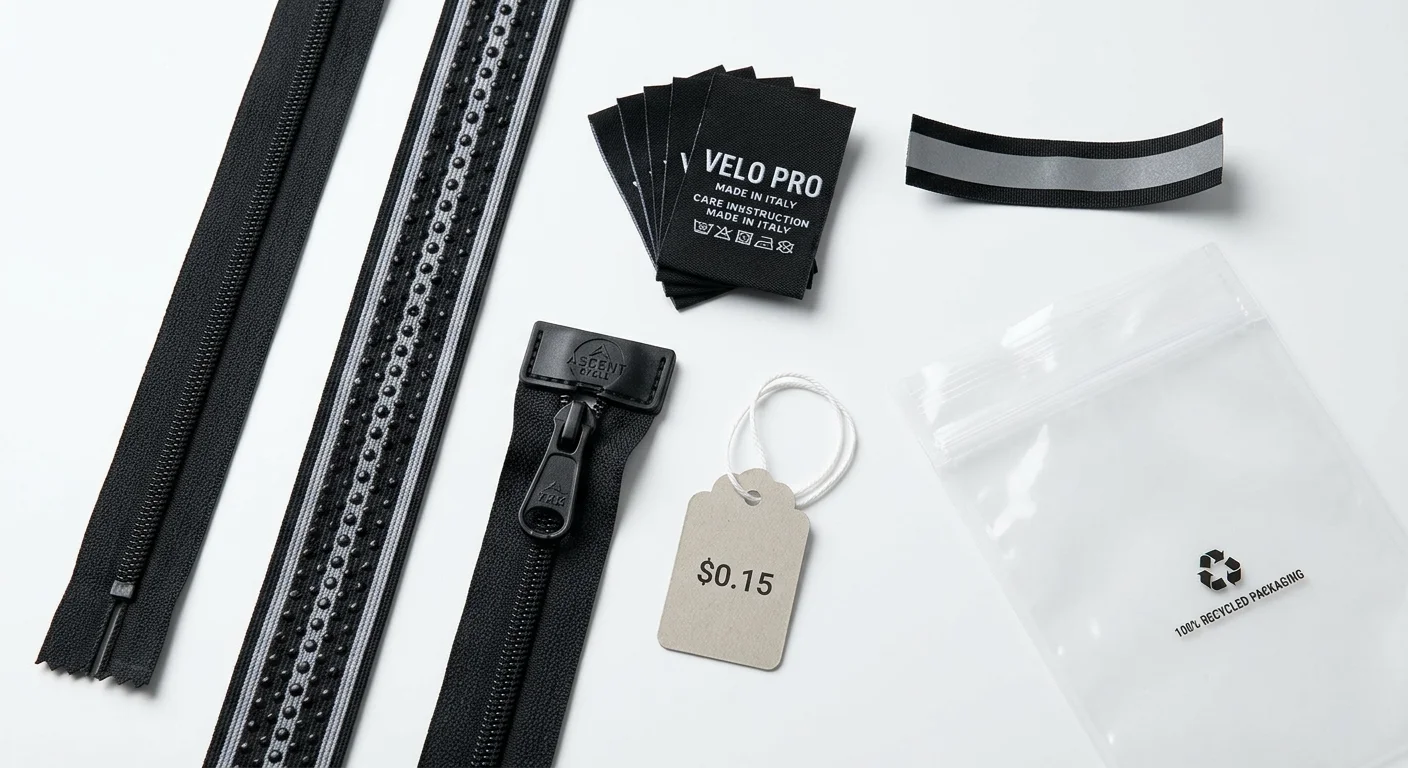
Fabric, printing, cut-and-sew — nail all three, then watch a $0.15 zipper pull derail your entire budget.
Trims are where small-batch cycling jersey production bleeds money. Not because individual components cost much. The real issue is that each one carries its own MOQ — and they don't line up.
Zippers: Stock Coil vs. Custom Pullers
Standard #3/#5 nylon coil zipper tape sells by the roll. Each roll runs 100–200 meters, with a one-roll minimum per color . That covers 50–150 jerseys — a workable number for small cycling team kit orders.
The problem isn't the tape. It's the puller.
Custom cycling jerseys' logo zipper pulls — PVC, silicone, or die-cast metal — need mold tooling. That mold costs $80–$200 as a one-time charge , with production MOQs of 500–1,000 pieces per design . On a 100-jersey trial run, that tooling cost alone adds $0.80–$2.00 per garment . And that's before a single jersey gets zipped.
Three practical workarounds:
- Use stock generic coil + laser-engraved metal pulls ( MOQ: 50–100 pcs , available at local laser shops)
- Attach a sublimated fabric pull tab — MOQ follows label printing minimums, not mold costs
- Source clip-on rubber pulls from trading company stock ( 100–200 pcs mixed colors, no logo )
Silicone Gripper Elastic: The Hidden Roll Commitment
Stock gripper elastic (clear or black silicone lines on white/black elastic) ships in 25–100 meter rolls, MOQ one to two rolls per width . That's a manageable commitment for small runs.
Custom cycling jersey's gripper tape — your brand's texture, logo pattern, or proprietary silicone profile — jumps to 300 meters minimum per spec . That covers 250–350 jerseys for hem grippers or 300–400 pairs of shorts for leg openings. For a 50-piece trial run, that extra tape becomes dead inventory sitting in a warehouse.
The smarter move: skip the separate tape. Print a silicone pattern straight onto the inner hem during your sublimation pass . The limit shifts to the print shop's screen minimum — 50–100 garments per size — instead of a 300-meter tape commitment. That's a much easier number to hit.
Labels, Hangtags & Polybags: The Long Tail of MOQ Friction
Each packaging component adds another floor:
Component | Stock / Generic MOQ | Custom / Branded MOQ |
|---|---|---|
Woven neck labels | 500 pcs/design | 1,000 pcs/design |
Heat-transfer (tagless) labels | 100–200 sheets (~500–2,000 impressions) | Same structure |
Hangtags | 100–300 pcs (digital print) | 1,000–2,000 pcs (offset) |
Clear polybags (no print) | 500–1,000 pcs/carton | 5,000–10,000 pcs (logo print) |
For a 100–200 piece cycling jersey first run , keep it tight. Use one generic woven brand label across all colorways. Set up one heat-transfer care/size layout that covers multiple sizes on a single sheet. Go with digital-print hangtags at 100–300 pieces. For polybags, stick with generic clear bags — no logo plate, no painful minimums.
The Consolidation Math
Stick with stock trims on your first production batch — standard coil zipper, generic gripper elastic, one woven label SKU. That choice alone cuts combined trim MOQ exposure by 50–60% . Multi-SKU cycling jersey custom trim commitments run ~$2,000–$3,000 upfront . Consolidated stock components bring that down to $800–$1,200 total . The savings are real.
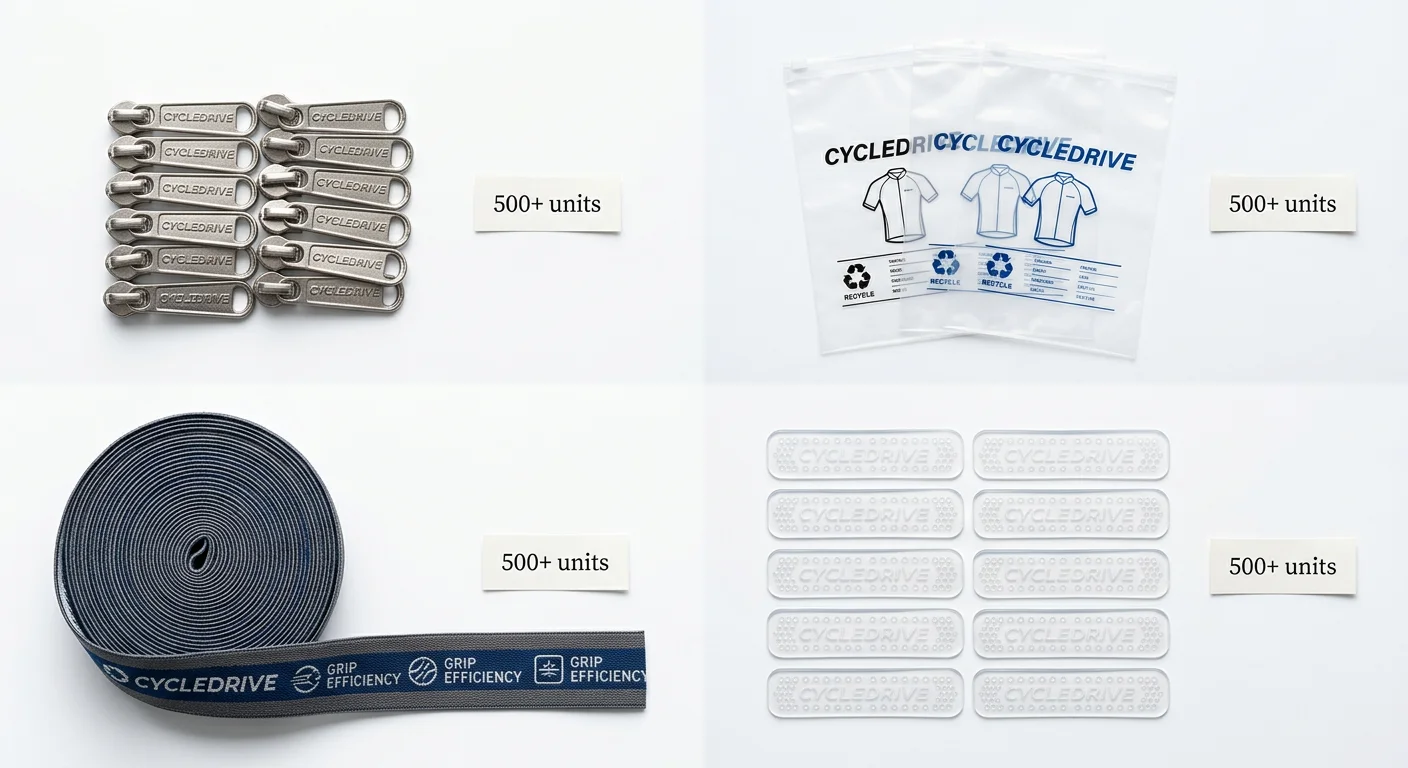
Switch to custom cycling appael branded pullers, jacquard gripper tape, and logo polybags once your volume hits 500+ units per style . At that scale, tooling costs spread out across enough units to stop hurting. The per-unit premium on branded trims folds into normal production economics.
MOQ Cost Comparison Decision Table: Matching Production Paths to Quantity
Four cost bottlenecks. Three production paths. One table that cuts through all of it.
Every quantity decision in cycling jersey production sets off a chain reaction — fabric strategy shifts, printing method changes, lead time stretches or shrinks. The table below puts those rules into one place. Use it before you contact a cycling jersey supplier, not after.
The baseline is 500+ pieces at $10.00/unit . At this level, dye lots fill without waste, lines run at full capacity, and setup costs disappear from your per-unit price.
Scenario | Order Qty | Fabric Path | Print Method | Unit Cost vs Baseline | Lead Time |
|---|---|---|---|---|---|
Team / Micro Run | 10–30 pcs | Stock 140–160 g/m² polyester-spandex, fixed colors | Digital sublimation only | +35–50% → $13.50–$15.00/unit | 12–18 days |
Brand Pilot / Small Batch | 50–200 pcs | Shared dye lot across 3–5 styles to hit 200–300 m threshold | Sublimation + selective transfer or embroidery placement | +10–15% → $11.00–$11.50/unit | 18–25 days |
Standard Production | 500+ pcs | Custom cycling apparel Pantone dyeing, 200–500 m per color | Sublimation dominant; screen print for flat 1–2 color logos | Baseline (0%) → $10.00/unit | 25–40 days |
What's Driving Each Row
10–30 pieces puts you in sample economics territory. There's no custom dyeing at this quantity. Ten jerseys use about 12–18 meters of fabric — far below any mill's 200-meter dye-lot floor. Stock fabric is the only path that works. Digital sublimation handles print without screen tooling costs. But neither choice removes fixed overhead. Pattern grading, heat-press calibration, and cutting setup all land on those 10–30 units. That's where the +35–50% premium comes from. A pattern/sample fee of $150–$300, spread across 20 jerseys, adds $7.50–$15.00 per garment before production starts.
50–200 pieces is the pivot zone. Managed poorly, costs climb fast. Consolidated well, the range becomes workable. The key move: pool two or three styles under one fabric color and spec to clear the 200–300 meter dye threshold as a shared lot. That one decision removes the short-load surcharge from your fabric cost. Print stays on digital sublimation for all-over artwork. Transfers or DTF prints cover placement logos where needed, with price breaks kicking in around 50–100 pieces. Many factories absorb separate sample fees once you commit above 100 units. They fold those fees into the +10–15% unit premium instead of billing a standalone invoice line.
500+ pieces is where the production chain starts working for you. Dye lots fill without gaps. Auto-cutting runs at full ply depth. Sewing lines hit 80–85%+ efficiency after the first 60–80 pieces. Screen printing for flat logos becomes cost-competitive at this scale. A placement print that costs twice as much per hit at 50 pieces drops well below the sublimation rate once screens spread across 500+ strikes. Lead time stretches to 25–40 days because custom dyeing adds 15–25 days to the front of the schedule. But the unit cost reflects real production economics — not a penalty for low volume.
The Negotiation Signal Hidden in This Table
Cycling apparel suppliers quote a single MOQ number — say, 200 pieces — by folding four separate thresholds into one figure. That number reflects their cut-and-sew line comfort zone , not the technical floor on any individual process.
The table above gives you the tools to push back on that. Ordering 80 jerseys? You can't argue the fabric dye lot math — those numbers don't move. But you can negotiate the CM rate by offering a consolidated size run. Or ask them to use stock fabric and skip the lab-dip queue, pulling lead time down from 25 days to 15. Knowing which constraint is real and which is a pricing preference is what separates a buyer who lands a better deal from one who pays the quoted rate without question.
Real-World MOQ Solutions: 10-30 vs 50-200 vs 500+ Unit Scenarios
Three numbers shape how your cycling jersey order gets made: the quantity you bring, the constraints each production stage sets at that quantity, and the gap between the two. Close that gap well and you get jerseys. Ignore it and you get a polite refusal from the factory floor.
Here is how each quantity band works — from the inside out.
10–30 Pieces: The Stock-and-Sublimate Formula
At this quantity, you are not running a production order. You are running a glorified sample with a program fee attached.
One path works here: factory stock fabric, full sublimation, standard size curve . No custom dye lots. No screen printing. No jacquard elastic or branded zipper pullers. Each deviation from stock components brings back a minimum you cannot meet at 30 jerseys.
The mechanics break down like this:
Fabric : Pick from the factory's existing cycling lycra or mesh color card — 140–180 g/m² white polyester-spandex on a sublimation-ready base. You skip the 200-meter dye-lot floor with no extra steps.
Print : Digital sublimation only. All graphics, all panels, single pass. Setup time is fixed regardless of quantity. There is no screen tooling cost to recover.
Size curve : Lock into a standard distribution — 2/6/6/2 for 16 pieces or 1/4/4/2 for an 11-piece run . Diverge from this and the cut room breaks into micro-bundles that cost more to track than to sew.
Program fee : Expect a $150–$250 one-time charge covering pattern grading, sublimation panel layout, and print file setup. Spread across 20 jerseys, that is $7.50–$12.50 per garment before a single thread moves.
The unit cost lands at $45–$60 ex-factory — about 2–3× the 500-piece price . That premium is real and structural. Fixed setup costs do not compress at low volume. They concentrate.
You do gain one real advantage: a 10–20 day turnaround once artwork is approved. No lab-dip queue. No dye scheduling. No mill lead time. For a cycling club that needs kits before the season opens, that speed justifies the higher cost per unit — no debate needed.
50–200 Pieces: The Consolidation Pivot
This range punishes poor planning harder than any other. Smart consolidation, on the other hand, pays off big here.
The key move at this quantity: stop thinking per-SKU and start thinking per fabric lot . A 200-meter stock or shared dye lot covers 250–320 jerseys on a standard build consuming 0.6–0.8 meters each. Spread that across two or three products — jersey, bib shorts, arm warmers — and you clear the mill's economic threshold without inflating the unit count on any single style.
What that opens up:
Sublimation printers with per-artwork minimums around 50 panels become reachable. Present total print area across the batch, not per-SKU numbers.
Factories fold pattern and marker fees into the unit rate — no standalone invoice line — once total commitment crosses 100 units .
Per-unit cost drops 20–40% versus the 10–30 piece tier as fixed costs spread across more output.
Ex-factory pricing for this range:
Quantity | Ex-Factory Unit Cost |
|---|---|
50 pcs | $35–$40 |
100 pcs | $28–$32 |
200 pcs | $24–$28 |
On trims: stay on stock components. Generic YKK or SBS zippers in standard colors. Heat-transfer care and size labels instead of woven branding. Standard silicone gripper elastic off the roll. Custom woven labels of cycling apparel carry MOQs of 1,000–3,000 pieces per design . At 150 jerseys, that tooling cost sits on your balance sheet as dead inventory — not branded value.
The discipline that defines this tier: two or three linked SKUs sharing one fabric lot , presented to the factory as a single consolidated program. Not three separate micro-orders sent through the same email thread.
500+ Pieces: Where the Production Chain Works For You
Below 500 units, you negotiate around constraints. Above it, most of those constraints drop away.
Custom Pantone dye lots become economical. Marker utilization climbs above 85% once a full size run from XS to XXL populates a long lay. Automatic spreaders and CNC cutters run at full design capacity. The sewing line works through its learning curve in the first 60–80 pieces and hits target efficiency for the rest of the run.
Print method shifts at this scale too. A screen-printed chest logo that costs twice as much per hit at 50 pieces drops well below the sublimation rate once screens spread across 500+ strikes. The practical split: screen print for simple 1–2 color logos or team marks where per-position quantity exceeds 200. Reserve sublimation for full-coverage panels , gradients, and design elements that screen printing cannot reproduce with clean results.
Custom trims now make financial sense:
Woven main and care labels: MOQ 1,000–3,000 pieces per design — covered within one or two styles
Jacquard waist elastics and branded silicone grippers: 1,000-meter lots — economical once you add bib short volume to the program
Logo-printed polybags: price breaks hit at 500, 1,000, and 2,000 units — align packaging specs across jersey and short styles to reach these thresholds without over-ordering
The pricing floor at this quantity reflects real production economics — not a penalty for volume. Further cost reductions come from multi-style commitments, seasonal capacity agreements, or construction simplification. A landed cost structure supporting 40–60% wholesale margins becomes reachable once you have small-batch price data from the 50–200 piece tier to anchor your DTC pricing above it.
The 500-piece order is not just a quantity milestone. It is the point where your cycling jersey supplier stops pricing you as a risk and starts pricing you as a program.
Factory Selection & Negotiation Tactics: Decoding "Comfort MOQ" vs Technical Limits
Every factory quotes a minimum order. But there's another number — smaller, unpublished — sitting on the actual production floor. That gap between the two is where your negotiation happens.
The MOQ on a supplier's quotation sheet is not an engineering constraint. It is a scheduling preference. Factories set their comfort MOQ based on line efficiency, labor balance, and procurement batching. The technical minimum — the smallest lot the process can run — is almost always lower. In 75–85% of sourcing conversations, MOQ is negotiable. Most buyers never test it.
Comfort MOQ vs. Technical Minimum: The Practical Test
Ask one question to separate the two: Can you quote setup fees, sample fees, and per-unit production costs as separate line items?
A factory quoting a technical minimum will say yes. They know exactly where fixed costs sit — CAD marker work, heat-press calibration, cutting setup — and they can price those separate from the unit rate. A factory quoting a comfort MOQ will hedge, bundle, or redirect.
Get a yes on cost separation, then ask four more:
Can you produce from stock fabric (no custom dye lot)?
Do you offer trial run pricing with surcharge credit on reorder?
Can my order be batched with another client's run ?
Will you accept a higher per-unit price in exchange for a lower minimum ?
Three yes answers out of four means the factory is working around real constraints, not invented ones. That's your signal to push harder.
The Seven Negotiation Levers, Ranked by Impact
1. Pay fixed costs upfront.
Pre-pay CAD, pattern grading, and sample costs. This pulls those expenses out of the unit price. The factory no longer needs to spread setup overhead across every piece. The viable run quantity drops — sometimes by 30–40%.
2. Offer a rolling forecast.
Put a 6–12 month reorder projection in writing. This moves you from one-time buyer to program customer. Factories price risk. Give them visibility and that risk shrinks.
3. Consolidate SKUs under one fabric spec.
Three jersey colorways on the same 160 g/m² polyester-spandex base share one dye lot, one marker file, one size curve. The factory sees one clean program. Not three fragile micro-orders.
4. Choose stock materials.
Stock fabric, standard YKK zipper tape, off-the-shelf silicone gripper elastic — each one removes an upstream MOQ the factory needs to hit before your order moves. Switching from custom dye to in-stock fabric alone can cut your negotiated minimum by half.
5. Simplify the style count.
Two styles in one color beat four styles in two colors at the same total unit count. Fewer changeovers mean fewer line interruptions. A simpler order is an easier yes.
6. Use CMT structure where possible.
Supply your own fabric and trims. This shifts the factory's constraint from procurement to labor. You control the materials. They control the sewing. That split often produces lower cut-make minimums than a full-package deal.
7. Co-order with another buyer.
Ask straight out. Some factories will group a 50-jersey order alongside another client's run on the same fabric and line setup. Your pieces ride a fixed-cost wave someone else is already paying for.
Five Factory Characteristics Worth Screening For
Not every cycling apparel factory that claims a low MOQ can deliver on it without problems. Look for these signals before you commit:
In-house sublimation printing. External print shops add a separate MOQ layer. Factories with their own heat-press capacity control the full workflow — and the full minimum.
Published stock fabric and trim library. Ask them to send a list of available in-stock polyester-spandex bases and standard trim options before any design talk starts. A factory that can do this has the infrastructure for small-batch production runs.
Transparent, itemized setup fees. A clear breakdown of CAD, sample, and changeover charges shows the factory knows its own cost structure. That clarity makes honest negotiation possible.
Tiered unit pricing by quantity. A factory with a 100-piece price, a 250-piece price, and a 500-piece price has already built a small-batch pathway into its business model. A factory with one flat price has not.
Willingness to combine orders across clients. A factory that openly offers shared-line batching is built for low-volume work. One that treats every order as a standalone program is not — no matter what the sales rep says.
The Pre-Contact Checklist
Have these ready before reaching out to any cycling jersey supplier:
A complete tech pack — the single strongest signal that you are a low-risk buyer
A request for their stock fabric list and standard trim options
A target quantity, a realistic reorder timeline, and a written forecast range
Separate budget lines for setup fees and unit cost — so you can negotiate each one on its own terms
Two buyers send the same order size. One emails "what's your MOQ for 50 jerseys?" The other shows up with a clean tech pack, a stock-material preference, and a six-month forecast. The factory sees the same quantity. It sees a completely different level of risk. Those two buyers get very different conversations.
Sourcing directly? See our OEM/ODM Cycling Apparel Manufacturing program for MOQ, lead times and private label options.
Conclusion
Every MOQ number a cycling clothing supplier quotes you is the start of a negotiation, not the end of a conversation.
Production costs for cycling jerseys don't scale in a straight line. Fabric dyeing lots, sublimation printing setups, and cut-and-sew line efficiency each have their own minimum thresholds. These thresholds don't line up with each other. So the real leverage isn't finding a factory that drops all requirements at once. It's knowing which bottleneck is eating your money at your specific order quantity.
Kitting out a 20-person club team? Testing a brand concept with a 100-piece cycling apparel run? The path forward is the same. Walk into supplier conversations with numbers, not just intentions.
Use the decision table. Know your production path before you send the first inquiry. Ask straight out whether the MOQ quoted is a hard technical limit or just a comfort zone the factory prefers.
Small-batch friendly factories are out there. Now you know how to find them.