There's a reason cycling fans stop scrolling the moment Pogačar's name appears in a race preview.
He doesn't just win Grand Tours — he dismantles them. He attacks on climbs where rivals are fighting to stay on their bikes. He dominates time trials while others focus on damage control. He sprints to stage wins that no GC contender should realistically take.
His racing style isn't some tactical plan built in a team meeting room. It's closer to controlled chaos pushed to the absolute physical limit.
Watched him drop a peloton on the Col du Tourmalet and thought how? Or why? This breakdown answers that. We're covering the five defining characteristics of Pogačar's racing style — the ones that set him apart from every other Grand Tour rider out there today.His influence extends beyond racing tactics, inspiring cycling apparel manufacturer partners to develop performance-focused gear that meets the demands of ambitious riders.
Reason 1: All-Terrain Dominance That Forces Rivals to Defend Everywhere
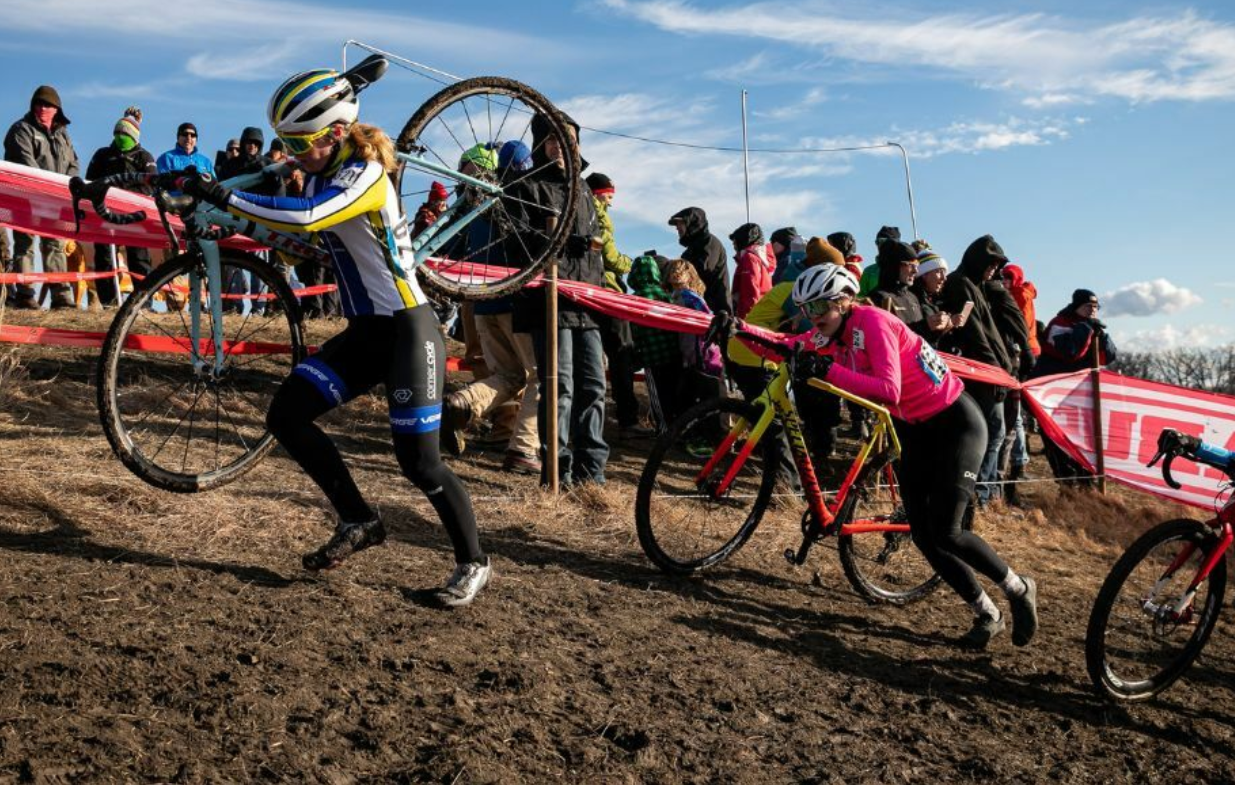
By age 25, Tadej Pogačar had already won 5 Grand Tour titles , 13 Monument classics , and a Road World Championship. That's not a career highlight reel. That's what he'd achieved before most riders even hit their peak form.
Here's what makes those 13 Monument victories stand out: they didn't cluster around one terrain type. They spread across four different race profiles :
Liège–Bastogne–Liège (Ardennes climbing) — 3 wins
Tour of Flanders (cobblestones + punchy short climbs) — 3 wins
Il Lombardia (long sustained mountain climbing) — 4 wins
Strade Bianche (gravel roads + mixed terrain) — part of the same winning sequence
He became the 3rd rider in history to win both the Tour de France and the Tour of Flanders — joining Bobet (1955) and Merckx (1975). He's also the first rider ever to win four Monuments back to back.Performances like these have also encouraged teams and clubs to invest in custom cycling apparel designed for different terrain, weather conditions, and racing disciplines.
Why This Breaks Every Tactical Framework Rivals Try to Use
Other elite Grand Tour contenders follow a pattern. Pure climbers dominate mountain stages but back off on cobblestones. Time trial specialists protect gaps on flat stages but play defense on summit finishes. Every rival has a preferred battlefield and a safe retreat .
Pogačar eliminates both.
His 2020 Tour de France win came down to one decisive time trial on the final day. He overturned a 57-second deficit to Primož Roglič and took the yellow jersey. That wasn't luck. That was a pro peloton race strategy backed by full TT-level power at the most critical moment.
The damage this does to rivals is real:
Opponents can't defend mountains alone — he wins time trials too
Opponents can't recover in Monuments — he targets cobblestones and Ardennes and alpine one-day races
Opponents can't skip race weeks to save energy — ignoring any race category means giving up ground across the full season
That same year he won the Tour de France, he also grabbed multiple Monument titles. That made him the first rider in 48 years to pull off that combination in a single season. His rivals had to spread full defensive resources across every terrain type, every race format, every week of the calendar.
That's not competitive cycling. That's a resource war — and Pogačar is the one rider forcing everyone else to fight it on every front at once.
Top riders in this sport almost always carry a trade-off. Great on climbs, limited on cobblestones. Fast in time trials, exposed on summit finishes. That's just how elite road cyclist characteristics tend to work. Pogačar's career data doesn't follow that pattern at all. His Grand Tour domination cycling numbers and his Monument win spread point to the same conclusion — there is no terrain where rivals can breathe easy.
Reason 2: A Hyper-Aggressive Grand Tour Strategy Built on Instinct, Not Calculation
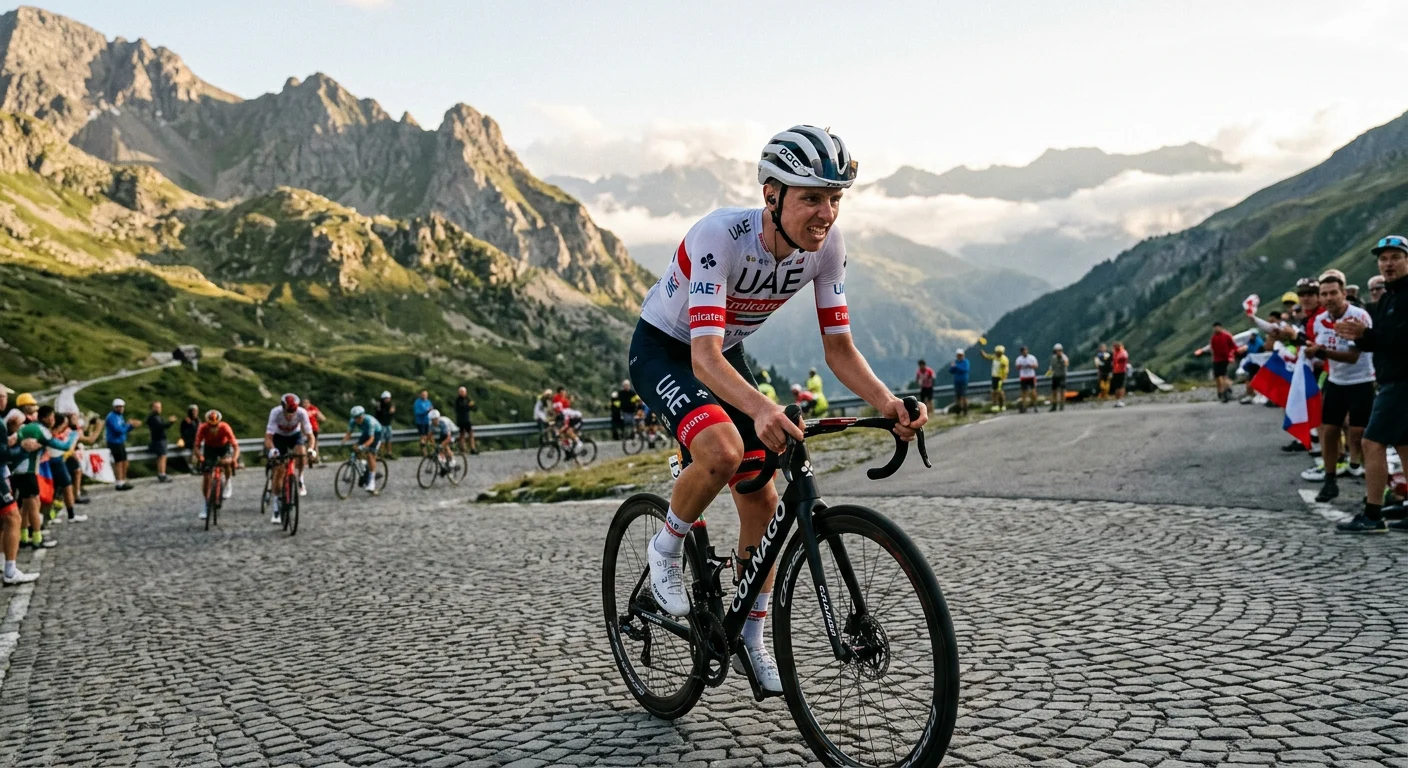
"Racing intelligently or not, it's a nonsense. Right now I have the best legs, so that's what matters."
That quote tells you everything about how Pogačar approaches a Grand Tour. Rival teams run race-day simulations and draft tactical spreadsheets. He shows up and reads the road in real time. His attacking style isn't reckless — it runs on a different logic than everyone else in the pro peloton.
He Attacks When Nobody Expects It — And That's the Point
At the 2024 Strade Bianche, Pogačar launched his decisive move with 81 kilometers still to race . Not 20 km out. Not on the final climb. Eighty-one kilometers from the finish line. He already had two hours of racing in his legs, with two more hours still ahead.
He rode the rest of the race alone. He won by 2 minutes and 45 seconds .
The standard Strade Bianche playbook calls for decisive moves in the final 20–40 km. Pogačar pushed the critical phase forward by 40–60 km. Rivals had to chase far earlier than planned. Their domestiques burned energy before the real battle had even started.
His own description of his 2023 World Championships attack? "It was a stupid move, but it worked." He knows the textbook. He just doesn't follow it.Delivering professional-level cycling apparel requires an experienced cycling apparel factory capable of combining advanced fabrics with race-proven garment construction.
The Science Behind Why This Works
Most Grand Tour riders stick to a strict match-burning budget. Traditional GC strategy limits mountain stage attacks to 1–2 maximal efforts — concentrated in the final climb — to stop cumulative fatigue from building across 21 stages and 3,500 km of racing.
Pogačar burns matches earlier and more often. On key mountain stages, he attacks 10–30 km from the finish . Sometimes on penultimate climbs. Sometimes he pushes straight through descents while rivals rest and recover.
So why doesn't this break him down by Week 3?
Two reasons:
His estimated 5-hour power output sits well above 6.0 W/kg on big race days. That means repeated hard efforts cost him a smaller share of his maximum output than they cost any rival.
His fatigue resistance is exceptional. Performance decay over multi-hour efforts is far smaller than the standard WorldTour benchmark.
That 81 km Strade solo was not a desperate gamble. From a physical standpoint, it was a hard but submaximal effort for him — a sustained near-threshold block that would break a standard pro cyclist. For Pogačar, it sits inside his normal operating range.
What This Does to Everyone Else's Race Plan
This is where Pogačar's instinct-driven aggression becomes a strategic weapon — not just a personality trait.
He attacks 60 km from the finish on a Tour de France mountain stage. Rival GC teams suddenly face an impossible call with no good answer:
Do they commit domestiques now — burning resources hours before the final climb?
Do they let the gap grow and hope he cracks — betting against a rider who almost never cracks?
Either choice costs them. Conventional GC strategy runs on controlled, model-driven pacing — picking up 10–30 second gains in final climbs. One successful Pogačar raid delivers 1–3 minutes in a single move . Rivals who chase him down to stop the damage still pay a price. The effort leaves them more depleted for what comes next.
He's not just winning races. He's turning every mountain stage into a chaos problem. In chaos, his superior fitness and raw instinct become the decisive edge — every single time.
Reason 3: The Unconventional Bike Position That Makes His Power Output Sustainable
Most elite riders chase aerodynamics at the cost of everything else. Pogačar found a way to have both. The numbers behind his bike fit explain why he can produce 6.2–6.5 W/kg on 20–30 minute climbs and still look composed in Week 3 of a Grand Tour.
His position rejects the "lower is faster" logic that drives WorldTour fitting culture. Here's what sets it apart.
A Flat Back, Not a Folded One
Pogačar rides with a flat but relaxed back . Shoulders stay loose. The torso doesn't collapse inward.
That matters more than it sounds. A deep hunched position closes the diaphragm, cuts airflow, and loads the upper body with constant muscle tension. Over a four-to-six hour mountain stage, that tension drains endurance steadily. Watts that should go to the pedals get lost to unnecessary muscle work instead.
His setup matches what modern fitters call an "all-day aero" configuration. The bars sit ~40–60 mm higher, with ~60–100 mm more reach than old low-drop positions. You still get a low head position — but the torso stays relaxed and breathing stays open.Cycling retailers and clubs often work with a trusted cycling apparel wholesaler to source technical kits that balance aerodynamic performance with long-ride comfort.
The Hip Angle That Changes Everything
This is the most important piece of his position from a technical standpoint.
Pogačar uses a zero-offset seatpost with the saddle pushed all the way forward. This creates a virtual effective seat angle of 78° — well past the typical 74–75° range. Add in a knee angle at full extension of just 136° (the standard road fit sits between 140–150°), plus short cranks at 165 mm on road and 160 mm in TT . The result: his hip stays open at the top of every pedal stroke.
That open hip angle does two critical things:
It preserves diaphragm space through the full pedal cycle. Breathing stays deep even at race intensity.
It removes the power blockage at top dead center that closed hip angles cause. Watts go straight into forward motion instead of fighting the body's own mechanics.
Traditional extreme aero positions — bars very low, saddle pushed back — often cost riders 5–10% in sustainable power output from this exact compression. Pogačar's fit sidesteps that trade-off altogether.
Bent Elbows, Rounded Stroke
Two final details hold the whole system together.
His elbows stay bent throughout — never locked. This works like passive suspension. Road vibration gets absorbed before it reaches the shoulders and neck. Less vibration means less nerve and muscle fatigue building up across multi-day racing. His hands also pull inward toward his hips. This keeps the upper body still and sends more watts to the drivetrain.
On the pedaling side, he holds 85–100 rpm with a complete 360° stroke. Quads drive the downstroke. Hamstrings carry through the transition. Calves finish the rotation. That cadence range puts the load on the cardiovascular system rather than peak muscle force per stroke. High-power outputs become far more repeatable across long stages.
The position looks almost relaxed . Yet it produces some of the highest sustained watts per kilogram in the modern peloton. That's the whole idea.
Reason 4: The Physiological Engine Built for Three-Week Consistency
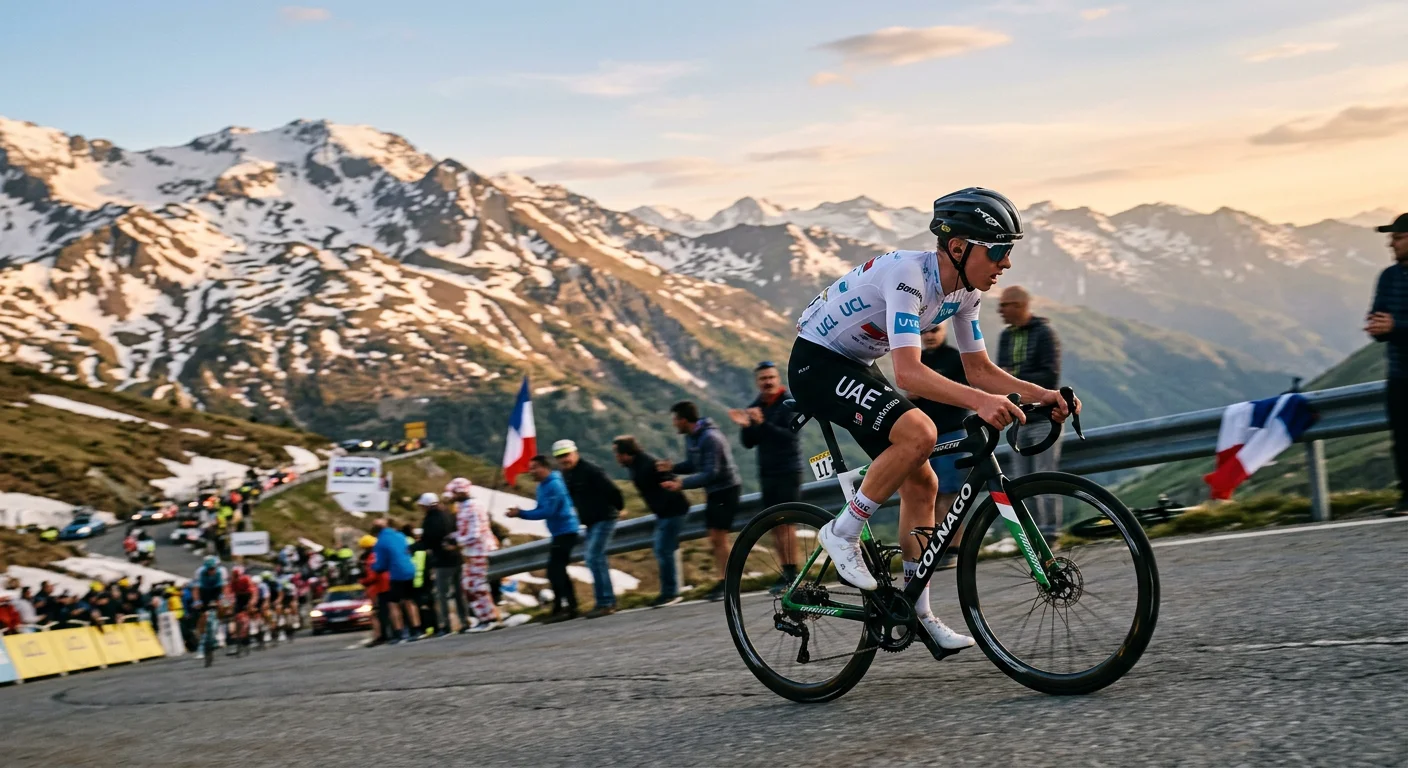
Here's a number that puts everything in perspective. In 2024, Pogačar won the Giro d'Italia, the Tour de France, the UCI Road World Championship, and two Monument classics. All of that happened in a five-month window covering 60+ race days.
That's not a training block. That's five separate world-class peak performances, back to back, across different race formats, different terrain profiles, and different physical demands.
Merckx (1974) and Roche (1987) had completed the Triple Crown before him. Neither also picked up two Monuments in the same season. Pogačar did.
Why Week 3 Is Where Most GC Engines Break Down
Three-week racing is a stress accumulation problem. By Stage 17 of a Grand Tour, most GC contenders are in damage-control mode. Their power on long climbs drops 10–15% compared to Week 1. Heart rate drifts upward — the same output now costs 10–15 extra beats per minute. Attacks fade, not from bad tactics, but because the body can't absorb another hard effort without risking total collapse the next day.
The biology is straightforward. Glycogen stores drain faster than overnight recovery can refill them. Micro-muscle damage builds up. Neural fatigue breaks down pedaling efficiency — the smooth mechanics from Week 1 start falling apart at the molecular level.
Pogačar's Week 3 looks different. He doesn't defend. He attacks.
The Physiological Architecture Behind the Consistency
His estimated VO₂max sits around 80–85 ml·kg⁻¹·min⁻¹ with a functional threshold power near 6.0 W/kg . Those numbers put him at the outer edge of what human aerobic systems can produce. But raw ceiling numbers aren't the full story.
What separates him is how little he loses over time.
Most WorldTour riders in a hard Grand Tour show a 10–15% output decline by the final week. Pogačar's fatigue curve drops an estimated 5–8% under the same total load. On a mountain stage with 20 days already in the legs, that gap decides race outcomes.
The physiology behind this works on three levels:
Lactate clearance speed. In key climbing segments, he can hit 2–4 above-threshold attacks in the final 3–5 km, then recover to near-threshold pace within 1–2 km — without his power curve collapsing. That takes elite mitochondrial density and capillary development, which clear lactate faster than the muscles generate it.
Metabolic flexibility. Across 70–90 total racing hours in a Grand Tour, he holds a working balance between glycogen use and fat burning. This keeps him away from the energy-wall scenario that hits most riders in Week 3 — where glycogen reserves crash and performance drops off a cliff.
Anaerobic recovery speed. His sprint finish on summit climbs — pushing >9 W/kg for 15–30 seconds — doesn't cut into his output the next day. That reflects phosphocreatine recovery rates and hormonal resilience that most pro cyclists don't have.
What 2024 Proved
The 2024 season wasn't just a strong results list. It was proof of a new physical ceiling in professional cycling.
Between May and October, Pogačar held championship-level output across five separate peak targets — two Grand Tours, a World Championship, and two Monuments. His total race time in Zone 4–5 intensity across that stretch is estimated at 20–30% higher than a typical defensive GC rider's full season load.
He became the third rider in history to complete the Triple Crown — and the only one ever to do it with two Monuments added on top . That isn't just a palmares milestone. It's a data point about how his watts per kilogram output holds across months, not just days.
Other elite cyclists plan their season around one or two peak targets and protect everything else. Pogačar plans for five — and still has more left when autumn arrives.
Reason 5: A Fearless Race Psychology That Turns Uncertainty Into a Weapon
Physiology explains what Pogačar can do. Psychology explains why he does it when nobody else would dare.
Every top Grand Tour contender carries elite numbers — VO₂max scores, threshold power outputs, recovery metrics. At the very top of the sport, those gaps are narrow. What separates Pogačar from every other GC rider isn't a physiological ceiling. It's a mental framework. He treats uncertainty as a competitive advantage — not something to avoid.
He Races by Feel — On Purpose
Pogačar has said it plainly: even with a power meter on the bike, he often ignores the numbers and rides on sensation alone. That's not casual indifference to data. It's a deliberate choice. He operates without a fixed energy budget. He attacks when the body says go — not when the spreadsheet says it's safe.
The result? A typical GC contender executes one or two planned attacks per mountain stage. Pogačar launches three to five extended high-intensity efforts across a single race day. Each one pushes rivals into a decision they hadn't prepared for.For brands expanding their racing apparel collections, evaluating product quality alongside competitive cycling apparel wholesale price options is equally important when serving both elite and recreational cyclists.
The Pressure-to-Attack Loop
His coach has described Pogačar's mental core using three factors: upbringing, mental outlook, and genetics. The psychological piece is the most interesting. He converts competitive pressure — the kind that makes most riders conservative — into an urge to attack. More success creates more expectation. More expectation feeds more aggression. The cycle compounds.
Traditional GC leaders do the opposite. Once they're ahead on GC, attack frequency drops . Risk control takes over. Pogačar attacks more once he's already winning.
Turning Every Terrain Into an Ambush Point
His psychological model targets the exact moments rivals switch off mentally:
Gravel and technical sections — GC riders shift into damage-avoidance mode. Pogačar accelerates. The sudden intensity forces rivals to improvise on terrain they'd written off as "safe passage." That improvisation costs an average 3–5 seconds in response delay — on technical roads, that compounds fast.
Crosswind splits — most riders play defense. Pogačar uses UAE's lead-out to spike speeds past 50 km/h and force peloton fractures at the precise moment rivals weren't switched on.
Mid-category climbs — instead of saving attacks for the final HC summit, he pushes near 6 W/kg on Category 2–3 climbs mid-race. Rivals burn critical reserves at a point their tactical plan told them to conserve.
The logic is precise. Force rivals into their red zone before they planned to go there. Their performance on the climbs they trained for drops. Their team scripts become worthless.
That's not reckless racing. That's high tactical entropy — pushing the number of unpredictable scenarios so high that the opponent's prepared playbook runs out of answers.
The best Grand Tour riders share similar physiology. What Pogačar has that they don't is simple: the willingness to treat doubt, risk, and uncertainty not as threats to manage — but as the exact conditions where he wins.
What Pogačar's Style Teaches Amateur Cyclists (And Why Gear Matters)
Most amateur cyclists watch Pogačar and think the gap is unbridgeable. It isn't. Three of his core habits apply to your weekend rides. Each one comes with a concrete action you can take this week.
Ride at 80–90 RPM on Climbs (Stop Grinding)
Pogačar favors a smooth, rounded pedal stroke at 85–100 rpm on sustained climbs. That's not a coincidence. Higher cadence moves the workload from your muscles to your cardiovascular system. Your cardiovascular system recovers between efforts. Your legs don't.
Here's what to do:
- Add a cadence sensor and target 80–90 rpm on every climb
- Select a gear that keeps you in that range without forcing heavy breathing
- Run 2–3 tempo climb sessions per week at 20–30 minutes each, tracking average cadence and heart rate
Grinding at under 70 rpm? That one change cuts leg fatigue on long rides more than almost anything else.
Attack Smart, Not Often
Pogačar doesn't push the pace all the time. He finds the right moment, then goes all-in. Before your next group ride, pick 1–2 climbs to go hard and ride easy everywhere else. In training, match your local route profile. Your target climb takes 4–5 minutes? Do 6 × 4–5 minute intervals at 95–105% of FTP with equal recovery. That's race simulation, not random suffering.
Build Your Base Before You Build Your Explosiveness
Pogačar's actual structure each week: 5-hour zone 2 rides on flat terrain, plus separate sessions with 8-minute high-intensity repetitions . Most amateurs do the opposite. They go somewhat hard all the time and wonder why they stop improving.
The fix is straightforward:
- Reserve 60–70% of your weekly volume for easy, conversational-pace zone 2 riding
- Add 1–2 days of structured intervals: 4–6 × 5–8 minutes at 90–105% of threshold power
- Track your zone distribution each week — Z4–Z5 dominating your hours? Pull back
Why Gear Supports These Habits
This is where it gets practical.
At typical road speeds, 80–90% of your resistance is aerodynamic drag . Your clothing accounts for a big chunk of that. A race-fit jersey over a loose club jersey can save 5–10 watts at 40 km/h . That's a real time gain over a 40 km effort — no extra training needed.
Compression bib shorts matter too. They deliver 10–20 mmHg of graduated compression around your quads and hamstrings. That stabilizes your pedal stroke under fatigue. So on climb number four of the day, holding 85 rpm stays doable.
Breathability goes beyond comfort. Pro-level jerseys with mesh panels rated above 150–200 g/m² pull sweat off your skin within 30–60 seconds. Dry, cool skin keeps your heart rate under control. That's basic thermoregulation physiology — not a marketing line.
You're putting in the work — the smooth cadence, the smart pacing, the polarized training structure. The right cycling apparel pro riders wear removes the friction that turns good intentions into a breakdown on hour four. Check out our race-fit jerseys and high-compression bibs at Runcyclingapparel.com and match your effort with gear built to back it up.
Conclusion
Pogačar doesn't just win races — he rewrites the rulebook while everyone else is still reading it.
His dominance covers all terrain. His aggression runs on instinct. His race mindset never cracks. These aren't separate traits. They build one complete identity — rooted in physical strength, mental toughness, and a riding style so smooth it looks easy at 6.2 w/kg.
Here's the real takeaway for you as a cyclist: elite performance isn't accidental. It comes from deliberate choices — in strategy, training, and yes, even in the gear you wear.
Pogačar's Grand Tour domination sparks something real. That itch to push harder, climb stronger, and ride with more purpose — you feel it. So act on it. Start with how you show up on the bike.
Check out Run Cycling Apparel 's performance cycling gear. Wear the mindset of a champion on every ride.
The peloton doesn't wait. Neither should you.