You’ve got a season deadline closing in, a group chat arguing about color schemes, and a supplier quote that looks either suspiciously cheap or eye-wateringly expensive—so which one do you actually need, semi-custom or full custom? The real difference isn’t just the price tag on your Semi Custom cycling jerseys versus a full custom order. It’s the 20-day gap in your production timeline, the fabric swatches you'll never get to feel, and the minimum order quantity fine print that can quietly wreck your budget. This guide skips the sales talk and gives you the hard numbers—cost tiers, turnaround windows, and a simple gut-check to decide which custom cycling apparel manufacturer fits your team before you sign anything.
Semi-Custom Cost Breakdown: What You Pay for Template-Based Kits
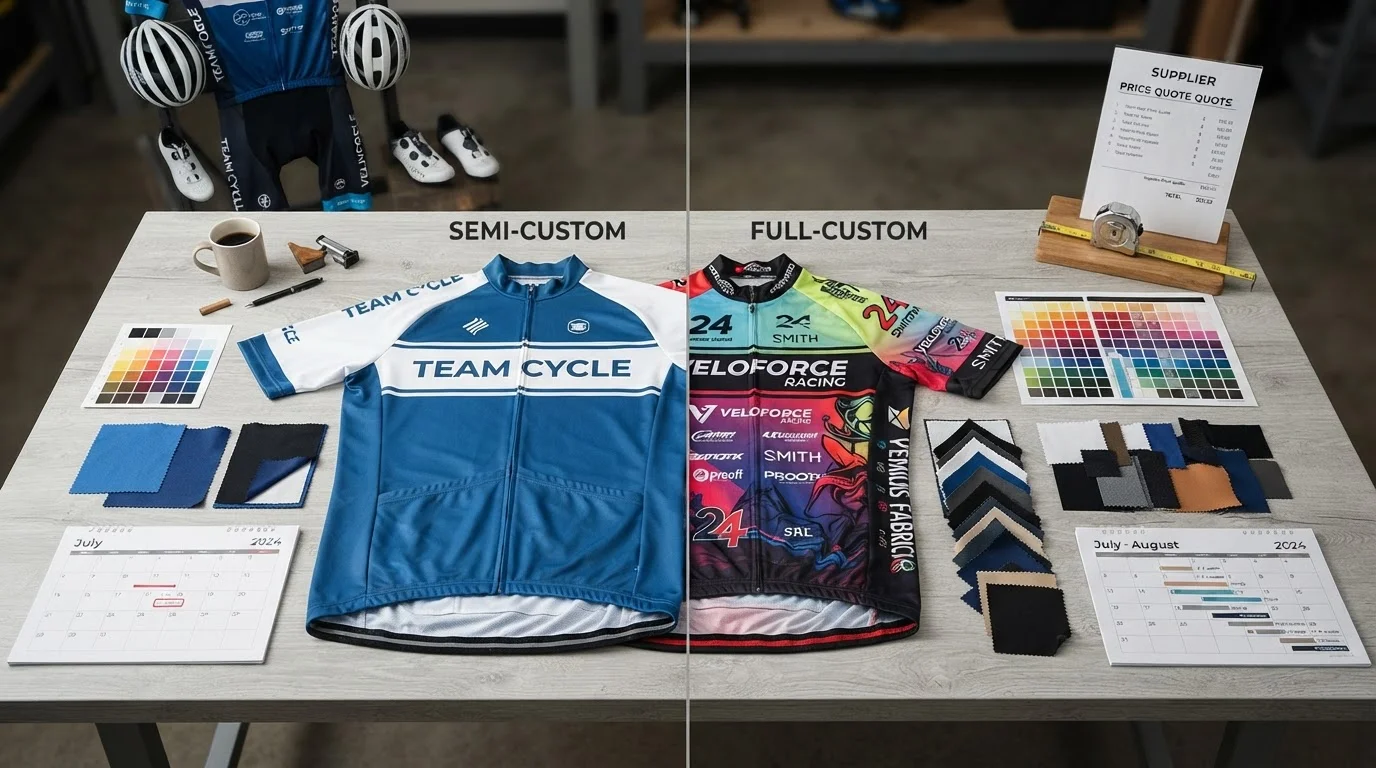
Template pricing is a ladder, not one flat number, and where your team lands depends on order size.
For semi-custom cycling jerseys, most manufacturers work from a pre-built template. You pick colors and swap in your logo—no pattern redrawing. The math stays predictable. Typical pricing tiers look like this:
20–49 units: $28–$38 per jersey
50–99 units: $22–$30 per jersey
100–249 units: $17–$24 per jersey
250+ units: $13–$19 per jersey
The curve flattens fast. That's normal for sublimation printing—setup costs get absorbed once you hit a certain volume. It's not generosity.
Expect a one-time screen or digital-print prep fee of $50–$150, sometimes waived if you meet the semi-custom cycling clothing MOQ (usually 20 units, versus much higher minimums on full custom runs). Ask upfront whether that fee is included. Suppliers rarely volunteer the detail.
Extras creep up. Sponsor logo placement, extra panel colors, or premium fabric options like moisture-wicking mesh instead of standard polyester add $1–$6 per unit depending on coverage. The first design proof round is usually free; revisions after that run $10–$25 per mockup.
The trade-off: you're customizing colors and text, not the cut or construction. If your club needs consistent branding, fast turnaround, and budget certainty, this tier delivers that. If you want a silhouette or fabric blend nobody else has, that's a different conversation.
Full Custom Cost Breakdown: Factory-Direct and Brand-Level Pricing
Full custom starts where semi-custom ends, and then keeps climbing based on what you’re asking the factory to build. full custom cycling apparel requires pattern-cutting, custom construction, and sometimes proprietary fabric blends. That complexity shows up in the quote. A custom cycling apparel manufacturer working factory-direct typically anchors pricing around $1.50 per piece FOB as a baseline for low-MOQ custom cycling kits, then scales quotes across 100, 300, 500, and 1,000-unit tiers. Full cut-and-sew construction—what true full custom cycling kits require—has an MOQ of 100–200 units, well above the 20-unit floor for template work.
A typical discount structure runs: 100–299 units at base price, 300–499 units at 5% off, 500–999 units at 10–15% off, and 1,000+ units at up to 20% off base. But the factory quote isn’t your real cost. Packaging, freight, duty, testing, and printing plate setup usually add 40–80% on top before the kit reaches your team. Landed cost—which includes those additions—is the number you should budget against.
Cost structure inside the factory typically breaks down as roughly 40% materials, 23% labor, 10% decoration, 15% overhead, 12% margin. Full custom fabric options—compression weaves, thermal-bonded seams, specialty grip silicone—pull straight from the materials line, which is why swapping fabric blends moves price more than swapping colors does on a semi-custom order.
If your club is reselling kits or building a brand around the team, pricing yourself at 4–5× landed cost for direct sales, or 6–8× if you’re going through a distributor or retail partner, keeps margin intact once markup, shipping, and returns eat into revenue.
Full custom makes sense only once you know your real order size and whether your team can absorb a 100-unit minimum before the season starts.
Lead Time Comparison: From Design Approval to Delivery
Time is the variable that quietly wrecks race-season plans. A quote can look perfect on paper and still leave your riders in last year's kit if the calendar doesn't work.
Semi-custom moves fast because the template already exists. Validation takes 1–2 days—there's no pattern to redraw, just colors and logo placement to lock in. Sublimation cycling jersey printing runs 5–10 days once approved. QA and packing add 1–2 days, and domestic shipping tacks on another 1–3. Total: 7–15 days , start to finish.
Full custom runs a longer, heavier process:
Stage | Semi-Custom | Full Custom |
|---|---|---|
Design approval/spec sign-off | 1–2 days | 3–7 days |
Material procurement | Included in production | 1–2 weeks |
Production (cut-and-sew or print) | 5–10 days | 3–5 weeks |
QA/packing | 1–2 days | ~1 week |
Shipping | 1–3 days | 15–30 days if overseas |
Total | 7–15 days | 25–45 days |
That gap compounds fast if your custom Cycling apparel manufacturer sources fabric overseas—international freight alone can eat 15–30 days before the kit even reaches your door.
A first custom kit design proof usually turns around within a day or two on semi-custom orders. Full custom proofs take longer, since they often involve physical fabric samples and pattern fittings, not just a digital mockup.
For a May race, semi-custom orders can go out as late as mid-April. Full custom needs a commitment by January to leave room for delays. Miss that window, and no amount of team cycling jersey customization enthusiasm fixes a shipping backlog.
Customization Boundaries: What You Can and Cannot Change
The boundary that matters: what you're allowed to change depends on whether you're editing a template or commissioning a new one. Most suppliers won't spell this out unless you ask.
On a semi custom cycling kit design template, you can change color, logo placement, sponsor branding, trim accents, and sometimes swap in a mesh panel if the template already supports it. What you can't touch is the pattern. The cut, the seam placement, the sleeve length, the collar shape are all locked in. Ask for a racer-fit cut instead of the club's standard relaxed silhouette, and you've stepped into full custom territory, whether your supplier flags it or not.
Full custom removes those walls. New silhouette, new seam construction, thermal-bonded panels instead of stitched ones, a proprietary compression weave nobody else is riding in — all fair game, because you're paying for a new pattern, not editing someone else's.
The MOQ scales with how deep you go:
Template tweaks — color, logo, standard fabric: 20–100 units
Semi-custom with minor panel or trim changes: 100–500 units
Full pattern redesign or new fabric blend: 500+ units, unless you pay pattern-development costs separately
There's a smaller benchmark worth knowing too. A limited custom detail — a unique zipper pull or trim piece pulled from existing stock rather than a new mold — can sometimes run 200–500 pieces MOQ on its own, separate from the jersey order itself.
Here's a rule of thumb for any club captain sitting on the fence: if the change is surface-level — color, logo, branding — it's semi-custom, and your cycling jersey fabric options stay within the template's approved list. If it changes the structure, the fabric composition, or the fit, you're commissioning something new. The price and the timeline both reflect that, whether you asked for it or not.
Decision Matrix: "Budget-Sensitive Club" vs "Brand-Identity Team"
Two teams can order the exact same jersey style and walk away with different priorities scored on completely different scales. That's the whole point of a weighted decision matrix. It forces you to name what matters before a supplier's slick deck talks you into the wrong tier.
Score every custom cycling apparel manufacturer on a 1–5 scale across ten criteria: cost per unit, MOQ, setup fees, lead time, customization depth, brand guideline compliance, sample quality, reorder consistency, communication speed, and approval complexity. Then multiply by weights that match your team's identity.
Criteria | Budget-Sensitive Club | Brand-Identity Team |
|---|---|---|
Cost | 35 | 10 |
MOQ | 20 | — |
Lead time | 15 | 10 |
Setup fees | 10 | — |
Customization | 10 | 25 |
Brand fit | 10 | 30 |
Proof quality | — | 15 |
Reorder consistency | — | 10 |
A budget-sensitive club weights cost and MOQ heaviest: cheapest total spend, small minimums, standard colors, minimal setup fees, fast turnaround. A brand-identity team flips that. Brand consistency and customization depth carry 55 combined points because color accuracy and logo placement control matter more than shaving a few dollars off unit price.
Ask every vendor the same six questions regardless of which camp you're in: MOQ, unit price tiers, sample cost, production lead time, decoration methods, and their brand guideline proofing process. Budget clubs push for best price at low volume and standardized SKUs. Brand teams push for evidence the manufacturer can actually hold templates and standards consistent across reorders, not just the first batch.
Quick Self-Check: Can Your Team Use Semi-Custom? (3-Minute Decision Tool)
Grab a coffee and answer five questions honestly. No supplier calls needed yet.
Run through this checklist:
Do you need fewer than 500 units, or are you testing the waters with a smaller order first?
Can you work from an existing kit design template rather than starting from a blank slate?
Is your launch window 2–8 weeks away, not months?
Are you trying to avoid new mold or pattern-development costs entirely?
Is your differentiation mostly about branding, color, or logo placement, not fit or fabric structure?
Three or more "yes" answers means semi-custom fits. Expect roughly 15–30 days total lead time and MOQs in the 50–200 unit range for most semi-custom ODM programs.
Mostly "no" means you need full custom. That's new tooling, deeper engineering, and realistic timelines of 45–90 days, sometimes longer if your team wants proprietary fabric blends or a redesigned silhouette.
The honest answer usually surfaces by question three.
Comparing Suppliers on Price, MOQ, Lead Time, and Customization Depth
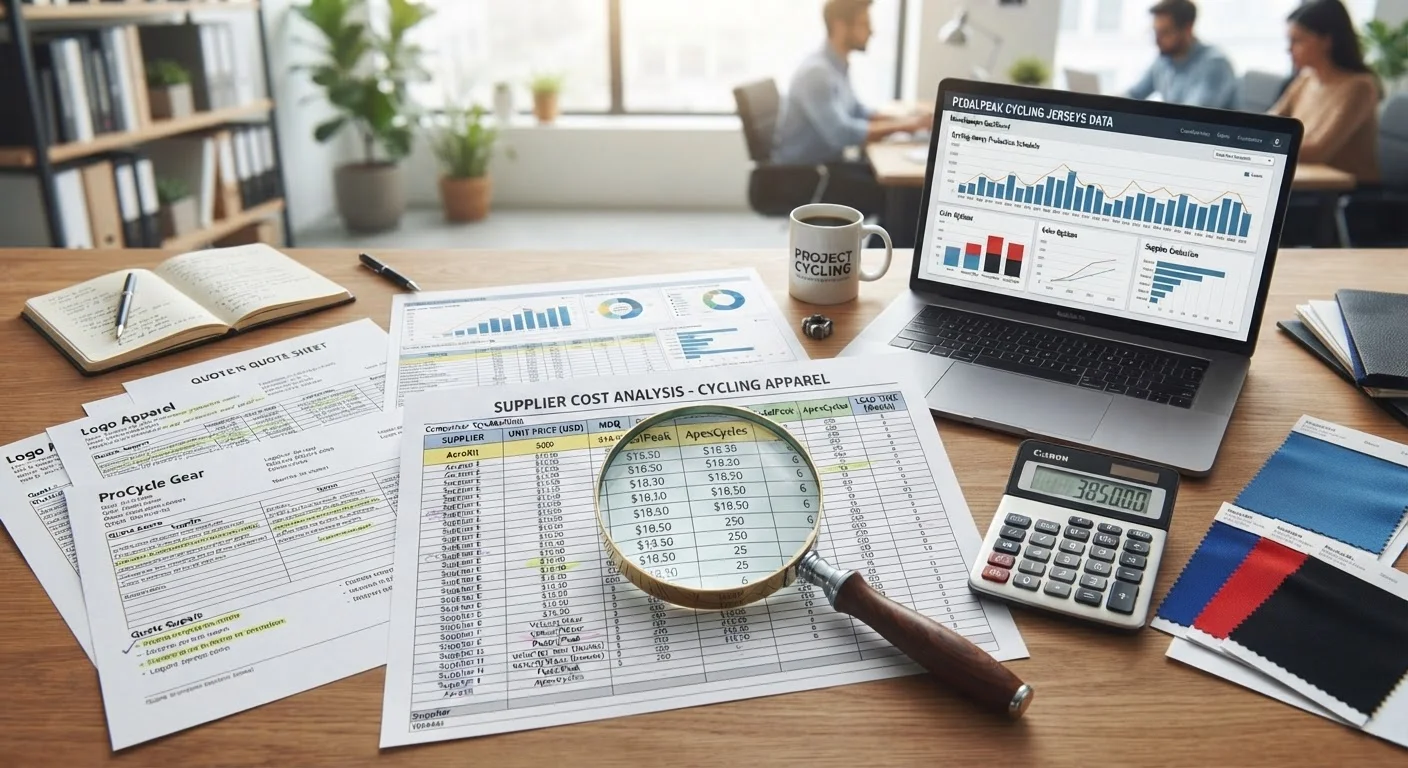
Three quotes land in your inbox, and none of them use the same units of measurement. One supplier's "MOQ" means per color, another's means per SKU, and you're comparing apples to a spreadsheet of oranges. Before you rank anyone, standardize the request. Ask each custom cycling apparel manufacturer for the same fields. These include unit price, MOQ per SKU/color, whether mixed variants count toward that MOQ, sample cost, lead time at MOQ versus a smaller pilot order, tooling fees, packaging options, and the QC process. Anything less, and you're guessing, not comparing.
Here's an example of real quote sets side by side:
Supplier | Unit Price | MOQ | Lead Time | Sample Cost |
|---|---|---|---|---|
A | $5.00 | 100 | 15 days | $30 |
B | $4.50 | 200 | 20 days | $25 |
C | $5.50 | 50 | 10 days | $40 |
Price, MOQ, and speed pull against each other. Cheaper unit cost usually means a higher floor. Faster turnaround usually costs more per piece. Rarely does a supplier win on all three.
For cycling apparel pricing tiers, expect a similar spread. One manufacturer quotes $2.30/unit at 1,000 MOQ with a $35 sample and 18–22 day lead time. Another quotes $2.12/unit, 800 MOQ, 15–18 days, and includes a custom label. That second quote looks cheaper until you factor sample cost and whether their custom kit design proof process adds revision rounds you didn't budget for.
Assign weights to your scorecard. Landed cost and total price should carry 25–35% of your decision, MOQ another 10–20%, lead time 20–30%, and quality proof or QC the remaining 20–30%. Skip the weighting, and you'll default to whoever emailed back fastest, not necessarily the manufacturer built for your team's cycling kit production timeline.
Conclusion
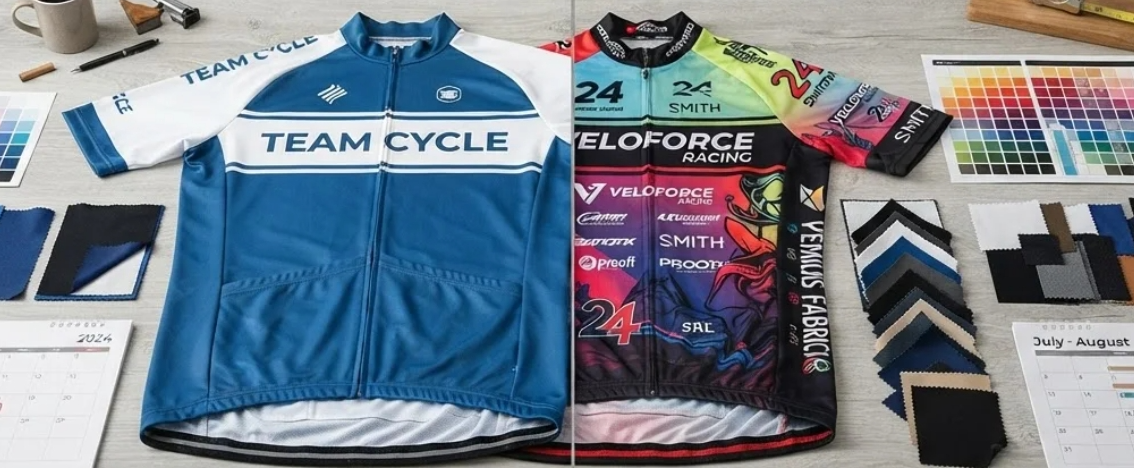
Choose the option that fits your team's timeline, budget, and how badly you need that logo placed just right . If you're a club watching every dollar and racing against a season deadline, semi custom cycling jerseys get you sharp-looking kits fast, without the financial gut-punch. If your brand identity is non-negotiable, full custom buys you that freedom. Budget the extra weeks for it.
Pull out the cost tables and self-check list from this guide, run your numbers, and you'll know exactly which path fits before you ever pick up the phone. Then reach out to a custom cycling apparel manufacturer who can confirm your specific MOQ and timeline in writing.