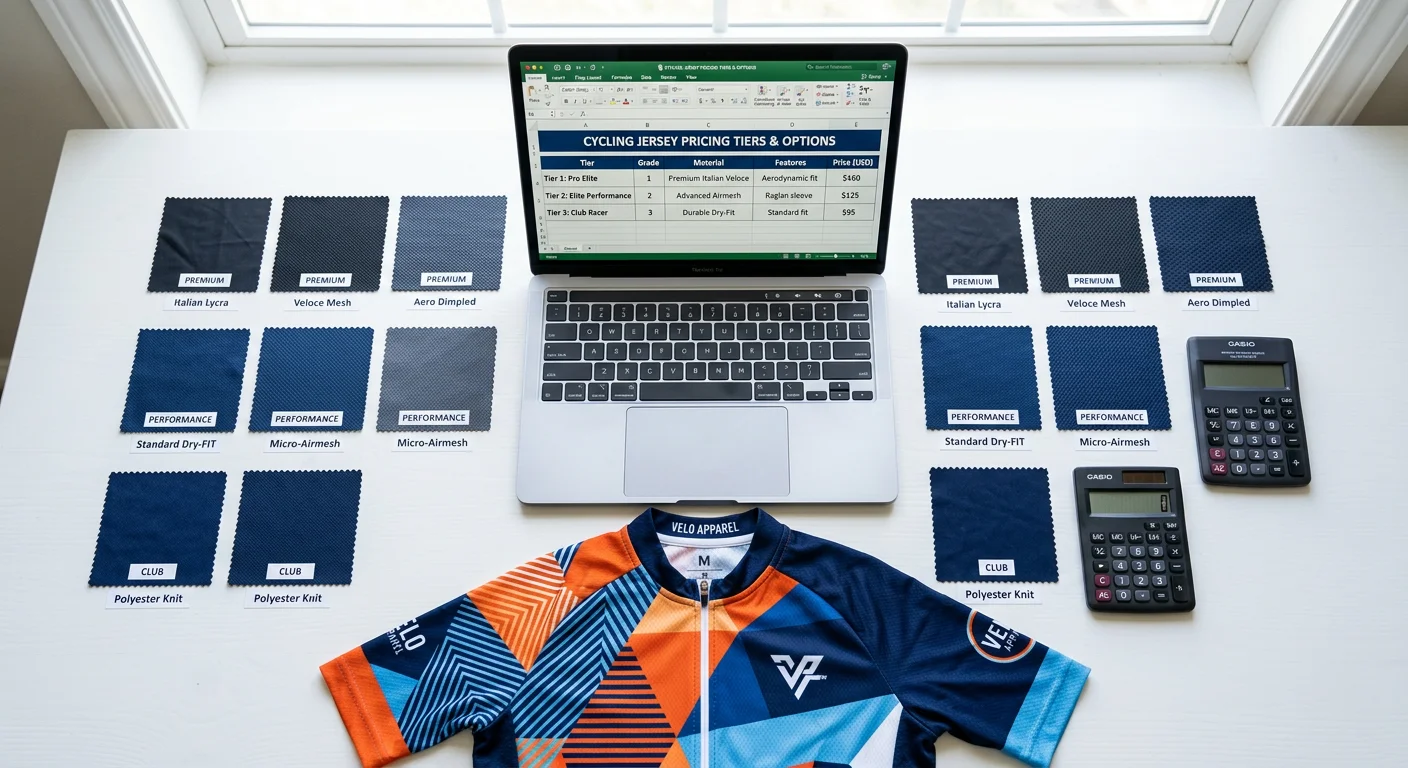
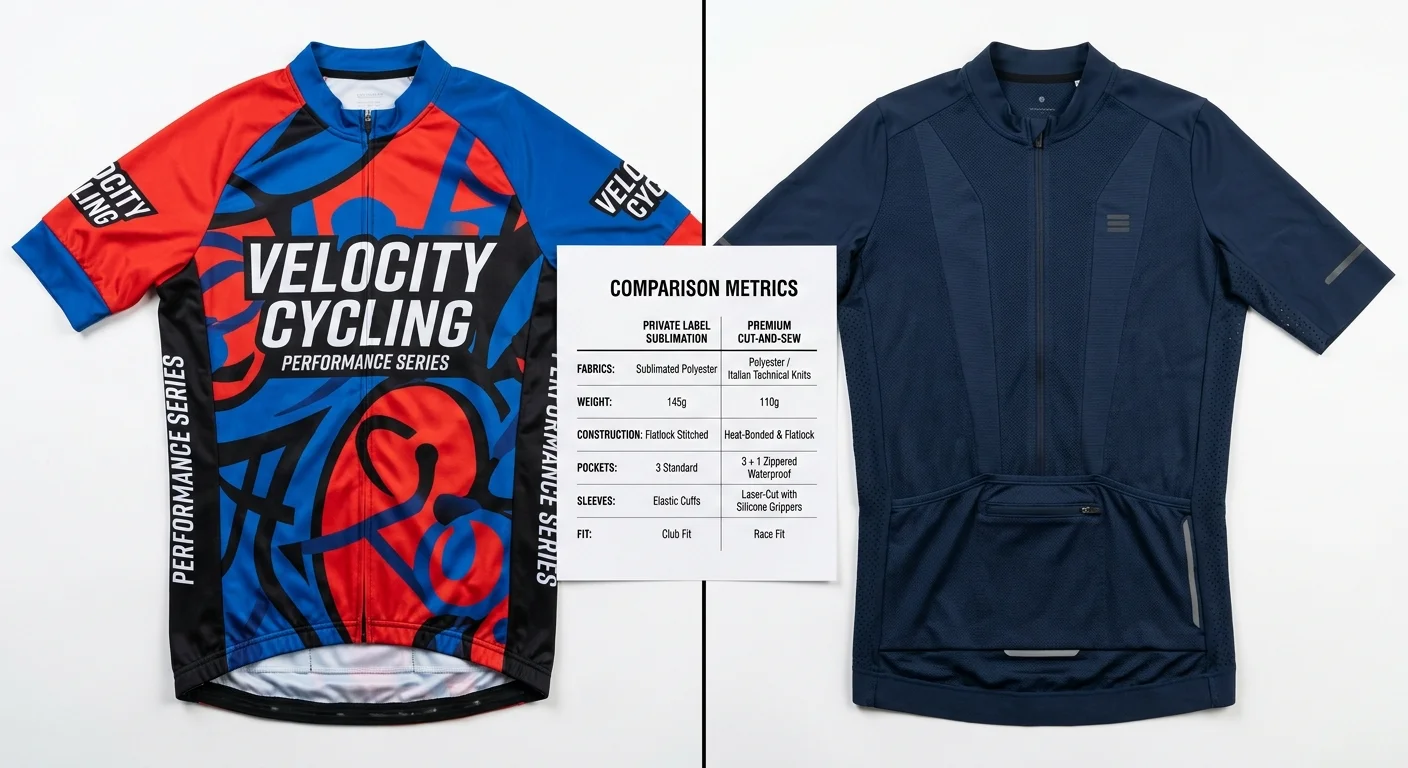
Every triathlon brand founder faces the same big question: one-piece or two-piece? It sounds simple. But look closer — production quotes, SKU counts, and cost structures all shift based on this one call.An experienced triathlon apparel supplier will often evaluate these factors differently depending on a brand's sales volume, target market, and product positioning. Your inventory strategy changes. Your target customer changes. Even your return rates change.
The tri suit one piece or two piece decision goes beyond athlete preference. It shapes your margin floors, your sell-through rate, and whether your first production run moves fast or sits in a warehouse.
Below is a data-driven breakdown of where each design wins, where it loses profit, and which product mix fits your brand's current stage.
Market Demand & Sales Volume Trends by Athlete Segment
The data tells a clear story — but only if you know which athlete segment you're selling to.
Triathlon's buyer base splits into two very different groups. Each group behaves in ways that should reshape your product mix decisions. Get this segmentation wrong, and you're either overstocking the wrong format or leaving serious margin on the table.
Performance-Tier Athletes: One-Piece Dominates
Serious age-groupers, club race teams, and sub-elite athletes racing three or more events per year control the upper 25–30% of category spend. In this segment, one-piece suits capture 65–70% of units sold — and 70–80% of total revenue value.
Why the revenue gap? Technical fabrics, minimal seam construction, and aero-engineered patterning push one-piece ASP (average selling price) well above two-piece kits in this tier.
Two-piece formats hold a 30–35% unit share here. But that share is driven by specific use cases:
- Athletes with difficult torso-to-hip ratios
- Hot-race mid-course adjustments
- Mixed sizing between top and bottom
It's a real need — just not the dominant one.
Growth outlook for this segment: Performance-tier tri suits are tracking 8–10% YoY growth , outpacing the broader activewear CAGR of 8.57%. One-piece growth sits at the upper end of that range. Two-piece performance kits grow at mid-single digits, as competitive athletes continue to consolidate into integrated suits.
Mass & Recreational Athletes: Two-Piece Takes the Lead
Flip the segment, and the numbers flip with it.
First-timers, short-course participants, and bucket-list Ironman racers are more price-sensitive. They also tend to buy through general sporting goods channels. In this group, two-piece kits account for 55–65% of unit volume.
The reason is simple: separates lower the commitment barrier. New athletes can reuse a tri top for cycling training or a tri short for running. There's no psychological risk of buying a full race suit they're not sure fits their body or their ambition yet.
One-piece suits still hold a 35–45% share here — driven by recreational athletes stepping up to their first half or full-distance race who want to "feel like a real triathlete." But one-piece share only grows at higher price points.
Growth outlook for this segment: Mass and recreational tri kit demand is tracking faster — 10–14% YoY — fueled by new participants entering the sport. Position two-piece kits as year-round performance training sets rather than race-day-only gear. That move smooths out the seasonal demand curve and cuts markdown pressure in Q4–Q1.
The Seasonal Factor Your Inventory Plan Can't Ignore
One-piece race suits follow the race calendar hard. In North America and Europe, demand concentrates in May–September . Sales velocity runs 30–45% higher during that peak race window versus the annual average. Miss your April–June allocation window, and you're discounting in August.
Two-piece kits don't spike the same way. Year-round training use, indoor cycling crossover, and repositioning as "performance fitness sets" keeps variance within a manageable ±5–10% range across quarters. That inventory predictability has real operational value — particularly for brands managing tight cash flow in early growth stages.
The bottom line for your product planning: your athlete segment determines your format mix, your growth rate assumption, and your seasonal buying strategy. These aren't abstract marketing personas — they're the numbers driving your first SKU decisions.
Production Complexity & Cost Breakdown: Manufacturing Realities
Here's a number most new tri suit brands find out too late: the difference between a one-piece and a two-piece isn't just a design choice. It's a cost structure decision that affects every production run you'll ever place.
Before you lock in your first OEM order, know where the money actually goes.
MOQ Realities: Where Capital Risk Lives
One-piece tri suits demand higher upfront commitment. Reputable Asian OEM activewear manufacturers require 300–500 units per colorway for custom cycling apparel orders, full-sublimation one-piece orders to hit competitive unit pricing. Drop below ~300 units and you face 5–15% unit price surcharges — plus separate print runs and cutting batches that eat your margin before a single suit ships.
Two-piece programs work differently. Tops and bottoms each carry their own MOQ — 150–300 pieces per component, per color. A launch order of 200 tops + 200 bottoms gives you a 400-unit two-piece program. Capital at risk is much lower than a comparable one-piece run.
Here's the operational advantage most brands miss: you can reorder tops and bottoms on their own. Size curves often differ between components — more small tops, more medium bottoms. So you're not forced to carry the same ratio across a single integrated garment. That flexibility cuts initial production commitment by 30–40% versus a one-piece program at the same size-and-color range.
Fabric Yield & Material Cost: The Numbers Behind the Quote
Fabric consumption is where one-piece suits cost more per unit — and it's easy to miss.
A standard short-sleeve one-piece tri suit uses 1.25–1.40 meters of primary tri fabric per suit. This accounts for torso panels, leg integration, side panels, and grading waste. At landed fabric costs of $4.50–$7.00/m , main fabric cost lands at $5.60–$9.80 per suit . Add mesh panels, silicone grippers, power bands, and pockets. Total raw materials for a race-level one-piece reach $9–$14 per unit at mid-volume.
Two-piece sets cut tighter. Separate tri top and short patterns nest better together. Combined yield runs 1.05–1.15 meters per set — cutting efficiency improves by 8–12% versus one-piece patterns. At $5.50/m fabric, main fabric cost per two-piece set comes in at $5.80–$6.30 .
Two-piece also gives you a cost lever that one-piece doesn't: differential fabric allocation. Spec a lighter, less expensive fabric in the top. Run premium Italian compression fabric in the short. Performance material goes where it creates the most real value. BOM cost stays in check.
Assembly Complexity & Defect Rates: The Hidden Labor Cost
One-piece tri suits are genuinely hard to build. Panel counts run 25–35 panels — torso, shoulders, sleeves, side panels, gusset, leg bands. Each suit needs multiple continuous flatlock seam runs, zipper installation, and chamois bonding. Cycle time in an efficient line: 20–35 minutes per unit .
That complexity carries a quality cost. Early-run internal defect and rework rates for performance one-pieces sit at 3.5–5.0% , averaging around 4.2% with solid process control. Misaligned zippers, torso-leg grain distortion, or pad centering errors can make the entire garment second-quality. There's no easy fix.
Two-piece assembly breaks into two shorter, simpler operations. Each piece runs 10–18 minutes . Teams can run both operations in parallel across the production floor. No torso-to-leg zipper alignment. No continuous cross-body seam runs. The internal defect rate drops to 2.8–3.1% .
That gap matters more than it looks on a spec sheet. On a $40 ex-factory cycling suit , absorbed rework cost from the defect rate difference adds $0.50+ per good unit . That either squeezes cycling apparel factory margin or lands in your COGS if you don't price it in during negotiation.
Fully Loaded Ex-Factory Cost Comparison
For a mid-tier custom triathlon suit private label program — sublimation, Italian-grade main fabric, quality pad, Asian production at 300–500 units per color:
Cost Component | One-Piece | Two-Piece Set |
|---|---|---|
Materials (fabric, pad, zippers, trims) | $12–$18 | $11–$17 |
Labor (cut, sew, bond, inspection) | $8–$12 | $8–$11 |
Overhead + printing/decoration | $6–$9 | $6–$9 |
Factory margin | $4–$7 | $4–$7 |
Total ex-factory target | $30–$46 | $29–$44 |
The raw numbers sit close. But the risk profile is different. One-piece requires a larger committed MOQ to hit those cost floors. Two-piece gives you component-level inventory flexibility, lower defect exposure, and a modular pad line where QC issues stay isolated to bottoms. Pad-related reject contribution on a high-volume recurring short SKU stays below 1% of output .
For early-stage brands: the two-piece cost structure is more forgiving. You're not putting $30–$46 per unit on the line across 400+ integrated suits in a single colorway. You're building two smaller, more manageable product lines. Reorder tops or bottoms on their own as sell-through data comes in.
Inventory Management & Operational Efficiency Metrics
SKU complexity is where most tri suit brands silently bleed margin — not at the design stage, not at production, but inside the warehouse.
One-piece suits create a very different inventory burden than two-piece sets. You need hard operational metrics to see that difference — not gut feel. That's what separates brands that scale smoothly from brands that get strangled by working capital.
SKU Count and Warehouse Load
A one-piece triathlon skinsuit in four sizes and two colorways = 8 SKUs. Simple enough. Add a sleeved and sleeveless variant, a rear zip and front zip option, and that number climbs to 32 SKUs — before you've touched a second colorway.
Two-piece sets come with their own SKU multiplication. But they carry a structural advantage. You can track, store, and reorder tops and bottoms independently . Your smalls sell out on bottoms but mediums stall on tops? You're not stuck with a single integrated unit that no longer fits your sell-through pattern. Bin-location load, pick-slot use, and storage density all get better when you manage components as separate pieces.
The Metrics That Tell You What's Working
Track these five KPIs across both formats from day one:
Inventory turnover rate by SKU — one-piece suits tend to turn slower outside peak race season (May–September); two-piece sets keep a steadier rotation year-round
Days on hand (DOH) by season — expect 90–120 DOH on one-piece suits in Q4–Q1; well-positioned two-piece programs can hold DOH below 60 across the full calendar
Return rate by fit reason — one-piece suits produce higher sizing-mismatch returns due to torso-length variance; track return reason codes by style category as two separate groups
Fill rate and perfect order rate — SKU proliferation eats into both; too many integrated size variants leads to more frequent stockouts on boundary sizes
Freight cost per unit — one-piece suits cube out larger; that adds real holding cost and per-unit freight cost that builds up across reorder cycles
The Practical Playbook
Start with fewer integrated SKUs and wider two-piece coverage. As sell-through data builds up, use EOQ modeling to set reorder quantities per component. Bundle slow-moving top sizes with fast-moving bottoms to clear fragmented stock — no markdowns needed. Set up barcode or basic WMS tracking from your first production run. Waiting until inventory complexity forces your hand costs more in counting errors and misallocation than the system itself.
The brands that win on operational efficiency don't just pick the right design. They build a measurement system around it from the start.
Pricing Architecture & Profit Margin Comparison
Margin isn't made at the point of sale — it's made at the point of product architecture. The pricing decisions you lock in now, before your first production run, determine whether your brand builds compounding profitability or keeps chasing sell-through just to break even.
Here's how the numbers stack up.
MSRP Bands & Price Ladder Positioning
Performance-tier triathlon suits in developed markets (North America, Western Europe, Australia) sit within a clear MSRP structure:
One-piece suits:
- Entry race / sprint-distance: USD 120–160
- Core performance (front-zip, short-sleeve, Italian fabric): USD 160–260
- Flagship aero / long-course with textured panels and bonded seams: USD 220–350+
Two-piece sets:
- Tri tops: USD 60–120 (sleeveless basic to short-sleeve aero)
- Tri shorts: USD 70–140 (pad and fabric dependent)
- Effective mid-market bundle: USD 140–220 combined
This price architecture isn't random. Smart brands use it as a deliberate three-rung ladder:
Entry (~USD 100–140): Sleeveless one-piece or basic two-piece set — low commitment, wide reach
Core volume (~USD 140–190): Mid-tier two-piece or solid one-piece — this is where most of your units move
Hero / premium (~USD 220–300+): Aero short-sleeve one-piece — your brand-building SKU, your highest-margin anchor
The one-piece sits at the top of that ladder. The two-piece sits in the middle — and that position is a feature, not a limitation. Two-piece kits give you a bundle pricing mechanism that one-piece can't match. A "kit & save 10–15%" promotion on tops + shorts raises average order value. You don't have to discount your flagship suit or chip away at its perceived premium.
Gross Margin Comparison: Brand Level vs. Retail Level
Here's the margin math most tri suit brands never see laid out this clearly. At mid-volume OEM (200–500 units per design, Asian production, quality pad and Italian-grade fabric):
Product | FOB Cost (mid) | Wholesale Sell-In | MSRP | Brand Gross Margin | Retail Gross Margin |
|---|---|---|---|---|---|
One-piece | ~USD 35 | USD 70–80 | USD 140–180 | ~50–56% | ~50–55% |
Two-piece kit | ~USD 44 | USD 80–90 | USD 150–180 | ~45–51% | ~45–50% |
At first glance, the one-piece looks like the margin winner. But that's the wrong conclusion — and here's why.
One-piece margin is higher in percentage. Two-piece margin is more durable in practice.
The one-piece's 50–56% gross margin only holds at full-price sell-through. Get stuck with wrong-size inventory in November, and that margin profile collapses fast. Performance race suits with seasonal colorways or sponsor graphics carry near-zero carryover value once the next design drops. Clearance depth of 25–40% is common for specialized tri SKUs that don't sell through completely. A 30% markdown on a 52% initial margin leaves you with around 20–30% net realized margin on those leftover units.
Two-piece sets hold their value in a different way. Your size curve will break — expect more demand for M tops and more L shorts. Two-piece lets you respond with precision:
- Discount excess tops at ~20% in the off-season
- Hold core black or neutral shorts at or near full price with minimal promotion (≤10%)
- Rebundle shorts from the current season with updated tops next cycle
That flexibility is real, compounding financial value. Across a full season, two-piece programs show 15–18% higher realized gross margin than one-piece programs. Not because the sticker margin is higher — but because write-off exposure is lower and average discount depth is shallower.
The AOV Multiplier: Where Two-Piece Has the Edge
There's a second margin lever that doesn't show up in any production quote — basket behavior at the point of purchase.
One-piece buyers arrive with high intent and a clear goal: buy the suit, done. The basket already "feels expensive" at USD 160–250. Accessory attachment — arm warmers, race belts, compression socks, visors — runs 10–15% lower than two-piece orders. The suit reads as a complete solution. There's no obvious next step.
Two-piece buyers think differently. Buying a top and shorts as separate items creates a natural "build your kit" mindset. That open mental frame makes it easier to add arm sleeves, calf compression, an extra training short, a race belt, or a sun hat. DTC brands running modular kit structures see 20–25% higher average order value from two-piece customers — driven by both the two baseline line items and stronger accessory attachment rates.
Accessories often carry 50–70%+ gross margins . That attached basket revenue is the highest-efficiency dollar in the entire transaction.
The Sleeved One-Piece Exception: Your Highest-Dollar SKU
One configuration deserves a direct callout: the short-sleeve one-piece aero triathlon suit.
Sleeved suits command 10–25% higher MSRP than sleeveless equivalents at the same brand tier. The OEM cost difference is just USD 4–8 higher at FOB level — but the MSRP gap opens to USD 20–40 . So your gross profit per unit is higher on sleeved suits, even if the percentage margin is similar or slightly lower.
For brands targeting performance age-groupers through a DTC channel, the short-sleeve one-piece is the highest total dollar margin SKU in your entire lineup. It's also your strongest brand storytelling vehicle — the product that backs up aero testing claims, pro-athlete references, and premium positioning that lifts the entire assortment.
Pricing Strategy by Brand Stage
Early-stage brand (first 1–2 seasons):
Build your price ladder around a core two-piece program at USD 60–75 top / USD 65–80 shorts , marketed as a "modular race system." You get full-price holding power on shorts, promotional flexibility on tops, and accessory upsell structure from day one. Keep one-piece SKUs limited — one sleeveless entry option at USD 120–140 covers that buyer segment without overcommitting production capital.
Growth-stage brand (established sell-through data, 3+ seasons):
Bring in a hero short-sleeve one-piece at USD 180–240 as your margin anchor and brand-positioning flagship. Use it to raise perceived brand authority. Let the two-piece program handle the volume work below it. This tiered structure — modular workhorse + premium hero — is the same pattern Zone3, Orca, and 2XU use at scale. It works because it captures both buyer psychology segments. You don't have to choose between them.
Brand Positioning & Optimal Product Mix Strategy
Three brand archetypes dominate the triathlon apparel market. Each one needs a different product mix. Get this wrong, and you're not just leaving margin on the table. You're building a product line that works against your own positioning.
Here's the framework that works.
Performance Racing Line: Own "Fastest on Race Day"
Your product mix target here is 80% one-piece / 20% two-piece in both units ordered and marketing spend.
This isn't an arbitrary ratio. It reflects buyer psychology at the performance tier. Serious age-groupers and sub-elite athletes buy one-piece aero trisuits because wind tunnel data backs them up. A well-fitted one-piece generates ~3–8 W of drag savings at 40 km/h versus a comparable two-piece. That translates to 60–90 seconds gained on a 90 km bike leg. That's a real number. Use it.
Your flagship SKU should be a long-sleeve aero trisuit with bonded sleeves and front zip . Go with seam-minimized construction and hydrophobic surface treatment. Target under 5% water absorption after immersion. Keep garment weight at 180–230 g for men's size M . That weight spec alone signals race-day intent — before anyone reads a single product description.
Price the hero one-piece at 1.6–2.3× your mass-market line . Think USD 280–450. That's consistent with what Zone3 and Orca anchor at the top of their performance ranges.
The 20% two-piece allocation still matters. Build it with identical fabric and chamois specs as your one-piece. Customers picking the two-piece here are making a fit decision — not a performance trade-off. Make sure the product reflects that.
Mass & Recreational Line: Volume Through Versatility
Flip the ratio. 70% two-piece, 30% one-piece — and the two-piece is your workhorse, not your afterthought.
Your primary buyer here is the new triathlete. They enter through sprint races, camp programs, or charity events. Two-piece kits lower their commitment barrier. They reuse the top for cycling training. They pair the short with different tops. At their race distances, a quality two-piece covers all the performance they need.
Prioritize:
- Quick-dry construction : 120–160 gsm moisture-wicking blends, dry-to-touch within 20–30 minutes post-swim
- Fit tolerance : longer inseam options (7–9" men, 6–7" women), higher front necklines, optional removable padded bra for women's tops
- Sleeveless as your entry SKU , short-sleeve as a natural upsell — position it as "sun protection + more pro-looking"
For the 30% one-piece allocation, use simplified panel construction with fewer exotic fabrics. Price it at 1.3–1.6× two-piece kit MSRP . Label it as the "race-ready upgrade for athletes on their second or third event." That framing converts customers already in your ecosystem. They won't need to benchmark against your premium line.
For retail and camp distribution, standardize two-piece colorways across XS–3XL size runs . Offer a 10–15% bundle discount on top-and-short purchases together. That raises AOV without touching your one-piece margin structure.
Team & Club Custom Line: Stable B2B Revenue Through Smart Defaults
The cycling team wear custom channel runs on a different logic. List 50% one-piece / 50% two-piece in your catalog — but expect shipped volume to land around 70% two-piece / 30% one-piece once real club orders roll in.
Why? Club organizers handle dozens of athletes with varied body types and racing distances. Two-piece kits cut their sizing risk. Separate top and bottom sizing means fewer returns and less inventory headache for whoever runs the order. Build your default club package around two-piece as the standard. Position one-piece as a premium upgrade for relay specialists, long-course athletes, and top club competitors.
MOQ structures that close club deals:
- Two-piece: 20–30 sets per design per season via digital sublimation
- One-piece: 10–15 units per design (higher ASP justifies the smaller run)
Offer semi-custom cycling apparel template programs — clubs swap colors, logos, and text on a fixed panel layout. This cuts pattern development time and brings lead time to 4–6 weeks from artwork approval . For clubs ordering 100+ units per year, add inside-neck private label branding as a relationship lock-in. Tiered B2B pricing at 40–55% off MSRP , based on volume and payment terms, closes the deal without a drawn-out negotiation.
The Brand Stage Decision: What to Launch First
Early-stage brands (seasons 1–2): Start with 3–4 men's and 3–4 women's two-piece kits — sleeveless and short-sleeve variants. Keep one-piece SKUs to a maximum of 1–2 options. This isn't timidity. It's a smart move. Two-piece gives you fit data across body types, cleaner return tracking by garment part, and smaller size-run MOQs that protect cash flow. Unsold tops and bottoms can still move as separates. An unsold one-piece in the wrong size can't.
Growth-stage brands (season 3+): Move 500–1,000 units first. Build 12–18 months of real fit and returns data. Then launch your flagship one-piece as a PR event . "Wind-tunnel tested. Race-day only. Limited colorways." Use pre-orders with deposits for production that doesn't strain cash flow. Put 60–70% of your marketing budget behind that hero suit in its launch window. Let it anchor your pricing — a USD 380 aero trisuit in your lineup makes a USD 200 mid-range suit look like a solid deal rather than a big spend.
That sequencing — two-piece foundation first, one-piece halo second — is the same growth arc that built Zone3 and 2XU into category leaders. The product mix strategy isn't about picking a winner between one-piece and two-piece. It's about knowing which format does its job best for your brand at each stage.
First-Order SKU Planning & Risk Mitigation Framework
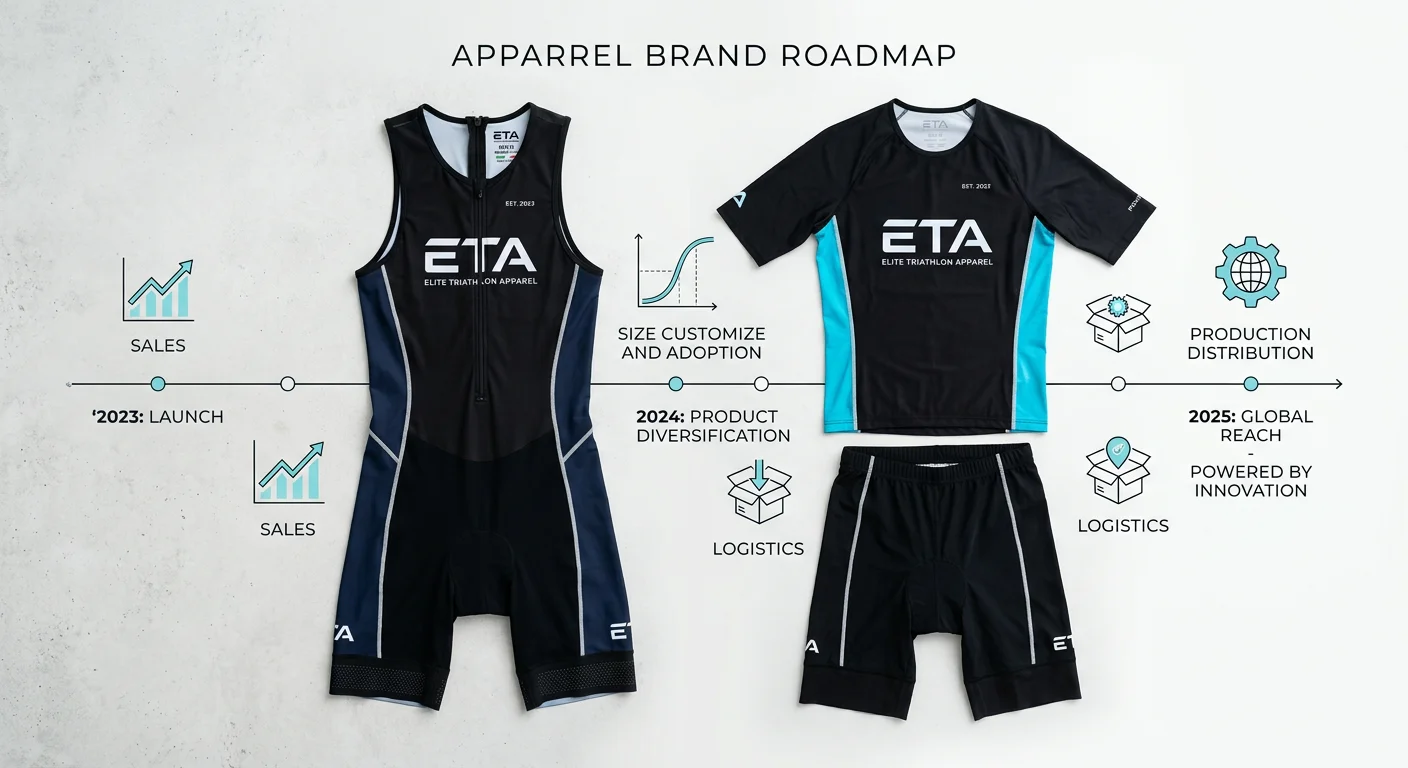
Most triathlon brands don't fail because they picked the wrong design. They fail because they overbought the wrong sizes, skipped wear testing, and had no reorder logic when sell-through data came in.
Here's the framework that fixes that.
Budget Allocation: Where Your Opening Inventory Capital Goes
Split your first production budget with one clear rule: two-piece carries the volume, one-piece earns the attention.
A risk-balanced opening order looks like this:
65% of inventory budget → two-piece core colors (black, navy, charcoal). These are your workhorse SKUs — high sell-through, low fashion risk, easy to customize for team orders. Core neutrals drive 60–80% of performance apparel units across the board.
35% of inventory budget → one-piece hero suit . One colorway, with high-visibility panels. This SKU is for content, ambassadors, and race-day exposure — not volume. Its job is to elevate brand perception and justify your pricing tier.
Cash is tight? Channel fit still unproven? Drop the hero one-piece allocation to 25–30% and use made-to-order for club branding on your two-piece core.
Size Curve: Front-Load Proven Size Bands
Don't spread inventory evenly across sizes. Triathlon buyers in North America and Western Europe cluster in the middle of the curve.
Men's / unisex two-piece tops and shorts:
- S: 20%
- M + L: 50% (split 25/25)
- XL + XXL: 30% (20% XL, 10% XXL)
One-piece suits need extra attention. Torso-length variance pushes return rates 5–10 percentage points higher than two-piece separates. Add 10% incremental units in short and tall variants on your best-selling size bands — for example, 5 units of M-short and 5 units of L-tall on a 100-unit run. Keep length variants at 10% of total one-piece order in season one. Expand once demand confirms itself.
For women's, shift 5–10% out of XL/XXL into S/M if your channel skews smaller. For US markets with higher average BMI, move +10% into XL/XXL and tall variants.
Pre-Bulk Wear Testing: Your Last Line of Defense
Never release a bulk PO without structured wear testing. Pad issues, fit problems, and zipper failures get caught here — before they turn into return rates and angry reviews.
Test on at least 3 male and 3 female body archetypes:
1. Lean endurance build — BMI ~20, typical long-course athlete
2. Muscular/stocky build — BMI ~24–26
3. Torso outlier — ±2 size-equivalents in torso length versus your size chart
Each archetype tests both formats, at minimum two adjacent sizes. Run a 1–1.5 hour brick workout to simulate race conditions.
Pass/fail thresholds — no exceptions:
- Reject or modify if >20–25% of testers report seam blowout, chafing at neck or inner thigh, or suit rolling at leg grippers
- Reject pad spec if >30% of testers say the chamois interferes with run stride
- Run one full PP sample round after corrections. Then do a 30–45 minute validation ride before releasing bulk
Reorder Logic: Thresholds That Remove Guesswork
Set your triggers before launch. Don't wait until you're staring at half-empty shelves.
One-piece hero suit:
- ≥80% sell-through within 6–8 weeks → reorder approved
- 60–80% sell-through by week 8 → reorder top two sizes (M and L)
- <60% by week 8 → no reorder; bundle with accessories or offer team/club pricing to clear inventory
Two-piece core SKUs:
- Keep rolling production with your triathlon clothing OEM once base demand is confirmed
- Target 25–30 day lead time on repeat core colors with pre-positioned fabric
- Adjust POs ±20–30% each month using pre-order data, club order pipeline, and ambassador feedback as leading indicators
To manage OEM MOQ risk on 300–500 unit minimums: hold greige fabric in black/navy and cut across both formats. Negotiate split deliveries — 60% upfront, 40% at a 60-day sell-through checkpoint.
Season-End Adjustment Gate
Your first season exists to generate data, not just revenue. At the close of season, use SKU-level sell-through and return reason codes to update three things:
Size curve — shift 5–10% into sizes that keep underselling or overselling
Budget split — one-piece sell-through and margin beat your two-piece? Move from 35% to 40–45% hero allocation next season
Underperforming inventory — route slow SKUs into team/club bulk pricing first, then off-price after 6–9 months
The brands that grow margin season over season aren't guessing on sizing or reorder timing. They build a measurement system in season one and let the data make the call.
Conclusion
The data doesn't lie — and neither does your inventory spreadsheet.
Leading with a one-piece aero triathlon suit or building your line around two-piece flexibility — this is not a gut-feel decision. It's a math problem with a market layer on top. One-pieces command premium pricing and dominate the competitive racing segment. But two-pieces win on SKU manageability, lower return rates, and the cross-sell revenue most emerging brands leave on the table.
Here's the real picture: no single-design product line scales well . The brands winning in triathlon clothing OEM today aren't picking one-piece vs. two-piece. They're sequencing them. Start lean with two-piece to validate your market and protect cash flow. Then layer in your signature skinsuit once you have customer data to back the investment.
Stop guessing which design sells. Take the framework from this article and run with it. Reach out to your manufacturing partner. Turn that decision into a product roadmap that moves real units.
Your competitors already did.