You've got a quote for 20 custom cycling jerseys . Another team just told you they paid way less for 50. So where's the line between overpaying and getting the factory rate? Most cycling club managers guess their way through this. They either over-order to "be safe" or under-order and get stuck with a bloated per-unit price. Bulk jersey pricing isn't linear, and it isn't random either. It's built around specific quantity breakpoints that most suppliers won't volunteer upfront.
This breakdown walks you through real factory price ladders for orders of 10, 25, 50, and 100 jerseys. You'll see why those numbers matter, and find the MOQ zone that fits your club — whether you're outfitting 8 riders or coordinating a 100-person event kit. You'll also get negotiation scripts to lower your unit price without padding your order for no reason.
The Real Bulk Pricing Thresholds: 10 vs. 25 vs. 50 vs. 100 Jerseys
Your per-unit price on cycling jerseys drops when you order 10, 25, 50, or 100 units. Cross one of those thresholds and the price drops. Stay just below it and you pay retail-adjacent pricing for no good reason.
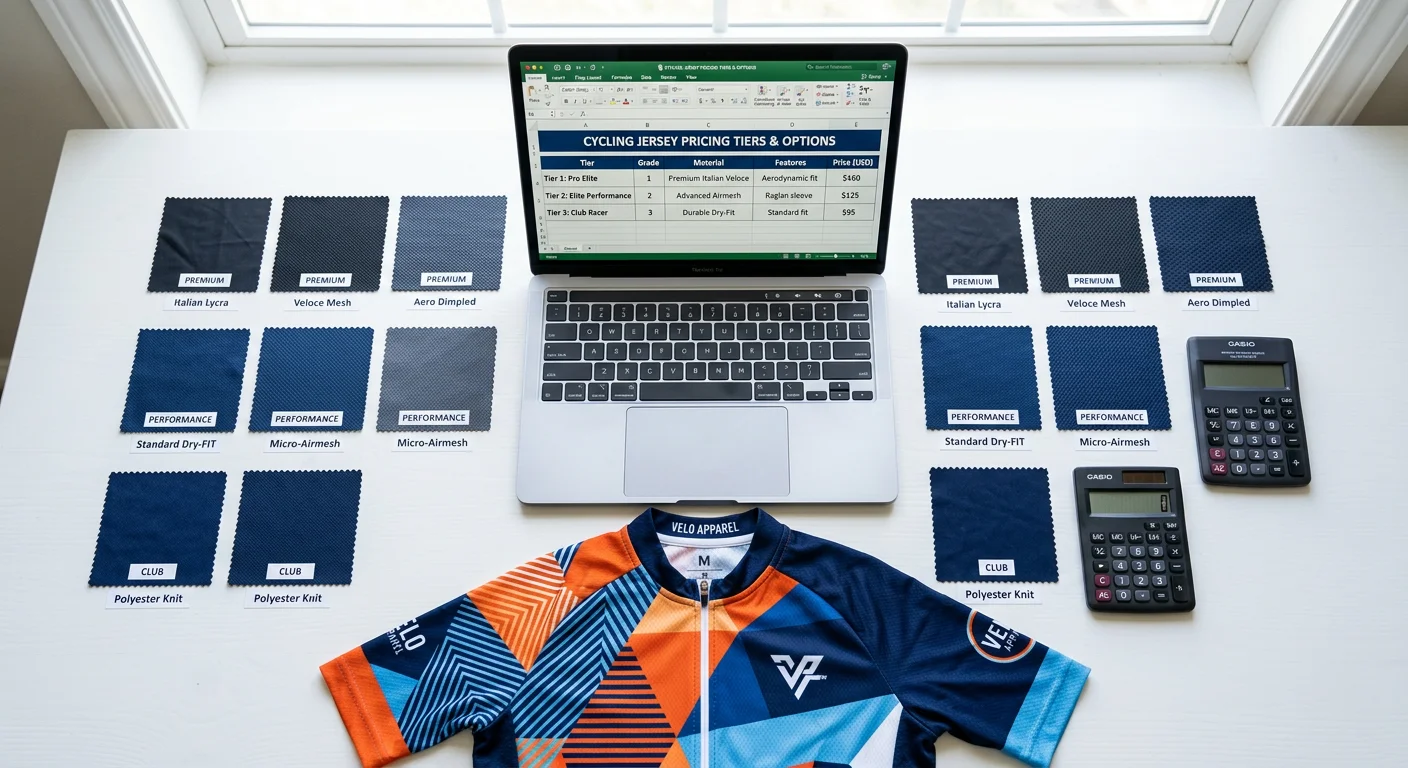
For custom sublimation cycling jerseys, the price breaks are 10-24 units at $28.99 per cycling jersey, 25-49 at $24.99, 50-99 at $21.99, and 100-249 at $18.99. That is a 34% price drop between ordering 10 and ordering 100. Not a rounding error.
A second supplier's pricing on sublimated jerseys follows the same pattern, just starting lower. They charge $15 for 10-25, $13 for 26-50, $12 for 51-100, and $10 for 101-250. Same pattern, different price floor.
The 25-unit mark is the first meaningful discount. Below that you are paying sample pricing. Cross 25 and factories treat you as a real bulk order worth adjusting print runs and fabric cuts for.
50 units is where the real savings kick in. Most cycling club uniforms hit their sweet spot at this threshold. You are ordering enough that the factory optimizes labor scheduling around your batch.
100 units gets you true wholesale pricing. Depending on fabric weight and customization complexity, per-jersey cost can land anywhere from $18.99 down to $10, sometimes lower on overseas manufacturer runs.
Know which zone your roster falls into before you request a quote.
Why 25, 50, and 100 Are the Critical Breakpoints (Not Just "More Is Cheaper")
Most buyers don't see that these numbers are baked into how factories structure production, payment, and packing — long before your quote hits your inbox.
Take block pricing. Many custom cycling jersey manufacturers price in increments of 100, not per unit. So 99 jerseys count as a “partial block” — you get charged closer to full-block rates for less product. Order 100, and you've hit a satisfied block. Your unit cost recalculates instantly. That's why 100 is a hard operational line, not a soft suggestion.
Payment terms shift here too. Orders in the 25-to-50 unit MOQ range typically require 100% prepayment. Cross into 100+ units, and many suppliers drop that to a 50% deposit. That's a real cash-flow difference for club treasurers, and it's tied directly to order volume, not how well you negotiate.
Case-pack planning explains the rest. Apparel factories often build size mixes around pack totals of 25 or 50 — that's how cutting tables and print runs get scheduled efficiently. Order outside those totals, and you force a partial run, which the factory prices accordingly.
25, 50, and 100 aren't marketing thresholds. They're where cost structure, payment risk, and production logistics all reset at once — which is exactly why your unit price jumps at those exact points.
Small Clubs (Under 10 Riders): Real-World Ordering Strategy
Nine riders should look for a supplier who doesn't force a 50-unit minimum. Many small clubs get burned by chasing bulk pricing tiers designed for teams triple their size.
Target MOQ cycling apparel suppliers built for tiny rosters instead. YKYWBIKE accepts orders as low as 10 pcs. Monton Sports runs a 15-unit minimum, 3-4 week lead time, and 50% deposit. ICM Factory Direct (Vietnam) drops to 25 units. If nobody hits your number, treat 50 pcs as the fallback industry standard and pad it.
To pad it without wasting money:
- Bundle jersey, bib shorts, training tee, and supporter polo under one artwork run
- Mix all rider sizes into a single production batch
- Add spares (2-3 extra units) to clear MOQ thresholds
- Ask if training tees can count toward the same jersey artwork run — some custom cycling jersey manufacturers allow this
Before committing, ask about sample cost, per-color MOQ, and reorder minimums. GenXport waives minimums entirely on repeat orders once your design's on file, which is critical for mid-season replacements.
Medium-Sized Clubs (20–50 Riders): The Sweet Spot Zone
Twenty to fifty riders is where bulk cycling jerseys pricing starts working in your favor. This range isn't arbitrary. It's the same band most clubs use to structure rides in the first place. One club source caps expected turnout at 15–50 riders, and a large club event example limits rides to 20 participants before splitting into two smaller groups.
That splitting pattern matters for your order too. Cycling group rules commonly force sub-groups once riders exceed 6 or 8, spaced 50–100 yards apart for safe overtaking. If your club already runs multiple pace groups, you're managing multiple ride leaders, and that's the headcount that should push you toward the 25-unit or 50-unit pricing tier, not just your active roster.
A club onboarding 20 new riders sits right at the 25-unit breakpoint once you add 2–3 leaders and spare jerseys. A club scaling toward 50, treated by one major cycling organization as a manageable single-cohort ceiling, should order at the 50-unit tier outright.
Practical sizing rules for this zone:
- 20–24 active riders → order 25 units, absorb leaders/spares into the tier
- 30–40 riders → still order 50, the price-per-unit gap justifies padding
- 45–50 riders → order 50, you're at the ceiling for optimized labor scheduling
Don't order 22 or 44 jerseys. You're paying tier prices for a partial batch either way; round up to the breakpoint instead.
Large Teams and Event Organizers (50+ Riders): Maximizing the Price Floor
Fifty riders changes how you buy. At this point you stop shopping for a discount and start negotiating factory-direct pricing. The numbers swing wide: $28.99/unit on a low-cost bulk offer, $44.00/unit for a branded club program, or as low as $12–$14/unit entry-level up to $36–$45 for race-tier fabric at a factory-direct 50-piece run.
Run the math on a 50-person roster and the gap gets real. You're looking at about $1,450 at $28.99 each, $2,200 at $44 each, or $600–$700 at the cheapest factory-direct entry tier before shipping, taxes, or decoration fees. Same headcount, triple the spend range.
One club program illustrates why this matters. At 50 jerseys, their algorithmic bulk price landed at $56.73/unit. A straight bulk-rate quote from a different supplier came in at $44.00. Tiered reward math doesn't always beat flat bulk pricing once you cross 50 units. Always request both.
Stretch Your MOQ Further With Mixed Sizing and Multi-Design Runs
Several custom cycling jersey suppliers count mixed sizes toward one MOQ. Example: 15 S + 20 M + 10 L + 5 XL = 50 total pieces, still one production run, one price tier.
Running home and away kits? Some vendors set the MOQ per design. Order 30 home plus 30 away, and you can hit two separate 50-piece thresholds. That doubles your kit variety without losing bulk pricing.
Budgeting rule of thumb: plan for $30–$45 per rider at 50-piece scale for solid sublimated jerseys. Premium race kits push $55–$95 each.
Manufacturer Price Ladder Comparison (Real Factory Data)
Not every custom cycling jersey manufacturer prices the same way. The model behind your quote, OEM or ODM, changes your entire cost structure before you even talk quantity.
OEM (your original design, factory builds it from scratch) usually comes with upfront tooling or setup fees ranging from $10,000 to $50,000+ for complex products. ODM (shared templates, factory modifies existing patterns) drops that setup cost to $1,000–$10,000 . Cycling jersey factory direct suppliers work the same way. Full custom cut-and-sew with original patterns costs more to set up than sublimation printing on an existing jersey block.
A comparable garment example makes this concrete. A linen midi dress runs $18.50–$24.00 per unit under OEM at 60 pieces , dropping to $13.50–$17.00 at 300 pieces . The ODM version starts lower, $16.00–$21.00 at 60 pieces , falling to $11.50–$15.00 at 300 pieces . Same garment category, same volume jump, but ODM undercuts OEM by roughly 10-15% at every tier because there's no pattern development cost baked into your unit price.
Apply that logic to your cycling jersey unit price breakdown. If your custom cycling apparel supplier quotes a fully original cut with custom paneling, expect OEM-style setup costs layered on top of your per-unit rate. If they're using an existing block pattern and just running your artwork through sublimation, you're in ODM territory — lower setup, lower floor price, faster turnaround.
Ask suppliers directly which model they're quoting. It explains why two wholesale sportswear pricing sheets for the same headcount can differ by hundreds of dollars before a single jersey ships.
runcyclingapparel.com
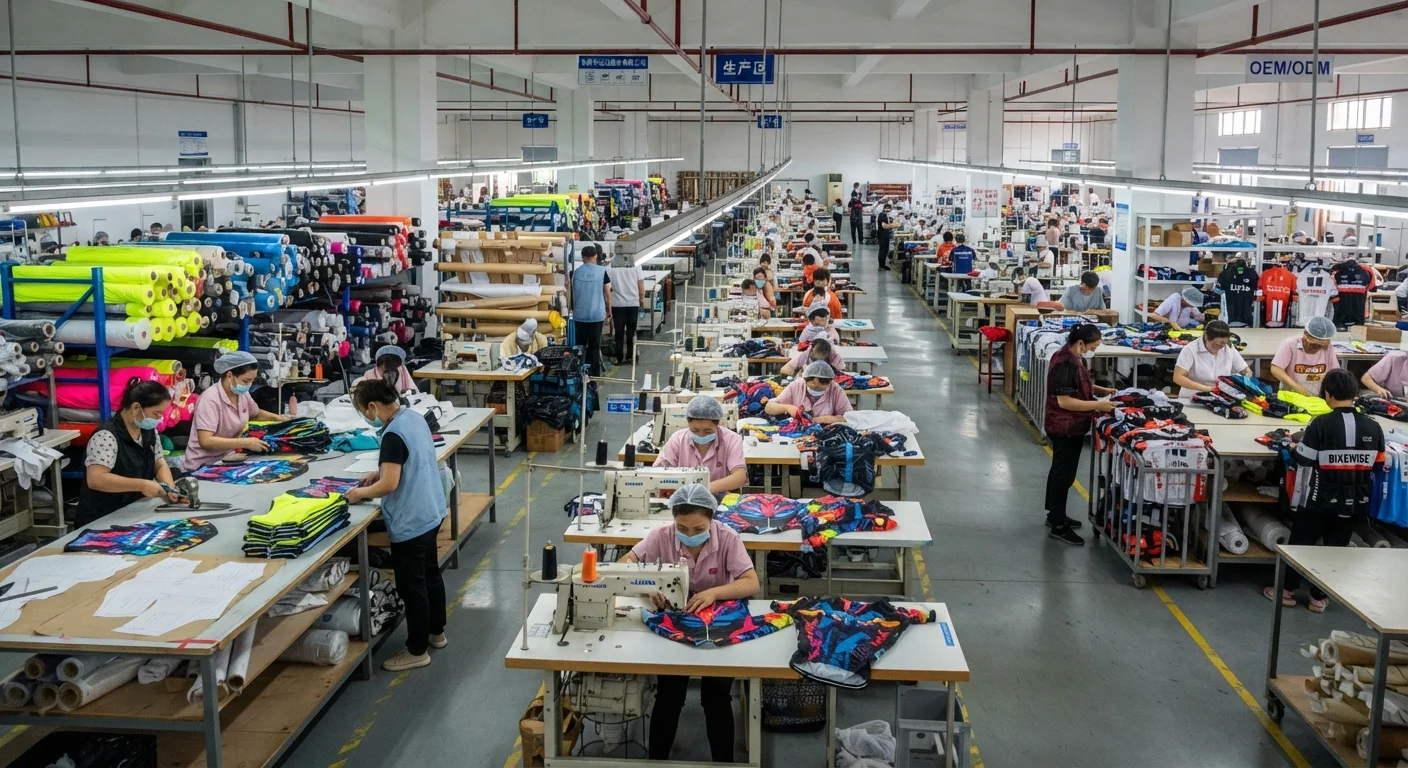
Run Cycling, based in Dongguan, has been running OEM/ODM cycling kit production since 2009. That 15-year track record shows in how tightly they lock their MOQ. Fifty pieces, flat, no exceptions on the wholesale page. That's your floor for custom cycling apparel here.
Pricing lands at $45–$65 per unit for mid-grade kits using their Italian-sourced 200–250gsm poly-elastane fabric with UV50+ and anti-odor treatment. Want a bundled Pro Endurance bib shorts and aerodynamic race jersey combo? That runs $100–$150 per set.
Production takes 20–30 days, but they'll ship a sample via DDP in 7 days first. Lock your design before committing to the full 50-unit sublimation printing run.
The Hidden Discount: Combining Jerseys with Shorts & Bibs
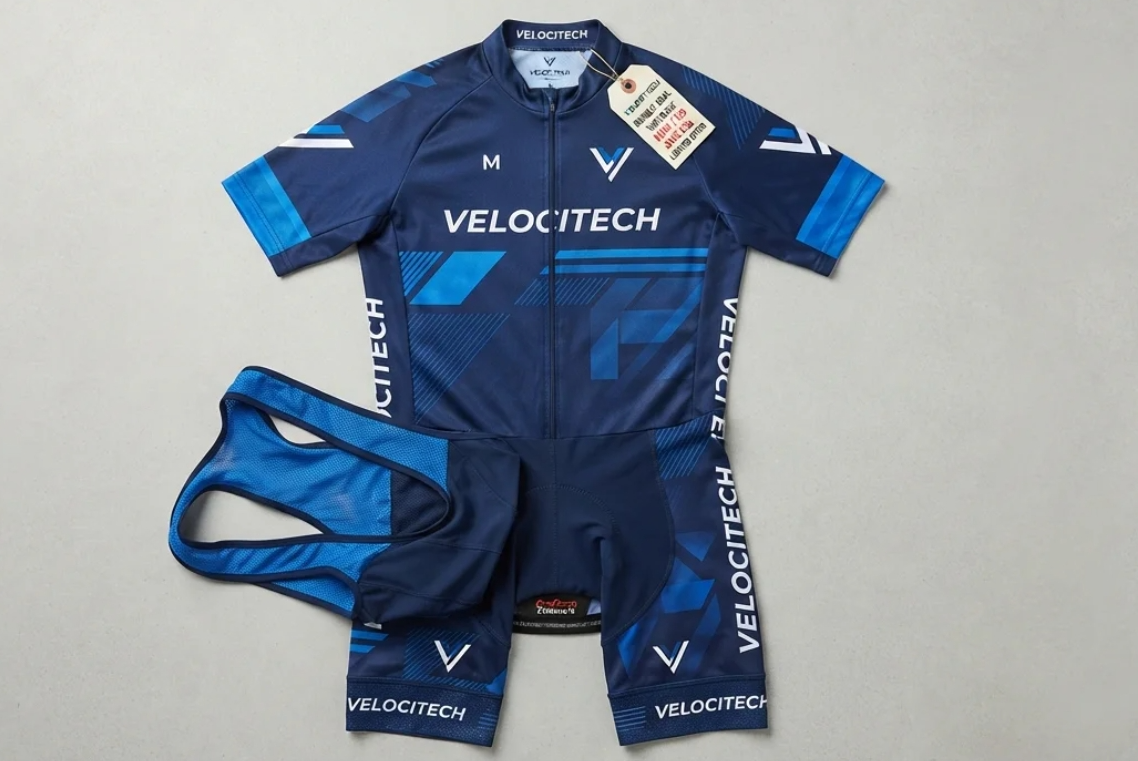
Bundling jersey + bib shorts is standard practice across cycling brands, and the savings run 15%–20% off the combined price. Often that discount beats hitting a quantity breakpoint. One retailer applies a flat 20% discount the moment any jersey pairs with any bib of matching gender in a single order. Automatic at checkout, no code needed.
A GCN Core 2.0 jersey + bibshorts bundle lists at £107.98. A three-piece jersey + bib + socks set sells for €200 against a stated €225 retail price — roughly 11% off. Add socks or a cap and some pages advertise up to 30% savings depending on SKU mix.
The same logic works wholesale. Factory-direct suppliers set MOQ at 50 pieces per style, with size mixing allowed inside that run, then step pricing down again at 200, 500, and 2,000 pieces. Bundling shorts into your jersey order stacks a second discount layer on top of your quantity tier.
How to Negotiate with Suppliers: 3 Proven Tactics to Avoid Overpaying
A quote is a starting offer, not a final answer. Most club managers accept the first number a custom jersey manufacturer sends because they don't know what levers exist. Here's what does.
Tactic 1: Force Competitive Bidding Before You Talk Price
Get quotes from at least 3 suppliers on the exact same spec: same fabric weight, same Incoterm, same lead time, same payment terms. Competitive bidding delivers 5–15% cost savings over sole-source quoting, and well-run RFQs can push that reduction to 20% . If you're stuck with one familiar cycling jersey factory direct contact, you're likely paying 8–15% above market rate . Structured, side-by-side quoting typically brings that down 8–12% .
Tactic 2: Negotiate the Full Package, Not Just Unit Price
Unit price is the least flexible number on the sheet. Payment terms move more. Push for Net 30 or Net 45 instead of full prepayment, or split payment 35% after pre-shipment inspection, 35% after loading . On MOQ, ask for tiered pricing by volume , mix-and-match SKUs , or a rolling forecast with quarterly releases instead of one lump order.
Tactic 3: Restructure the Order to Lower Real Cost
Cutting colors cuts setup fees. Five colors at 200 units each often gets renegotiated down to 200 minimum per colour when you consolidate. A $500 setup fee works for roughly 40% of factories in exchange for dropping MOQ from 500 to 200.
Script to use directly: "We value the relationship, and we also need market-rate pricing. Here are comparable quotes and our forecast. What can you do on price, MOQ, and payment terms together?"
Conclusion
Pricing on bulk cycling jerseys has breakpoints at 25, 50, and 100 units. Each jump unlocks a lower unit cost because it corresponds to a real production efficiency gain. If you're a small club under 10 riders, don't chase discounts you can't reach – pool orders with a partner team instead. Mid-sized clubs in the 20-50 range are in the sweet spot, where negotiating leverage matters most.
Before you sign anything, pull out the price ladder from this article, plug in your rider count, and run the math yourself. Then use the negotiation scripts to push your custom jersey manufacturer toward the next tier instead of accepting their first quote. Knowing your number beats guessing every single time.