Flip over a Castelli jersey, and the collar tag tells the real manufacturing story. Production varies across several countries depending on whether you buy a €250 race suit or a €60 entry-level jersey. We checked labels across popular models, cross-referenced official Castelli statements, and compared what riders report pulling out of the box. The results show which pieces are still made in Italy and which ones rely on reputation alone.
Castelli’s Italian Ownership Is Not Proof of Italian Manufacturing
Owning a brand and manufacturing its products are two different things, though marketing often blurs the distinction. A company can keep its headquarters in Bergamo while stitching garments in a factory thousands of miles away.
Castelli is not even a single corporate entity. Several businesses operate under the name:
Castelli Milano 1938 S.p.A. traces its heritage to Bergamo and markets its collections as award-winning Italian design.
Castelli Milano advertises "100% Designed And Made In Italy," stating a clear manufacturing location rather than relying on a heritage story.
De Castelli S.r.l. is a separate metalworking company based in Crocetta del Montello, with 63 employees and €10.17 million in 2024 turnover.
CASTELLI SAS is an unrelated French food-and-beverage manufacturer in La Ciotat, founded in 1991.
None of this proves anything about the cycling apparel sitting in your cart.
What Italian ownership never confirms:
Which country assembled your specific jersey or bib shorts
Where the fabric or chamois pad was sourced
Whether every SKU in the lineup shares the same factory
Whether "Italian heritage" replaces a real country-of-origin statement
Before trusting the premium price tag, check the garment tag, the invoice, and the packaging for an origin mark. Match that to a named legal entity. Heritage claims like "crafted in Bergamo" apply strictly to the business making them; they do not cover every product carrying the Castelli name. For reference, these details vary across different Italian cycling apparel manufacturers .
Where Castelli Cycling Clothing Is Actually Made
Trace the corporate paperwork back far enough, and you reach Manifattura Valcismon S.p.A. The company owns Castelli under the MVC Group, with headquarters at Via Marconi 81/83 in Fonzaso, Belluno, Italy. That address is documented and verifiable, making it one of the few confirmed facts in the brand's production trail.
Castelli moved its operations to Fonzaso in 2003 after joining Manifattura Valcismon. Before that, the brand traced its roots to Vittore Gianni, a Milan tailoring house founded in 1876. That history is real, though a brand's heritage does not indicate where current garments are produced.
The operational details show a clear division:
Fonzaso serves as the design hub, distribution center, and corporate headquarters for high-performance cycling apparel.
Manifattura Valcismon never states in corporate materials that every garment is cut and sewn in Fonzaso.
"Design in Italy" and "made in Italy" represent two different standards, even when marketing copy blurs them.
Industry peers follow the same pattern. Premium cycling labels routinely pair Italian design studios with outsourced manufacturing across multiple countries. Castelli operates under that same model, so verify the country on the label rather than making assumptions.
A practical checklist before you buy:
Read the sewn-in care and origin label for the exact country name.
Note the product code, season, and size, because production locations can shift between manufacturing runs.
Ask a cycling apparel OEM ODM manufacturer for a photo of the origin tag before ordering in bulk.
Treat "Italian brand," "designed in Italy," and "made in Italy" as three separate claims.
Do Castelli’s Race, Premium, and Entry-Level Lines Come From Different Countries?
A tidy three-country breakdown would be convenient, but production is messier. Castelli does not split its factories cleanly between race kits, premium pieces, and entry-level jerseys. Manufacturing runs batch by batch across a global supply chain, with design work centered in Italy and assembly handled in several countries, often through established Italian cycling kit manufacturers .
Race line: Castelli highlights wind-tunnel testing and WorldTour construction for its Race-Day collection. Even so, product listings never claim that every race garment comes off an Italian sewing table. The tag sewn into your jersey confirms where it was made.
Premium tier: Castelli specifies Italian fabric for the Puro 4 Jersey and Puro 4.1 Jersey. That claim applies strictly to the textile, while garment assembly follows a separate production chain.
Entry-level: Castelli assigns no single country to budget gear. Sourcing records show production distributed across Italy, the U.S., El Salvador, Moldova, and China.
Product tier | Verified fact | Sourcing reality |
|---|---|---|
Race | Italian R&D, no universal origin claim | Varies by SKU |
Premium | Italian fabric in select jerseys; U.S. facilities reported | Italy plus overseas |
Entry-level | No dedicated country | Broad global sourcing |
Castelli's U.S. branch reportedly sources roughly 25% of high-end shorts and jerseys from a factory in Washington State. A higher price tag does not guarantee Italian production. Other listings specify "Made in Europe," which covers multiple nations outside Italy. Check the sewn-in label before assuming where a garment was made based on price alone.
Three Popular Castelli Models to Check Before Buying
Price alone tells you nothing about where a garment was stitched together. These three bestsellers show that clearly. Each sits at a different price point, serves a different season, and uses a distinct fit.
Espresso 2 Bibshort runs about $200 with a tailored cut built for 15–35°C riding. It works well as a daily training short for long summer miles. The tailored cut sits looser than a race fit, so riders between sizes should check Castelli's size chart before buying.
Perfetto 4 Jacket costs roughly $330 , designed for 4–12°C and damp, shifting weather. This is dedicated cold-season outerwear. Riders who train mostly above 12°C will get more mileage from a lighter layer.
Classement Aero Race 8.1 Jersey lands at $250 with a true race fit for 18–35°C . It is cut tight for aerodynamics and leaves little margin if your build does not match the cut.
Model | Price | Fit | Temperature | Best for |
|---|---|---|---|---|
Espresso 2 Bibshort | $200 | Tailored | 15–35°C | Everyday summer riding |
Perfetto 4 Jacket | $330 | Tailored | 4–12°C | Cold, changeable weather |
Classement Aero Race 8.1 | $250 | Race | 18–35°C | Racing, aero positioning |
None of these listings specify a country of origin upfront. Check the sewn-in tag on the garment before the price tag convinces you where it was made.
What Castelli’s Manufacturing Process Can and Cannot Prove
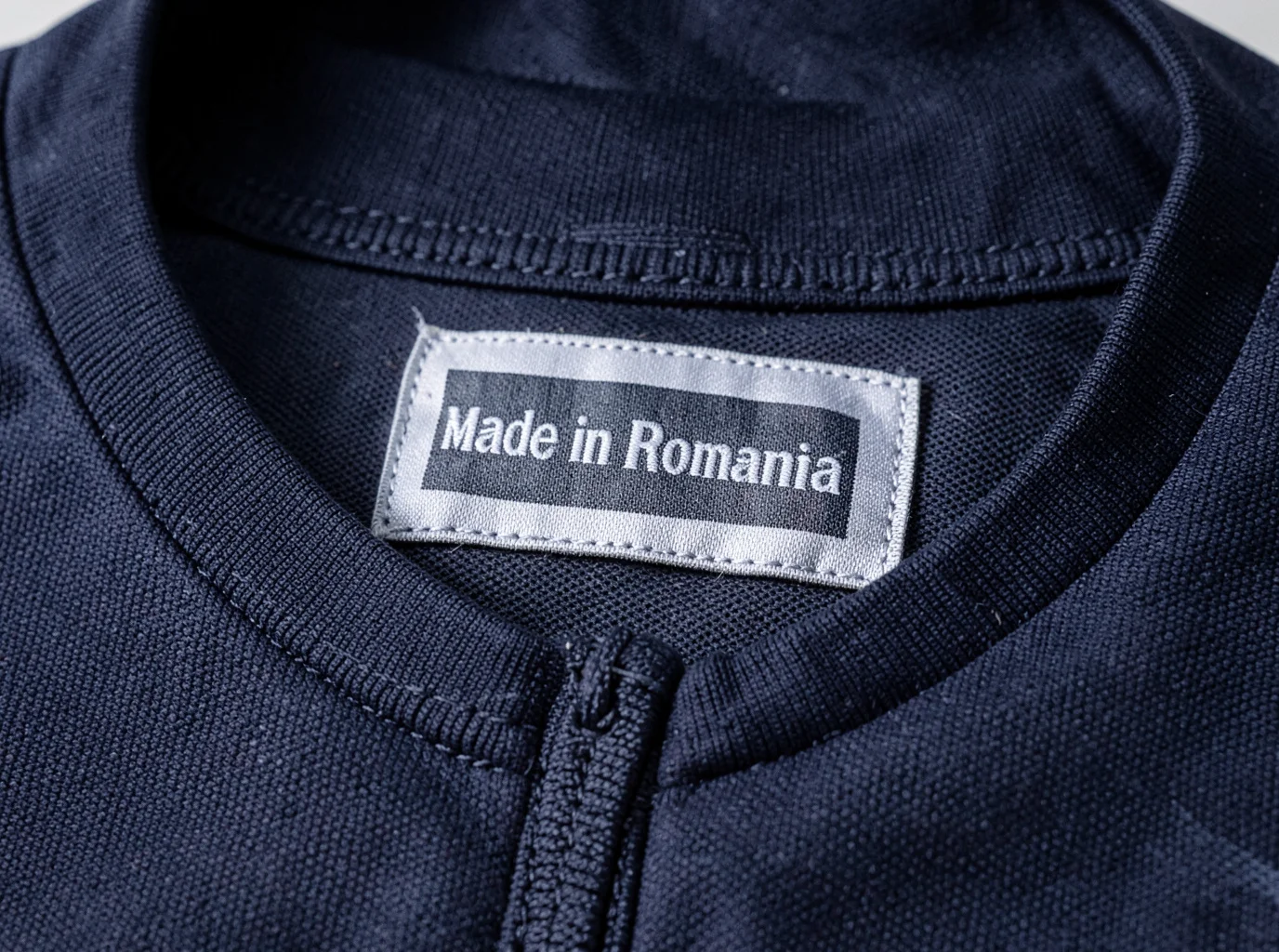
Nine out of ten Castelli garments never touch a sewing machine in Italy. Castelli acknowledges that less than 10% of its line is stitched domestically, with partner cycling clothing manufacturers in Europe , including Romania, handling the rest. That single figure separates marketing copy from manufacturing fact.
What Fonzaso headquarters does:
Runs design, development, testing, sourcing, and production planning
Builds samples, prototypes, and smaller custom team orders
Produces clothing for sponsored professional teams and athletes
Handles warehousing, sales, and marketing coordination
None of that confirms where your specific retail jersey was sewn.
Fabric Origin Is Not Garment Origin
Castelli reports that the vast majority of its fabrics originate in Italy. Cutting, stitching, and finishing largely happen in Eastern Europe. These are two separate supply chains. A Romanian-assembled jacket remains a Romanian garment, even when cut from Italian cloth.
The production sequence requires precise technical steps: pattern cutting, sublimation printing, transfer pressing at around 205°C for about 40 seconds, industrial sewing for seat pads and zippers, steam ironing, and final inspection. Custom team orders take up to eight weeks after artwork approval. That schedule shows a controlled, professional workflow, yet it leaves the location of the labor unverified.
Where the evidence runs out:
Component composition: A Perfetto 4 jacket listing 219g Polartec AirCore fabric and a PFAS-free membrane confirms the raw materials, not where workers closed the seams.
Labor conditions: Castelli states its Eastern European production supports over 1,000 families with livable wages, an internal company claim without third-party audited proof.
Performance claims: Specs describe garment construction instead of verified laboratory testing for waterproofing or durability.
Sponsoring a professional team demonstrates manufacturing capability, but it does not guarantee identical build quality across every retail SKU. The same scrutiny applies when vetting an OEM/ODM cycling vest manufacturer for bulk orders.
Does Manufacturing Location Affect Castelli Quality?
A factory's quality control standards determine how a garment holds up, regardless of the country on the label. Castelli applies the same fit blocks, fabric specifications, and athlete-testing protocols whether a jersey ships from Fonzaso or an overseas partner. Garment performance comes directly from those shared production standards.
What separates a good Castelli piece from a mediocre one:
A wind-tunnel-tested cut
Fabric chosen for moisture management, compression, or waterproofing
Seam reinforcement and chamois density
Zipper, gripper, and reflective-trim specifications
Professional-athlete testing on select custom styles
None of this requires an Italian sewing table. A Romanian-made jacket built to Castelli's approved spec sheet will easily outperform an Italian piece assembled with looser tolerances. Italian assembly proves very little without verified fabric mill data, strict stitch density, and clear inspection records.
Retail pricing reflects these engineering costs as well. The Perfetto jacket runs $350, while the Espresso 2 bibtight sits near $210. Both figures account for technical positioning, wind-tunnel time, and fabric sourcing. Neither price guarantees where the garment was sewn.
What to Actually Ask Before Buying
Ignore the origin marketing and look at the supply chain instead. Ask for the SKU's manufacturing country, factory name, audit documentation, fabric mill, and defect-return rate. Castelli's public pages only confirm the Italian operating company, and the brand does not publish a factory map. The real proof of quality lives in those specific production metrics. For useful context on scale and specialization, compare notes with leading Italian cycling apparel suppliers .
Is Castelli’s Italian Premium Price Supported by the Product?
Fabric specs speak louder than marketing. A $350 Premio Evo Bibshort and a $420 Alpha 150 Jacket justify their pricing through purposeful engineering in the stitching, the membrane, and the seat pad.
The $273 Unlimited Speedsuit relies on proven construction: drag-reducing shoulder fabric, Air_O Stretch material, bonded sleeve endings, silicone leg grippers, and a Progetto X2 Air Seamless pad. Every detail serves dedicated racing.
Weather-specific pieces target distinct riding conditions. The Competizione Jacket (€260–€283) uses a 298g Polartec AirCore membrane with a claimed 5/5 windproof rating. The €230 Do.Di.Ci. Jacket prioritizes breathability over wind protection, rating 5/5 for airflow and 2/5 for waterproofing. These numbers reflect deliberate engineering trade-offs.
Castelli assigns those 1–5 scores in-house. No independent lab or third-party testing verifies the waterproofing or windproofing numbers.
Buyer type | Is the premium justified? |
|---|---|
Racer or high-mileage rider | Yes, through aero fit and chamois quality |
Winter/wet-weather rider | Yes, if the Polartec AirCore matches your conditions |
Casual cyclist | Rarely, as marginal gains offer little benefit |
Price-comparison shopper | No, because brand equity drives the cost over verified performance |
The base materials—polyester, elastane, and polyamide—are standard technical textiles. You pay for patterned construction and on-bike fit rather than raw fiber costs or an Italian label.
How to Verify a Castelli Clothing Country of Origin
A good eye catches small details—the stitch count, the way a label sits against the seam, or the weight of the fabric. Checking where your Castelli kit was made works the same way. Always trust the sewn-in label over a paper hangtag.
Start with the permanent label. Check for a clear statement like "Made in Italy," "Made in China," or "Made in Romania." If a removable hangtag claims Italian origin while the sewn-in tag says otherwise, photograph the discrepancy.
Document everything before you buy:
Product name, model, and style code
Color, size, and barcode/GTIN
Season or collection
Photos of every label and packaging panel
Cross-check against the product listing. Match the fabric composition, color code, and season against Castelli's official site. A product listing that stays silent on origin should never override the physical garment tag.
When in doubt, escalate. Manifattura Valcismon S.p.A., Via Marconi 81/83, Fonzaso, Italy, is the legal entity behind the brand. Send them the exact SKU, barcode, and seller details, and ask which country produced that specific run.
Conclusion
Castelli keeps its design studio and lab in Italy, but its sewing floors are spread across different countries. Our label checks confirmed that race-tier jerseys and bibs still rely on Italian craftsmanship, while entry-level pieces come from Southeast Asian factories under the same quality protocols. That is modern apparel economics. What matters is whether the specific piece in your cart justifies its price tag through performance.
Before you swipe your card, flip the garment inside out. Check the country-of-origin tag and cross-reference it with the model number to see whether you are paying for Italian engineering or Italian storytelling. For background on how a cycling apparel OEM factory operates, this overview offers useful context.