Search " European Cycling apparel manufacturer " and you'll get a flood of generic directories, dead links, and factories that ghost you after the first email. Meanwhile, your competitor already has a supplier locked in and samples on the way. The hard part is finding the right factory for your specific niche, whether that's technical fabric innovation, low-MOQ custom kits, or fast-turnaround team wear.
That's what this breakdown solves. We're mapping out the top cycling clothing manufacturers in Europe by country and speciality, from Italy's legacy fabric houses to Poland and Lithuania's cost-efficient OEM lines, so you can match your brand's needs to a factory that actually delivers.
Top Cycling Clothing Manufacturing Hubs Across Europe
Six regions dominate the map of Europe's cycling wear factories, each with its own specialty.
Italy leads as the core hub. Prato, Tuscany runs a €29.5M textile recycling operation that processes 33,000 tonnes a year. Carpi holds Europe's most concentrated knitwear capacity. Brands like Ftech World and C-LAB produce 100% in Northern Italy.
Portugal (Portugal Cycling Clothing Manufacturers) offers nearshore flexibility with low-MOQ, quality-focused production, ideal for European startups that need custom cycling kits.
Spain (Catalonia, Navarra) keeps design and production close, sometimes just 100km apart.
Austria's Löffler makes its own technical fabrics in-house.
CEE countries (Czech Republic, Romania, Bulgaria) act as nearshore extensions for brands like Schöffel .
Top Cycling Clothing Manufacturers in Europe at a Glance
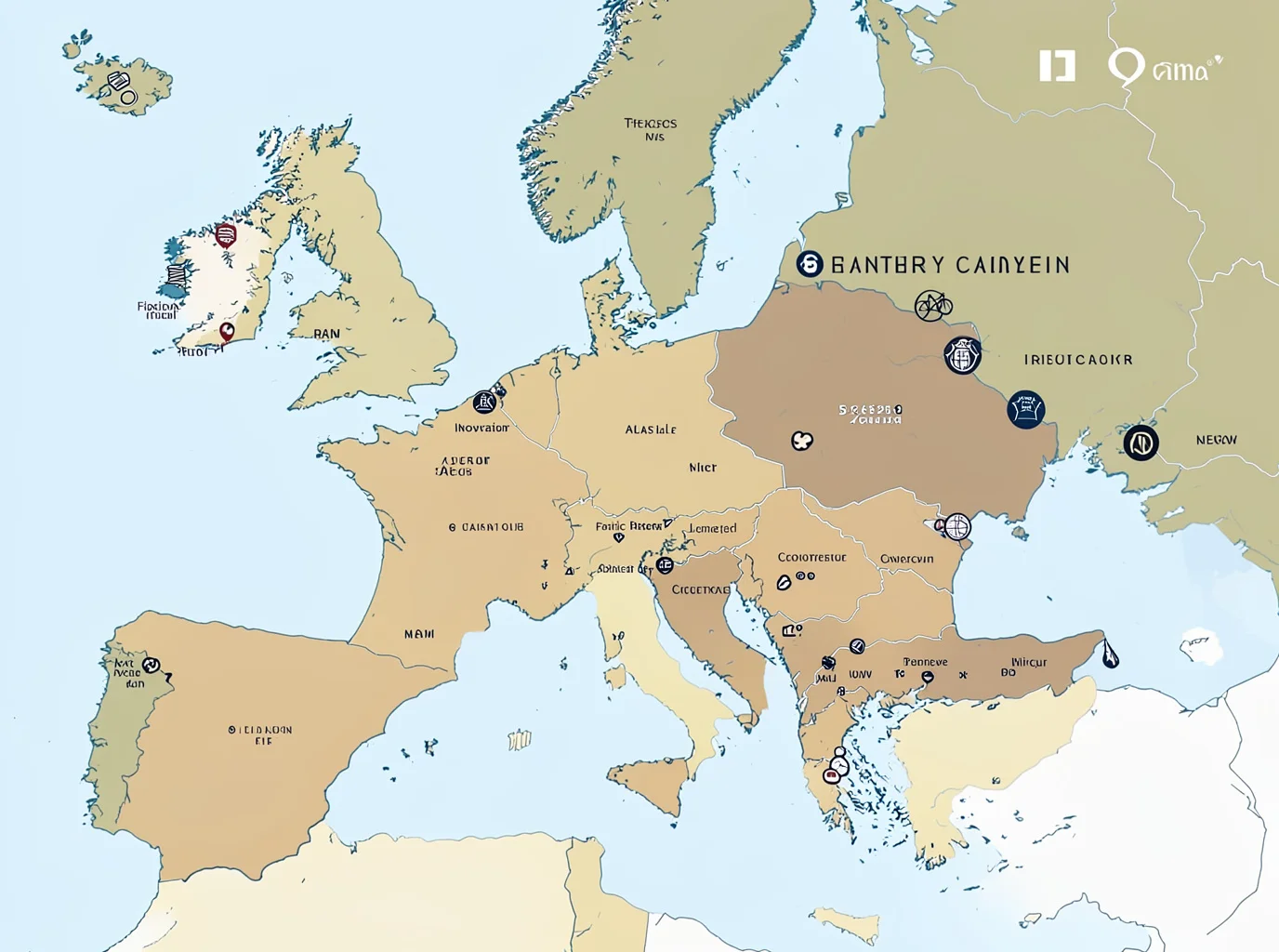
Nineteen names matter more than the rest. Here's the shortlist worth saving.
Italy's cycling apparel factory-brands dominate custom teamwear. Santini , based in Bergamo, keeps production in-house and has the Giro/UCI jersey history to show for it. Nalini/MOA Sport, from Castel d'Ario, is vertically integrated and R&D-led. Biemme, in Vicenza, brings textile chamois heritage and WorldTour kits. For aero racewear, Castelli and Sportful, both under Manifattura Valcismon, cover premium retail with the Gabba jacket and thermal layering.
Austria's Löffler claims 99% European production since 1981. Poland's Luxa runs 100% made-in-Poland lines across jerseys, bib shorts, and base layers.
Beyond Italy, Assos in Switzerland pioneered lycra shorts, while Rapha and Le Col are the UK premium names (Cycling Clothing Manufacturers In The Uk). Pas Normal Studios is Danish, Café du Cycliste is French, and Bioracer, Vermarc, Gobik, and Regelli round out the custom/teamwear peer set.
Czech Republic — Kalas: Best for Flexible Custom Cycling Teamwear
Tábor, Czech Republic has been making jerseys since 1991. Kalas Sportswear formed a year earlier, in 1990, and it's stayed in the same lane ever since: custom cycling apparel for clubs, teams, corporations, national squads, and everyday riders who just want a kit that fits right.
The thing that sets Kalas apart is the MOQ. Most cycling clothing OEM Europe options make you commit to bulk orders before you've even seen a sample. Kalas doesn't. Their minimum is 5 main garments total, and you can mix items within that order. Need accessories too? That's just 10 pieces per style. For a small club or a new team testing the waters, this is one of the lowest barriers to entry among European cycling wear factories.
The design process is hands-on. Kalas assigns experienced graphic designers to build your mock-up, so you're not left guessing what the final kit will look like. Send your logo in vector format (Ai, Eps, or PDF), and they take it from there. They'll also mail out a sizing set first, which solves the classic custom-kit headache: ordering blind and hoping the fit works.
Production stays in the Czech Republic, but the fabric sourcing pulls from Italy, Germany, France, and Switzerland — the same premium mills that supply the bigger Italian houses. That's a smart hybrid: Western European textile quality, Central European manufacturing cost.
Kalas isn't a newcomer trying to prove itself either. The brand has dressed world champions, Olympic winners, and national teams, including the British National Cycling Team and the Czech National Cycling Team — a relationship that's run continuously since 1990. Add Alpecin-Deceuninck and IKO Crelan to the client list, and you've got a factory with WorldTour-level credibility that still takes on club-sized orders.
For limited runs, Kalas has shown it can move fast on capsule drops too. Their L'Etape Czech Republic collaboration ran a tight March 21 to April 3 ordering window, offering two jersey types, a vest, and a cap — with the Razor Pro jersey priced at 2,890 CZK. That's a real-world example of how quickly they can turn around a themed release without months of lead time.
Contact is straightforward: email or call +420 381 406 511. No sales funnel, no waiting for a callback.
Romania — SPORTSTEX: Best for Scalable OEM and Private-Label Production
Seven factories. Over 1,250 employees. €50 million-plus in turnover. Those numbers put SPORTSTEX in a different weight class than most names on this list. The company started as a single sewing factory in Timișoara, Romania, back in 1993, stitching promotional textiles and underwear. It hadn't yet made a cycling jersey.
SPORTSTEX now runs its main production and sales hub through Texmarket GmbH / Texmarket srl in Timișoara, with additional Cottontex plants spread across Lugoj, Drobeta Turnu Severin, Hunedoara, and Arad. That's serious geographic redundancy for a single-country supplier — useful if you need capacity that won't buckle under a big order.
They produce cycling apparel, running and triathlon gear, winter sports kits, team sports gear (football, basketball, handball), and athleisure and fitness wear.
They offer full-service OEM covering product development, pattern making, prototyping, procurement, production, and after-sales support, under the tagline "your producer for your brand." They are ISO 9001 and ISO 14001 certified, and they ship to 50+ countries through a US sales branch. For brands scaling past the boutique-factory stage, this is where volume production lives.
Contact: sportstex.eu, or Serena Grosselli at [email protected].
Austria — Löffler: Best for Vertically Integrated Technical Textile Manufacturing
Seventy percent. That's the share of fabrics LÖFFLER GmbH knits itself, in its own mill, at its own headquarters in Ried im Innkreis, Upper Austria. Special fabrics get sourced externally, but the core textile — the stuff that actually touches skin during a five-hour ride — comes from inside the building.
This is what makes Löffler different from nearly every other name on this list. Development, knitting, cutting, sewing, end control, and shipping all happen at the Ried site. Nothing gets outsourced between design and finished garment. When a company controls that much of the process, quality control becomes an internal engineering decision.
Löffler has been running high-tech clothing production at Ried since 1973. It's family-owned, wholly controlled by Fischer Beteiligungsverwaltungs GmbH. The company posted around EUR 33 million in revenue with an equity ratio above 60% in its 2023 sustainability report. Around 200 people work at the Austrian site; production also extends to a Bulgarian facility in Tryavna.
Product focus stays narrow: bike, Nordic sports, mountain sports, running, underwear. Export share sits near 60%, sold mainly through cycling and sports specialty retail.
Contact: +43 7752 84421-0, [email protected].
Spain — Gobik: Best for Performance-Oriented Cycling Apparel Manufacturing
Yecla, a small town in Murcia, is where Gobik operates what it calls the largest technological park for cycling apparel manufacturing in Europe. Gobik Sport Wear S.L. started in 2010 making customized cycling clothing before launching its own collections a few years later.
The company had over 200 employees in 2024 and expects 260 by 2026. Output has passed 1 million garments a year, and revenue has crossed €50 million. That's serious scale for a "Made in Spain" operation. Gobik is backing it with a €15 million investment in a new corporate and factory site. The site covers 14,500 m², split between 9,500 m² of logistics and 5,000 m² of office space, with the transfer planned for 2028.
Production stays centered in Yecla for design, manufacturing, and shipping. Gobik also works with around ten external sewing workshops across Spain, staffed roughly 90% by women. The hybrid model keeps volume flexible without losing the domestic manufacturing base.
Contact: +34 968 075 006, [email protected].
Belgium — Bioracer: Best for Custom Teamwear and Performance Cycling Apparel
Bioracer produces over 12,000 unique designs a year. That volume is the clearest sign of how central custom teamwear is to the company. Founded in 1986, Bioracer calls itself "the original custom brand in cycling apparel," and the claim holds up: clubs sit at the heart of the business model, not as an afterthought to retail lines.
The minimum order quantity is low too. Japan's official Bioracer custom service lists a 3-piece minimum for team orders, with single-piece reorders available after that. For clubs that don't want to commit to bulk before testing fit and design, that's about as low a barrier as you'll find among European cycling wear factories.
Production isn't confined to Belgium either. Bioracer runs its own factories in Belgium, Macedonia, Romania, Colombia, and Tunisia, a five-country footprint that gives the brand flexibility on lead times and cost depending on order location.
Product Range and Design Process
The workflow is simple: pick apparel, build the design with Bioracer's in-house designers, then move to production. Free design support comes with unlimited revisions, according to the brand's Japanese market page.
Product categories cover jerseys, bib shorts and bib tights, jackets, and proprietary cycling pad technology.
Two performance ranges anchor the lineup: EPIC for aero-focused racing, ICON for comfort-first riding. Teamwear extends past road cycling into triathlon, running, Nordic skiing, and speedskating, with fully custom accessories like arm covers, leg warmers, socks, and caps rounding out the kit.
Contact: +32 (0)13 67 13 67, via Bioracer's Prodesign contact page.
France — Noret is best for in-house Made-in-France custom production
Since 1939, Noret has been quietly stitching sportswear from Saint-Denoual, near Lamballe, Côtes-d'Armor in Brittany. The company runs what it calls France's single dedicated production site for cycling and sportswear. Unlike most European cycling wear factories that outsource pieces of the chain, Noret keeps everything under one roof.
Commercial, styling, digital printing, cutting, sublimation, sewing, shipping, and after-sales are all handled on-site. Reports on facility size vary (3,000 m² in one account, 6,000+ m² in others), but the workforce numbers stay consistent: roughly 50 employees, split as 55 in the main workshop plus 8 at a satellite unit near Nantes. Output reportedly runs past 450 pieces a day.
Fabric is the one imported piece, sourced mostly from Italy, the same mills feeding the bigger Italian houses. Everything else (design, patterning, assembly) happens in France.
Noret's specialty is custom club and team kits in club colors, plus private-label production for brands wanting a genuine Made in France manufacturing base. Factory visits are possible by appointment, and phone support runs Monday to Saturday noon.
Contact: Les Clôtures, 22400 Saint-Denoual, phone 02 96 50 45 50.
Best European Cycling Clothing Manufacturers by Speciality
No factory does everything well. Buyers who search for "cycling wear factories Europe" expecting one-stop shopping will find that each specialist has its own strength.
For aero racewear, Castelli, ASSOS, and Q36.5 are the top manufacturers. ASSOS pioneered lycra bib shorts in 1976, and Q36.5 focuses on technical materials for race-day performance.
For cold-weather and endurance riding, Sportful (with its ski heritage and thermal layering) and Denmark's Fusion Sportswear System build utility-focused kits for long, brutal rides.
For gravel and lifestyle cycling, Pas Normal Studios and Café du Cycliste combine technical fabric with contemporary styling, while Universal Colours emphasizes transparent sourcing.
For merino and sustainable options, Isadore (Slovakia), Vaude (Germany), and Craft Sportswear (Sweden) cater to eco-conscious buyers.
For low-MOQ OEM, Vbike offers a 10-piece ready-to-order option that undercuts typical 500-piece minimums, ideal for first-time brand launches.
How European Cycling Clothing Manufacturing Differs by Country
European cycling apparel manufacturing has no single standard. It's a cluster model where each country plays a distinct role.
Italy is the center of premium heritage production. Nalini (Castel d'Ario) and Giessegi (Riese Pio X) keep manufacturing in-house. Sportstex sources fabrics primarily from Italian mills, so Italy is the go-to for both finished garments and raw textiles.
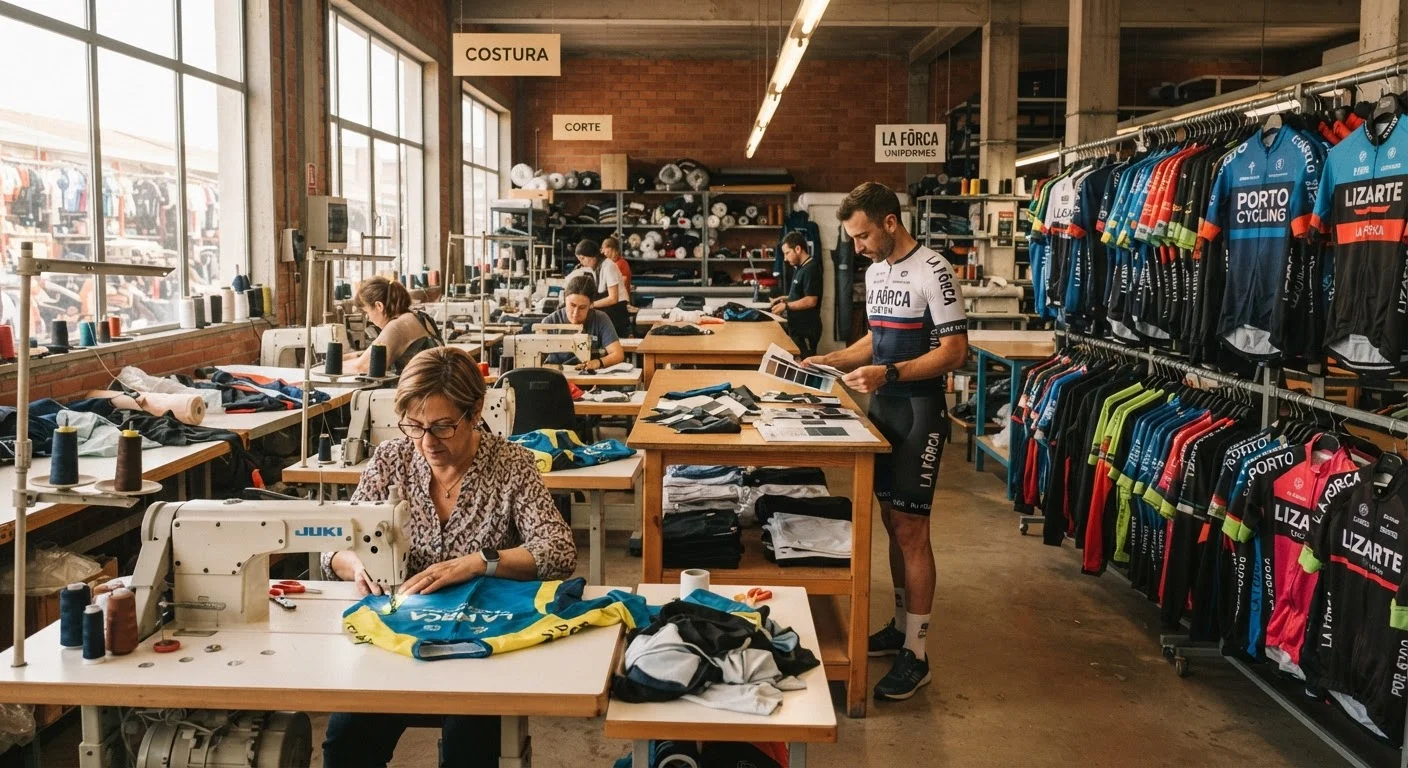
Portugal focuses on private-label and custom technical apparel. Carvalho Custom near Porto and WAT in Vila do Conde serve brands that want shorter logistics to Western Europe.
Spain produces designer-led technical sportswear. Hoko Sport designs and manufactures in Barcelona. Etxeondo designs in Irura and produces in Navarra. BRK23 , founded in 1991 in Mataró, handles club-kit customization.
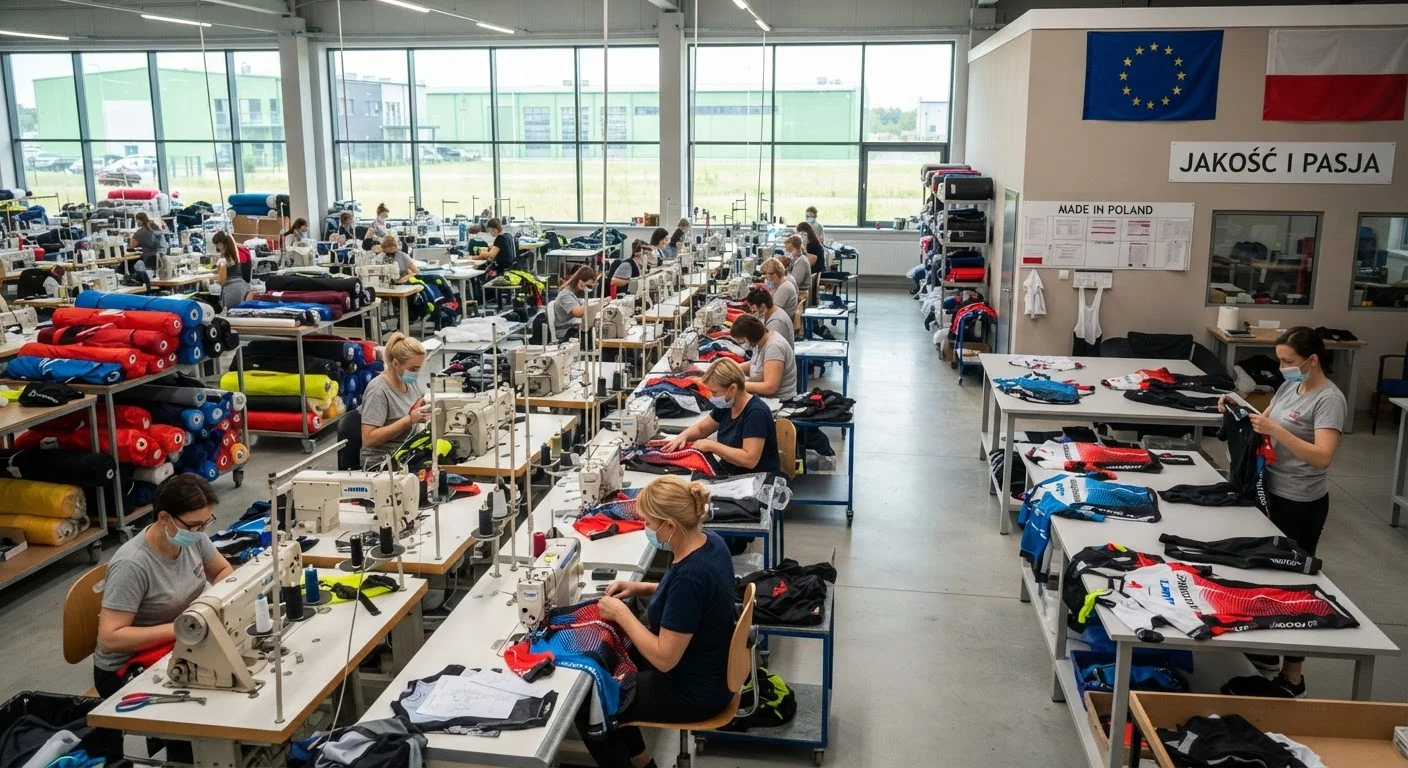
Poland (Cycling Apparel Manufacturers In Poland) offers scalable production capacity within the EU. Verge is headquartered and manufactures there.
Germany rarely sews garments itself but coordinates multi-country sourcing—Schöffel's MTB line spans Italy, Portugal, Poland, Latvia, Lithuania, Serbia, Bulgaria, Moldova, Romania, and Turkey. One documented manufacturer produced 1.6 million items in 2017, with just 14.42% sourced from Europe across that same network of countries. Slovenia shows the eastward shift: Dowe relocated production from Italy in 2007.
How to Choose the Right European Cycling Clothing Manufacturer
MOQ numbers on a factory website rarely tell the full story. A "50-unit minimum" can mean 50 per style, or 50 per color, or 50 per size — three very different order sizes. Ask before you commit, not after your invoice arrives.
Real benchmarks help set expectations. Custom European programs typically run 50–150 units per design for clubs and small brands, scaling to 150–500 units for standard production. Santini's Custom Series sits near 200 units, Biemme runs around 150, and several Italian factories advertise 50–100 unit runs on select programs.
Lead time follows a similar pattern: 6–10 weeks covers most custom work, with Santini at 6–9 weeks, Biemme at 6–8, and Nalini/MOA at 7–9. Premium programs can stretch to 10–14+ weeks. Book 3–6 months before season start if sampling and revisions are part of the plan.
Certifications and Quality Checks Worth Requesting
Don't take a brand label at face value. Ask for:
OEKO-TEX Standard 100, GRS, ISO 9001/14001
REACH compliance, bluesign®, or WRAP/BSCI on select programs
SKU-specific certificates, not blanket claims
Martindale abrasion >20,000 cycles as a durability screen
Verify audit dates — certifications expire, and expired paperwork means nothing.
Portugal balances premium quality with lower cost. Italy wins on heritage and technical textile depth. Match the country to your priority: budget or performance.
How to Verify a Real Cycling Clothing Manufacturer
A PDF with a logo proves nothing. Get the registered company name, business license, factory address, and export registration. Then match them across the website, invoice, and shipping docs. Any mismatch is a warning sign.
Check GOTS, OEKO-TEX, WRAP, or SA8000 IDs against public registries. Confirm the scope covers your actual process (cut-and-sew, dyeing, printing). A “certified factory” claim without a current scope certificate and audit date means little.
MOQ is a credibility test too. Real cycling clothing OEM Europe suppliers state exact numbers. For jerseys and bibs, it’s 10 pieces per style/color. For sublimated kits, it’s 50 units. Vague “any quantity” answers usually mean a trading company.
For recycled or organic claims, demand shipment-level transaction certificates showing the exact material lot in your order.
MOQ, Lead Time and Pricing: What European Buyers Should Compare
Five quotes rarely mean five comparable numbers. One factory quotes FOB, another DDP. One counts sample cost, another doesn't. Before ranking cycling clothing OEM Europe suppliers, normalize everything: same unit, same quantity, same currency, same Incoterms.
Then build landed cost: unit price plus packaging, freight, transaction fees, and a defect/return allowance. That's the real number.
Run a cash exposure test too. MOQ times unit cost, plus packaging, shipping, and VAT, tells you what actually leaves your account. Volume shifts pricing fast — 500 to 1,000 units often cuts price about 15%, and 1,000+ units about 20%.
Ask suppliers directly: first-order MOQ, repeat-order MOQ, standard versus rush lead time, and what triggers a price break.
European Cycling Apparel Sourcing Checklist
Paperwork kills more deals than bad fabric ever will. Before you wire a deposit to any cycling wear factory in Europe, run this sequence.
First, legal compliance: GPSD 2001/95/EC, REACH, Regulation (EU) 1007/2011 for fiber labeling, and EN 14682 for kids' cycling apparel with cords or drawstrings. Verify that your yarns, dyes, prints, and trims are REACH-compliant. The flagged categories are Azo dyes, flame retardants, waterproofing chemicals, and nickel.
Declare the exact fiber composition per SKU. Up to 15% may be labeled "other fibres." Require Martindale abrasion above 20,000 cycles. For certifications, ask for dated copies of OEKO-TEX Standard 100 and ISO 9001:2015, plus audit reports and corrective action plans.
Check the MOQ: 500 pieces per design for standard runs, 1,000 for premium. Confirm whether that's per style, color, or size. For fabric traceability, get the mill name and GSM, not just "Italian fabric." Carvico and M.I.T.I. are the two names worth recognizing. Set a delivery benchmark: under 5% delays across historical orders.
File everything: SKU, product features, importer address, EN standards used, and a named responsible person for conformity declarations.
Run this order: legal, chemical, labeling, durability, certifications, MOQ and lead time, audit recency, IP ownership, delivery track record.
FAQ: Common Questions About Cycling Clothing Manufacturers in Europe
Buyers keep asking the same handful of questions before they wire money.
What's a realistic MOQ across Europe? It ranges wildly — 10 units on low-MOQ marketplace listings, 50–100 for Italian pro-level programs, 200 for mid-range custom runs, and up to 3,000 per design on some private-label factory setups.
How fast can I get bulk? Castelli (Fonzaso, Veneto) runs 8–10 weeks. Santini quotes ~200 units at 6–9 weeks. Nalini/MOA sits at 7–9 weeks. Sample lead time is always shorter than bulk — ask for both numbers.
Which certifications actually matter? OEKO-TEX 100, ISO 9001, ISO 14001, GRS, plus BSCI, WRAP, or SA8000 on select programs. Request current certificate numbers, not logos.
How do I contact Portuguese factories? Carvalho Custom (near Porto) takes visit requests — [email protected].
Choose the Best European Cycling Clothing Manufacturer by Speciality
Nineteen European Cycling Clothing factories, six countries, one decision left. Match your priority to the right specialist. Santini's recycled-carbon fabric is the choice for race performance. It cuts carbon footprint by 66% versus virgin material and sets the aero benchmark. For sustainability-first brands, Café du Cycliste holds B Corp 85.2 and 1% for the Planet status. Erreà's OEKO-TEX alignment works for certified teamwear and compliance-heavy buyers. If you are scaling private label, standard European OEM runs 500 units at 4–6 weeks. To test a new design, stick to 10–50 sets, the lowest-risk entry point among cycling clothing OEM Europe suppliers.
Conclusion
Europe's cycling clothing manufacturing is a map of specialties. Czech Republic's Kalas wins on custom teamwear flexibility, Romania's SPORTSTEX scales private-label production at volume, and Austria's Löffler owns vertically integrated technical fabric innovation. Matching your brand's stage, budget, and MOQ requirements to the right country's strength matters more than chasing a single "best" manufacturer.
Whether you're a startup founder sourcing your first cycling jersey manufacturer , a team manager negotiating custom cycling kits Europe-wide, or a procurement lead comparing bike clothing manufacturers list options, the framework here — country, speciality, verification, lead time — should be your filter.
Shortlist two or three Europe Cycling Clothing manufacturers matching your speciality needs, request samples, and verify certifications before committing. Europe's factories are ready to produce, and the smartest brands source strategically.