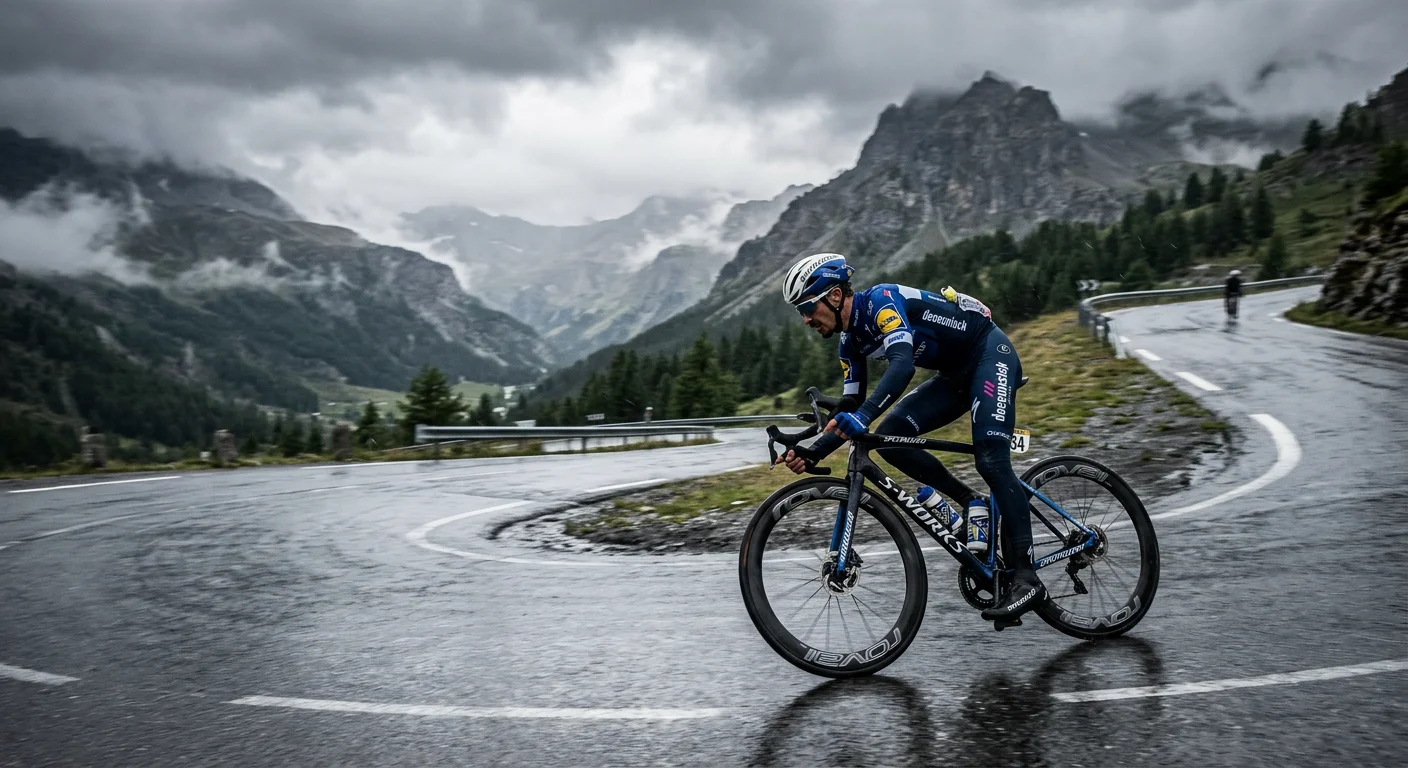
Wout van Aert's hands started trembling on the descent of the Mortirolo. Not from effort — from cold. And three minutes behind him, a decision was already taking shape inside a team car.
Not a spontaneous one. Not a reactive one.
That decision had been tested 48 hours earlier against weather forecasts. It was rehearsed in a pre-race briefing most fans never hear about. It was shaped by UCI weather regulations, internal team protocols, and a rider's own right to say stop .
Pro cycling's approach to extreme weather is one of sport's most complicated risk puzzles. Yet the system behind it stays almost invisible — whether you're watching from the roadside or your sofa.
This article breaks down that system piece by piece. For brands developing custom cycling apparel collections, these decision-making processes also reveal how elite teams prepare for extreme environmental conditions.Every role. Every decision point. Every protocol that stands between a rider and real danger once the mountains turn hostile.
Pre-Stage 48-Hour Meteorological Monitoring and Route Hazard Mapping
Forty-eight hours before the flag drops, the race is already being run — in data.
Every serious WorldTour team starts its weather operation two full days out. A professional cycling apparel supplier often uses similar forecasting and environmental data when advising teams on race-specific clothing selections.Not with a quick look at a weather app. They use purpose-built forecasting dashboards that pull hyperlocal numerical weather prediction models at 1–3 km grid resolution, aimed at the race corridor. That level of detail tells you the wind speed at a specific bridge crossing — not just the province it sits in.
The route gets divided into segments — every 0.5 to 1 km — and each segment carries its own risk profile. Teams and race officials tag these segments with fixed hazard markers before any weather develops:
High-elevation thermal drop zones : Any point above 1,800 m gets its own flag. At 2,000 m+, a standard atmospheric lapse rate of ~6.5°C per 1,000 m means summit temperatures can run 12–15°C colder than the valley start town. Forecast precipitation combined with temperatures at or below 2°C pushes the segment into snow and freezing rain watch — the same condition that turned the 2019 Giro's Mortirolo stage into an operational crisis.
Flood-prone descent sectors : Teams cross-reference these against hydrological records. They cover underpasses, culverts, and river-adjacent roads with documented flooding histories. Each one gets a flood-susceptibility score based on catchment slope, soil saturation indices, and upstream drainage area. The practical trigger: 30–50 mm of forecast rainfall over 6–12 hours on already saturated ground.
Wind-exposed structures : Teams pull bridges, viaducts, and open ridge roads from infrastructure catalogues. Each structure carries an exposure factor — 1.2 to 1.5 times the valley wind speed — used to calculate gust thresholds.
The weather data layered over these fixed markers is just as precise:
Precipitation intensity above 5–10 mm/h on descent sectors flags aquaplaning risk. Above 20–30 mm in six hours on known flood corridors, you're into potential route closure territory.
Crosswind components get calculated against the road bearing every kilometer. Sustained crosswinds at 35–40 km/h, or gusts hitting 50–60 km/h, trigger lateral instability warnings. That's the threshold where wind crosswind echelons stop being a racing tactic and start becoming a safety concern.
Heat index thresholds run in three bands: ≥32°C activates enhanced cooling protocols; ≥35°C opens discussion about neutralised sections; ≥38–40°C on prolonged climbing segments with low wind is where heat stroke prevention cycling race procedures move from contingency to near-certainty.
Visibility below 200 m on fast descents triggers pace-car guidance. Below 50–100 m combined with wet roads, race neutralisation becomes an active option on the dashboard — not a last resort.
All this information feeds into one place. The go-to setup is a combined weather-hazard dashboard — a single operational interface that merges national meteorological service warnings, private mesoscale nowcasting updated every 5–15 minutes, and on-site instruments at critical passes and bridges. Those on-site sensors carry more weight than you might expect. Anemometers and rain gauges at key summits let teams correct model output in the final hours. They catch local phenomena — katabatic wind events, convective downbursts — that regional forecasts often miss.
Under all of this sits institutional memory. Historical route reconnaissance notes, stored as metadata: "typical fog between km 40–55," "crosswinds form echelons here above 30 km/h," "Bridge X has been closed at 80 km/h gusts before." These aren't just anecdotes. They're fixed hazard layers that switch on as soon as incoming weather patterns match the conditions that caused past incidents.
By the time a DS sits down for the pre-stage team meeting, the conversation isn't starting from zero. It's refining a risk map that's already been 48 hours in the making.
The Directeur Sportif's Pre-Race Briefing and Technical/Medical Coordination
The briefing room is where forty-eight hours of data becomes a plan four different departments can execute.
A DS running this meeting well isn't delivering a tactical monologue. The room holds a doctor, a head mechanic, at least one soigneur, and the riders — and each of them needs something different from the next ninety minutes. The DS's job is to make sure they all leave on the same page.
The scenario tree is the briefing's structural backbone. Many WorldTour teams collaborate with OEM cycling apparel partners to ensure clothing systems are prepared for each weather scenario outlined during these briefings.A prepared DS doesn't build one race plan — they build five: normal conditions, cold/wet stress, heat stress, crosswind exposure, and crash or neutralization response. Each scenario has its own clothing decision, feed timing, car positioning, and team-radio trigger. Conditions shift mid-stage? No one scrambles from zero. They switch branches.
Medical Directives
The doctor's block in the briefing isn't a five-minute add-on. It's where exposure thresholds get named and ownership gets assigned .
For cold and wet stages, three things need to be locked in before rollout:
The physical warning signs of early hypothermia in professional cyclists — shivering, coordination loss, irrational pace decisions
Who on the road is responsible for calling it into the team car
What the response chain looks like, step by step
Wet clothing off. Thermal layer on. Warm vehicle access. These steps seem obvious — until a rider is descending the Mortirolo at 60 km/h and the soigneur at the finish has no idea which car holds the dry kit.
Heat protocols follow the same logic, just in reverse. The medical plan needs to define hydration escalation intervals, cooling access points along the route, and the specific signs — cessation of sweating, confusion, core temperature above 40°C — that move a rider from "monitor" to "pull." Responsibilities get pre-assigned across soigneur, team doctor, and car staff. Teams running an IV-capable medical pathway must pre-clear that capability in the race medical plan and assign it to a named clinician before the stage starts. You don't source that in a panic at the finish line.
Mechanic Contingency Routing
Wet-stage mechanical prep follows a verification checklist , not gut instinct.
Tire compound and pressure confirmed for the forecast surface
Brake response tested under wet-rim conditions
Electronic shifting sealed and functional
Spare wheels staged in car-one, ordered by which riders will need them first
Bike handoff sequence defined and rehearsed
On heavy-rain or muddy stages, pre-positioned spare bikes and a rapid replacement protocol aren't optional. The window between a mechanical and a lost stage can be under ninety seconds.
Soigneur Staging
The soigneur's briefing output is a wet-stage inventory checklist : rain jackets, arm warmers, leg warmers, base layers, gilets, gloves, dry socks, and post-stage kit. All of it staged before rollout — not thrown together at the finish in the rain. Feed planning matches the conditions too. Cold stages need easy-open packaging and hot liquids adjusted for viscosity. The briefing also assigns clear ownership — who controls emergency blankets, who manages dry clothes, and who handles rider handover at the finish line.
Closing the Briefing
Every DS should end with one question answered out loud: who decides what if conditions change mid-race? Not implied. Stated. The riders know their threshold for flagging distress. The doctor knows the escalation point. The mechanic knows the swap trigger. The soigneur knows the finish staging. The mountain turns hostile — the decision chain has already been rehearsed.
In-Race Radio Communication and Peloton Management Tactics
Every team car runs three radio channels at once. That's not a luxury — it's the bare minimum to keep riders safe as conditions fall apart.
The DS sits in the front passenger seat. He manages three separate audio feeds: Radio Tour (the race organization's global broadcast), a car-to-car channel linking the team's two vehicles, and a direct line to the riders. Each feed carries different information at different urgency levels.This constant flow of race intelligence also influences how some ODM cycling apparel development programs design adaptable garments for rapidly changing conditions.
A crosswind echelon splitting a peloton across a coastal road triggers all three at the same time.
The Language of the Radio
DS commands are not made up on the spot. The pre-race briefing maps out most of what gets said mid-stage. Radio calls are refinements of decisions already locked in — not fresh inventions. Messages stay short by design. At race speed, the brain has no room for long explanations.
The crosswind playbook shows this clearly. Two to five kilometers before a known exposed sector, the DS calls positioning:
"At km 47, road turns right — full crosswind from the left. Move up from now."
"Left gutter. First line: A, B, C. No more than eight riders per echelon."
"No overlapping wheels. Diagonal lines only. Gap opens beyond one bike length — close it fast."
On wet descents, the language shifts from positioning to hazard control:
"Hairpin at 300 m, off-camber. Brake before the sign."
"Wide-late-apex on the next left — inside line is wet."
"Follow B's wheel only. No one passes him on this descent."
One trusted descender gets named as pilot. Everyone else follows his line. The DS uses the TV or moto camera feed to override individual instinct. A rider mid-descent cannot see the standing water pooling at the next switchback. The car can.
The Information Loop
Riders push data upward just as the DS pushes instructions down. Surface intelligence — "gravel in the right-hand corner," "potholes on the white line," "rain starting at km 82" — travels from the road to the car. The DS relays it straight to riders further back. It also goes to the second team car, which uses it to adjust tyre pressure and stage jackets for the next feed zone.
This two-way loop is what separates reactive safety management from real risk control. The DS is not just broadcasting. He's pulling together race radio time gaps, rider reports, and live visual data — then turning all of it into decisions the peloton can act on at 60 km/h.
Push conditions far enough toward the extreme, and that multi-channel structure becomes the operational backbone of the entire team car support extreme conditions response. It's centralized, fast, and already rehearsed well before the flag drops.
Race Director Negotiations: Neutralization Protocols and Stage Cancellation Decisions
The race director's call isn't made in isolation. It never is.
Conditions don't just flip a switch. They get bad enough to force a formal intervention — and by that point, three separate conversations are already running at once. The commissaires' panel is talking. The race organization is talking. Team representatives are talking, sitting in cars that smell of wet kit and cold coffee. The UCI Extreme Weather Protocol gives this process its legal backbone.Behind the scenes, a high-performance cycling apparel factory may already be evaluating how similar weather scenarios affect future garment development and testing standards.
Race management and commissaires share joint authority. They pick from a set list of interventions: neutralization, route shortening, alternative routing, delayed start, or full cancellation. The actual process of getting there, though? It's messier, faster, and more political than any rulebook captures.
The Intervention Menu and How It Gets Used
Not every dangerous stage calls for the nuclear option. Race directors move through a practical hierarchy before cancellation becomes the answer:
Stage time modification — the lightest touch. Racing continues, but exposure time gets cut. Classification logic stays intact.
Alternative routing — a hazardous segment gets bypassed. A viable detour has to preserve the competitive meaning of the stage, or this option doesn't work.
Partial neutralization — the peloton rides through a dangerous section at a controlled pace. The racing clock stops. A defined restart point on safer ground is set before the peloton moves.
Full cancellation — used when no safe, fair, and workable format can be built from the conditions. The threshold here isn't a specific wind speed or a rainfall figure. It's the point where continuing cannot be made safe — not without breaking the sport's core safety-first standard.
The Negotiation in Practice
Team representatives and captains get the same operational brief before any decision reaches the peloton. Convoy order, restart format, neutralized segment boundaries, safety zones — all of it, shared at once. That shared alignment isn't a courtesy. It's what makes 200 riders moving through a mountain valley actually manageable.
The decision criteria run in a fixed priority order: rider welfare first. Then competitive fairness. Then peloton control. Then logistical and broadcast impact. Each factor after the first matters — but it's a non-starter if rider welfare isn't already handled.
What gets documented is just as important as what gets decided. Forecast source, timestamp, location-specific hazard points, medical access limits, commissaire recommendations, the clear rationale for the chosen intervention — all of it builds the paper trail. That trail is what separates a defensible safety call from a liability waiting to surface.
Emergency Response Logistics and Soigneur Mobilization During Sudden Stops
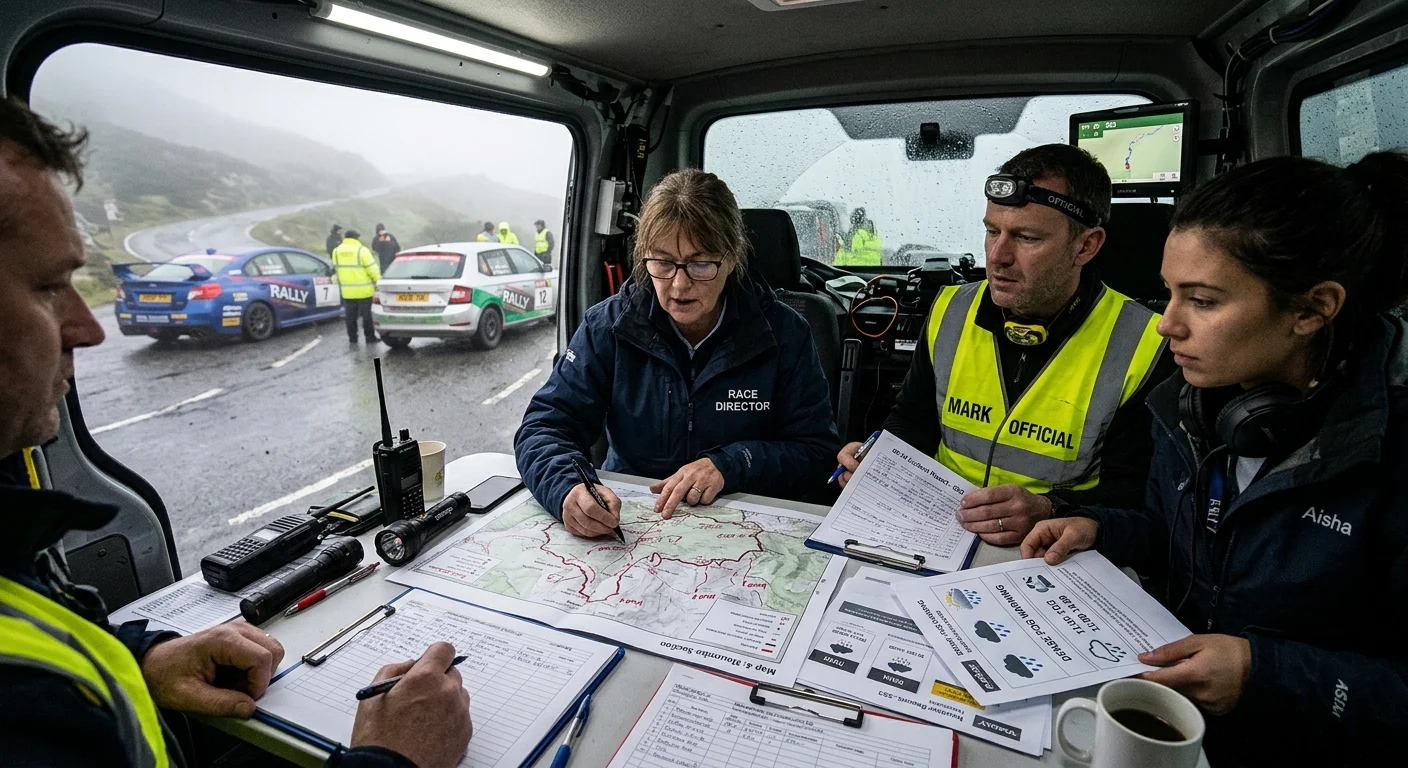
The race stops. Now everything has to move at once.
A stage gets neutralized mid-route for many reasons — freezing rain on a summit descent, a multi-rider crash on wet tarmac, or a sudden gust scattering echelons across a coastal road. The clock doesn't pause for logistics. The gap between "race stopped" and "riders in real physiological danger" can be just a few minutes. What happens in that gap isn't improvisation. The same emphasis on preparation is why many professional teams work with specialized equipment and cycling apparel wholesalers capable of supporting complex race logistics.It's a choreography drilled long before the first rider rolled out.
The Five-Minute Deployment Mandate
The target is simple and unforgiving: soigneurs reach every isolated rider cluster within five to seven minutes of the neutralization call. Miss that window in cold rain, and hypothermia risk starts climbing. Miss it in a heat stage, and the restart turns into a medical event instead of a race.
To hit that window, the logistics chain must be pre-loaded. Each soigneur carries a standard backpack covering six to eight riders : eight to ten bottles, six to ten gels, three to four solid food items, and a layering kit — dry gloves, a cap, and a lightweight shell jacket per rider. In cold-wet conditions, the kit gets extra emergency blankets for the highest-exposure clusters. In heat conditions, cold towels or ice socks take their place.
The numbers inside those bottles matter too. A hot-stage neutralization needs at least two bottles per rider per thirty minutes of hold time. Those bottles run at 500–1,000 mg sodium per litre , and up to 1,500 mg/L in extreme heat. That covers both the standstill and the pre-restart loading window. Cold stages call for warm fluids and high-carbohydrate mixes that stay fluid in low temperatures — no thickening, no delays.
The Cluster Problem
The peloton can split across a mountain descent before a neutralization. Team cars get stuck. A car sitting seventy seconds behind the front group has no clean path forward. The fix isn't improvisation — it's pre-authorization.
Race direction assigns which neutral service motorbikes or commissaire vehicles cover which cluster. The senior soigneur acting as cluster logistics lead contacts race radio to confirm which groups are reachable under the active vehicle corridor rules. Those rules run at the same time as the deployment — so the lead soigneur has to track both at once.
Vehicle Movement: The Way Out / Way In Protocol
Static riders and moving vehicles on a mountain road create a serious collision risk. Race radio issues a "vehicles freeze" command the moment a neutralization is called. Nothing moves until corridors are set.
The standard setup creates a "Way Out" lane — the left side in right-hand traffic countries — reserved first for medical vehicles, then for race direction and neutral service. Team cars use the opposite side. They move only after race control gives call-sign authorization. No reversing near the peloton. No unsupported movement. Every repositioning car has a moto marshal out front. A five-to-ten metre buffer stays between the moving vehicle corridor and any stationary rider. Speed caps at 20 km/h across the board.
The sequence runs like this:
- 0–3 minutes : all vehicles freeze; medical units pass first; corridors secured
- 3–7 minutes : soigneurs move on foot inside rider lanes only, no crossing into vehicle corridors
- After seven minutes : restricted team car repositioning begins, marshal-escorted, car by car
Pre-Restart Fueling and Thermal Management
Hold time goes past five minutes? Soigneur focus shifts from emergency distribution to sustained thermal and metabolic management .
Cold conditions demand more than handing out jackets. Riders need to clear spray zones, stay upright, and keep core temperature stable. Emergency blankets go out to any rider showing early hypothermia signs — coordination loss and impaired judgment are the signals DS staff were briefed to watch for that morning. Heat conditions call for shade zones built with team vehicles or umbrellas, cold towels on neck and wrists, and close monitoring of cognitive function.
Five to ten minutes before the restart signal, every soigneur runs one final task: pre-restart fueling . A gel or thirty to forty grams of carbohydrate per rider. Not optional. A neutralized peloton that restarts on depleted glycogen is a crash waiting to happen on the first real climb.
Through the entire hold, soigneurs report inventory status and any riders showing distress to the team car every five minutes . That cadence keeps the DS informed in real time. It also keeps the medical escalation chain open — all the way to the race doctor if it needs to go there.
Differentiated SOPs for Heavy Rain, Extreme Heat, and Crosswind Pelotons
Three weather types. Three different failure modes. Three separate playbooks.
Most coverage gets this wrong — treating extreme weather as one problem with one solution. It isn't. A DS managing a rain-soaked Alpine descent is running a different risk calculation than one watching his GC leader's mental sharpness fade at 38°C on a Sicilian flatland. And both of those look nothing like the controlled chaos of a coastal crosswind splitting a 180-rider peloton into diagonal fragments across a two-lane road.
Each scenario has its own physiology, its own mechanical weak points, its own decision triggers. Here's how the SOPs differ.
Heavy Rain: Braking Physics and the Layering Equation
Rain stages are, at their core, a braking problem wearing a clothing problem as a disguise.
The physics are stark. On grades above 8%, disc brake stopping distance in heavy rain rises 15–30% compared to dry conditions. Rim brakes — still used on some bikes in mixed fleets — can see stopping distances climb over 50% on carbon rims in sustained wet. That's not a small margin. At 70 km/h on a switchback descent, it's the difference between a clean line and a barrier.
WorldTour teams respond with hard speed limits built into their descent SOPs. The DS call sounds something like: "Max 60 on this descent. Hands on hoods or drops — no aero-tucks. Three to four bike lengths spacing." Those caps run 10–20 km/h below the dry reference on technical descents. They're non-negotiable in the early race phases — riders haven't read the road surface yet.
Tire pressure gets adjusted before the stage starts. On 28 mm tubeless, a 70 kg rider who runs 5.5–5.8 bar in dry conditions drops to 5.0–5.3 bar in heavy rain. That gives a better contact patch and more grip through corners. In the first two bends of each descent, riders get a clear instruction: scrub and release the brakes in short bursts. Not to slow down. To warm the rotors and rims before the real braking load arrives.
The clothing protocol runs on a three-layer system:
- A water-repellent base layer around 120–150 g/m²
- A thermal gilet or gabba over that
- A full rain shell for anything below 10–12°C on long descents
Neoprene overshoes — 2–3 mm — go on any time forecast temperatures sit below 12–15°C with rain probability above 60%. Teams carry at least two spare pairs of long-finger gloves in the rain bag. That detail matters: a rider who loses brake-lever sensitivity in the third hour of a mountain stage isn't making tactical choices. He's a liability.
Role differentiation applies here too. GC leaders stay insulated on flat sections before the key climb — the medical priority is keeping core temperature stable long enough to race. Domestiques go early into the top-10 of a descent to set a controlled pace and build a safety buffer behind them. Teams authorize more frequent bike swaps to keep braking setup sharp. The team doctor checks in every 20–30 minutes on cold-rain mountain stages — core temperature, shivering, and dexterity. Finger numbness or brake-lever issues trigger an immediate response: glove change and hot drink at the next available window, not at the finish.
Extreme Heat: The Intake Debt Problem
Heat stages don't announce themselves with a crash. They break riders down from the inside, over three or four hours.
The internal threshold for most WorldTour teams sits at 32–35°C with high solar load — that's the point where the expanded cooling SOP activates, separate from the UCI's broader guideline of action above WBGT 28–30°C. Above those numbers, sweat rate climbs to 1–2.5 litres per hour . Sodium loss runs 600–1,000 mg per litre under normal conditions, and can exceed 1,500 mg/L in high-output riders.
The intake targets are aggressive:
- 90–120 g of carbohydrate per hour — spread across two to three bottles of 30–40 g carb mix plus gels
- 800–1,200 mg of sodium per hour — rising to 1,500 mg/h for heavier sweaters
The first 30–45 minutes of a red-heat stage are critical loading time. The target is one full 500–750 ml bottle consumed before the peloton hits the first real challenge of the day. Miss that window, and the rider enters a hydration deficit that's nearly impossible to close during the race.
DS radio reminders go out every 10–15 minutes : drink, ice, drink. Not optional. Not advisory.
Active cooling follows its own sequence. Ice socks — crushed ice in pantyhose — go on the back of the neck and between the shoulder blades at feed zones. Ice slush bottles, prepared at 0–2°C, get distributed in the final 90–120 minutes. Wet sponges go over the helmet and back. One hard restriction: avoid dousing the quads and hamstrings . Cold water on active muscle groups spikes cramp risk in the final hour — exactly when that's most dangerous.
Pre-race, riders spend 20–30 minutes in ice vests. That's a real, measurable drop in core temperature of 0.3–0.5°C, and it helps protect late-stage power output. Staff hold shaded pen areas at the start. GC leaders and sprinters stay under cover until five minutes before rollout.
Mid-stage, the DS calls shade lines on exposed flats: "White line, right side" — tree lines, road barriers, building shadows. The draft calculation shifts too. On flat terrain in sustained heat, staying in the bunch's aero shadow matters more than chasing the perfect line. The medical team watches for hard warning signs — altered mental status, goosebumps in heat, cessation of sweating . Those signs appear, the response is immediate: stop, cold packs to neck, groin, and armpits, plus a direct call to the race doctor.
Crosswinds: Controlled Fragmentation and the Anchor Role
Crosswind stages carry a different kind of danger. Cold won't kill you in the next 20 minutes. Heat won't buckle a wheel on a bridge crossing. A crosswind at the wrong moment — 20–25 km/h component across the road on a section wide enough for 10–12 riders — can slice the peloton into fragments and put riders in the barrier within seconds.
The team SOP starts 5–10 km before the exposed sector . Leaders move to the top-15 wheels. Staff confirm wind direction against the road angle from pre-race scouting notes. Convoy staff flags act as live wind direction indicators. Every rider knows which gutter they're heading for before they get there.
In the echelon, the structure is precise:
- One or two rouleurs on the windward front
- The GC leader sitting 2nd to 4th wheel on the leeward side
- Remaining teammates staggered behind
The instruction is clear: "Never on the windward edge unless you're the designated engine." Riders overlap the front wheel by half a wheel to maximize shelter — but hold a 10–20 cm lateral gap. Enough to draft. Not enough that one wobble takes three riders down.
One rider gets assigned the anchor role : last in the echelon, responsible for calling gaps and flagging the moment the line is about to snap. The team is already in front after a split? Rotation stays steady but not maximal — the goal is to open 10–20 seconds per 10 km on dropped rivals without burning domestiques before the critical terrain arrives. Caught out? The DS calls for smooth through-and-off with whatever group is present, even opposing team riders. Short 30-second red-zone pulls that cause blow-ups later get cut off.
Pre-race recon marks crash corridors : narrow bridges, road furniture, pinch-point islands inside high-crosswind sectors. At those features, the instruction is simple — hold your lane, no aggressive swerving. One rider may take obstacle-calling duty , pointing and shouting hazards ahead to cut pile-up risk in the chaos of a splitting peloton.
For GC leaders, the rule is straightforward: no rotating at the front in early or mid-race crosswind echelons. Stay 2nd to 5th wheel behind the designated engines. Spending more energy in the first hour — accepting a higher normalized power — is a deliberate trade-off to guarantee front-group placement before the exposed sectors arrive. The cost of getting dropped in a crosswind is almost always higher than the cost of fighting to stay at the front.
Three SOPs. Three different sets of triggers, thresholds, and trade-offs. What connects them is one principle running through every layer of this system: the decision gets made before the weather arrives. By the time the road turns dangerous, the plan is already in motion.
UCI Regulations Versus Internal Team Protocols and Rider Welfare Rights
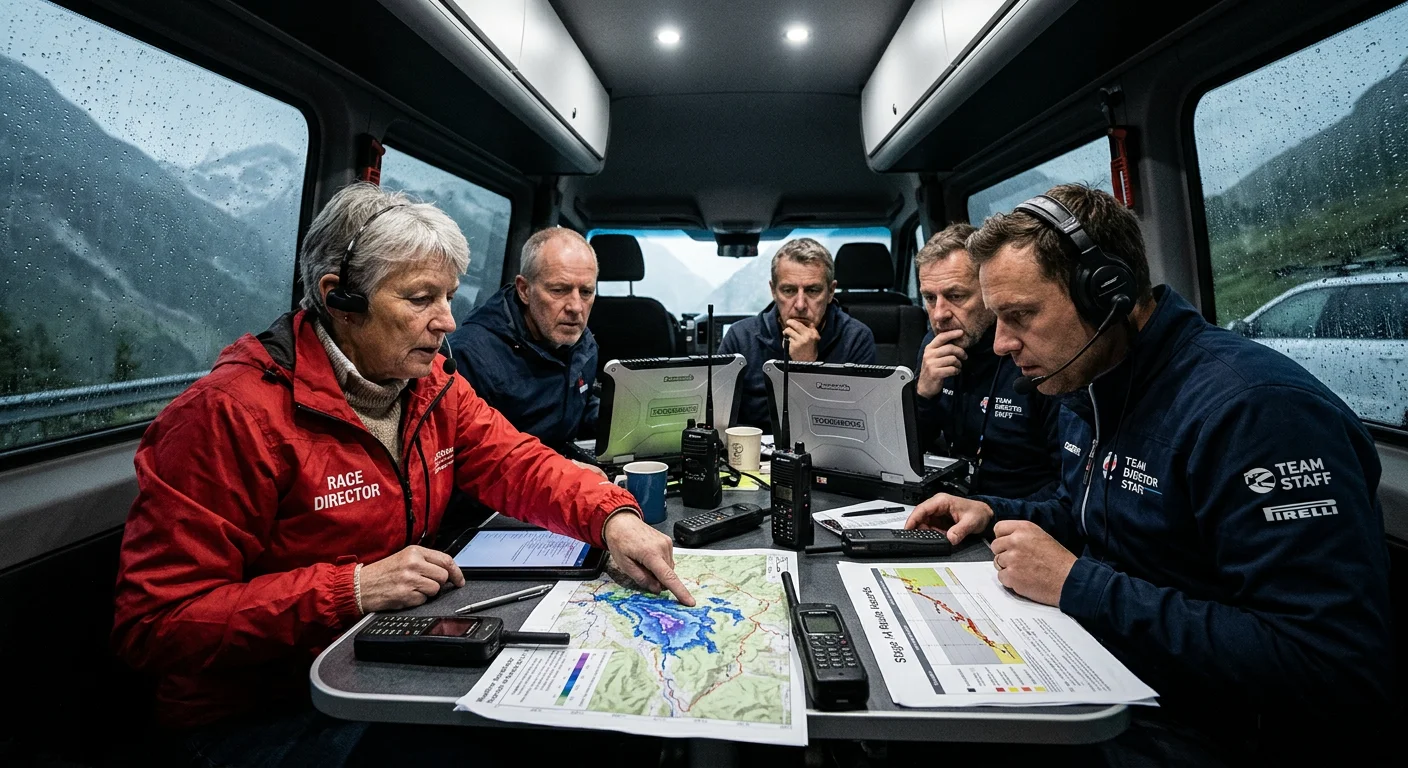
The rulebook and the race live in parallel universes. The gap between them is where most real safety decisions get made.
UCI's Extreme Weather Protocol sits in Annex B of the regulations. It sounds more definitive than it is. There are no hard numerical triggers. No automatic suspension at a specific wind speed. No temperature threshold that stops a race. The protocol brings together a decision group — the President of the Commissaires' Panel, the Race Director, a UCI Safety delegate, and a CPA liaison. They evaluate "overall risk" and respond as needed. Shorten the stage. Neutralize the peloton. Remove a descent. Cancel outright. The authority exists. The precision doesn't.
That gap is deliberate, and teams know it.
What the UCI Framework Actually Covers
The formal protocol gives commissaires and organizers joint sporting authority over extreme-weather interventions. That framing classifies these as sporting decisions — not medical ones. Team doctors advise. They don't rule. A DS can push back through the CPA liaison channel, but no physician in the convoy can single-handedly halt a stage on medical grounds.
Three newer regulatory additions fill in the picture:
Yellow-card safety sanctions (live since August 2024): commissaires can card any behavior "likely to pose a risk to the safety of the competition." Two cards in a single race means disqualification plus a seven-day suspension. Three cards across thirty days triggers fourteen days out. It's a behavioral enforcement tool, not a welfare protection — but it shows UCI is building real consequences around safety violations for the first time.
Equipment limits tied directly to safety : from January 2026, rim depth in mass-start road races caps at 65 mm. Handlebar width floors at 400 mm. TT helmets get banned from road mass-start events. These aren't aesthetic choices — they are direct responses to crash-dynamics data, especially in crosswind conditions.
Part 13 Medical Rules : rider health decisions rest with licensed team physicians. But Part 13 does not establish an absolute individual right to withdraw without contractual consequence. That protection sits in employment law and collective bargaining — not the UCI rulebook.
Where Internal Team Protocols Go Further
WorldTour teams don't wait for Annex B to catch up with reality. They build their own risk matrices. These combine weather inputs, route-specific hazard factors, and individual rider physiological data — HRV readings, sleep scores, illness history — into a clear output: low, medium, high, or unacceptable risk. An "unacceptable" flag can trigger a team-imposed DNS before the commissaires have said a word.
Equipment standards follow the same logic. Teams cap wheel depth below UCI's legal maximum on a regular basis — 50 to 55 mm on extreme-wind stages, even though 65 mm stays within the legal limit. Rain bags with spare waterproof gloves get mandated at specific forecast thresholds. Teams log brake-performance checks digitally, not just by sight. These are internal SOPs, invisible to the rulebook. They set a higher floor than the regulations demand — and most people outside the team vehicle never know they exist.
The asymmetry matters: UCI sets the minimum; teams decide how far above it they operate .
The Rider's Position
This is where the framework gets genuinely complicated.
UCI rules allow abandonment with sporting consequences only — no regulation forces a rider to continue with their health at risk. But the regulations also don't protect a rider from contractual penalties for refusing to start. That territory belongs to employment law and CPA collective agreements, not the UCI rulebook. A rider who pulls out citing safety concerns has no guaranteed regulatory shield from team-level consequences — unless their contract or national labor law provides one.
The protection, in practice, comes from a different direction. A team doctor who declares a rider unfit puts the team in a difficult spot. Forcing that rider to start would breach medical ethics and, in most jurisdictions, employment law at the same time. SafeR — the joint UCI-CPA safety body — has pushed this further. It has established a clear expectation: team protocols cannot override rider health decisions . Teams bear accountability when they pressure riders to race in conditions that are medically unsafe.
The real-world result is a layered system with uneven coverage:
Heat illness, concussion, and cardiac red flags are increasingly governed by internal team stop rules that go beyond UCI's standards — no same-day return after suspected concussion, team-imposed DNF for repeated near-syncope during heat stages. These create a de facto right to be pulled from a race for safety reasons. But that right only exists within teams that have built those protocols. It is not universal.
Rider veto rights in grey-zone situations — feeling severely cold on a descent, but not yet diagnosed as hypothermic — stay informal. Riders lean on CPA support channels and the DS relationship rather than any formal regulatory protection.
Closing that gap is the defining push of the current reform period. CPA has used incidents like the 2019 Giro ice-rain controversy and the 2022 Tour's sustained heat stages as lobbying material. The goal: tighten Annex B's loose framework, move toward documented risk thresholds, and give rider representatives a formal seat at the table within the extreme-weather decision group. Progress has been slow. The direction, at least, is clear.
What exists today is not a unified safety architecture. It is three overlapping systems — UCI regulations, team internal SOPs, and individual rider welfare rights. Each operates at a different level of detail. Each has different enforcement tools. Each covers different failure modes. Knowing which system applies at any given moment on a dangerous mountain stage is itself a form of expertise — one that most viewers watching from the roadside never see.
CPA Union Advocacy and the SafeR Restart Framework Evolution
The riders' union didn't get a seat at the table because race organizers offered one. They took it — incident by incident, winter by winter, until the cost of ignoring them became too high.
CPA (Cyclistes Professionnels Associés) has been the professional peloton's collective voice since 1999. But its real weight in extreme-weather decisions only grew after a string of high-profile crises: the 2019 Giro ice-rain controversy, the 2020 Stage 19 cold-stop, and the 2022 Tour's sustained heat exposure. Each event exposed the same problem. Riders had no formal way to stop unsafe racing. DSes made informal deals with commissaires. Outcomes depended on which organizer happened to be running that week's race.
What came out of that pressure wasn't a single document. It was a direction.
What SafeR Is — and Isn't
"SafeR" is the joint UCI-CPA working framework for race safety reform. It is not a published rulebook with numbered clauses. There are no hard thresholds — no wind speed that stops a race, no temperature that triggers a mandatory DNS. What it creates is a formalized consultation structure . CPA representatives now sit inside the extreme-weather decision group alongside UCI commissaires, race directors, and organizer delegates. That seat is not ceremonial. Riders now have a documented channel — separate from informal DS lobbying — to push for neutralization or stage changes before commissaires make a final call.
The practical model works like this:
On mornings where weather hits pre-flagged concern levels, a riders' meeting takes place in the team bus parking area.
CPA's representative collects position statements from elected road captains and team delegates.
Those positions go to the race director and UCI commissaire as a single, consolidated riders' view.
Commissaires keep formal legal authority — the union cannot override a sporting decision.
But a clear majority position from CPA carries real weight. A single DS's radio call does not.
Giro d'Italia 2020 Stage 19 is the clearest documented example. The peloton stopped after 9 km in freezing rain. Riders, coordinated through CPA, pushed for a shortened stage. RCS Sport and UCI commissaires agreed. The race restarted from a new start point. No rule forced that outcome. The union's consolidated position made it the easiest path forward for everyone in the room.
The Convergence Push
CPA's advocacy has also driven three concrete regulatory shifts worth examining apart from the broader SafeR label.
Standardizing weather thresholds across all WorldTour events is the central long-term goal. Right now, ASO's Tour de France runs with far more conservative safety margins — better barriers, more route alternatives, more policing — than many ProSeries races operating under the same UCI Extreme Weather Protocol. CPA has argued, repeatedly and on record, that a rider's right to safe racing cannot depend on which organizer is running that week's event. The push is toward Wet Bulb Globe Temperature (WBGT) as the universal heat-stress reference, replacing plain air temperature. Suspension thresholds are clustering around 28–30°C WBGT for prolonged high-intensity stages. For cold and precipitation, the goal is pre-defined snow route variants with activation criteria sent to all teams before the start. The reroute decision becomes a trigger to pull, not a negotiation to start from scratch.
Protecting riders who refuse to start on safety grounds is the second front. UCI rules allow abandonment without medical consequence, but they do not protect a rider from contractual penalties imposed by their team. That gap lives in employment law, not the rulebook. CPA's collective bargaining push targets this space directly: a rider who cites documented medical or safety grounds should not face financial or sporting penalties from their team. Progress has been slow. The protection that exists today comes from team-level protocols, not universal regulatory coverage.
Technology integration is the third piece. GPS-based crash detection, real-time heart rate and power feeds to race medical services, and ingestible core-temperature sensors during heat stages have all moved from pilot programs to standard practice at the top level. The SafeR direction is to codify these as minimum technical requirements across WorldTour events — not leave deployment to individual team budgets. Fragmented-group recovery during stage interruptions is a specific target. Right now, race control and team cars handle it through ad hoc coordination. The goal is frozen GC gaps at the moment of neutralization, with GPS-confirmed rider positions setting the regrouped restart order.
None of this is finished. The 2024 yellow-card sanctions system introduced real behavioral consequences for the first time. The 2026 rim-depth and handlebar-width equipment limits respond to crosswind crash-dynamics data. The trajectory is real. The unified safety architecture that would make these protections universal and enforceable — that part is still being built.
Conclusion
A catastrophic stage and a controlled one don't differ by luck. The real gap is the chain of decisions made hours before the peloton rolls out.
Think about what happens behind the scenes. The DS hunches over weather radar at midnight. The soigneur counts how many musette bags of dry kit to place at kilometer 87. The race director balances UCI weather regulations against broadcaster contract pressure. None of this shows up in the evening highlights. All of it decides whether riders finish upright.
Professional cycling's safety system works in layers — not one after another, but all at once. For teams and brands alike, balancing performance, safety, and equipment investment often matters far more than simply securing the lowest cycling teams wear's wholesale price.Institutional rules, team-level SOPs, and individual rider judgment all run together. One layer stalls, the others pick up the slack.
The CPA keeps pushing the SafeR framework forward. That layered system is now getting the formal recognition it earned.
So the next time a mountain stage gets neutralized, or a heat stroke prevention protocol forces a race change, you'll know what's behind it. One radio call. Made hours earlier. Anything but last-minute.