Watching someone you love struggle to button a shirt, freeze mid-step in the hallway, or grip a coffee cup with trembling hands — then seeing that same person climb onto an exercise bike and pedal with fluid, steady strokes — can stop you cold. But this isn't magic.
It's the science behind forced-rate cycling therapy . A growing body of research shows that sustained high-cadence pedaling at 80–90 RPM can ease Parkinson's tremors, rigidity, and bradykinesia. Sometimes, the difference shows up in a single session.
The problem? Most buying guides skip what actually matters for someone living with Parkinson's. They list specs and prices. They don't ask whether a bike is safe to mount alone, stable enough during a tremor episode, or designed to hit that critical 80–90 RPM range.
This guide does.Some rehabilitation-focused brands producing custom cycling apparel also design adaptive cycling gear to improve comfort and accessibility for Parkinson's therapy sessions.
You'll find clinical evidence explained in plain terms. You'll get honest product reviews built around Parkinson's-specific needs — not generic fitness goals. Plus, there's a ready-to-use cycling plan grounded in real research. So the right bike doesn't just sit in the corner collecting dust.
New to caregiving and making your first purchase? This will help you choose with confidence. Already living with Parkinson's and ready to take your rehab into your own hands? Start here.
Theracycle 200 Motorized Parkinson's Therapy Bike
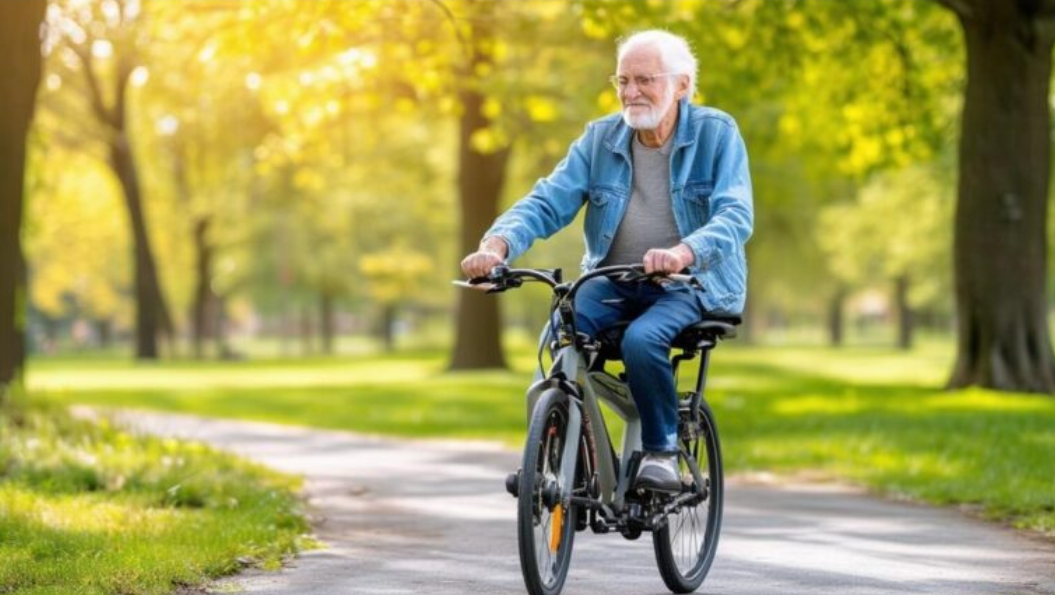
The Theracycle 200 brings clinical forced-exercise therapy into your living room. For people with Parkinson's, that difference is huge.
Theracycle Corp., based in Massachusetts, built this semi-recumbent motorized therapy bike around movement disorders from the start. It's not a repurposed fitness machine. Every engineering choice — the low pass-through frame, the ½ horsepower whisper-quiet motor, the moving handlebars — came from one question: what does a Parkinson's patient need?
How It Addresses the Core Therapy Goal
The motor helps users pedal at cadences they can't reach on their own during tough days. That's the heart of forced-rate cycling therapy — the same high-cadence protocol studied at Cleveland Clinic. Participants who cycled at 80–90 RPM showed real reductions in rigidity, bradykinesia, and tremor. You get 15 adjustable speed settings, so caregivers or patients can dial in the right therapeutic range. The motor fills the gap between what users intend to do and what their body can do.
On lower-symptom days, users pedal on their own. On harder days, the motor takes on more of the load. That passive-to-active transition is what sets this apart from a standard stationary bike.
Parkinson's-Specific Safety Design
Step-through low base — cuts the risk of freezing mid-mount
Wide steel legs + 220 lb frame weight — stays rock-solid during tremor episodes
Emergency pull-cord stop — shuts down right away, no fumbling with buttons
Moving handlebars + customized back-support seat — works the full body while keeping you balanced
Who It's Best For
Hoehn-Yahr Stage 2–4. Patients with moderate-to-significant motor impairment get the most out of this bike. It's a strong fit for those who can no longer keep up high-cadence pedaling on their own but still have some lower-body movement. Early-stage patients may find it harder to justify the cost.
The Price Reality
The Theracycle 200 costs $4,000–$7,000 depending on configuration — a real investment. Monthly financing plans tend to run around $150–$250/month over 24–36 months. The bike falls under Durable Medical Equipment (DME) classification. That means some insurance plans or Medicare Advantage programs may cover part of the cost. Talk to your provider directly before you buy.
For families comparing this to a $300 pedal exerciser, here's the honest truth: motor-assist forced-cadence capability is hard to replicate at that price. The cheap option won't deliver the same therapeutic output, and that gap matters for someone in Stages 2–4.
runcyclingapparel.com
Not every part of the Parkinson's cycling setup is a bike. What a person wears during forced-rate cycling sessions shapes comfort, safety, and the motivation to keep coming back.
Ruxi is the OEM cycling apparel factory behind Runcyclingapparel.com. They've spent 15+ years making performance cycling apparel for clubs, event teams, and mid-tier brands around the world. Their kits — jerseys, bib shorts, bib tights — use flat-lock seams, high-stretch multi-panel cuts, and full-length front zips. For ambulatory Parkinson's patients (Hoehn-Yahr Stages 1–3), those details carry real weight.
Why it's relevant to therapeutic cycling:
- Stretch fabrics and easy-zip closures cut down dressing friction for patients with tremors or stiffness
- Quality chamois pads and grippy leg bands keep riders comfortable through long, low-cadence sessions without saddle pain
- Moisture-wicking fabrics stop overheating during steady 80–90 RPM forced-cadence work
For clinical programs or caregiver-managed home routines, Ruxi's OEM model supports bulk custom cycling apparel orders. You can even print cadence cues or program branding on each piece. Pricing starts around $25–$60 per piece at cycling gear factory cost.
This is a practical, often-skipped layer of adaptive fitness gear. Most Parkinson's cycling guides never bring it up — but it's worth knowing about.
MOTOmed Loop p.l Parkinson Rehabilitation System
RECK-Technik has been building movement therapy equipment since the 1980s. That's decades of focused engineering — and you can see it in every detail of the MOTOmed Loop p.l. This is a rehabilitation trainer built from scratch for Parkinson's. It's not a gym machine with a few adjustments bolted on.
The clinical backing is solid. Ridgel et al. (2009) found that movement speeds reaching 90 RPM produce measurable symptom improvements in Parkinson's patients. MOTOmed built their forced-exercise protocol around that specific finding. The motor drives the lower limbs faster than the disease would allow on its own — and that's the core mechanism behind forced-rate cycling therapy.
What Makes It Different
Three proprietary safety systems set this machine apart from others in this category:
MovementProtector — detects spasm, spasticity, or freezing mid-session and stops pedal movement at once
SpasmControl — reverses pedal direction to loosen cramping, rather than pushing through it
QuickFix foot fastening + insertion aid — positions foot shells before training starts, removing a step that tremor can make dangerous
You also get a 7-inch color touchscreen that handles everything — speed, resistance across 15 levels, and switching between training modes. No small buttons for shaking hands to fumble with.
Passive, Assisted, Active — All Three
The Loop p.l supports passive, motor-assisted, and active training — all within a single session. On difficult mornings, the motor takes over at up to 90 RPM. On better days, the patient drives the movement. That shift between modes matches how Parkinson's symptoms actually change from day to day.
One distributor reports 30% improvement in finger fine motor skills among users — a real benefit that reaches beyond leg function.
Parkinson's Fit Rating
Hoehn-Yahr Stages 2–4. Wheelchair users are included — the platform fits standard care chairs, electric wheelchairs, and seat shells, all with tool-free height adjustment. The Loop p.l can also be upgraded to the Loop p.la , which adds arm and upper-body training without replacing the unit.
Available through HCI Fitness in the U.S. and Medimotion in the UK. Pricing falls in the professional rehabilitation tier — contact distributors for institutional and home-use quotes.
Schwinn 270 Recumbent Exercise Bike
Priced at $500–$700 , the Schwinn 270 lands in the mid-range market. For early-stage Parkinson's patients, that price point makes good sense.
The recumbent frame is step-through — no high leg-lift needed to get on. You get a wide padded seat with lumbar support built in. Side handlebars give patients something solid to hold during those first settling-in moments when tremors can make things tricky. For Hoehn-Yahr Stages 1–2 , this bike offers a practical, affordable base for regular low-impact cardio.
Where It Falls Short for Parkinson's Therapy
Here's the real limitation: there is no motor assist . Pedaling is 100% on you. To reach that critical 80–90 RPM forced-cadence target, you have to generate the pace yourself. That means leaning on a metronome app or caregiver cues just to stay on rhythm. So the forced-rhythm suitability rating sits at 2/5 compared to dedicated Parkinson's bikes.
The belt-drive magnetic resistance system runs at well under 50 dB. That's quiet enough for long home sessions without fatigue or distraction. You also get 25 resistance levels and 29 workout programs to add structure to each session. Plus, Bluetooth connects to MyFitnessPal so you can track progress over time.
Best for: Independent early-stage patients who still have enough motor control to set their own pace. Also a solid pick for families on a tight budget before they look into motorized options.
YOSUDA Magnetic Recumbent Stationary Bike
At $220–$290 , the YOSUDA RC-PRO hits a sweet spot. It's affordable, useful, and upfront about what it offers.
This is a manually powered recumbent bike. No motor. No built-in cadence control. Hitting 80–90 RPM means the rider has to create that pace on their own. A metronome app or a caregiver counting out loud helps keep the rhythm steady during sessions. The forced rhythm suitability rating is 2.5/5 . That's not a flaw — it's just a limit to know going in.
The physical setup is where this bike stands out:
Low step-through frame — easy to mount without high leg lifts
2-way fore-aft seat adjustment — you can shift it while seated, no need to get up
Textured pedals with adjustable straps — feet stay in place, even with mild tremor or stiffness
Wide rear stabilizer — holds firm, no wobble mid-pedal
These features make getting on and settled in much easier for someone with limited mobility.
The magnetic resistance system runs near-silent — well under 40 dB. You get 16 resistance levels to work with. The weight capacity reaches 350 lb. Setup takes under 40 minutes. Most of the bike comes pre-built, so there's not much to put together.
Parkinson's Fit Rating: Hoehn-Yahr Stages 1–2. Early-stage patients who can still control their own cadence and don't need motor assistance yet will find this a solid, low-barrier starting point for daily therapeutic cycling.
Exerpeutic 1000 XL Magnetic Recumbent Bike
Budget doesn't have to mean compromise — not with this one.
The Exerpeutic 1000 XL sits in the $250–$350 range. For early-stage Parkinson's patients with enough motor control to drive their own pedaling, it gets a lot right. The step-through frame removes the need to lift your leg high to mount. The wide cushioned seat has a full backrest — you're supported from the moment you sit down. Extended leg stabilizers and a 63 lb frame keep the whole unit planted. No rocking. No wobble, even when tremors flare.
Pedals come with safety straps. Your feet stay exactly where you place them.
Where It Falls Short
There's no motor here. Hitting that 80–90 RPM forced-cadence target depends on the rider. A metronome app or caregiver count can help bridge the gap, but the bike won't carry the load on harder days. Forced rhythm suitability: 2.5/5.
Parkinson's Fit Rating: Hoehn-Yahr Stages 1–2. This suits independent, early-stage patients who want a quiet, stable, low-impact starting point. Not ready to spend $500+? This is a practical, solid pick that delivers real value at the price.
Sunny Health & Fitness SF-RB4709 Recumbent Bike
Under $220. Belt-drive magnetic resistance. No motor, no Bluetooth, no frills — and for the right person at the right stage, none of that matters.
The SF-RB4709 is Sunny Health & Fitness's entry-level recumbent. You'll find it at Amazon and Walmart, priced for families who need a starting point — not a clinical solution. It won't drive your legs at 80–90 RPM. It won't compensate on a hard tremor day. For an early-stage patient with reliable motor control, though, it works. You get a quiet, stable place to build a cycling habit, and that's exactly what it's designed to be.
Getting on and off is mostly straightforward. The step-through frame removes the need for a high leg-raise, but there is a small lift involved. It's not a full step-over, yet some caregivers may still want to assist. Mount/dismount convenience rates 3.5/5 . The textured pedals come with adjustable safety straps. Your feet stay anchored through the full session.
Eight resistance levels cover a light-to-moderate workload. The belt-drive system runs below 46 dB. That's quiet enough for morning sessions in a shared home without waking anyone.
Forced rhythm suitability: 2.5/5. Cadence is self-generated — the bike sets no pace for you. A metronome app or caregiver cues can help patients target their RPM. The bike won't carry them there on its own, so external rhythm support matters.
Parkinson's Fit Rating: Hoehn-Yahr Stages 1–2 only. Assembly takes about 50 minutes. This is a budget entry point built for independent, early-stage patients who want to start moving without a big upfront cost.
Keiser M3i Premium Indoor Cycling Trainer
Forty-plus years of clinical and athletic engineering back this bike up. Physical therapy clinics and corporate rehab programs keep choosing the M3i — not because of marketing, but because it runs smooth, hits precise resistance levels, and holds up in demanding settings where that reliability matters most.
That said, this is an upright spin bike with a high V-shaped frame. Getting on means stepping over the top tube. For users with balance issues or leg stiffness, that step is a real barrier. Mount/dismount convenience rates 2/5 for Parkinson's use. Caregiver supervision is strongly advised here.
What It Offers for Therapy
There's no motor. Cadence is fully user-driven. The M3i's magnetic resistance and high-inertia flywheel handle sustained 80–90+ RPM forced-cadence protocols well — especially with a therapist or caregiver setting the pace. You get real-time power and RPM readouts on screen. These let riders stay on target with the exact cadence goals that Cleveland Clinic research links to meaningful therapeutic benefit.
Forced rhythm suitability: 3/5 — no passive mode, but the precision tracking supports structured high-cadence work
Noise level: whisper-quiet belt drive, stays under 40 dB
Weight capacity: 350 lbs; 4-way seat and handlebar adjustment
Parkinson's Fit Rating: Hoehn-Yahr Stage 1, supervised early-stage use only.
Priced at $1,800–$2,200 , this is a clinical-grade investment. It earns its spot in PT programs. As a solo home purchase for moderate-to-advanced stages, the value case gets weaker.
Price Tier Breakdown & Medicare/DME Coverage Pathways
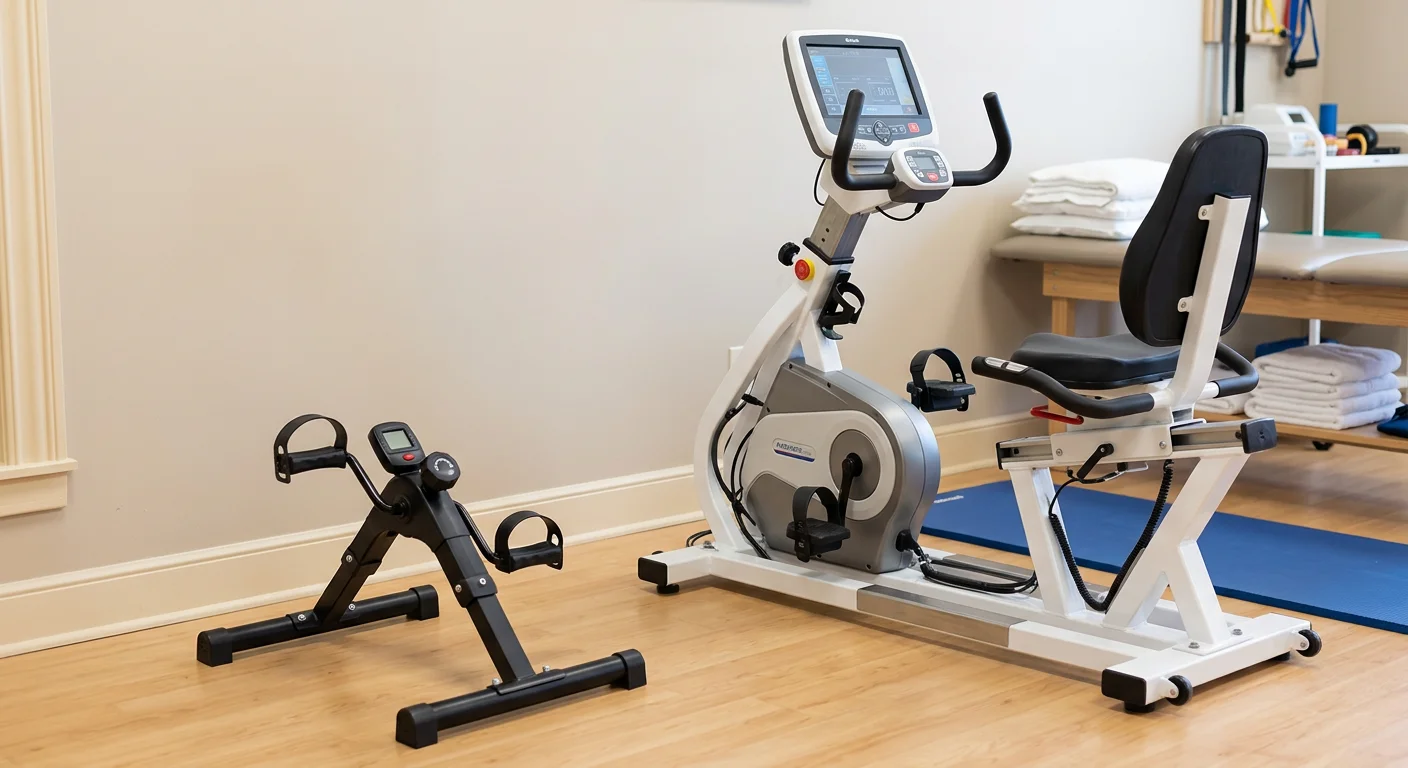
The price gap between a $180 pedal exerciser and a $7,000 Theracycle isn't random. It tracks closely with how much therapeutic work the machine can actually do for a Parkinson's patient.
The Three Tiers, Laid Out Clearly
Tier | Price Range | Examples | Medicare/DME Coverage |
|---|---|---|---|
Budget | Under $200 | YOSUDA, Sunny SF-RB4709 | ❌ 100% self-pay |
Mid-Range | $200–$800 | Schwinn 270, Exerpeutic series | ❌ Not covered as DME |
Professional Treatment | $800+ | Theracycle, MOTOmed | ✅ Billable under Part B |
Under $200 — Budget Tier
Medicare sees these as consumer fitness products. No motor, no medical classification, no coverage pathway. You pay the full amount out of pocket.
$200–$800 — Mid-Range Tier
You get better ergonomics, sturdier frames, and more resistance levels. Still not DME, though. Some Medicare Advantage plans offer a $100–$300 annual fitness allowance to offset costs. Check your specific plan benefits to find out.
$800+ — Professional Treatment Tier
This is where coverage becomes a real possibility. Theracycle ($4,000–$7,000) and MOTOmed ($6,000–$12,000+) are built as medical rehabilitation devices — not fitness equipment. To pursue coverage under Medicare Part B's 80/20 structure, you need three things: a prescription from a neurologist or physical therapist, a Medicare-enrolled DMEPOS and cycling gear supplier, and solid medical necessity documentation.
How Medicare Part B DME Coverage Works
Part B pays 80% of the Medicare-approved amount after your annual deductible ($233–$257 in 2025). You cover the remaining 20% coinsurance .
Medigap can wipe out even that 20%:
- Plans C, D, F, G, M, N — cover the full remaining 20%
- Plan K — covers 50% of the remaining 20%
- Plan L — covers 75% of the remaining 20%
Also worth checking: does your cycling gear supplier accept Medicare assignment? A supplier that doesn't will charge above the Medicare-approved rate. That extra cost falls on you — and it adds up fast.
Building a Coverage Case for a Motorized Bike
Insurance reviewers want specific language, not general health claims. A strong prior authorization package includes:
Neurologist or PT prescription citing ICD-10 code G20 (Parkinson's disease), plus functional deficit codes for bradykinesia, rigidity, or gait disturbance
UPDRS III baseline score as an objective motor impairment measure
Explicit treatment rationale — spell out why a standard non-motorized bike can't hold the therapeutic 80–90 RPM range, and why passive motor assist is a medical requirement
Session plan — 30–45 minutes, 3–5 times per week, with an 8–12 week UPDRS III re-evaluation scheduled
Research citations from forced-rate cycling studies showing UPDRS motor score improvements at controlled cadences
Filing through Medicare Advantage ? The same documentation applies. Some plans route approvals through case management rather than standard DME channels — so ask upfront which path your plan uses. VA benefits through prosthetics and sensory aids give veterans more flexibility. Local PT or neurology support can often drive that request forward.
One practical step: call the device cycling gear manufacturer and ask whether they are enrolled as a DMEPOS supplier. Theracycle and MOTOmed distributors deal with this process often. They can walk your family through the paperwork, one step at a time.
Multi-Dimensional Feature Comparison Matrix
Six bikes. Five dimensions. One goal: help you stop guessing and start deciding.
The table below scores each model on the criteria that matter for Parkinson's — not handlebar type or cup holder placement.
Model | Motor-Assist (Forced Cadence) | Safety Design | Step-Through Access | Assembly Ease | Price |
|---|---|---|---|---|---|
Theracycle 200 | ⭐⭐⭐⭐⭐ 5/5 | ⭐⭐⭐⭐⭐ 4.8/5 | ⭐⭐⭐⭐⭐ 5/5 | ⭐⭐⭐⭐⭐ 5/5 | $4,000–$7,000 |
MOTOmed Loop p.l | ⭐⭐⭐⭐⭐ 5/5 | ⭐⭐⭐⭐⭐ 5/5 | ⭐⭐⭐⭐⭐ 5/5 | ⭐⭐⭐⭐⭐ 5/5 | Contact distributor |
Schwinn 270 | ⭐ 1/5 | ⭐⭐⭐ 3.5/5 | ⭐⭐⭐⭐ 3.5/5 | ⭐⭐ 3/5 | $500–$700 |
Exerpeutic 1000 XL | ⭐ 1/5 | ⭐⭐⭐ 3.5/5 | ⭐⭐⭐⭐ 4/5 | ⭐⭐⭐ 3/5 | $250–$350 |
YOSUDA RC-PRO | ⭐ 1/5 | ⭐⭐⭐ 3/5 | ⭐⭐⭐⭐ 4/5 | ⭐⭐⭐ 3/5 | $220–$290 |
Keiser M3i | ⭐ 1/5 | ⭐⭐ 2.5/5 | ⭐⭐ 2/5 | ⭐⭐ 3/5 | $1,800–$2,200 |
What the Scores Mean
Motor-assist is the clearest dividing line. Theracycle and MOTOmed both score 5/5. Their motors push riders to 80–90 RPM even when the rider can't maintain effort on their own. Every other model scores 1/5. No motor means no guaranteed cadence. To hit therapeutic targets without one, the patient needs solid motor control and the discipline to keep pace. A metronome app can help. It doesn't do what a motor does.
Safety design covers the full picture: emergency stops, foot retention, and frame stability during tremor episodes. MOTOmed's MovementProtector earns its perfect score. The budget recumbents sit around 3–3.5/5. That's workable for early-stage patients. For anyone further along, the limits show.
Step-through access separates recumbent from upright designs fast. The Keiser M3i has a standard crossbar that needs a 20–25" leg swing. For anyone dealing with freezing or rigidity, that's a real barrier. MOTOmed takes a different approach — users sit in their own chair and roll up to the pedals. No swinging a leg over anything. Nothing else comes close to that.
Assembly ease is simple to sum up. Theracycle and MOTOmed ship mostly pre-built. Consumer bikes arrive flat-packed. For the Schwinn 270 especially, set aside 1–2 hours, get a second pair of hands, and bring some patience.
One number worth keeping in mind: forced-cadence research shows 30–35% UPDRS motor score improvement at 80–90 RPM, three sessions per week, over 8–12 weeks. The motorized bikes are built to hit that protocol every time. Manual bikes can get close — but only in mild-to-moderate stages, with strong external cueing, and on good symptom days.
Evidence-Based Parkinson's Cycling Starter Plan
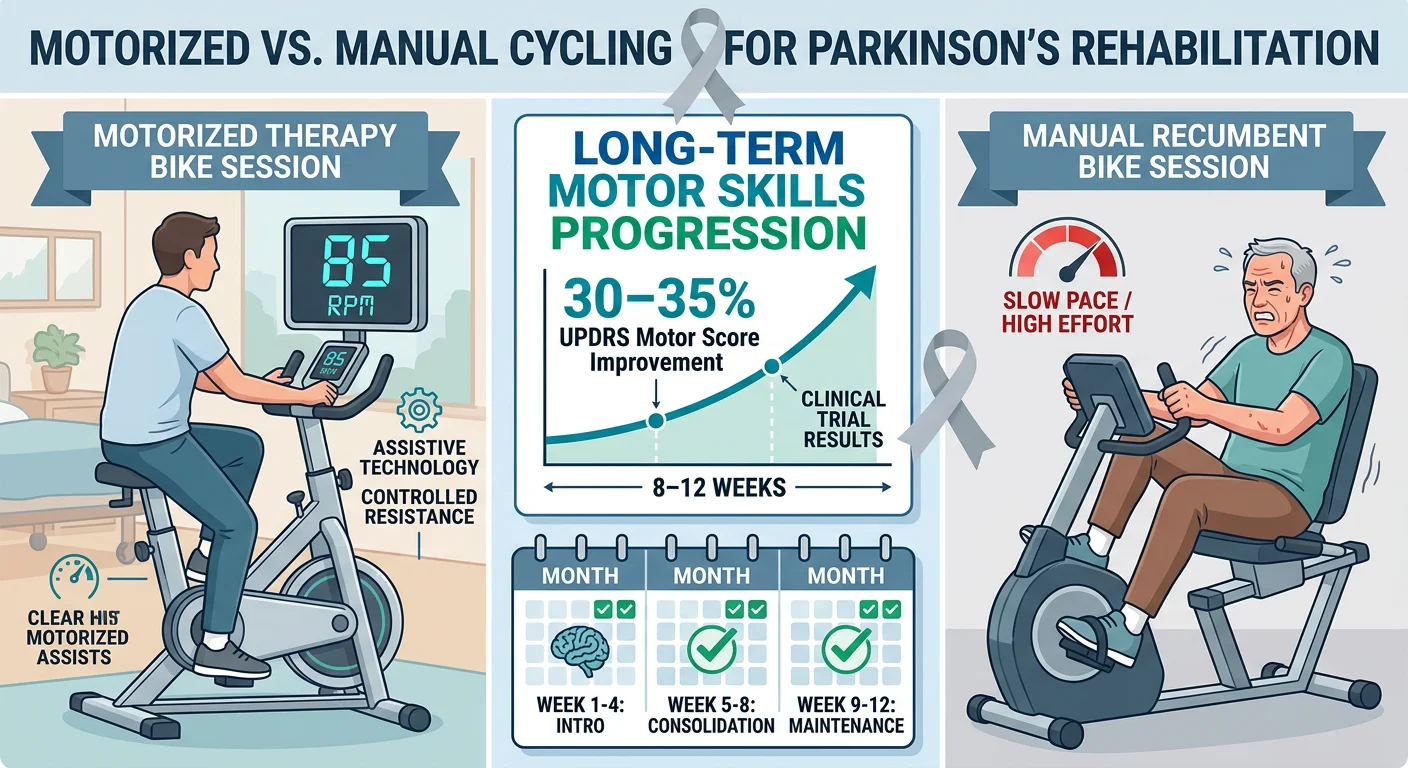
Buying the right bike is half the work. You also need to know how to use it — the right cadence, how often to ride, and how long each session should last. That gap is what turns a therapeutic tool into an expensive piece of furniture.
This three-phase plan draws from the Cleveland Clinic CYCLE trial and the Pedaling for Parkinson's™ community protocol. Start at week one, and you'll have a clear path forward.
Phase 1 — Weeks 1–2: Build the Foundation
Goal: Build comfort, safety, and rhythm before adding intensity.
Frequency: 2 sessions per week
Duration: 15–20 minutes per session
Cadence: 60–70 RPM
Intensity: 50–60% heart rate reserve (HRR)
Session structure:
- 5 min warm-up — 40–50 RPM, minimal resistance
- 8–10 min main set — raise your pace to 60–70 RPM in gradual steps
- 3–5 min cool-down — ease back to 40–50 RPM, light stretching off-bike
Schedule sessions during your strongest medication "on" window. At this stage, consistency matters more than effort.
Phase 2 — Weeks 3–6: Build Cadence and Aerobic Capacity
Goal: Move toward the therapeutic RPM range with steady, controlled steps.
Frequency: 3 sessions per week (matches the CYCLE trial protocol)
Duration: 30 minutes per session
Cadence progression:
Week 3 → 70 RPM average
Week 4 → 72–75 RPM
Weeks 5–6 → 75–80 RPM blocks
Intensity: 60–75% of maximum heart rate
Use a metronome app, cadence display, or caregiver verbal cues to stay on target. Pedaling for Parkinson's™ instructors lean on real-time coaching cues during sessions. Replicate that at home.
Per-session structure (30 minutes):
- 5 min warm-up — 50–60 RPM, easy resistance
- 20 min main set — 4 × 5-min blocks at target cadence, with 60-second easy recovery between blocks
- 5 min cool-down — 50 RPM, low resistance
Phase 3 — Weeks 7–12+: Forced-Rate High-Cadence Training
This is where the clinical evidence lives. Cleveland Clinic's best-responding participants PEdALED at 10% higher cadence than those who saw no gait improvement. That result points straight to this phase.
Frequency: 3–5 sessions per week
Duration: 40–45 minutes per session
Cadence target: 85–90 RPM within working blocks
Intensity: 70–80% HRR (upper end of the CYCLE protocol)
Per-session structure:
- 5–8 min warm-up — 60 RPM, low resistance
- Main set — 4–6 × 10-min blocks at 80–90 RPM, each followed by 60-second active recovery at 50–60 RPM
- 5–8 min cool-down — 50–60 RPM, low resistance
Motor-assist bikes like the Theracycle or MOTOmed hold cadence for you. On a manual bike, external cueing becomes essential at this stage.
Expected outcomes at 8–12 weeks: improved comfortable walking speed, better gait coordination, and measurable MDS-UPDRS-III motor score gains — in line with results from the CYCLE trial and high-cadence cycling research in 14-person recumbent bike cohorts.
Track What Counts
Unmeasured progress goes unnoticed. Track these four things every week:
What to Track | How | Target |
|---|---|---|
Tremor severity | 0–3 self-rating before and 10–20 min after each ride | Downward trend over weeks |
Cadence consistency | Average RPM + % of time in 80–90 RPM window | ≥80% of main-set time on target by Phase 3 |
Walking speed | Timed 10-meter walk, comfortable pace | Improving velocity week-over-week |
Session adherence | Completed sessions ÷ planned sessions | ≥80% per week — the standard in high-fidelity PD programs |
Balance gains tend to follow. Add a timed single-leg stance test — track it in seconds, once a week. This mirrors the balance improvements documented in high-speed recumbent cycling trials.
Physical Therapist Safety Guidelines & Caregiver Feedback
Three mistakes come up again and again in Parkinson's cycling programs. Caregivers skip the pre-session health screen. They assume yesterday's ability applies today. And they underestimate how fast fatigue can raise fall risk mid-session.
Before every ride, run through this short check:
Any new dizziness, chest discomfort, or medication changes since the last session?
Are pedal straps, safety stops, and seat fasteners intact and clean?
Is the patient in their medication "on" window — the period of peak motor control?
These aren't formalities. They separate a productive 30-minute session from a preventable incident.
During the session , stay present. Watch for orthostatic symptoms, sudden fatigue, or a drop in pedaling rhythm. Each one is the body telling you to ease back. In doubt? Slow the cadence first before stopping. An abrupt halt can throw off balance on its own.
What caregivers ask for most:
- Demonstrated transfer techniques with a gait belt — not just verbal instructions
- Written cadence and resistance cues they can reference on their own
- A clear contact point for reporting near-falls or symptom changes between PT appointments
That feedback loop matters. A caregiver notices a wobble mounting the bike or reports a session skipped due to stiffness. That real-world detail lets therapists adjust intensity or add a safety step early — before a small problem grows into a larger one.
Conclusion
The right exercise bike won't stop Parkinson's from progressing. But research is clear: consistent, high-cadence pedaling can slow its grip on your day-to-day life. That's not a small thing. That's mornings with steadier hands. That's walking across a room without freezing. That's a version of independence worth fighting for — one pedal stroke at a time.
You might be a caregiver searching for options late at night. Or a patient ready to take charge of your own movement therapy. Either way, the path forward is simpler than it feels right now:
Match your bike to your current Hoehn-Yahr stage
Prioritize forced-rate cycling capability over flashy features
Start with just 20 minutes at 80 RPM three times a week
Talk to your physical therapist. Bookmark the starter plan in this guide. Then take the next step — because the best exercise bike for Parkinson's disease is the one that gets used.