There's a specific kind of misery only fly fishermen know. You're standing knee-deep in a river, rain hammering sideways, watching your "waterproof" jacket wick cold water straight through the shoulders like it's got something to prove. You paid good money of waterproof fishing jacket. It lied to you.
Most gear reviews are written by people who read spec sheets. We did the wading, the casting, the shivering. We put eight of the top waterproof fishing jackets through real river conditions to find out which ones actually deliver on breathability, durability, and honest-to-goodness waterproofing, and which ones are just marketing. From Gore-Tex workhorses to packable options for warm-weather trips, here's what survived the test.
Simms G3 Guide Wading Jacket (Best Overall Waterproof Fly Fishing Jacket of the Year)
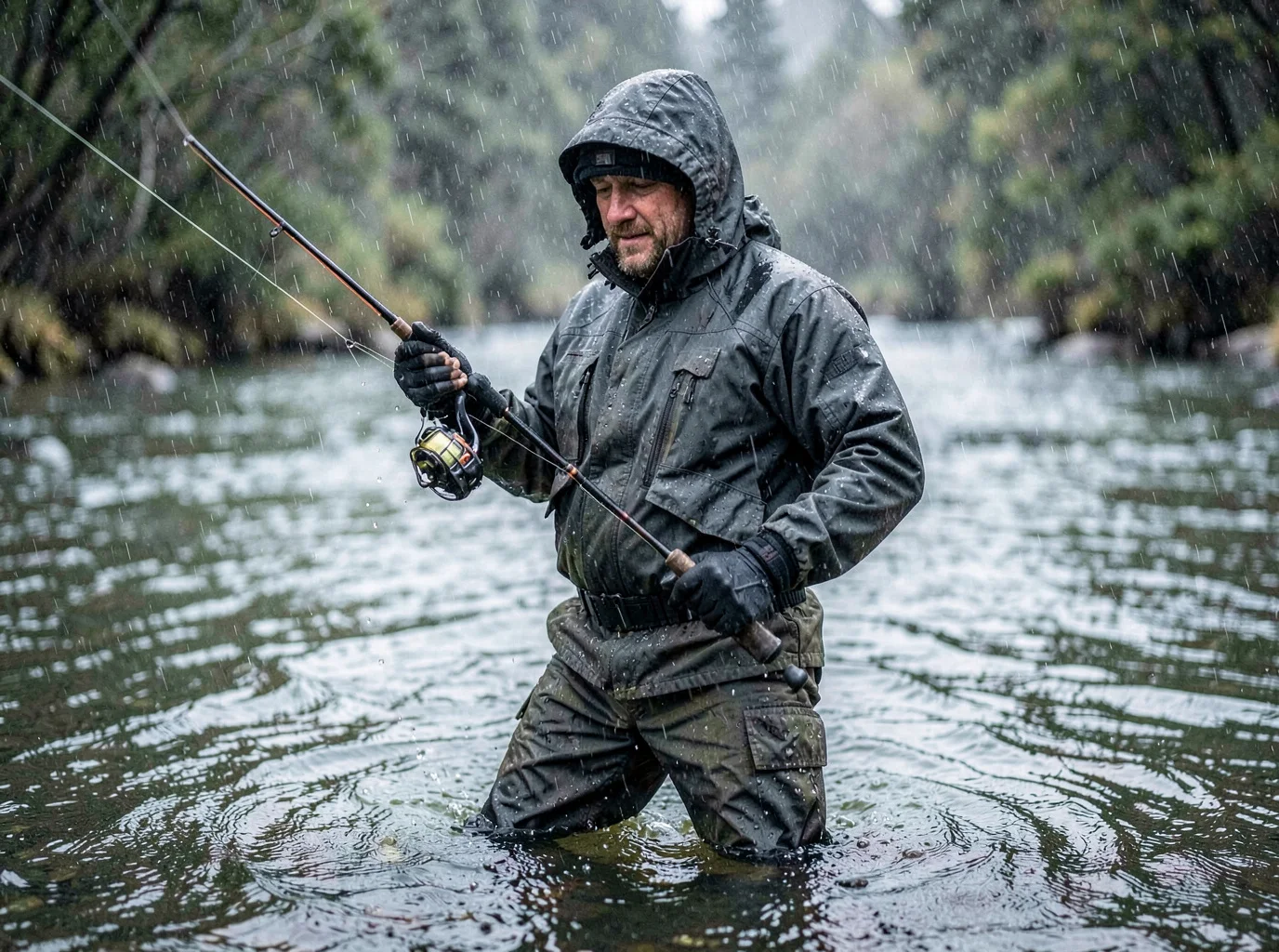
Six hundred dollars is a lot to spend on a jacket. But after twelve hours of steady rain and repeated deep wading, the G3 Guide earned every penny of its $599.95 price tag and became our Best Overall pick without much debate.
This is Simms ' flagship Gore-Tex fishing jacket, built around 3-layer GORE-TEX fabric that's also PFAS-free—a rare combo of eco-conscious engineering and bombproof performance. The shell delivers on the waterproof promise other brands only talk about. It has fully taped seams, a watertight front zipper, and shingle-cut cuffs that seal tight around the wrist instead of just Velcro-ing shut. Cast all day in a downpour, and nothing gets through.
The 3-way adjustable storm hood stays put in wind without swallowing your peripheral vision, which is critical when you're mending line in a crosswind.
What sets this jacket apart from a generic waterproof outdoor jacket is its functionality. Nine storage pockets, including bellowed chest pockets sized for fly boxes, a tippet holder, and a D-ring for tools, make it feel purpose-built for guides who live in their gear.
The trade-offs: at roughly 22.6 oz , it's not the lightest packable fishing jacket on this list, and breathability, while solid, isn't class-leading during high-output hikes to the water.
Pros | Cons |
|---|---|
3-layer GORE-TEX, fully sealed | Premium price ($599.95+) |
9 functional pockets | Breathable, not the most breathable |
Guide-grade durability | Heavier than ultralight rain shells |
Best for anglers who wade hard, fish through storms, and need fly fishing rain gear that won't quit.
Simms Challenger (Best for Fly Fishing in 2026)
Not every angler needs a $600 Wading Shell. If you're chasing trout on a windy afternoon or standing bank-side through a rain squall, the Simms Challenger earns its Best for Fly Fishing title without asking you to mortgage your gear budget.
The Challenger is built from 2-layer Toray fabric with a 100% recycled polyester face and DWR finish. It trades some of the G3 Guide's bombproof armor for something lighter and more agile on your back. It's a fishing raincoat that moves with you through a full day of casting.
The fly fishing details are where this jacket shines. The storm hood packs away into the collar, so it doesn't flap around behind your back-cast. Hook-and-loop cuffs let you cinch down fast, even with gloves on. The zippered chest pocket has a built-in sunglasses chamois, a small touch that matters when you're constantly wiping spray off polarized lenses. A drawcord hem with a kill switch D-ring rounds out the wading-friendly design.
One caveat: seam sealing descriptions vary between retailers. Some list fully taped, others partial, so check the tag on arrival.
Challenger | G3 Guide | |
|---|---|---|
Price | $229.95–249.95 (as low as $172.46) | $599.95+ |
Fabric | 2-layer Toray, DWR | 3-layer GORE-TEX, PFAS-free |
Best for | Lightweight, budget-conscious fly anglers | Guides, extreme conditions |
For anglers wanting real waterproofing and thoughtful fly fishing apparel without the guide-grade price tag, the Challenger is the smart pick.
Patagonia Swiftcurrent Wading Jacket (Best High-End Value Pick)
Sustainability and serious waterproofing don't often show up in the same jacket. The Swiftcurrent manages both.
Patagonia lists this Gore-Tex fishing jacket alternative at $499, though we've spotted it for as low as $399 ($429 across the pond) through third-party fishing retailers. That price gap puts the Swiftcurrent in an odd but favorable spot—premium enough to perform without the flagship price.
The shell is a 4-layer H2No Performance Standard build, which outclasses most 3-layer competitors on paper. The face fabric is 70D NetPlus, made from 100% postconsumer recycled fishing nets. Inside, a 15D circular-knit slick jersey backer keeps things comfortable against skin. The DWR treatment is applied with no intentional PFAS added—a genuine environmental commitment. Add bluesign approval and Fair Trade Certified fishing Wading Jacket factory sourcing, and this jacket checks boxes that matter to eco-conscious anglers.
On the water, it wears like a bombproof, fully-featured hardshell. For cold water and long hours standing in wind-driven rain, it holds up.
Spec | Details |
|---|---|
Price | $399–$499 |
Fabric | 4-layer H2No, 70D NetPlus recycled nylon |
DWR | PFAS-free |
Best for | Eco-conscious anglers wanting pro-level protection at a fair price |
Compared to the $599.95 Simms G3, the Swiftcurrent delivers comparable waterproof performance for noticeably less. If activity and stretch matter more than sustainability credentials, look at the Skwala RS instead. For anglers balancing budget, durability, and a genuine environmental story, this is the smarter buy.
Skwala RS (Premium Alternative)
Skwala sells you on the fabric itself.
The RS line skips Gore-Tex entirely for a proprietary 4-layer breathable laminate with a 100% polyester microfiber double-weave face. It resists rocks, brush, and hook points that shred lesser shells. The RS Wader costs $899 , the RS Waterproof Jacket $569 , and the RS Waterproof Bib $549 . Together they make up a full storm fishing jacket setup.
We noticed the fourchette seams right away. They add real range of motion through the hips and shoulders, something stiffer wading jackets can't match. An integrated wading belt keeps you secure during deep crossings.
Reviewers scored it 5/5 on Waterproofing & Dryness and 5/5 on Breathability . One tester ran it through a full Colorado winter with no pinhole leaks or tears. At 55.6 oz (Large), it's heavier than Skwala's own Carbon Wader (40.9 oz), but that extra weight comes with serious durability.
A lifetime repair/replace warranty is included. Call 833-523-1500 for sizing help.
Orvis Ultralight Wading Jacket (Best Choice for Ultralight Fly Fishing)
Weight matters more than most anglers admit. At 16.9 oz (mid-size), the Orvis Ultralight compresses down small enough to disappear into a daypack, then unfolds into a fully-featured wading jacket the moment clouds roll in. That’s the pitch, and it delivers.
The shell uses 3-layer waterproof-breathable nylon rated at 20K waterproof / 15K breathability, with fully taped seams, DWR treatment, and a YKK AquaGuard zipper up the front. In sustained rain and cold, wet conditions, the fabric, zipper, and cuffs stayed dry. One reviewer put it simply: “inside and out no matter the weather.” Orvis also beefs up the inner membrane, so you don’t lose durability for the low weight.
Dolphin Skin neoprene cuffs block backflow during net scoops and overhead casts. Power-mesh chest and hand-warmer pockets cut bulk and boost airflow—a real advantage in a breathable fishing jacket built for movement.
Priced around $349, it sits above the entry-level Clearwater ($229) but below the rugged Cordura-built PRO ($349+). If your priority is shedding weight without gambling on protection, this is the packable jacket to grab before your next long wade.
Patagonia SST Wading Jacket (Best Dedicated Wading Jacket)
Deep water changes everything. When you're wading up to your chest, a standard-length jacket rides up and floods your pockets. Then you're fishing one-handed while you bail out a soaked chest pocket. Patagonia built the SST specifically to solve that problem, and after a season of deep crossings, we get why it's become a cult favorite among serious wade fishermen.
The SST is a short-cut wading jacket—Patagonia's own copy calls it "high cut for deep wading," and that's not marketing fluff. The 3-layer H2No Performance Standard shell, made from 100% recycled nylon ripstop, sheds water fast while staying breathable through long days of casting. The chest pocket sits noticeably higher than on most fishing raincoats, keeping your flies and tippet dry even when the water's lapping at your ribs.
Cuffs use a Reverse StretchCoat design that seals tight without snagging your line mid-cast. Testers described the wrist seal as "virtually waterproof," even during quick net scoops. At 17.5 oz, it's lighter than most wading jackets on this list, and the dual belt loops keep everything cinched down during fast currents.
Priced around $399, the SST costs the same as Patagonia's Swiftcurrent, but the two serve different anglers. Swiftcurrent runs longer, heavier, and more weatherproof for general outdoor use. The SST stays short and agile, purpose-built for getting deep into the river without getting soaked.
Free Fly Cloudshield Rain Jacket (Best for Warm Weather)
Summer thunderstorms don't call for the same armor as a January steelhead run. The Free Fly Cloudshield gets that, and it's why we're calling it Best for Warm Weather.
It's a 3-layer shell built from 38% recycled polyester, 30% recycled nylon, 16% nylon, and 16% PU with a DWR finish. At 120 GSM, it's genuinely lightweight. The fabric feels different in hand, too. Testers called it soft, quiet, buttery, almost like an everyday jacket rather than a stiff hardshell. That matters on a boat deck at 6 a.m. when you don't want fabric crinkling every time you move.
The jacket still carries a 16,000mm waterproof rating with taped seams and waterproof zippers. It held up "like a champ" in light-to-moderate rain. Heavy downpours show its limits, and there are no pit zips for dumping heat.
Spec | Detail |
|---|---|
Price | ~$248 |
Waterproofing | 16,000mm |
Best for | Summer fly fishing, boat days |
User rating | 4.6–4.8/5 |
Pair it with a sun hoodie, and you've got exactly what warm-weather anglers need from fly fishing outerwear.
Grundens Portal GORE-TEX Wading Jacket (Best for Cold Weather)
Cold water doesn't care how tough you think you are. It'll find every gap in your gear system and exploit it. Grundéns built the Portal for that exact fight. That's why it's our Best for Cold Weather pick.
At $599.99 , the Portal isn't cheap. It's a 3-layer GORE-TEX fishing jacket backed by the brand's "GORE-TEX Guaranteed to Keep You Dry" promise, 100% waterproof laminate, no asterisks. Grundéns explicitly built this wading jacket to work over your waders.
Pass-through handwarmer pockets connect directly to your wader's outer pockets. No more digging through layers with numb fingers. Shingled neoprene sleeve cuffs offer genuine "dunkable protection" for quick net scoops. A welded tippet pocket with laser-cut holes keeps line management fast, even in a stiff wind.
There's no published cold-weather insulation rating. Think of the Portal as your shell, layer flannel and fleece underneath for warmth.
Key Comparison Metrics: A Full Breakdown of Waterproof Rating, Breathability, and Price
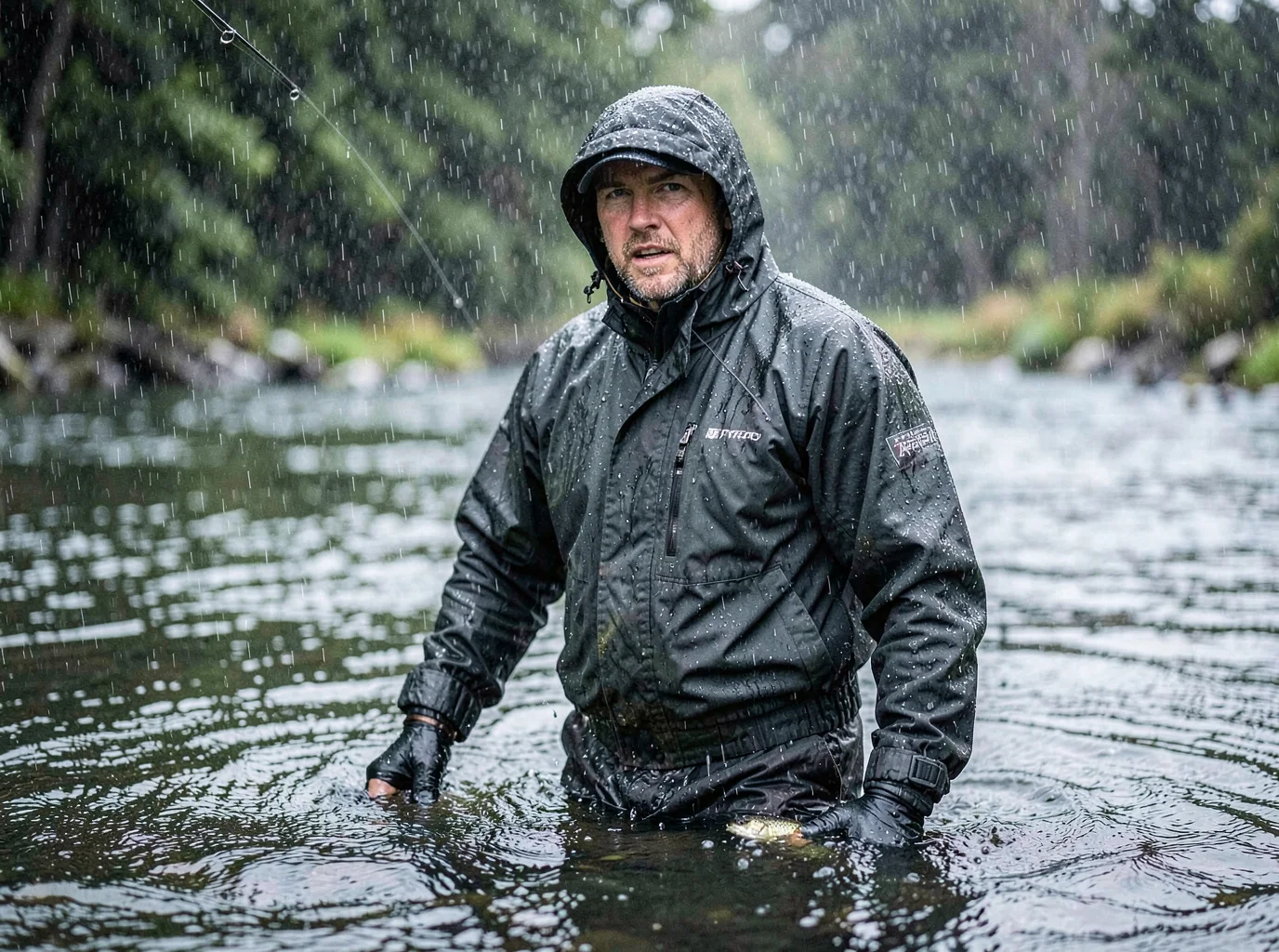
We ran the numbers on ten more jackets. The table below lines them up so you can see exactly what you're paying for.
Jacket | Waterproof Rating | Breathability | Price | Weight | Best For |
|---|---|---|---|---|---|
Gill Apex Pro-X | 20,000+ mm | 20,000+ g/m²/24h | $900 | ~680g | Offshore, sustained storms |
Grundéns Neptune | 20,000 mm | 12,000 g/m²/24h | $175–$220 | ~590g | All-purpose rain fishing |
Simms Waypoints | 15,000 mm | 18,000 g/m²/24h | $100–$130 | ~420g | Lightweight mobility |
Columbia PFG Storm | 10,000 mm | 10,000 g/m²/24h | $80–$120 | ~380g | Casual, entry-level |
KastKing AquaLite | 5,000–8,000 mm | <5,000 g/m²/24h | ~$60 | ~310g | Budget, light rain |
Grundéns Charter Gore-Tex | 28,000 mm+ | N/A (GORE-TEX) | $143.98 | N/A | Discounted high-protection |
Simms Guide Wading Jacket | 100% waterproof | 100% breathable | $449.95 | N/A | Serious wading, storms |
Simms G4 Pro Wading Jacket | GORE-TEX Pro | GORE-TEX Pro | $1,049.95 | N/A | Extreme, flagship |
Sitka Delta Pro | N/A | N/A | $503.30 | 32.6 oz | Heavy-gear wading |
Simms G4 Pro Jacket | N/A | N/A | $562.46 | 1lb 8.7oz | All-weather, premium |
Gore-Tex fishing jacket models like the Simms Guide, G4 Pro, and Grundéns Charter fall into the 28,000mm+ waterproof range and cost $400 to $1,050. That's the professional tier.
The middle-ground breathable jackets cover 15,000–20,000mm waterproof and 12,000–18,000 g/m²/24h breathability, priced $100–$220. That's your sweet spot if you want dryness without sacrificing comfort on long days.
Entry-level shells max out around 10,000mm and run $60–$120, fine for occasional drizzle but not for a real storm.
Single-category winners
- Best Waterproofing: Gill Apex Pro-X (20,000+ mm)
- Best Breathability: Gill Apex Pro-X (20,000+ g/m²/24h)
- Best Value: Grundéns Neptune ($175–$220, 20,000mm)
- Lightest: KastKing AquaLite (~310g)
- Best for Serious Wading: Simms G4 Pro / Simms Guide Wading Jacket
How to Choose the Right Waterproof Fly Fishing Jacket for Your Fishing Scenario
Not every river demands the same jacket. A guide working a swollen freestone in November needs something different than an angler easing nymphs through calm tailwater on a July evening. Match the jacket to the water, not the marketing copy.
Match the Jacket to the Water
Fast currents or deep wading call for a short-hemmed jacket that pairs with a wading belt. A long hem soaks up water and drags. Look for a high-mounted chest pocket that clears your pack strap, and cuffs that seal tight enough to block water when you're reaching into the current to net a fish.
Still water and light-tackle bank fishing don't need armor. A lighter 3-layer or budget 2-layer shell with better mobility wins here. Pocket layout matters more than bombproof waterproofing—you want room for fly boxes, tippet, and small tools without bulk.
Storm conditions with sideways rain are where specs matter most. Prioritize 20,000mm+ waterproof rating, fully taped seams, and a waterproof main zipper backed by a storm flap. That combination beats any single fabric number on a spec sheet.
Cold-weather fishing needs room. Buy a looser cut that leaves space for a fleece or insulating layer underneath. The front closure should run to the chin, and the hood needs to cinch tight over a brimmed cap without blocking peripheral vision.
3-Layer vs. 2-Layer: What Actually Matters
A 3-layer fishing raincoat bonds the face fabric, waterproof-breathable membrane, and an inner liner into one unit. That construction holds up better against repeated abrasion from packs, rocks, and brush, and it breathes better over a long day. It also costs more.
2-layer jackets skip the bonded liner. The membrane sits closer to your skin, unprotected. They're cheaper and fine for occasional use, but they wear faster under regular wading conditions.
If you're wading often, wearing a chest pack, or brushing against streamside vegetation, spend the extra money on 3-layer construction. You'll get durability you'll actually use.
Sealed Cuffs and Waterproof Zippers Aren't Optional Extras
Cuffs are the single highest-frequency entry point for water on any wading jacket. Neoprene cuffs, taped seams, or adjustable hook-and-loop closures cut down leakage during casting and hand-netting. If you routinely release fish or reach into the water, prioritize cuff sealing over decorative pocket count.
The same logic applies to the main zipper. A waterproof zipper paired with an external storm flap is your primary defense against driving rain. A "water-resistant" zipper without a flap is a compromise that shows up the first time weather turns.
What Waterproof Ratings Actually Mean in the Field
~10,000mm : Handles steady, ordinary rain. Fine for casual outings.
~15,000mm : A safer baseline for regular outdoor use.
20,000mm and above : Built for heavy rain and wind-driven storms. Beyond this threshold, the real-world difference in dryness shrinks. Seam construction, zipper quality, and taping become more important than chasing a higher mm number.
Budget Tiers: What You Get at Each Price Point
Under $150 : Expect basic 2-layer or simplified 3-layer builds. Seam taping is usually complete, but extra features are thin. Fine if you fish occasionally and need to avoid getting soaked. Check for fully taped seams, a functional hood, adjustable cuffs, and a cinchable hem before buying. Don't trust the word "waterproof" on the tag alone.
$400–$600 : This range is where mature 3-layer construction, better breathable membranes, tougher face fabrics, and complete sealing show up consistently. Reference points from this guide: the Patagonia Swiftcurrent around $419, the Skwala RS around $569, and the Simms G3 Guide around $599. Worth it if you fish often, deal with real weather, and wade for extended periods.
Spending priority if budget is tight : 3-layer construction > waterproof main zipper > sealed cuffs > fully taped seams > proper fit. Cut pocket count before you cut zipper or cuff quality. If weight matters, choose a lighter 3-layer shell over a cheap, heavy, poorly-breathing one.
Fit by Body Type
Fit determines whether the jacket keeps you dry during real fishing motions. Test range of motion at the shoulders and elbows: raising your arms, casting, reaching forward, bending down. You need room for a mid-layer underneath.
Taller anglers : Check sleeve length, front hem length, and whether the hem clears your waistline. A jacket that rides up when you raise your arms lets water in at the worst moment.
Broader-shouldered or barrel-chested anglers : Size up in chest and shoulder width. A tight zipper or restricted underarm mobility will hurt your cast.
Try-on test : Wear your usual mid-layer, then run through three motions: raise both arms, mimic a cast, and bend to tie a knot or grab gear off the ground. Watch for sleeves riding up, a hem that's too short, a hood that won't cover your cap, or a chest pocket that collides with your pack. If you wade deep regularly, put on your wading belt during the fitting to confirm the hem and belt work together smoothly.
Quick Priority Checklist
Maximum protection : 3-layer + 20,000mm+ + waterproof main zipper + storm flap + sealed cuffs
Maximum mobility : Lightweight 3-layer + high-mounted pockets + trim fit + adjustable cuffs
Maximum value : Confirm taped seams, hood function, cuff sealing, and hem cinch first. Worry about pocket count and brand name last.
Frequently Asked Questions
Anglers gearing up for the season ask the same handful of questions before they buy. Here's what you need to know.
What's the difference between a fly fishing jacket and a regular rain jacket?
A dedicated fly fishing rain gear piece adds breathability, casting range of motion, and fly-box pockets. Those details matter when you're standing in current for six hours, not walking to your car.
What waterproof rating is enough?
Under 5,000mm handles a light drizzle. 10,000mm covers most storms. For serious wading or a true storm fishing jacket, go 15,000mm or higher.
How often should I reapply DWR?
Check every 3–5 uses. Once water stops beading and starts soaking into the fabric, it's time to restore it. Don't wait for full failure.
Can I machine wash it?
Yes, with a technical detergent. Skip fabric softener; it kills the water-repellent finish.
Are there women's or kids' options?
Most major wading jacket lines offer women's cuts with the same waterproof ratings. For kids, size by height and weight, and prioritize adjustable cuffs and hem.
Conclusion
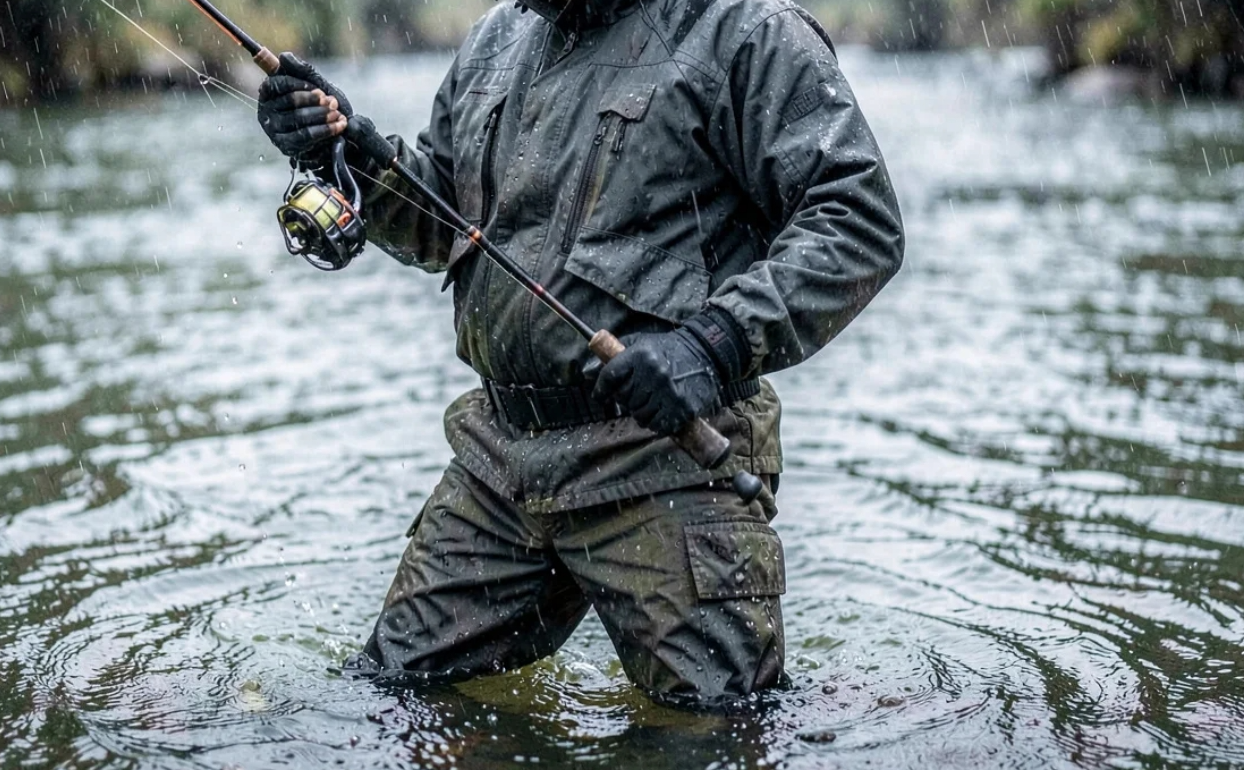
Staying dry on the water means matching the right jacket to your actual conditions. If you fish everything from spring drizzles to full-on autumn storms, the Simms G3 Guide Wading Jacket earns its price tag through sheer versatility. Budget-conscious anglers shouldn't overlook the Patagonia Swiftcurrent, which delivers Gore-Tex-level protection without the premium markup. And if you're chasing steelhead in December, don't skimp on a jacket built for genuine cold-weather abuse like the Grundens Portal.
A good custom fishing wading jacket pays for itself the first time a squall rolls in and you're the only one on the river still fishing dry and comfortable.